
The 1980s and 1990s produced some of the most recognizable performance cars in American automotive culture. From the Ford Mustang and Chevrolet Camaro to Japanese icons such as the Toyota Supra, Mazda RX-7, Mitsubishi 3000GT, Nissan 300ZX, Acura Integra, Honda Civic, and Subaru Impreza, these cars helped establish the foundation of today’s tuner and performance-car scene.
For years, many of these vehicles were considered old, inexpensive project cars. Today, that perception has changed. Enthusiasts are increasingly restoring, modifying, and restomodding older performance cars rather than simply replacing them with newer models.
The renewed interest is not just nostalgia. Older cars offer something that many modern vehicles cannot easily replicate: mechanical simplicity, lower curb weights, analog driving characteristics, distinctive styling, and enormous opportunities for customization.
The aftermarket is also responding. SEMA has reported renewed interest in performance cars and noted that the specialty sports-car aftermarket represents a significant U.S. market. SEMA has also documented the growing popularity of restomodding, where classic vehicles receive modern engines, suspension, brakes, electronics, comfort features, and other upgrades.
For American enthusiasts, this creates an exciting opportunity. A carefully built 1980s or 1990s performance car can combine classic character with modern drivability, braking, handling, reliability, and technology.
The key is knowing which upgrades actually make sense.
Why 80s and 90s Performance Cars Are Becoming Popular Again
One reason older performance cars are receiving renewed attention is that modern vehicles have become increasingly complex, heavy, and expensive.
Today’s performance cars can deliver extraordinary acceleration and handling, but they also come with sophisticated electronics, larger safety structures, advanced driver-assistance systems, complex emissions equipment, extensive infotainment systems, and increasingly complicated powertrains.
An older performance car offers a different experience.
A lightweight 1980s or 1990s coupe can feel more direct because the driver is interacting with a relatively simple mechanical platform. Steering, shifting, throttle response, and suspension behavior can feel more connected to the road.
That does not mean older cars are automatically better performers. A modern sports car will often outperform a stock car from 30 or 40 years ago in braking, acceleration, handling, safety, comfort, and reliability.
The advantage of an older performance car is its potential.
A classic platform can be upgraded component by component. An owner can improve braking, suspension, tires, cooling, lighting, electronics, engine management, drivetrain components, and interior technology while retaining the original character of the vehicle.
The Fox Body Mustang is a particularly strong example. SEMA has specifically highlighted the renewed popularity of Fox Body Mustangs in the restomod and pro-touring scenes.
This trend also fits the broader U.S. aftermarket environment. Americans are keeping vehicles on the road longer, and SEMA’s research has identified older vehicles as an important source of aftermarket performance spending.
 Start With Maintenance Before Performance Parts
 Start With Maintenance Before Performance Parts
The first upgrade for an older performance car should often be maintenance rather than horsepower.
This sounds less exciting than installing a turbocharger or aftermarket exhaust, but it can make a much bigger difference to the overall project.
A vehicle from the 1980s or 1990s may have decades of wear on its rubber components, cooling system, fuel system, suspension, electrical connections, seals, hoses, and drivetrain.
Before adding performance parts, inspect the fundamentals.
Engine oil leaks should be addressed. Cooling systems should be pressure-tested. Old hoses should be replaced when necessary. Belts and tensioners should be inspected. Brake fluid should be fresh, and wheel bearings should be checked for wear.
The same applies to suspension bushings.
A performance suspension installed on worn-out mounting points will not produce the results expected from the parts. The car needs a healthy foundation before performance modifications can work together.
This is especially important for project cars that have been sitting for extended periods.
A vehicle that looks excellent in photographs may still require significant mechanical rehabilitation underneath.
The goal should be to create a reliable baseline first. Once the car operates correctly, performance upgrades become easier to evaluate.
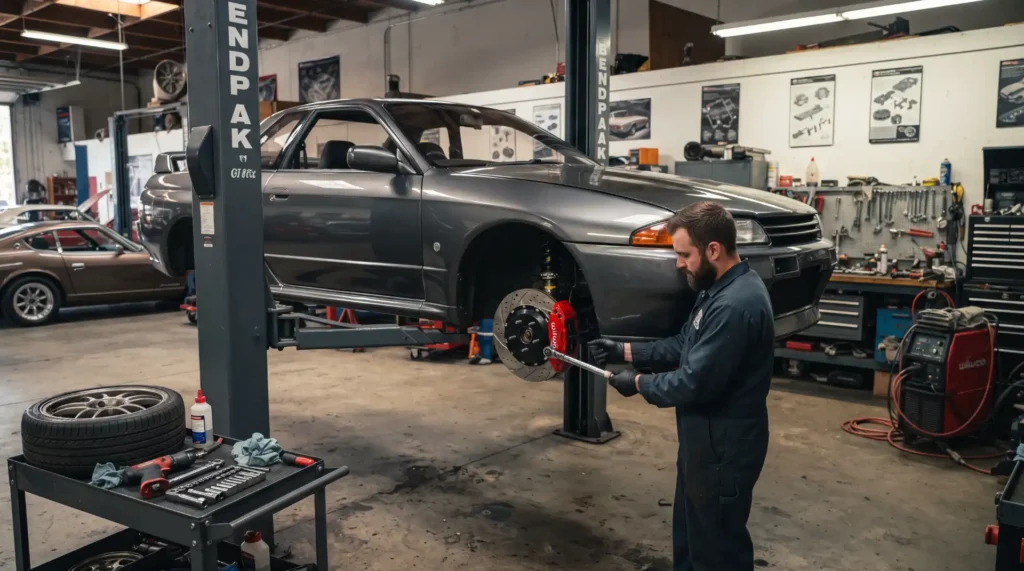
Modern Brakes Are One of the Best Upgrades
Braking technology has improved significantly since the 1980s and 1990s.
A classic performance car can have plenty of engine power yet still feel dated when braking from high speeds. Modern brake components can dramatically improve confidence and consistency.
A brake upgrade may include larger rotors, improved calipers, performance brake pads, stainless-steel brake lines, fresh high-temperature brake fluid, and appropriate master-cylinder components.
However, bigger is not always automatically better.
Brake components need to match the vehicle’s weight, wheel size, intended use, and overall setup. A street-driven car does not necessarily need an extreme track-oriented brake package.
Brake pads are especially important.
A performance pad designed for track temperatures may not be ideal for a daily-driven vehicle because it can produce additional noise, dust, and reduced cold performance.
For a street-focused classic, a quality street-performance pad and properly maintained braking system can provide a significant improvement without compromising everyday usability.
Owners should also remember that brake upgrades work together with tires and suspension. Better brakes cannot compensate for poor tire grip.
Upgrade the Tires Before Chasing Huge Horsepower
Tires are among the most important performance components on any vehicle.
This is particularly true for older performance cars because tire technology has advanced enormously since many of these cars were originally engineered.
A 1990s performance coupe equipped with modern high-performance tires can feel dramatically different even before the engine is modified.
Modern tires can provide better dry grip, improved wet-weather performance, stronger braking capability, and more predictable handling.
The correct tire depends on the purpose of the vehicle.
A daily-driven Mustang, Camaro, Supra, RX-7, or Integra needs a different tire strategy than a dedicated autocross or track car.
Tire width should also be considered carefully. Simply installing the widest tire possible can create clearance problems, steering issues, or unwanted changes in suspension geometry.
Wheel diameter matters too.
Many classic performance cars look excellent with period-correct wheels, but modern lightweight wheels can offer a combination of improved tire availability and reduced rotational weight.
That makes wheels and tires an excellent place to modernize an older performance car without changing its identity.
Modern Suspension Can Transform an Older Car
Suspension is another area where technology has moved forward significantly.
Many 1980s and 1990s performance cars were designed around suspension systems that were advanced for their era but are now decades old.
Replacing worn shocks, springs, bushings, ball joints, and mounts can make an enormous difference.
For owners seeking more performance, modern coilovers, adjustable dampers, performance springs, sway bars, and upgraded bushings can provide more precise handling.
However, the objective should not simply be to make the car as stiff as possible.
An overly stiff suspension can make a street car uncomfortable and may actually reduce grip on imperfect roads.
A well-balanced suspension setup should allow the tires to maintain contact with the road while controlling body movement.
Ride height is another important consideration.
Lowering a classic performance car can improve appearance and handling, but excessive lowering may create poor suspension geometry, scraping problems, and reduced usability.
This is why suspension modifications should be selected as a complete system rather than as isolated parts.
Your existing Auto Sport Performance article on Coilovers vs. Lowering Springs for Street Performance can naturally support this section as an internal resource. The site already covers how these two approaches affect ride height, handling, and street performance.
Lightweight Wheels Can Make an Older Car Feel Faster
Reducing unsprung and rotational weight is particularly valuable on older performance vehicles.
Large, heavy wheels can make steering feel slower and place additional demands on suspension components.
Lightweight wheels can improve steering response, acceleration feel, braking response, and suspension behavior.
The difference can be noticeable even when engine power remains unchanged.
This fits into a broader performance principle: speed is not only about horsepower.
A lighter car generally requires less energy to accelerate and stop. Reduced mass can also improve cornering response.
Auto Sport Performance has previously covered the importance of weight reduction in modern performance builds, explaining how reducing unnecessary mass can improve acceleration, braking, handling, and overall responsiveness.
That same philosophy applies extremely well to 1980s and 1990s performance cars.
Modern ECU Tuning Brings Old Engines Into a New Era
One of the biggest opportunities for older performance cars is modern engine management.
Many vehicles from this period used electronic fuel injection, but their original engine-control systems are extremely basic compared with today’s technology.
Modern standalone ECUs and upgraded engine-management systems can provide more precise control over fuel, ignition, boost, sensors, idle behavior, and data logging.
For a modified engine, this can make a major difference.
An upgraded ECU can allow a tuner to calibrate the engine around changes such as larger injectors, upgraded intake systems, different camshafts, turbochargers, superchargers, or engine swaps.
However, tuning should be approached carefully.
More aggressive calibration does not automatically mean better performance. An engine needs appropriate fuel delivery, ignition control, cooling, sensors, and mechanical components to support increased output.
The best tune is one that matches the entire vehicle.
For enthusiasts interested in modern tuning practices, Auto Sport Performance already has content covering Dyno Tuning vs. Street Tuning: Pros and Cons, as well as recent coverage of how software changes affect tuned vehicles.
Turbocharging Can Unlock Serious Power
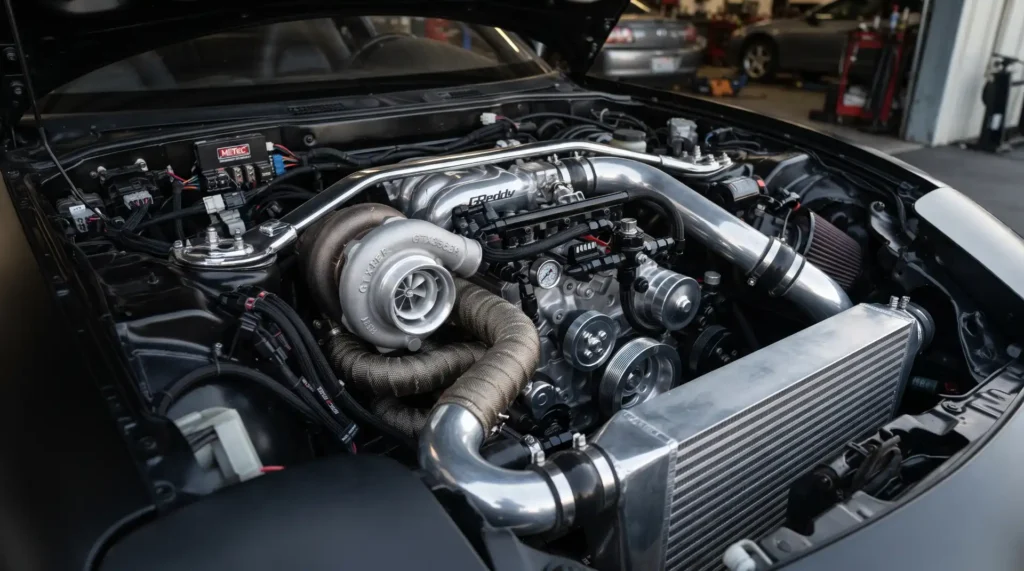
Turbocharging has become one of the most popular ways to increase power from older engines.
A well-designed turbo system can produce significantly more power without requiring an enormous engine displacement.
This is one reason cars such as the Toyota Supra, Nissan 300ZX, Mitsubishi Eclipse, Mazda RX-7, and various turbocharged Subaru and Mitsubishi models remain popular with enthusiasts.
But turbocharging an older car is not simply a matter of installing a turbo.
The supporting systems matter.
Fuel delivery, intercooling, exhaust flow, engine management, cooling, clutch capacity, transmission strength, and drivetrain components all need to be considered.
Heat management becomes particularly important.
An older engine compartment may not have been designed around the thermal demands of significantly increased power.
Upgraded radiators, intercoolers, oil coolers, heat shielding, improved fans, and better airflow management can help maintain consistent performance.
For forced-induction enthusiasts, Auto Sport Performance also has existing content on Water-Methanol Injection for Turbo Cars Explained, which can provide additional context about intake temperatures and thermal management in boosted applications.
Modern Cooling Systems Are Essential for High-Output Builds
Cooling is often overlooked when enthusiasts plan performance modifications.
Adding horsepower creates additional heat. If the cooling system cannot manage that heat, reliability can suffer.
Older radiators may have corrosion, restricted passages, damaged fins, or reduced efficiency. Original cooling fans may also be less effective than modern electric systems.
A performance-oriented cooling upgrade may include a larger radiator, improved fans, upgraded hoses, better airflow management, and an oil cooler where appropriate.
For turbocharged builds, intercooling becomes especially important.
A good intercooler can reduce intake temperatures and help maintain consistent power during repeated acceleration.
Transmission cooling should also be considered for high-output automatic vehicles.
Heat is one of the major enemies of drivetrain reliability, especially when an older transmission is being asked to handle significantly more power than it originally received.
Auto Sport Performance already covers coolant and thermal upgrades, making that article another useful internal resource for readers building older performance cars.
Modern Fuel Systems Improve Reliability
Fuel systems are another area that deserves attention during a restomod.
Fuel pumps, injectors, fuel lines, regulators, filters, and electrical connections can deteriorate over decades.
A high-performance engine requires stable fuel delivery.
For a mild naturally aspirated build, the original system may be sufficient after proper maintenance. A turbocharged or supercharged engine may require significantly more fuel capacity.
The fuel system should therefore be designed around the engine’s actual power target.
Oversizing components without a plan can create tuning difficulties, while undersized components can restrict performance and create potentially serious engine problems.
A properly engineered fuel system should provide adequate flow while maintaining stable pressure under load.
LED Lighting and Modern Electrical Upgrades
Performance is not limited to horsepower.
Electrical reliability is one of the most useful areas to modernize on an older car.
Many 1980s and 1990s vehicles use wiring, switches, bulbs, connectors, and charging systems that have experienced decades of heat and vibration.
A refreshed electrical system can improve reliability and convenience.
LED lighting can modernize exterior and interior lighting while reducing electrical load in certain applications. Modern relays, upgraded grounds, refreshed connectors, and improved battery cables can also help address common electrical problems.
An upgraded alternator may be appropriate for vehicles running additional electronics, audio equipment, electric fans, fuel pumps, or other accessories.
The important point is to preserve proper electrical protection.
Fuses, wiring sizes, relays, and connectors should be correctly matched to the electrical load.
Modern Seats and Interior Technology
Restomod builds do not have to sacrifice comfort.
An older performance car can retain its original character while receiving modern interior upgrades.
Modern seats can provide improved support. Better sound insulation can reduce road noise. Updated gauges can provide accurate readings for oil pressure, coolant temperature, boost, air-fuel ratio, and other important information.
Modern infotainment systems can add navigation, Bluetooth connectivity, hands-free calling, and smartphone integration.
However, interior upgrades should fit the character of the vehicle.
A fully modern touchscreen may look out of place in a 1980s sports car.
Many builders therefore choose technology that provides modern functionality while retaining a period-correct appearance.
This approach is one of the defining characteristics of a successful restomod.
Don’t Ignore Chassis Reinforcement
Adding horsepower to an old car without considering the chassis can create problems.
After decades of use, a unibody or chassis can develop fatigue, corrosion, or weakened mounting points.
Higher power also increases the loads placed on the drivetrain and suspension.
Depending on the platform, chassis braces, subframe connectors, upgraded mounts, reinforced suspension mounting points, or other structural improvements may be appropriate.
The correct solution depends heavily on the vehicle.
A Fox Body Mustang, for example, has a very different chassis design from a Nissan 300ZX, Mazda RX-7, Toyota Supra, or BMW E30.
Before adding significant power, owners should research known platform-specific weaknesses and inspect the individual vehicle.
Modern Drivetrain Upgrades
 Modern Drivetrain Upgrades
Once engine power increases, the drivetrain becomes increasingly important.
A stronger clutch may be necessary for a manual transmission. Automatic transmissions may require improved cooling and, depending on the build, internal upgrades.
Differentials can also become a limiting factor.
A performance differential can improve traction and power delivery, particularly in rear-wheel-drive cars.
Limited-slip differentials are especially useful for performance driving because they can help distribute torque more effectively between the driven wheels.
Driveshafts, axles, CV joints, and differential mounts should also be inspected.
The goal is to create a drivetrain capable of handling the engine’s output consistently.
Restomod vs. Period-Correct Restoration
Before beginning a project, owners should decide what type of build they actually want.
A period-correct restoration attempts to preserve or recreate the vehicle’s original specification.
A restomod takes a different approach.
The vehicle maintains its classic appearance and character while receiving modern technology and performance improvements.
There is no single correct approach.
For someone interested in concours-style collecting, originality may be extremely important.
For someone who wants to drive an older car regularly, modern brakes, tires, suspension, cooling, electronics, and engine management may provide much more value.
This is why restomodding has become an important part of the classic-car aftermarket. SEMA’s research has specifically identified modernized classic vehicles as a growing area of interest.
What About Emissions and Street Legality?
U.S. enthusiasts also need to consider emissions requirements before modifying an older performance car.
Federal emissions rules prohibit tampering with emissions-control systems and the use of illegal defeat devices. The EPA maintains guidance explaining its vehicle and engine tampering policy.
In July 2026, the EPA also announced recognition of SEMA’s Certified Emissions program as an alternative certification authority for qualifying aftermarket products.
That does not mean every aftermarket modification is automatically legal.
Owners should verify the requirements that apply to their vehicle and location before installing emissions-related performance parts.
California owners in particular should pay close attention to applicable state emissions requirements and CARB-related certification.
Street legality can also involve lighting, exhaust noise, ride height, tire fitment, window tint, and other requirements depending on the jurisdiction.
A performance build should therefore be planned around how and where the vehicle will actually be driven.
The Best Upgrade Strategy for an 80s or 90s Performance Car
The smartest approach is usually to build the car in stages.
Start by making the vehicle reliable.
Then upgrade tires and brakes.
Next, address suspension and chassis components.
After that, improve cooling and fuel delivery as necessary.
Only then should you begin pursuing substantial horsepower increases.
This order creates a balanced vehicle.
A 400-horsepower car with poor tires and weak brakes is not necessarily a better performance car than a 250-horsepower car with excellent suspension, tires, brakes, and cooling.
The same principle applies to daily drivability.
A street car needs to start easily, idle properly, operate in traffic, handle bad weather, maintain reasonable temperatures, and remain comfortable enough for regular use.
Extreme modifications can make a car faster under specific conditions while making it worse everywhere else.
The best restomod builds consider the complete driving experience.
Popular 80s and 90s Platforms for Modern Builds
The U.S. enthusiast market offers a wide variety of platforms suitable for modernization.
The Ford Mustang remains one of the most accessible choices because of its long production history and extensive aftermarket support.
The Chevrolet Camaro and Pontiac Firebird are also popular American performance platforms with strong modification potential.
Japanese performance cars such as the Toyota Supra, Nissan 300ZX, Mazda RX-7, Mitsubishi Eclipse, Acura Integra, Honda Civic, and Mitsubishi 3000GT offer different approaches to performance.
European cars such as the BMW E30 and other 1980s and 1990s BMW platforms can also make excellent handling-focused projects.
The right car depends on the owner’s goals, budget, parts availability, mechanical skills, and desired driving experience.
Building an Older Performance Car on a Budget
 Building an Older Performance Car on a Budget
A restomod project does not have to become a six-figure build.
One of the advantages of older performance cars is the ability to prioritize modifications.
Instead of replacing everything at once, owners can improve the vehicle gradually.
A sensible first stage could include maintenance, tires, brake pads, fluids, bushings, and basic suspension components.
A second stage could focus on wheels, dampers, sway bars, cooling, and electrical improvements.
The final stage can involve engine modifications, tuning, drivetrain upgrades, and cosmetic changes.
This approach also makes it easier to understand what each modification actually accomplishes.
Auto Sport Performance’s existing guide to Best Affordable Performance Mods Under $1,000 is a useful internal resource for readers who want to improve performance without immediately committing to an expensive build.
Why These Cars Matter to Modern Performance Enthusiasts
The renewed interest in 1980s and 1990s performance cars is about more than nostalgia.
These vehicles represent an important period in automotive history.
They were modern enough to introduce electronic fuel injection, turbocharging, sophisticated suspension systems, and increasingly advanced engine management, but they remained relatively simple compared with today’s vehicles.
That makes them excellent platforms for experimentation.
Owners can experience the original character of a classic car while using modern engineering to improve its weaknesses.
A carefully built restomod can therefore provide the best of two worlds.
It can look and feel like a classic performance car while offering improved braking, handling, reliability, cooling, lighting, comfort, and power.
Final Thoughts
The return of 1980s and 1990s performance cars is creating new opportunities for American enthusiasts.
Cars that were once viewed as outdated are now becoming sought-after project platforms. The renewed interest in Fox Body Mustangs and the broader restomod movement demonstrates how classic performance cars can be reimagined for modern roads.
The best approach is not simply to add as much horsepower as possible.
Start with reliability. Upgrade tires and brakes. Improve suspension. Reduce unnecessary weight. Strengthen the cooling and fuel systems when required. Add modern engine management where appropriate. Then build power around the capabilities of the rest of the vehicle.
Most importantly, build the car for its intended use.
A street car, weekend cruiser, autocross car, and dedicated track machine all need different setups.
For today’s U.S. performance enthusiast, an 80s or 90s car can be more than a nostalgic weekend toy. With the right modern upgrades, it can become a capable, reliable, and highly personalized performance machine while still retaining the character that made these cars special in the first place.
For additional information about the U.S. specialty-equipment industry and current aftermarket trends, readers can explore SEMA’s official resources.