
Transmission tuning has become an increasingly important part of modern performance builds because today’s automatic and dual-clutch transmissions rely heavily on electronic control. A transmission tune can change shift timing, torque management, clutch behavior, gear selection, and throttle response. For some performance cars, those adjustments can noticeably improve drivability. However, whether a transmission tune is worth the cost depends on the vehicle, modifications, transmission design, driving habits, and quality of the calibration.
For U.S. enthusiasts, engine tuning often gets most of the attention. Drivers discuss horsepower, boost pressure, intake systems, exhaust upgrades, and ECU calibration while the transmission receives less consideration. That approach can overlook an important part of the drivetrain. A powerful engine still has to send its output through the transmission before torque reaches the wheels.
Modern performance transmissions are also significantly more sophisticated than older automatics. Their electronic controllers constantly consider vehicle speed, throttle position, engine torque, temperatures, selected drive mode, gear position, and many other inputs. Changing the software that manages these systems can alter the way a performance car feels without replacing major mechanical components.
What Is a Transmission Tune?
A transmission tune is a software calibration that changes parameters used by the transmission control module, commonly called the TCM. Depending on the vehicle, the TCM may operate independently or communicate closely with the engine control module.
The calibration determines when the transmission shifts, how quickly certain shifts occur, the hydraulic pressure applied to clutches, torque converter behavior, downshift response, torque limits, and other operating characteristics.
Manufacturers calibrate transmissions for a wide range of priorities. Performance matters, but so do fuel economy, emissions requirements, comfort, component life, noise levels, warranty considerations, and smooth behavior across different drivers and environmental conditions.
A performance transmission tune changes some of those compromises.
For example, a tuner may adjust shift schedules to hold lower gears longer during aggressive driving. Shift pressure may change to create faster clutch engagement. Torque management may also be revised so the engine does not reduce output as aggressively during certain shifts.
The result may be a car that responds more quickly when the driver presses the accelerator, changes gears with greater urgency, and makes better use of engine modifications.
 Why Modern Transmissions Depend So Heavily on Software
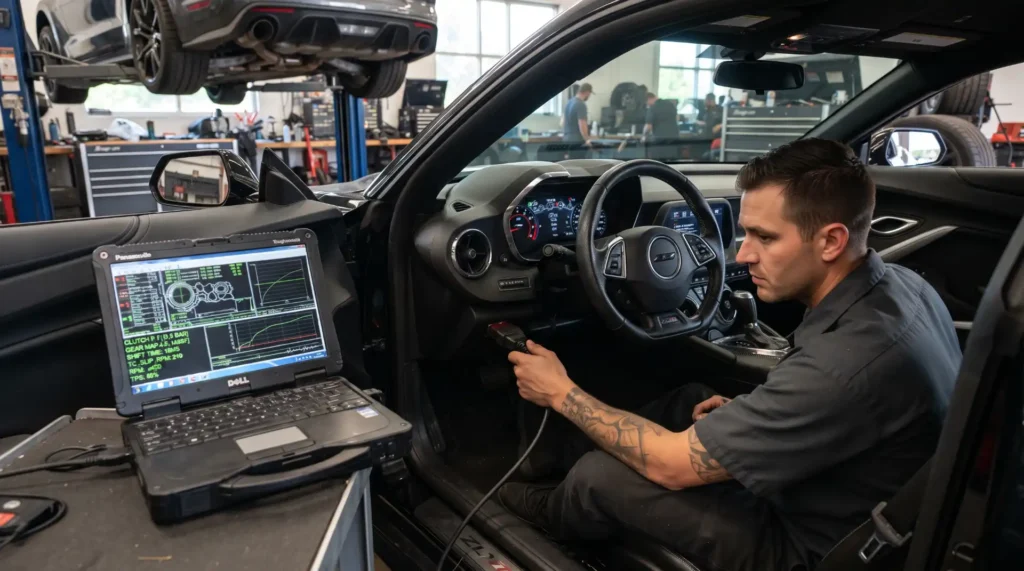 Why Modern Transmissions Depend So Heavily on Software
Older automatic transmissions relied more heavily on mechanical and hydraulic controls. Modern units use sophisticated electronic management.
A contemporary eight-speed or ten-speed automatic may have multiple clutch packs, planetary gearsets, hydraulic circuits, pressure-control solenoids, speed sensors, temperature sensors, and electronic controllers operating together.
SAE International research on automatic transmission shift control illustrates the complexity involved. Modern shifts require coordinated control of clutch engagement, engine torque, hydraulic pressure, and changing transmission ratios. Engineers balance shift duration against smoothness, efficiency, and drivetrain stress.
You can review technical research from SAE International on automatic transmission shift control for a deeper engineering perspective.
This electronic sophistication explains why software changes can make such a noticeable difference. The transmission hardware may remain exactly the same, yet changing the strategy controlling that hardware can alter the driving experience.
What Can a Transmission Tune Change?
The exact adjustments available depend heavily on the vehicle and transmission platform. Some manufacturers provide tuners with broad access to transmission parameters, while others restrict what aftermarket software can modify.
Common calibration areas include shift points, shift speed, line pressure, torque converter lockup, downshift behavior, torque limits, launch behavior, manual-mode response, and gear holding.
These parameters interact with one another. A good transmission calibration is therefore more complicated than simply making every shift faster or increasing pressure throughout the transmission.
Too much shift pressure could create harsh engagement or place unnecessary stress on drivetrain components. Poor torque-management settings could also make shifts uncomfortable or increase load on the transmission.
A balanced calibration attempts to improve performance while respecting the mechanical limitations of the hardware.
Can Transmission Tuning Make a Car Faster?
Yes, in certain applications, but the improvement does not come from creating engine horsepower.
A transmission tune may help a vehicle accelerate more effectively by changing when and how the transmission uses available engine power.
Imagine an engine that produces its strongest output near the upper portion of the rpm range. If the factory transmission shifts too early during wide-open throttle, the engine may repeatedly fall below its most effective operating range.
A revised shift schedule may keep the engine closer to the rpm range where it performs best.
Faster shifts may also reduce the amount of time during which acceleration is interrupted. The difference from one gear change may appear small, but several shifts during an acceleration run can add up.
Transmission tuning can become especially useful after engine modifications. An engine tune may increase torque beyond the assumptions built into the factory transmission calibration.
In that situation, coordinating the engine and transmission calibrations may create a more cohesive setup.
Transmission Tunes and Torque Management
Torque management is one of the most misunderstood areas of transmission tuning.
Modern vehicles often reduce engine torque momentarily during a shift. The engine controller and transmission controller communicate so the transmission can complete the gear change without being subjected to the full engine output throughout the entire event.
To an enthusiast, this may feel like the car briefly pulls power during a shift.
It can be tempting to remove all torque management, particularly when the goal is faster acceleration. However, those reductions often serve an engineering purpose.
Clutches need time to release and engage. Gears change speeds. Hydraulic pressure changes. Driveline components also experience sudden changes in load.
Reducing torque during part of the shift can help manage those loads.
A performance tune may reduce or reshape torque intervention rather than eliminate it completely. The calibration can allow more power through the transmission while still maintaining a controlled shift event.
This is one reason transmission tuning benefits from careful calibration rather than aggressive settings chosen simply because they feel harder or faster.
Firmer Shifts Are Not Automatically Better Shifts
Drivers often associate a strong physical kick during a shift with performance.
That is not always accurate.
A fast and properly controlled shift can feel relatively smooth while still transferring torque efficiently. A harsh shift may simply indicate abrupt clutch application or excessive pressure.
Transmission engineers work extensively on this balance. SAE research has examined controlling oncoming and off-going clutches along with engine torque to improve shift duration and comfort at the same time.
A good performance transmission tune therefore does not necessarily try to create the hardest possible shift.
The goal is usually a clean, predictable, responsive gear change that suits the vehicle’s intended use.
Transmission Tuning Can Improve Throttle Response
Drivers sometimes install a transmission tune and report that the engine suddenly feels stronger even when the ECU calibration remains unchanged.
Much of that sensation may come from gear selection.
Factory transmission programming frequently favors higher gears during normal driving to reduce engine speed and fuel consumption. When the driver asks for more acceleration, the transmission has to decide whether to remain in the current gear or downshift.
If the calibration hesitates, the car can feel sluggish.
A performance-oriented tune can request downshifts earlier and keep the transmission in a more responsive gear.
The engine has not gained horsepower, but the drivetrain gives the driver access to that horsepower more quickly.
This can make a particularly noticeable difference in turbocharged vehicles where proper gear selection helps keep the engine closer to its useful boost range.
What Happens to Shift Points?
Factory shift points are calibrated around the stock engine’s power curve and the manufacturer’s broader goals.
Once the engine is modified, those original shift points may no longer be ideal.
Suppose an upgraded turbocharger allows the engine to continue producing strong power at a higher rpm than the factory setup. If the transmission still shifts at the original rpm, some of that additional performance may remain unused.
A transmission tune could raise the shift point so the engine remains in its stronger operating range longer.
The opposite can also be true.
If an engine produces its strongest useful power earlier in the rev range, unnecessarily extending every gear toward redline may not improve acceleration.
Proper shift strategy should reflect the actual engine output rather than simply using the highest rpm possible.
Why Transmission Tunes Matter After Engine Tuning
An ECU tune can substantially change engine torque, particularly on turbocharged vehicles.
The transmission controller may contain torque limits based on the factory engine output. When increased engine torque exceeds those programmed limits, the vehicle may reduce power, change shifting behavior, or create inconsistent performance.
A coordinated transmission tune may revise those limits where appropriate.
This does not mean every limit should be disabled.
Some limitations protect mechanical components. A transmission designed around a particular torque range still has physical clutch capacity, gear strength, cooling requirements, and hydraulic limitations.
Software cannot turn stock hardware into an unlimited-capacity racing transmission.
Drivers considering larger engine modifications can review Auto Sport Performance’s information about performance upgrades and custom tuning as part of evaluating the complete drivetrain rather than focusing on one component.
Does Transmission Tuning Help Dual-Clutch Gearboxes?
Dual-clutch transmissions, often abbreviated DCT, can respond particularly well to calibration changes because clutch operation and gear selection are electronically managed.
A DCT uses separate clutches for different gear sets. While one gear is engaged, the transmission can prepare another gear for the upcoming shift.
This architecture allows extremely fast shifts when calibrated correctly.
A DCT tune may adjust clutch pressure, launch behavior, shift speed, torque limits, gear selection, and manual-mode response.
Higher-output engine modifications can also require changes to clutch clamping strategies because additional torque increases the load placed on the clutch packs.
However, additional clutch pressure does not create unlimited capacity. Heat, friction material, hydraulic performance, gear strength, and mechanical wear still matter.
Track-driven DCT vehicles may also need attention to transmission temperature because repeated launches and aggressive shifting can generate substantial heat.
What About Traditional Torque Converter Automatics?
Modern torque converter automatics have become remarkably capable performance transmissions.
Eight-speed and ten-speed units can shift rapidly while offering a wide gear-ratio spread. Electronic control allows them to behave very differently depending on drive mode and throttle demand.
A transmission tune may alter torque converter lockup strategy in addition to normal gear changes.
The torque converter allows some slip between the engine and transmission during certain conditions. A lockup clutch can mechanically connect portions of the system to reduce that slip.
Changing when lockup occurs can affect efficiency, responsiveness, heat generation, and driving feel.
Again, more aggressive is not always better.
A well-designed calibration considers the entire transmission operating strategy.
Can a Transmission Tune Improve Launches?
On vehicles equipped with launch-control systems, transmission calibration may influence launch rpm, clutch engagement, torque management, and the transition into the next gear.
A better-calibrated launch can help a car use available traction more consistently.
However, launching harder also increases stress.
Axles, driveshafts, clutches, differentials, mounts, tires, and transmission components all experience high loads when a vehicle accelerates aggressively from a stop.
A transmission tune cannot remove those physical stresses.
Drivers who repeatedly use launch control should consider drivetrain condition, tire grip, cooling, and maintenance as part of the performance setup.
Street Driving and Track Driving Need Different Calibrations
The ideal transmission behavior on a racetrack may become frustrating during a daily commute.
A track-oriented tune may hold gears longer, downshift aggressively, increase clutch pressure, and keep the engine operating at higher rpm.
Those characteristics can feel excellent during hard driving but unnecessary in stop-and-go traffic.
A street car often benefits from a more balanced calibration.
Many modern vehicles offer multiple drive modes, allowing transmission behavior to change between comfort, sport, and track settings. A tuner may preserve this flexibility by modifying each mode differently.
Comfort mode can retain relaxed shifts while sport mode becomes more responsive.
This can provide stronger performance without forcing the car to behave aggressively during every trip.
Can Transmission Tunes Improve Manual Mode?
Manual mode is another area where factory programming can frustrate performance drivers.
Some automatic transmissions upshift automatically near redline even when the driver has selected manual control. Others may delay paddle responses or reject downshift requests that the factory software considers unnecessary.
Some transmission tunes can alter these behaviors.
A performance calibration may allow the transmission to hold gears longer or respond more quickly to paddle commands.
However, protective logic should still prevent mechanically unsafe shifts.
For example, commanding first gear at highway speed would force the engine well beyond its normal operating range. Software protections against such requests remain valuable even in a modified performance car.
Transmission Temperature Still Matters
Performance driving generates heat.
Automatic transmission fluid performs several jobs, including lubrication, hydraulic control, cooling, and supporting friction behavior inside clutches and torque converters.
SAE research on transmission fluids has shown that friction characteristics play a significant role in shift quality and clutch durability.
A more aggressive calibration may increase heat depending on how it changes clutch engagement, converter behavior, and overall driving conditions.
Track cars and high-output street builds may therefore benefit from monitoring transmission temperature.
A larger transmission cooler may be appropriate for some applications, but cooling modifications should match the specific transmission and operating requirements.
A Tune Cannot Repair a Worn Transmission
Transmission tuning is not a substitute for mechanical repair.
If a transmission already slips, overheats, shudders, leaks fluid, or produces unusual noises, changing software may make the underlying problem more noticeable.
Clutch packs wear. Hydraulic seals deteriorate. Solenoids can fail. Fluid can degrade. Bearings and gears can develop mechanical problems.
A healthy transmission provides a much better foundation for calibration changes.
Drivers considering transmission tuning should address existing diagnostic trouble codes and drivability concerns before increasing performance demands.
This principle applies across most modifications. Tuning works best when the underlying engine and drivetrain are functioning correctly.
Transmission Tunes and Reliability
The reliability question does not have a simple universal answer.
A conservative calibration on a healthy transmission operating within reasonable torque and temperature limits may behave very differently from an aggressive tune on a high-mileage gearbox already near its mechanical capacity.
Some calibration changes may actually reduce unnecessary clutch slip or improve behavior for a modified powertrain.
Other changes may increase clutch pressure, reduce torque intervention, raise shift points, and place greater loads on components.
The tune itself is only one part of the equation.
Vehicle condition, engine output, driving style, cooling, fluid condition, tire grip, and transmission design all influence long-term results.
Why Transmission Fluid Becomes More Important
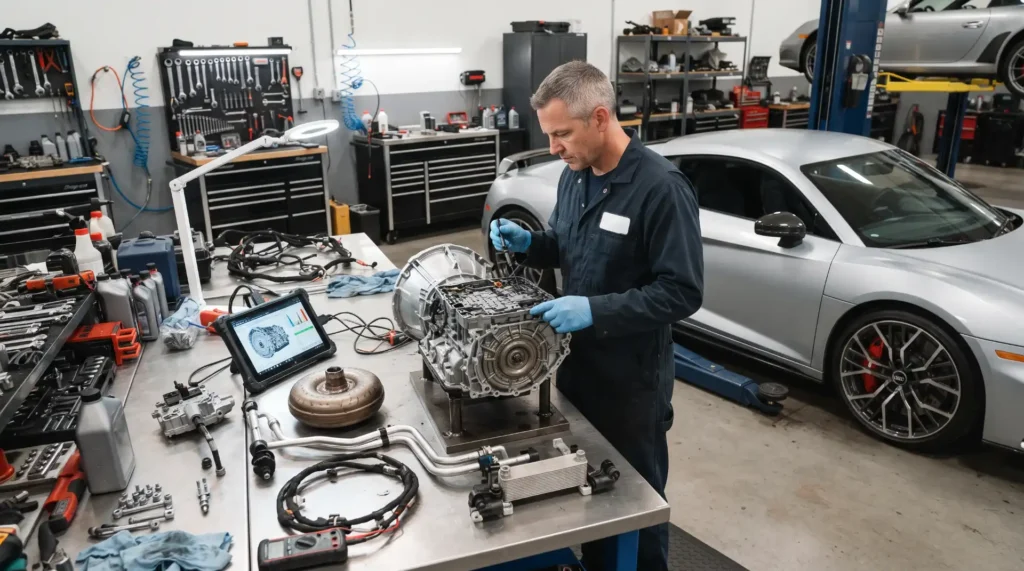 Why Transmission Fluid Becomes More Important
Performance modifications tend to increase attention on engine oil, but automatic transmission fluid deserves similar consideration.
Fluid characteristics directly affect hydraulic operation and clutch friction.
Old or overheated fluid may not perform like fresh fluid meeting the correct manufacturer specification.
Using the wrong fluid can also create shift-quality problems.
Transmission tuning should therefore be paired with appropriate maintenance practices.
Service intervals depend on the vehicle, transmission type, manufacturer guidelines, driving conditions, and usage.
A car that spends significant time at track events may place much greater thermal demand on its transmission than a vehicle driven primarily on highways.
Does a Transmission Tune Affect Fuel Economy?
It can.
A tune that holds lower gears longer and raises normal operating rpm may increase fuel consumption during aggressive driving.
Changes to torque converter lockup can also affect efficiency.
However, transmission behavior depends strongly on driver input. A calibration that maintains efficient behavior during light throttle while becoming aggressive only under larger throttle openings may have a smaller impact during normal cruising.
Drivers purchasing transmission tuning primarily for performance should view fuel economy as part of the tradeoff rather than assuming every calibration produces the same result.
Could Transmission Tuning Affect Emissions or Warranty Coverage?
Vehicle owners should consider the broader consequences of software modifications.
Manufacturers may be able to identify modified control-module software. Warranty coverage for a later drivetrain problem can become complicated if a modification is considered relevant to the failure.
U.S. drivers should review applicable manufacturer policies and federal or state regulations before modifying vehicle software.
California owners and drivers in states that follow California emissions standards may face additional considerations when modifications affect emissions-related systems or approved vehicle configurations.
A transmission calibration should not be viewed as completely separate from the rest of the powertrain because modern engine and transmission controllers exchange substantial information.
Who Benefits Most From a Transmission Tune?
A transmission tune tends to make the most sense when the factory calibration is noticeably conservative or when engine modifications have changed the power characteristics of the vehicle.
Turbocharged performance cars with substantial torque increases can be good examples. The original transmission strategy may no longer match the modified engine’s output.
Enthusiasts who regularly attend autocross, drag racing, or track events may also appreciate quicker shifts, improved gear holding, and more predictable manual-mode behavior.
Daily-driven performance cars can benefit as well when the goal is improved response rather than maximum aggression.
On the other hand, a completely stock vehicle whose factory transmission already behaves exactly as the owner wants may see less practical benefit.
What Should You Consider Before Tuning?
Start by identifying the problem you want the tune to solve.
Perhaps the transmission upshifts too early. Maybe downshifts feel delayed. An engine tune may have increased torque, or manual mode may feel less responsive than expected.
Defining the goal makes it easier to evaluate whether transmission calibration is the appropriate modification.
Next, consider the mechanical condition of the vehicle. Transmission faults should be diagnosed before software changes.
The engine calibration should also be considered. Transmission and engine tuning work together, particularly when torque limits and shift torque reduction are involved.
Finally, look at intended use. A daily-driven car needs different behavior from a dedicated drag or track vehicle.
Custom Tuning Versus Off-the-Shelf Transmission Tunes
Many popular performance vehicles have off-the-shelf transmission calibrations available.
These files are developed around common combinations of vehicles and modifications. They can provide a practical solution for relatively standard builds.
Custom calibration becomes more useful when the vehicle has extensive engine upgrades, unusual gearing, upgraded transmission hardware, specialized tires, or a specific motorsport application.
Custom tuning also allows shift behavior to be tailored around driver preference.
One driver may want extremely quick sport-mode shifts while maintaining smooth normal driving. Another may prioritize drag-racing consistency.
The best approach depends on the vehicle rather than simply choosing whichever file has the most aggressive description.
Transmission Hardware Still Sets the Limit
Software can change how a transmission operates, but it cannot eliminate mechanical limitations.
Every transmission has finite clutch capacity, gear strength, shaft strength, hydraulic capacity, and cooling capability.
As engine output rises, performance builds may eventually require upgraded clutches, valve-body components, torque converters, cooling systems, or complete transmission hardware.
A tune may help a stock transmission manage additional power, but there is always a point where mechanical upgrades become necessary.
This is particularly important for high-torque turbocharged engines because torque creates substantial load throughout the drivetrain.
Is Transmission Tuning Worth It for a Stock Performance Car?
It can be, depending on the factory programming.
Some vehicles leave the factory with excellent transmission calibration. Shifts are quick, gear selection is intelligent, and sport modes provide meaningful control.
Other cars may have conservative settings designed to prioritize smoothness and fuel economy.
Owners of the second group may notice a larger difference after tuning.
The value also depends on expectations. A transmission tune does not transform a stock vehicle into a dramatically more powerful car. Instead, it changes the way the existing power reaches the road.
For drivers who care about responsiveness, shift quality, and drivetrain behavior, that improvement can feel significant.
Is Transmission Tuning Worth It After Engine Modifications?
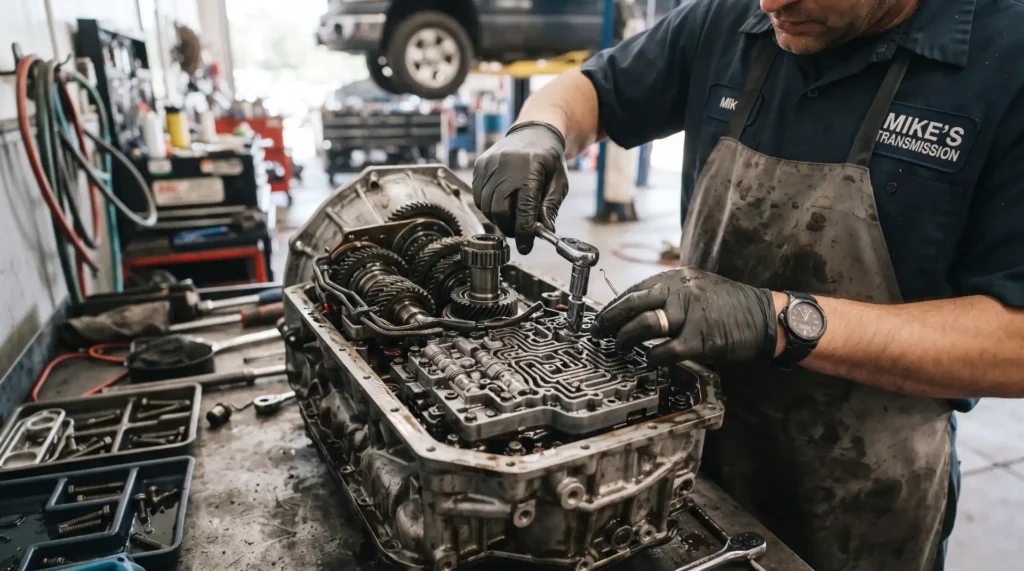 Is Transmission Tuning Worth It After Engine Modifications?
This is where transmission tuning often becomes more compelling.
Increasing engine output changes the demands placed on the transmission. The stock software may continue operating according to original torque targets and shift strategies.
A coordinated calibration can better match the transmission to the new engine output.
Shift points may be adjusted around the modified power curve. Torque limits can be reviewed. Clutch behavior can be calibrated around higher input torque, while downshift logic can better match the engine’s response.
The result can feel more integrated than adding engine power without revisiting transmission behavior.
Are Transmission Tunes Worth It for Modern Performance Cars?
For many modern performance cars, a well-developed transmission tune can be worthwhile because software controls so much of the drivetrain experience.
A good calibration may provide faster and cleaner shifts, more responsive downshifts, improved gear selection, better manual-mode behavior, and stronger coordination with an upgraded engine.
The improvement may be particularly noticeable on turbocharged cars, dual-clutch transmissions, and modern multi-speed automatics where electronic control plays a major role in delivering torque.
However, transmission tuning should not be treated as a simple way to remove every factory protection or make every shift as aggressive as possible.
Manufacturers use torque management, hydraulic-pressure control, clutch strategies, and temperature limits for several reasons. A performance calibration works best when it modifies those strategies thoughtfully rather than ignoring the mechanical requirements of the transmission.
Final Thoughts
Modern performance cars are integrated systems. The engine, transmission, differential, tires, electronics, and cooling system all affect how effectively a vehicle puts power to the road.
That is why transmission tuning can provide a meaningful improvement even though it does not directly add horsepower.
Changing shift strategy, torque management, clutch behavior, and gear selection can help drivers access the engine’s existing performance more effectively.
The strongest results usually come from viewing transmission tuning as part of a complete performance package. A healthy transmission, appropriate engine calibration, proper maintenance, adequate cooling, and realistic torque targets all matter.
Drivers planning broader upgrades can explore Auto Sport Performance’s performance tuning and automotive services when considering how engine, transmission, suspension, brakes, and other components work together.
For enthusiasts who find their factory transmission slow to react, overly conservative, or poorly matched to an upgraded engine, a carefully developed transmission tune can be one of the modifications that changes the character of the entire car.