
Turbocharged cars have become a major part of the American performance market. Automakers now use turbochargers in everything from compact sport sedans and hot hatchbacks to muscle cars, crossovers, and pickup trucks. Many of these vehicles produce impressive power directly from the factory, which raises a common question among owners who have not yet tuned their engines: is an upgraded intercooler worth it for a stock turbo car?
For many turbocharged vehicles, an intercooler upgrade can offer benefits even when boost pressure and ECU calibration remain stock. The biggest advantages usually involve lower intake air temperatures, reduced heat soak, and more consistent performance during repeated acceleration or hot-weather driving.
That does not mean every completely stock turbo car needs a larger intercooler immediately. The value depends on the factory cooling system, climate, driving conditions, vehicle design, and future modification plans.
Understanding what the intercooler actually does makes it easier to determine whether upgrading one makes sense.
What Does an Intercooler Do?
A turbocharger increases engine output by compressing incoming air before sending it into the engine.
Compressing air has an unavoidable side effect: it creates heat.
According to turbocharger manufacturer Garrett Motion, compressed air leaving a turbocharger can become extremely hot. An intercooler sits between the turbocharger and the engine and removes some of that heat before the air reaches the combustion chambers.
Cooler air is denser than hotter air.
Greater air density allows more oxygen to occupy the same volume. This creates better conditions for combustion and can help a turbocharged engine operate more consistently.
The factory intercooler therefore already plays an important role, even on a completely stock vehicle.
The question is whether the original unit provides enough cooling capacity for the way the car is actually driven.
Why Automakers Do Not Always Install Huge Intercoolers
If larger intercoolers can lower intake temperatures, it might seem logical for every manufacturer to install the biggest possible intercooler from the factory.
Vehicle engineering involves compromises.
An automaker needs to consider manufacturing cost, packaging space, weight, aerodynamics, crash requirements, airflow through the radiator and air conditioning condenser, fuel economy, noise, emissions, and performance.
The intercooler also has to fit behind the bumper while leaving room for other components.
A factory intercooler is therefore designed around the expected operating range of the vehicle rather than maximum aftermarket performance.
For normal commuting, occasional acceleration, and factory boost pressure, that design may work perfectly well.
Problems tend to become more noticeable when the vehicle experiences repeated high-load operation.
Heat Soak Is the Main Reason Owners Upgrade
Heat soak is one of the most common reasons enthusiasts replace a factory intercooler.
An intercooler absorbs heat from the compressed intake charge. As the intercooler itself becomes hotter, its ability to remove additional heat decreases.
Imagine making one full-throttle acceleration run.
The factory intercooler may handle that event without difficulty.
Make another hard acceleration run shortly afterward, and the intercooler may start the second run at a higher temperature.
Repeat the process several times and intake temperatures may continue climbing.
This is heat soak.
The car may feel strong during its first acceleration but noticeably less energetic after repeated pulls.
An upgraded intercooler with greater cooling capacity and thermal mass may slow this temperature buildup.
Garrett explains that effective intercooler design centers on transferring heat from compressed charge air while maintaining suitable airflow through the core. Its technical information also emphasizes that intercoolers need sufficient ambient airflow to function effectively.
This is especially relevant during spirited driving, track sessions, autocross events, mountain driving, and repeated highway acceleration.
Does Heat Soak Really Reduce Power?
Modern engine management systems continuously monitor operating conditions.
Depending on the vehicle, the ECU may use information from intake temperature sensors, knock sensors, coolant temperature sensors, exhaust-related sensors, and other systems when deciding how aggressively the engine can operate.
Hot intake air increases the possibility of knock or detonation.
When conditions become unfavorable, the ECU may respond by reducing ignition timing, changing boost strategy, adjusting fueling, or using another protective measure.
The result may be lower power.
The driver might describe the car as feeling slower after several hard acceleration runs.
The engine itself may be mechanically healthy. The ECU is simply responding to increased thermal stress.
An intercooler upgrade can help reduce this temperature rise.
For a broader explanation of heat in modified vehicles, read our guide to thermal management for performance cars.
Can an Intercooler Add Horsepower to a Stock Car?
This question requires some context.
An intercooler does not create power in the same manner as increasing boost pressure or changing an ECU calibration.
Its primary job is temperature management.
If the factory intercooler already keeps intake temperatures under control, replacing it may produce little difference in peak horsepower under normal conditions.
The greater benefit often appears during repeated high-load operation.
Imagine that a stock turbo car produces strong power during its first dyno run. By the third or fourth pull, heat builds and output falls.
A better intercooler may help the vehicle maintain output more consistently across those later runs.
In that scenario, the upgrade does not necessarily create a dramatic new peak number.
Instead, it helps preserve performance that heat might otherwise remove.
That difference between peak horsepower and repeatable horsepower is important.
For a daily-driven performance car, consistency can sometimes be more useful than a brief maximum number.
Why Hot US Climates Make Intercoolers More Relevant
Where the vehicle is driven matters.
A car operating during a mild spring day in the Pacific Northwest experiences different thermal conditions from the same model sitting in summer traffic in Arizona, Nevada, Texas, or inland California.
Intercoolers depend on the temperature difference between the hot compressed intake charge and the surrounding cooling air.
Higher ambient temperatures reduce that temperature difference.
The system therefore has less favorable conditions for removing heat.
Hot pavement, air conditioning operation, underhood temperatures, slow traffic, and repeated acceleration can add to the thermal load.
A stock intercooler that feels adequate during cooler weather may show its limitations during a 100-degree summer afternoon.
This is one reason owners in warmer parts of the United States often pay particular attention to intercooler performance.
 Daily Driving Versus Performance Driving
 Daily Driving Versus Performance Driving
Whether an intercooler is worth buying depends heavily on driving style.
A driver who commutes gently, rarely uses full throttle, and lives in a moderate climate may see little practical improvement from replacing a properly functioning factory intercooler.
The vehicle spends most of its time under low load, so the turbocharger generates relatively little additional heat.
The situation changes when the car regularly experiences demanding conditions.
A driver who enjoys canyon roads, autocross, track days, repeated acceleration, or long uphill grades places more stress on the charge-air cooling system.
Even if the engine remains completely stock, these conditions may create enough heat to expose the limitations of a small factory intercooler.
The real question is therefore not simply whether the engine has been tuned.
It is how much thermal load the car experiences.
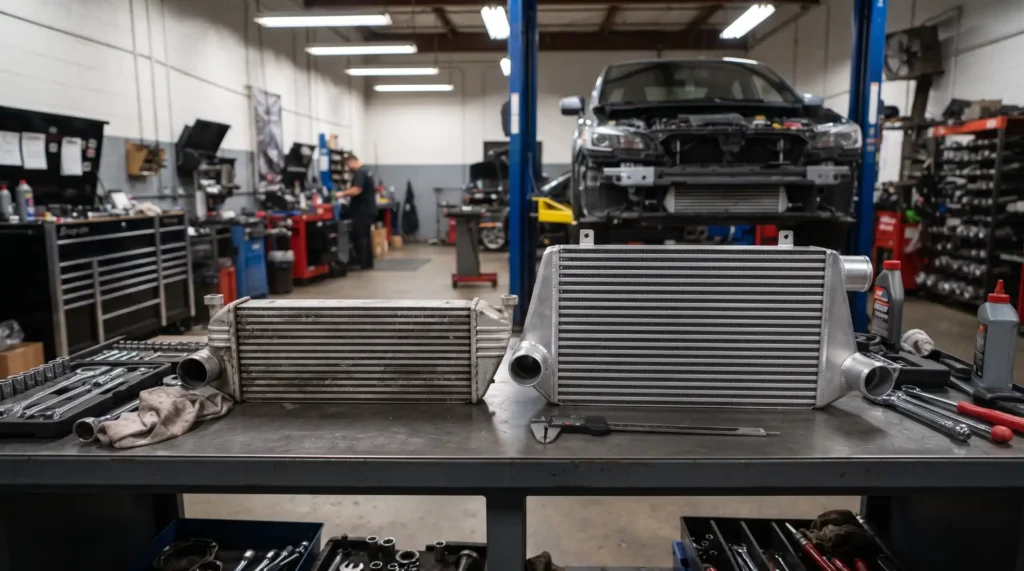
Factory Intercooler Versus Aftermarket Intercooler
Aftermarket intercoolers often differ from factory units in several areas.
The core may be thicker. Frontal surface area may be larger. Internal fins can have different geometry. End tanks may be designed to distribute airflow more evenly.
Some aftermarket systems also replace restrictive factory charge piping or plastic connections.
Garrett’s intercooler engineering information explains that core design, internal fin arrangement, end-tank shape, airflow, and pressure drop all affect intercooler performance.
This is why physical size alone should not determine whether an intercooler is good.
A huge intercooler with poor internal airflow can create unnecessary restriction.
A properly engineered smaller unit may provide better overall performance.
Bigger Is Not Automatically Better
The biggest intercooler that fits behind the bumper is not necessarily the right one.
Charge air has to travel through the intercooler core before entering the engine.
Every restriction creates some pressure drop.
Pressure drop means the pressure entering the intercooler is slightly higher than the pressure leaving it.
Some pressure loss is unavoidable, but excessive restriction makes the turbocharger work harder to reach the desired manifold pressure.
Garrett identifies pressure drop as an important part of charge-air cooler design and notes that airflow efficiency needs to remain part of the selection process.
An excessively large or poorly designed system can also increase internal volume.
That additional volume has to be pressurized when the driver accelerates.
On some applications, extremely oversized piping or cores may slightly affect transient response.
For a stock turbo vehicle, balanced engineering matters more than choosing the largest available core.
What Makes a Good Aftermarket Intercooler?
A quality intercooler needs to balance cooling effectiveness and airflow.
Core construction matters.
Many performance intercoolers use bar-and-plate construction because it offers substantial thermal capacity and strength.
Tube-and-fin construction is also used and may provide advantages in weight and external airflow depending on the application.
Neither design should automatically be considered superior in every situation.
The total design matters.
End tanks should distribute charge air across the core rather than concentrating flow in only one section.
The fins need enough surface area to transfer heat while allowing sufficient airflow.
Charge passages should support the required airflow without excessive pressure loss.
The physical location of the intercooler also matters because it needs access to cooler outside air.
An attractive intercooler hidden behind a poorly ventilated bumper opening cannot perform at its full potential.
Should You Upgrade Before Getting an ECU Tune?
For many builds, upgrading the intercooler before or alongside ECU tuning is a logical progression.
A performance tune frequently increases boost pressure or changes the way the engine delivers torque.
Higher boost generally creates additional compressed-air heat.
If the factory intercooler already struggles during stock operation, increasing engine output can expose that limitation further.
Installing a more capable intercooler first provides additional thermal capacity before asking the turbo system to do more work.
It also gives the tuner a more consistent operating environment.
Our engine tuning guide covers additional factors enthusiasts may consider when planning future power upgrades.
Owners who expect to tune their car later may therefore see an intercooler as a supporting modification rather than an isolated horsepower upgrade.
Does a Stock Car Need a Tune After an Intercooler Upgrade?
In many applications, a direct-fit intercooler does not require an ECU tune by itself.
The factory ECU can generally continue controlling the engine under its existing calibration while benefiting from cooler charge temperatures.
However, this depends on the vehicle and the specific intercooler system.
An upgrade that dramatically changes charge piping, airflow measurement, sensor placement, or another part of the intake system deserves closer attention.
Owners should follow the intercooler manufacturer’s vehicle-specific installation information.
A tune may unlock additional performance from supporting modifications, but that is different from saying every intercooler requires recalibration.
What About Turbo Lag?
Turbo lag is frequently mentioned when intercooler upgrades are discussed.
The theory is simple.
A larger intercooler and larger charge pipes contain more air volume. The turbocharger has to pressurize this volume before the engine reaches its target boost.
In practice, the difference from a properly designed direct-fit intercooler may be very small on many street cars.
Problems become more likely when the entire charge system is dramatically oversized for the airflow needs of the engine.
This reinforces the importance of choosing an intercooler designed around the vehicle rather than simply installing the largest universal core possible.
A stock turbocharger has a defined airflow range.
The intercooler should support that range efficiently.
Intercooler Pressure Drop Matters
Cooling performance receives most of the attention, but pressure drop deserves equal consideration.
Suppose the turbocharger produces a certain pressure before the intercooler.
If the intercooler creates significant restriction, pressure at the intake manifold may be lower.
The turbo may then need to operate at a higher compressor pressure to maintain the engine’s requested boost.
That additional work can create more heat.
A quality performance intercooler tries to achieve two goals at once: remove substantial heat and maintain efficient airflow.
Garrett’s Turbo System Optimization guide discusses the relationship between charge-air cooling, tubing design, intercooler sizing, airflow distribution, and pressure drop.
That makes it a useful technical reference for enthusiasts comparing different systems.
Front-Mount Intercoolers Need Airflow
Intercoolers cannot reject heat efficiently without cooling airflow.
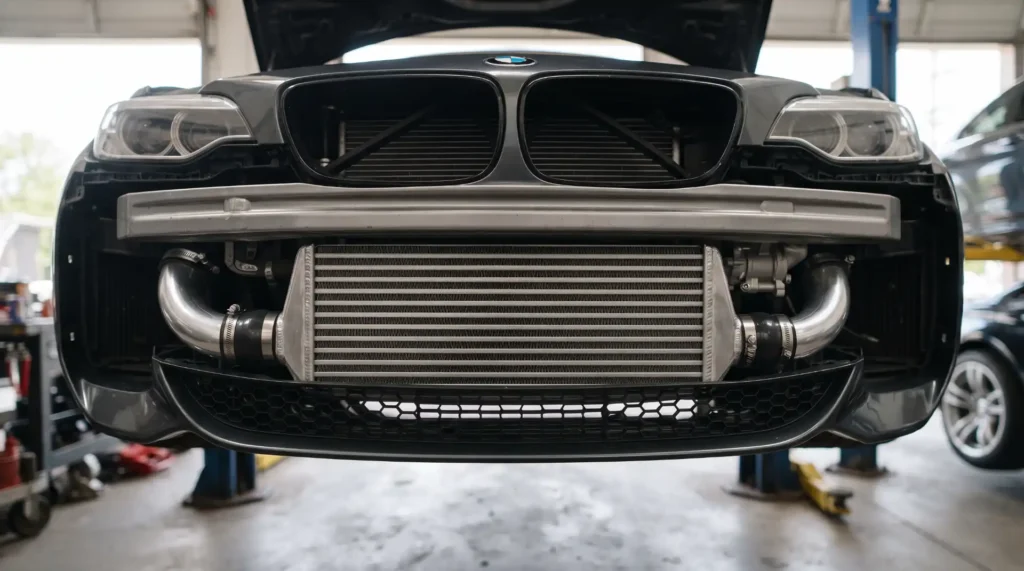
A front-mount intercooler usually sits behind the front bumper or grille where outside air passes through its cooling fins.
This positioning creates another engineering challenge.
The radiator and air conditioning condenser may sit directly behind the intercooler.
Making the intercooler much thicker can potentially affect airflow reaching those heat exchangers.
This does not mean a thick intercooler automatically causes coolant problems.
It means the complete cooling stack needs consideration.
Engine coolant temperature, oil temperature, transmission temperature, air conditioning performance, and intake temperature can all interact during demanding conditions.
Proper ducting can help air travel through the cooling components rather than escaping around them.
Performance cooling works best as a coordinated system.
How to Know Whether Your Stock Intercooler Is Struggling
Data is more useful than guessing.
Many modern vehicles allow enthusiasts to monitor intake air temperature through factory displays, diagnostic scan tools, data logging software, or aftermarket monitoring equipment.
Watch what happens during repeated acceleration.
If intake temperatures rise rapidly and remain elevated between runs, the intercooler may be approaching its thermal limits.
You may also notice that the car feels strong during the first pull but weaker after repeated acceleration.
Hot-weather performance may feel noticeably different from cool-weather performance.
However, these symptoms can have several causes.
A boost leak, ignition problem, fuel issue, or another mechanical fault can also reduce performance.
Before replacing the intercooler solely because the vehicle feels slow, inspect the complete turbo system.
Our guide on how to check for boost leaks explains common leak locations around intercoolers, hoses, clamps, charge pipes, and intake connections.
Check the Stock Intercooler Before Replacing It
Sometimes the factory intercooler is not undersized. It is damaged.
Road debris can bend fins and reduce external airflow.
Oil residue can collect inside charge components.
Plastic end tanks can develop cracks.
Seals and connections can deteriorate.
Hoses may loosen or split.
A damaged intercooler can leak boost and reduce performance even when its cooling capacity would otherwise be adequate.
Inspecting the system helps distinguish between a performance limitation and a maintenance problem.
If the existing intercooler is leaking, replacing it with a more capable unit may solve two problems at once.
Air-to-Air Versus Air-to-Water Systems
Most stock turbo street cars use an air-to-air intercooler or a charge cooler integrated into another part of the intake system.
Air-to-air systems use ambient airflow passing through the intercooler core to remove heat.
They are relatively simple and do not require a separate coolant circuit.
Some modern performance cars use air-to-water systems.
These circulate coolant through a charge cooler and then reject the heat through another heat exchanger.
Air-to-water systems can offer compact packaging and strong short-term cooling performance, but they introduce pumps, coolant lines, reservoirs, and additional heat exchangers.
Owners should understand which system their car uses before shopping for an upgrade.
A larger front-mounted intercooler is not relevant to every modern turbo vehicle.
Intercooler Upgrades for Track Cars
Track driving makes intercooler performance much more important.
A street car may experience full boost for only several seconds before returning to light load.
A track car can operate at high throttle repeatedly for an entire session.
The turbocharger keeps generating heat while the engine, transmission, brakes, and cooling system all experience sustained load.
Under these conditions, heat rejection becomes more important than simply having enough thermal mass for one acceleration run.
A well-designed intercooler can help stabilize intake temperatures from lap to lap.
Consistent intake temperatures also provide the ECU with more stable operating conditions.
For a stock turbo vehicle used regularly on track, an intercooler may therefore be one of the more practical supporting upgrades even before increasing boost.
Intercooler Upgrades for Autocross and Drag Racing
 Intercooler Upgrades for Autocross and Drag Racing
Short events create different demands.
Autocross usually involves brief runs followed by substantial cooldown periods.
Heat soak may still occur on hot days or during back-to-back runs, but total sustained load is lower than many road-course sessions.
Drag racing involves intense acceleration for a short period.
Between-run cooling time becomes important.
A larger intercooler can provide additional thermal capacity, particularly when the vehicle performs repeated passes during warm weather.
The best system therefore depends partly on the type of performance driving the owner enjoys.
Will an Intercooler Improve Fuel Economy?
An upgraded intercooler should not be purchased primarily as a fuel economy modification.
Under normal light-load driving, the turbocharger produces relatively little boost and the factory intercooler is unlikely to be heavily stressed.
A more efficient intercooler may improve charge-air conditions during higher-load operation, but real-world fuel economy depends heavily on driving behavior, vehicle calibration, temperature, traffic, tires, aerodynamic drag, and numerous other factors.
If the modification encourages the driver to use boost more frequently, fuel use could easily increase.
The intercooler’s main value remains thermal management and performance consistency.
Are Cheap Intercoolers Worth It?
Intercooler appearance can be misleading.
Two aluminum cores may look nearly identical from the outside while behaving very differently internally.
Internal fin design, core density, weld quality, end-tank shape, pressure testing, material consistency, and manufacturing tolerances all affect performance.
An intercooler that cools well but creates excessive pressure drop is not ideal.
A unit with excellent airflow but insufficient heat-transfer capacity is also a compromise.
Vehicle-specific testing is particularly useful when comparing products.
Look for data showing intake temperatures and pressure drop rather than relying only on marketing descriptions such as “massive core.”
When a Stock Intercooler Is Probably Enough
Not every factory intercooler needs replacing.
A completely stock commuter driven in moderate weather may operate comfortably within the original system’s capacity.
If logged intake temperatures remain stable and the vehicle delivers consistent performance, the factory hardware may already meet the owner’s needs.
Money could potentially be better spent on tires, brakes, maintenance, suspension, or another area that affects the way the car is used.
Modification should address an actual goal.
Replacing parts simply because aftermarket versions exist can create additional cost without producing a meaningful driving improvement.
When an Upgrade Makes More Sense
An intercooler becomes more attractive when the car regularly experiences heat soak.
Owners in hot climates may see greater value.
Drivers participating in track days, mountain drives, drag racing, or repeated spirited runs may also benefit from additional cooling capacity.
The upgrade becomes especially logical when a future ECU tune or higher boost level is planned.
Cars known for small factory intercoolers are another strong case.
The most useful approach is to research the exact platform and examine real temperature and pressure data when possible.
Installation Quality Matters
Even an excellent intercooler can perform poorly when installed incorrectly.
Charge pipes need secure connections.
Clamps need proper positioning.
O-rings and seals should remain undamaged.
The intercooler should not contact surrounding components in a way that causes vibration damage.
Garrett recommends appropriate mounting practices because intercoolers experience vibration and thermal expansion during normal operation.
After installation, checking the system for boost leaks can identify loose connections before they become performance problems.
A clean installation is especially important on daily-driven vehicles expected to remain reliable through thousands of miles of changing weather and road conditions.
Is an Upgraded Intercooler Worth the Money?
For a completely stock turbo car used only for normal commuting, the answer may be no.
The factory intercooler was designed for factory power levels and ordinary operating conditions.
For a stock turbo car exposed to repeated acceleration, hot climates, mountain driving, autocross, drag racing, or track use, the answer becomes more favorable.
The largest benefit may not appear as a dramatic peak horsepower increase.
Instead, the car may retain its performance more consistently as temperatures rise.
That distinction matters.
An enthusiast who evaluates modifications only through a single dyno number may underestimate the value of thermal management.
A car that produces nearly the same power during its fifth hard pull as it did during its first can provide a more consistent driving experience than one that records a slightly higher initial peak before heat soak sets in.
Think About Future Modifications
An intercooler also makes sense as part of a longer modification plan.
Suppose the car is stock today, but the owner expects to add an ECU tune later.
The additional boost from that calibration can create more intake heat.
Installing a capable intercooler first means the cooling system is already prepared for the increased thermal demand.
The same logic applies to future turbocharger upgrades.
Intercooler capacity should be selected around realistic airflow and horsepower goals rather than only the vehicle’s present output.
Avoid going excessively large for a mild build, but leave enough cooling capability for planned upgrades.
Final Thoughts
An upgraded intercooler can be worthwhile on a stock turbo car, but its value depends on how the vehicle is used.
The main benefit is not necessarily a huge increase in peak horsepower.
A better intercooler primarily helps control intake air temperature. Lower and more stable temperatures can reduce heat soak and support more consistent performance during repeated high-load driving.
Drivers in hot parts of the United States, enthusiasts who regularly use full boost, and owners planning future ECU tuning may see the greatest benefit.
Drivers who use a completely stock car mainly for normal commuting may find the original intercooler perfectly adequate.
The best decision comes from looking at actual operating conditions instead of treating the intercooler as a universal power upgrade.
Monitor intake temperatures when possible. Inspect the existing system for leaks or damage. Consider the climate, driving style, factory intercooler capacity, and future power goals.
If an upgrade makes sense, look beyond core size. Efficient airflow, low pressure drop, thoughtful end-tank design, suitable mounting, and proper charge piping all contribute to a successful system.
Turbocharged performance is closely connected to heat management. Whether the car remains stock or eventually receives additional boost, maintaining a cooler and more consistent intake charge can create a stronger foundation for repeatable performance.