
Building a car that feels at home both on public roads and at a racetrack sounds like the ideal enthusiast project. You can drive it to work during the week, take it through your favorite back roads on Saturday, attend a high-performance driving event on Sunday, and then commute again Monday morning.
The challenge is that street driving and track driving demand very different things from a vehicle.
A dedicated track car benefits from stiff suspension, aggressive alignment, extreme tires, additional cooling, reduced weight, increased brake capacity, and sometimes substantial changes to the engine and drivetrain. A daily driver needs ride comfort, predictable wet-weather behavior, reasonable noise levels, usable ground clearance, reliability, emissions compliance, and components that can survive thousands of ordinary road miles.
Trying to maximize both sides at once can easily create a car that technically remains street legal but is unpleasant to drive anywhere except a smooth circuit.
The better approach is not to transform a daily driver into a race car. It is to build a balanced performance car with enough capability to handle occasional track use while preserving the qualities that make it useful on the street.
That means choosing modifications based on how the car will actually be used rather than simply installing the most aggressive parts available.
Start by Defining How Much Track Driving You Actually Do
Before ordering suspension parts, track tires, brake kits, or engine upgrades, decide what percentage of the vehicle’s life will realistically be spent on a racetrack.
For many American enthusiasts, track driving represents a small fraction of total mileage. A car might cover 10,000 street miles during a year but participate in only two or three high-performance driving events.
That usage pattern should influence the entire build.
A car that spends approximately 95 percent of its time on public roads should not necessarily be configured around the remaining five percent. Instead, the goal should be to strengthen the areas that become stressed during track driving while retaining reasonable street characteristics.
Occasional track drivers can often achieve surprisingly good results with high-quality tires, better brake pads and fluid, proper alignment, improved cooling, and modest suspension changes.
Drivers attending numerous events every season may eventually benefit from dedicated track wheels, more aggressive brake components, adjustable suspension, and additional cooling.
Understanding where your car sits on that spectrum helps prevent unnecessary modifications.
Reliability Should Come Before Horsepower
One of the most common mistakes in dual-purpose builds is adding power before making sure the vehicle can repeatedly handle it.
A larger turbocharger, supercharger pulley, ECU calibration, intake, or exhaust may make the car faster in a straight line, but increased output also creates additional heat.
Track driving magnifies that problem because the engine may remain under heavy load for extended periods rather than experiencing the short acceleration bursts typical of street driving.
Engine oil temperatures can rise. Coolant temperatures can climb. Transmission and differential fluids may become hotter. Turbocharged vehicles generate additional heat around the turbine, catalytic converter, and engine compartment.
For that reason, preventative maintenance should be considered part of the performance build.
Fresh engine oil, healthy cooling-system components, properly functioning fans, quality fluids, good wheel bearings, fresh belts, healthy hoses, and properly torqued hardware are often more important for a first track event than another 30 horsepower.
Drivers planning repeated circuit use may also benefit from upgraded radiators, oil coolers, transmission coolers, differential cooling, or improved ducting when supported by the vehicle platform.
Auto Sport Performance’s existing guide to Coolant and Thermal Upgrades You’re Missing is a useful internal-link opportunity here because heat management becomes increasingly important as track intensity and engine output increase.
The fastest dual-purpose build is not necessarily the one with the highest dyno number. It is the one capable of completing every session without overheating, triggering limp mode, boiling fluid, or requiring repairs before the drive home.
Suspension: Avoid the “Stiffer Is Always Better” Trap
Track cars often use significantly stiffer springs and dampers because smooth racing surfaces allow them to control body movement aggressively.
American public roads are different.
Potholes, expansion joints, broken pavement, drainage channels, steep driveways, speed bumps, construction zones, and uneven asphalt require suspension travel.
A car that is extremely stiff may feel responsive on smooth pavement, but that does not automatically mean it has more grip on a rough road. If the suspension cannot absorb irregularities, the tire may temporarily lose consistent contact with the pavement.
For a dual-purpose car, suspension should control body movement without eliminating compliance.
Quality dampers paired with appropriate springs can provide a major improvement. Adjustable coilovers can work particularly well when they offer usable damping adjustment rather than simply extreme ride-height reduction.
Drivers considering this route can internally link to Coilovers vs. Lowering Springs for Street Performance, which explains why a moderate, properly engineered setup can be more suitable for street use than an aggressively lowered suspension.
Ride height matters as well.
Lowering the car excessively may reduce suspension travel, alter geometry, cause tires to contact bodywork, make alignment difficult, and create problems when entering parking lots or crossing uneven roads.
A useful dual-purpose setup generally keeps enough ride height to maintain suspension travel and allow ordinary street use.
The goal is not to make the car look like a race car. The goal is to make the chassis work.
Alignment Can Transform the Car Without Ruining It
Alignment is one of the most effective tools for balancing street and track performance.
Track-oriented alignment often uses additional negative camber to keep more of the tire in contact with the surface during hard cornering. It may also use toe settings that sharpen turn-in.
Those settings can work extremely well at speed, but overly aggressive alignment may create undesirable street behavior and accelerate tire wear.
A dual-purpose car normally benefits from a compromise alignment.
Moderate negative camber can improve cornering performance while remaining manageable during highway driving. Conservative toe settings help preserve straight-line stability and tire life.
The ideal numbers depend heavily on the suspension design, tire, vehicle weight, and intended use. A Chevrolet Corvette, Ford Mustang, Honda Civic Type R, BMW M3, Mazda MX-5 Miata, and Porsche 911 will not necessarily respond to the same alignment settings.
Drivers with adjustable coilovers may also consider professional corner balancing, particularly if they attend frequent events.
Auto Sport Performance’s Master Suspension Setup for Corner Weights & Dampers provides another useful internal reference for readers who want to explore more advanced chassis setup.
 Tires Make a Bigger Difference Than Most Power Mods
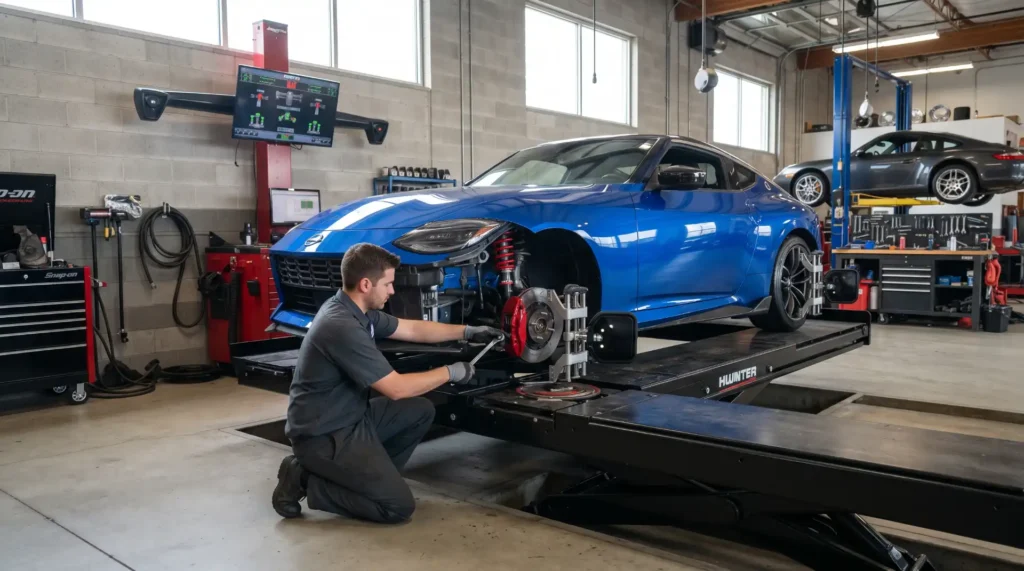 Tires Make a Bigger Difference Than Most Power Mods
Tires influence acceleration, braking, steering response, cornering grip, wet-weather safety, and overall confidence.
That makes them one of the most important choices in a daily driver vs track build.
The mistake is assuming that the stickiest available tire is automatically the correct option.
Extremely aggressive track-oriented tires may provide remarkable dry grip once they reach operating temperature, but they often involve compromises in tread life, standing-water resistance, cold-weather performance, noise, comfort, and cost.
For a car that occasionally attends track days, a high-performance summer tire or suitable extreme-performance street tire may provide an excellent compromise.
Tire Rack notes that drivers attending only one or two track days per year can often continue using a capable performance tire, while dedicated track wheels and tires become increasingly useful as event frequency rises.
This is one reason owning two sets of wheels can be one of the smartest upgrades for an enthusiast who tracks a daily driver regularly.
The street wheel-and-tire package can prioritize rain performance, comfort, reasonable tread life, and ordinary commuting.
The track package can use a more aggressive compound selected specifically for circuit temperatures and driving conditions.
This also prevents expensive track tires from accumulating unnecessary highway miles.
Readers researching that decision can be directed internally to Are 200-Treadwear Tires Still the Best Choice for Street and Track?, which examines the increasingly diverse range of modern 200-treadwear performance tires.
Auto Sport Performance also has a broader How to Choose the Best Performance Tires for Your Car guide that can support readers deciding between summer, ultra-high-performance, all-season, and more track-focused options.
Upgrade the Brakes Before Chasing Big Power
Street braking and track braking are dramatically different.
A hard stop from highway speed lasts only a few seconds. On a racetrack, the brakes may experience repeated high-speed stops every lap for 20 minutes or more.
That generates enormous heat.
A completely stock braking system may feel strong during ordinary driving yet experience brake fade during sustained circuit use.
For many beginner and intermediate track drivers, the first brake upgrades do not need to involve an expensive oversized brake kit.
High-temperature brake fluid and appropriately selected performance pads can make a significant difference.
Brake fluid is especially important because moisture contamination and excessive heat can reduce performance. Track-oriented fluid generally offers a higher boiling point, although some products may require more frequent maintenance.
Pads also need to match how the vehicle is used.
Aggressive track pads can tolerate high temperatures but may produce additional dust, noise, rotor wear, and weaker cold performance. Those characteristics can become frustrating on a daily commuter.
A street/track pad may provide a better compromise for occasional events.
Drivers who become more serious can use separate brake pads for track days, although changing pads frequently adds preparation time and may require consideration of pad and rotor compatibility.
Brake cooling ducts, larger rotors, multi-piston calipers, and complete big-brake kits become more useful as speed, vehicle weight, tire grip, and event frequency increase.
The key is matching brake capacity to the actual thermal demands of the car.
Don’t Destroy Street Performance With Excessive Weight Reduction
Removing weight can improve nearly every area of vehicle performance.
A lighter car generally accelerates more easily, places less demand on its brakes, and requires less tire force during cornering.
But some weight is there because a street car needs to function as a street car.
Removing air conditioning, sound insulation, carpeting, interior panels, speakers, rear seats, and other comfort equipment may reduce mass, but it can also make the vehicle dramatically less enjoyable during long drives.
Removing structural or safety-related components can introduce much more serious concerns and should not be approached casually.
For a dual-purpose vehicle, look for weight reduction that does not significantly reduce everyday usability.
Lighter wheels are a good example because they can reduce unsprung and rotational mass while preserving cabin comfort.
A lighter exhaust system, appropriately designed battery, or other carefully chosen components may also reduce weight without turning the interior into a noisy shell.
Auto Sport Performance’s article Why Weight Reduction Matters More Than Ever in Performance Builds provides an appropriate internal link for readers interested in understanding how vehicle mass affects acceleration, braking, and handling.
The objective should be intelligent weight reduction rather than simply removing everything that is not required to make the engine run.
Engine Tuning Should Preserve Drivability
Peak horsepower is easy to advertise.
Good drivability is more difficult to measure.
For a dual-purpose car, throttle response, cold starts, idle quality, low-speed behavior, heat management, fuel availability, and transmission behavior all matter.
An aggressive calibration that delivers impressive dyno results but produces surging, poor cold operation, inconsistent throttle response, or constant warning lights may make the car worse to live with.
Tuning should therefore match the hardware, fuel, and intended use.
Conservative calibrations with proper data logging are often more appropriate for daily-driven vehicles than calibrations designed purely around maximum output.
Owners should also consider what happens when the manufacturer updates vehicle software. Modern performance cars increasingly rely on interconnected engine, transmission, traction-control, and emissions software.
Auto Sport Performance’s How Over-the-Air Software Updates Can Affect a Tuned Car is a relevant internal resource for owners of newer vehicles.
Fuel availability matters too.
A car built exclusively around a specialty fuel may be inconvenient on road trips or in regions where that fuel is difficult to find.
Flex-fuel setups can provide additional flexibility on some platforms when properly engineered, but readers should understand the entire fuel system and tuning strategy rather than assuming E85 is simply a lower-cost path to more power.
Auto Sport Performance’s existing Flex Fuel (E85) Performance Builds: Is the Power Worth It? article can naturally be linked from this section.
Keep Emissions Compliance in the Build Plan
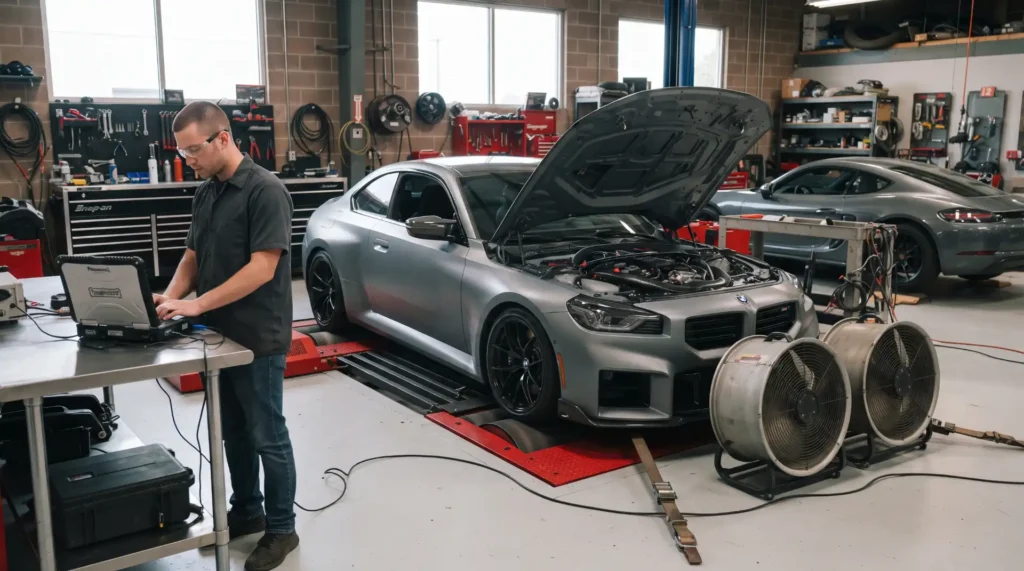 Keep Emissions Compliance in the Build Plan
Performance modifications on street-driven vehicles should also account for federal, state, and local emissions requirements.
This is particularly important when modifying engine software, exhaust systems, catalytic converters, or emissions-related hardware.
The U.S. Environmental Protection Agency states that the Clean Air Act prohibits tampering with required emissions controls and also prohibits the manufacture, sale, or installation of aftermarket devices intended to defeat those systems.
Recent EPA enforcement activity shows that defeat-device enforcement remains relevant to aftermarket performance companies. In 2026, EPA enforcement materials continued addressing hardware and software designed to bypass or render emissions controls inoperative.
For owners building a street-driven performance car, this means a modification should not be assumed legal simply because it can physically be installed or because it is sold online.
Requirements may also vary by state.
California, for example, has additional emissions requirements that can affect aftermarket parts, while inspection rules differ elsewhere in the country.
The safest approach for a street vehicle is to verify whether performance components are designed and approved for the intended application before installation.
Suggested authoritative external resource: U.S. Environmental Protection Agency — information on aftermarket defeat devices and vehicle emissions compliance.
Exhaust Systems: Performance Without Highway Regret
A louder exhaust may seem exciting during a short drive.
After two hours of highway cruising, the same system can become exhausting.
This is another area where dedicated race-car thinking can damage daily usability.
Track cars may use lightweight, minimally restrictive exhaust systems because cabin noise is not a major concern. A commuter benefits from resonators, mufflers, effective sound control, and reduced drone.
For a street/track build, prioritize an exhaust that improves flow where needed while maintaining reasonable cabin sound.
Valved exhaust systems can provide additional flexibility when properly designed and permitted, allowing quieter operation during ordinary driving and a more aggressive sound when appropriate.
Local noise ordinances and state equipment regulations should also be considered.
An exhaust system should enhance the driving experience rather than make every highway trip uncomfortable.
Don’t Replace Every Rubber Bushing With Solid Mounts
Stiffer bushings and mounts can sharpen vehicle response by reducing movement between suspension, drivetrain, and chassis components.
But reducing movement often increases noise, vibration, and harshness.
Solid engine mounts may make shifts feel more precise but transmit substantial vibration into the cabin.
Spherical suspension bearings can improve precision yet introduce noise and require more inspection than factory rubber components.
For a dual-purpose car, selectively upgrading bushings often makes more sense than replacing every compliant component.
Performance-oriented rubber or carefully selected polyurethane components may provide more precise response without creating the harshness of a full competition setup.
The same philosophy applies throughout the car: improve the areas that actually need improvement rather than replacing every factory compromise with the most aggressive aftermarket alternative.
Aerodynamics Need to Work at Both Speeds
Large wings, splitters, diffusers, and other aerodynamic components can generate useful forces at track speeds when they are properly engineered.
However, aerodynamic parts designed mainly for appearance may add drag without providing meaningful balance.
Very low front splitters can also become difficult to use around parking ramps, curbs, steep driveways, and road debris.
For a street/track car, aerodynamic modifications should be functional, securely mounted, and appropriate for the speed range in which the vehicle operates.
Some enthusiasts use removable track-specific aerodynamic components, allowing the car to maintain a more practical configuration during normal driving.
Factory performance packages can also provide a useful reference because automakers often design them to balance cooling, stability, drag, pedestrian requirements, durability, and real-world ground clearance.
Consider a Second Set of Track Components Instead of One Extreme Setup
Trying to create one configuration that is perfect everywhere can lead to unnecessary compromise.
In many cases, interchangeable track components provide a better solution.
A separate wheel-and-tire package is the most obvious example.
Some drivers also change brake pads before events, adjust damping settings, increase tire pressure according to the tire manufacturer’s recommendations, or modify alignment within a practical adjustment range.
This allows the vehicle to remain civilized during commuting while becoming more focused for a track weekend.
Tire Rack similarly notes that dedicated track tires become more logical as drivers participate in more events and begin overheating or excessively wearing their normal performance tires.
Track use also subjects wheels to significantly higher loads and repeated thermal cycles compared with ordinary street driving, making routine inspection particularly important for cars that frequently participate in circuit events.
Interior Modifications Should Protect Daily Usability
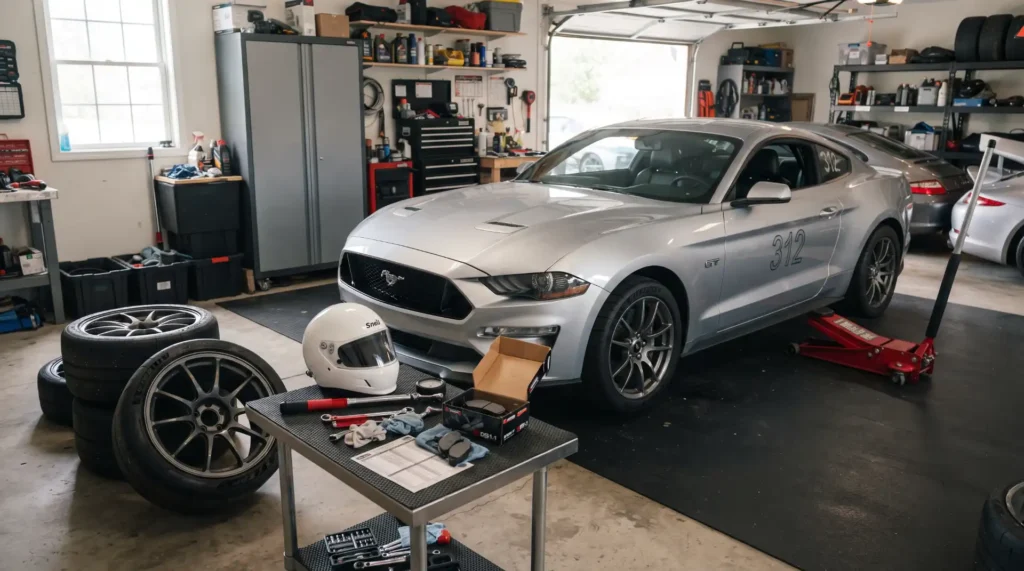 Interior Modifications Should Protect Daily Usability
Race seats, harnesses, roll bars, cages, steering wheels, and other motorsport equipment require especially careful consideration.
Purpose-built competition safety systems are designed to work as complete systems and should not automatically be treated as upgrades for public-road driving.
A vehicle’s factory seats, airbags, seat belts, sensors, and interior components are engineered to function together.
Changing one component can affect how other systems operate.
A full roll cage may be appropriate for a dedicated competition vehicle, but hard metal tubing near an unhelmeted occupant introduces concerns on a street-driven car.
Similarly, racing harnesses should not be installed simply because they look more secure than factory belts.
Drivers entering organized track events should follow the rules established by the sanctioning organization, track, event organizer, and vehicle class.
For many casual track-day drivers, retaining the factory restraint system while using an approved helmet and following event-specific safety rules is the most practical approach unless additional equipment is required.
Track Preparation Matters More Than Many Modifications
A well-maintained, mostly stock performance car can often provide an excellent track-day experience.
Preparation matters more than building the most extreme car in the paddock.
Before an event, inspect tires for damage and adequate tread. Check brake pad thickness, rotor condition, fluid levels, suspension hardware, wheel bearings, hoses, and potential leaks.
Wheel lug hardware should be tightened according to the vehicle or wheel manufacturer’s specifications.
Remove loose items from the cabin and trunk.
After each session, pay attention to tire condition, unusual noises, fluid temperatures, brake behavior, and warning lights.
After the event, inspect the vehicle again before returning to routine use.
Repeated high-temperature operation can accelerate wear in ways that may not be immediately obvious.
The track should expose weaknesses in your maintenance program, not create an excuse to ignore them.
Driver Development Is the Best Performance Modification
There is a point where adding better hardware produces smaller improvements than improving the driver.
A high-performance driving instructor can help drivers understand braking zones, vision, weight transfer, smooth steering inputs, corner entry, throttle application, and vehicle balance.
Those skills transfer between vehicles.
They also help enthusiasts recognize what their car actually needs.
A driver who initially believes the car needs more horsepower may discover that better braking technique produces larger lap-time improvements.
Someone convinced that the suspension is too soft may learn that poor corner entry is creating the sensation of excessive body movement.
A driver who gains consistency can make much more informed modification decisions because the car’s behavior is no longer hidden behind inconsistent inputs.
For beginners, spending money on professional instruction and seat time can therefore provide more useful performance than immediately installing major engine modifications.
The Ideal Dual-Purpose Build
The best daily driver vs track build is usually less extreme than enthusiasts first imagine.
Start with maintenance.
Then improve the tires and brakes.
Address heat management.
Use a sensible alignment.
Upgrade suspension only as necessary, preserving usable travel and ride quality.
Increase power after the chassis, fluids, and cooling systems are prepared to support it.
Choose modifications that can tolerate thousands of street miles, bad pavement, rain, traffic, highway travel, and repeated heat cycles.
Most importantly, avoid modifying the car simply because a part is marketed as “race inspired.”
Race cars operate in a highly controlled environment. Daily drivers do not.
A real street-performance build should start every morning, remain manageable in traffic, survive potholes, handle unexpected rain, pass applicable inspections, and still deliver consistent performance when it reaches the circuit.
Daily Driver vs Track Build: Balance Wins
There will always be a faster setup.
Stickier tires exist. Stiffer springs exist. Larger turbos exist. More aggressive brake pads exist.
But maximum performance in one environment usually creates compromises somewhere else.
For a vehicle that must serve as both transportation and a weekend track car, the goal should be usable performance rather than maximum specification.
A carefully chosen set of tires, high-temperature brake fluid, appropriate pads, modest suspension improvements, proper alignment, reliable cooling, and quality maintenance can create an extremely capable dual-purpose car without sacrificing the qualities that make it enjoyable every day.
As track experience increases, dedicated wheels, adjustable suspension, additional cooling, and specialized components can be added gradually.
That progression is often more effective than building an extreme car before understanding what it actually needs.
A successful daily driver vs track build should make you look forward to both parts of ownership: driving to work on Monday and heading back to the circuit on the weekend.