
Performance exhaust systems remain one of the most popular modifications among American car enthusiasts in 2026.
The appeal is easy to understand.
An exhaust can change how a car sounds every time the engine starts. It can reduce restriction in certain applications, improve the appearance of the rear of the vehicle, reduce weight, and sometimes support additional power when combined with other engine modifications.
But modern exhaust upgrades are more complicated than simply replacing a muffler with a larger pipe.
Today’s vehicles use sophisticated catalytic converters, oxygen sensors, particulate filters, active exhaust valves, turbochargers, ECU monitoring, and tightly integrated emissions-control systems. Changing one portion of the exhaust can affect sound, engine calibration, warning lights, drivability, emissions compliance, and even how the vehicle behaves during normal commuting.
For enthusiasts in the United States, there is another major consideration: federal and state emissions requirements.
The ideal performance exhaust system in 2026 therefore needs to do more than sound aggressive. It should match the vehicle’s engine, intended use, tuning strategy, local regulations, and the owner’s expectations for everyday drivability.
Understanding how the different sections of an exhaust system work is the first step toward making the right choice.
What Does a Performance Exhaust System Actually Do?
An internal-combustion engine creates exhaust gases as fuel burns inside its cylinders. Those gases must move through the exhaust system and eventually exit behind or underneath the vehicle.
A typical modern exhaust system may include exhaust manifolds or headers, turbocharger components on forced-induction vehicles, catalytic converters, oxygen sensors, resonators, mufflers, particulate filters on some models, intermediate pipes, and tailpipes.
Manufacturers design these systems around numerous competing requirements.
They need to control emissions, meet federal and state standards, reduce cabin noise, survive corrosion and vibration, fit within packaging constraints, control production costs, and satisfy millions of drivers with different expectations.
An aftermarket performance exhaust may prioritize different goals.
Larger or smoother tubing can sometimes reduce backpressure. High-quality mandrel bends may improve flow compared with sharply compressed tubing. Different muffler and resonator designs can alter exhaust tone. Lighter materials may reduce weight.
Whether those changes actually produce noticeable power depends heavily on the car.
A factory exhaust that already flows efficiently may offer little additional horsepower from a simple cat-back system. A highly modified turbocharged engine moving substantially more air may benefit much more from increased exhaust capacity.
That distinction is important because exhaust marketing frequently emphasizes maximum possible gains without explaining the conditions required to achieve them.
Cat-Back Exhaust Systems: The Most Common Street Upgrade
For many daily-driven performance cars, a cat-back system is the most straightforward exhaust modification.
As the name suggests, a cat-back generally replaces the exhaust components located behind the catalytic converter.
Depending on the car, this can include the mid-pipe, resonators, mufflers, and exhaust tips.
Because the primary emissions-control hardware often remains untouched, a well-designed cat-back system can provide a relatively simple way to change sound and reduce exhaust restriction without modifying the catalytic converter itself.
The biggest difference most drivers notice is sound rather than horsepower.
A factory exhaust may be deliberately quiet to meet noise targets and appeal to a broad customer base. An aftermarket system can produce a deeper idle, stronger acceleration tone, and more character at higher rpm.
Power gains can occur, especially if the original exhaust becomes restrictive at higher airflow levels, but owners should maintain realistic expectations.
A naturally aspirated street car may gain only modest power from a cat-back exhaust alone.
A turbocharged vehicle with additional modifications may respond differently because reducing exhaust restriction after the turbocharger can sometimes improve overall flow.
The effectiveness of the upgrade depends on pipe diameter, muffler construction, engine output, turbo size, tuning, and the original system.
For most street enthusiasts, the real value of a quality cat-back is the combination of sound, appearance, durability, and modest performance improvement rather than a dramatic horsepower increase.
Axle-Back Exhaust Systems Prioritize Sound
An axle-back system typically replaces only the rear portion of the exhaust, usually the mufflers and exhaust tips.
These systems are popular because they can be less expensive and easier to install than a complete cat-back.
Their primary purpose is normally sound.
Because much of the factory exhaust piping remains in place, airflow changes may be relatively small.
That makes axle-back systems appropriate for drivers who like the factory power level but want the car to sound more aggressive.
A well-designed system can add character without introducing excessive drone.
A poorly designed one can make the vehicle unpleasant during steady highway cruising.
Drivers should therefore evaluate how the exhaust sounds at ordinary engine speeds, not just during full-throttle acceleration.
A car that sounds impressive during a short video may become tiring after two hours at 70 mph.
For a daily driver, sound quality is usually more important than maximum volume.
Headers and Exhaust Manifolds Can Offer Larger Gains
Headers replace or redesign the section of exhaust directly connected to the engine’s cylinder head.
On naturally aspirated engines, properly designed headers can improve exhaust scavenging and potentially increase power across portions of the rpm range.
Tube length, diameter, collector design, firing order, engine displacement, camshaft profile, and tuning all influence how well a header works.
Long-tube headers are often associated with stronger performance potential, particularly on American V8 platforms.
However, installation can be significantly more involved than replacing a rear exhaust section.
Headers may also alter catalytic-converter placement or integrate with emissions-related components, making legality and emissions compliance especially important.
Shorty headers sometimes offer easier installation and may retain more factory-style component placement, though power gains can be more modest.
A header upgrade should therefore be treated as part of the engine’s overall airflow strategy rather than simply as a louder exhaust modification.
 Turbocharged Cars Change the Exhaust Equation
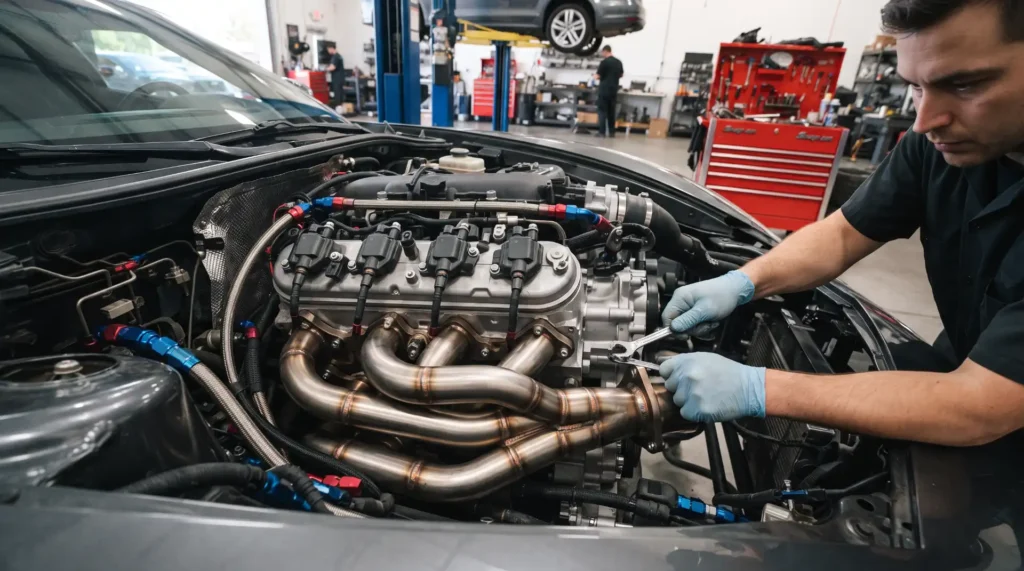 Turbocharged Cars Change the Exhaust Equation
Turbocharged engines have different exhaust requirements from naturally aspirated engines.
Exhaust gas leaving the cylinders spins the turbine wheel inside the turbocharger. After passing through the turbine, the gas travels through the downstream exhaust system.
Restriction after the turbine can influence turbocharger efficiency and overall engine performance.
This is one reason larger downpipes and freer-flowing exhaust systems are common modifications on turbocharged vehicles.
Reducing post-turbo restriction may help the turbo operate more efficiently and can sometimes improve boost response or support higher power levels.
However, the downpipe area frequently contains important emissions components, including catalytic converters and oxygen sensors.
That means modifications in this area deserve much more scrutiny than a simple rear muffler change.
Changing catalytic-converter configuration or installing software designed to suppress emissions-related diagnostic codes can create federal emissions-compliance problems.
Modern ECUs closely monitor catalyst efficiency and sensor readings.
A modification that disrupts those readings may trigger a check-engine light or require calibration changes.
That is why turbo exhaust modifications should be considered together with tuning, emissions compliance, heat management, and the intended use of the vehicle.
Does Bigger Exhaust Tubing Always Make More Power?
No.
One of the oldest performance myths is that the largest possible exhaust diameter automatically produces the most horsepower.
Exhaust sizing needs to match the engine’s airflow requirements.
A very small pipe can create excessive restriction at high output levels.
But an unnecessarily large system may reduce exhaust-gas velocity and can change how the engine responds, particularly on naturally aspirated applications.
The correct diameter depends on engine displacement, horsepower, forced induction, rpm range, number of exhaust pipes, and the rest of the system design.
A mildly modified four-cylinder engine does not necessarily need the same pipe diameter as a supercharged V8 making several times the horsepower.
This is where complete, vehicle-specific exhaust systems often have an advantage over randomly assembled universal parts.
Reputable manufacturers generally size pipes, resonators, mufflers, and junctions around specific vehicle applications.
Enthusiasts planning major engine modifications may need a more customized approach.
The important principle is simple: maximize useful flow without assuming that more diameter is always better.
Exhaust Tone Is About More Than Volume
A good performance exhaust is not necessarily the loudest exhaust.
Tone matters.
Frequency matters.
Resonance matters.
Cabin comfort matters.
Two systems producing similar exterior decibel levels can sound completely different from inside the car.
Muffler design plays a major role.
Straight-through mufflers typically use perforated tubing surrounded by sound-absorbing material. Chambered mufflers manipulate sound waves through internal passages and chambers. Some systems combine multiple strategies.
Resonators are also important.
A resonator can target specific sound frequencies, reducing unpleasant buzzing or drone while allowing the exhaust to remain aggressive under acceleration.
Removing a resonator may make a system louder, but louder does not automatically mean better.
The result can be rasp, metallic resonance, or constant low-frequency cabin noise.
For a street-driven vehicle, the best setup usually provides different personalities depending on engine load.
It should remain reasonably subdued at idle and highway cruise while producing a stronger tone during acceleration.
Active-Valve Exhaust Systems Are Increasingly Popular
Many modern performance cars now use factory active exhaust valves.
These systems electronically open or close valves inside the exhaust depending on drive mode, engine speed, throttle position, or driver selection.
The concept allows manufacturers to combine quieter cruising with a more aggressive sound during performance driving.
Aftermarket active-valve exhaust systems apply the same idea.
A driver may select a quieter setting for early morning starts, residential areas, or highway travel and a more aggressive setting for spirited driving or closed-course use.
When integrated correctly, this can make a dual-purpose vehicle far easier to live with.
However, quality varies significantly.
Valve motors, wiring, controllers, heat resistance, and mechanical durability all matter.
A cheap valve assembly exposed to exhaust heat, moisture, and road debris may eventually stick or fail.
Owners should also remember that an electronically adjustable exhaust does not override state or local noise laws.
A loud mode that is available through a button is not automatically legal to use everywhere.
Drone Can Ruin an Otherwise Great Exhaust
Exhaust drone is a low-frequency resonance that often occurs at a narrow engine-speed range.
It is especially noticeable during steady highway driving.
A system may sound excellent during acceleration yet produce an exhausting hum while cruising.
Drone depends on numerous variables, including pipe length, muffler design, vehicle cabin structure, gearing, engine configuration, and cruising rpm.
This makes it difficult to judge an exhaust only from an exterior recording.
For a daily-driven car, owners should research how a system behaves around typical highway speeds.
Some manufacturers use Helmholtz resonators or other acoustic techniques to cancel specific frequencies.
Others use larger resonators or active valves.
For drivers who spend substantial time commuting, these features may matter more than an additional one or two horsepower.
Stainless Steel, Titanium, and Other Exhaust Materials
Material selection affects weight, durability, appearance, cost, and sound.
Stainless steel remains one of the most common choices for quality street exhaust systems.
Grades such as 304 stainless steel provide excellent corrosion resistance and can last for many years in environments where vehicles encounter rain, road salt, and temperature cycling.
Less expensive systems may use lower-grade stainless materials or aluminized steel.
These can still perform well but may not offer the same long-term corrosion resistance.
Titanium is significantly lighter than stainless steel and is frequently associated with premium motorsport applications.
It also produces a distinctive appearance and sound.
However, titanium systems are expensive and may provide little practical benefit for a normal commuter beyond weight reduction and aesthetics.
For a daily driver, stainless steel often offers the best balance between price, durability, and performance.
For a dedicated high-end build where every pound matters, titanium can make more sense.
Will a Performance Exhaust Increase Horsepower?
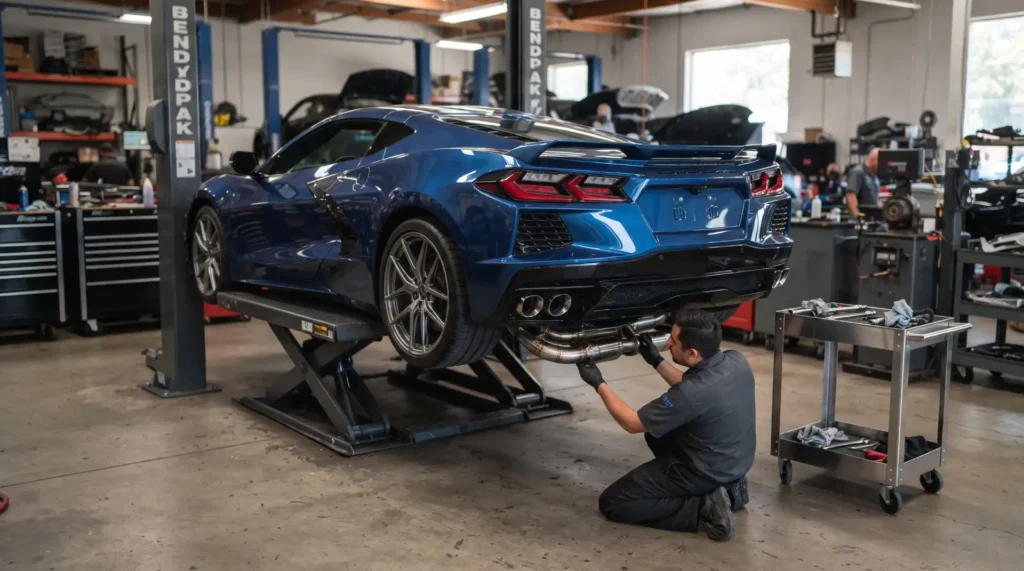 Will a Performance Exhaust Increase Horsepower?
Sometimes, but expectations should be realistic.
A modern vehicle’s factory exhaust may already flow efficiently at stock horsepower levels.
Replacing the rear section may therefore produce only a small measurable gain.
The improvement may become more significant when the car has other airflow modifications or higher engine output.
Forced-induction vehicles often respond more noticeably once exhaust flow becomes a limiting factor.
Naturally aspirated engines may benefit from properly matched headers, exhaust diameter, collectors, and tuning.
But an exhaust should not be evaluated based solely on peak dyno horsepower.
Throttle response, torque delivery, weight reduction, sound, turbo response, and heat management can all contribute to the way a vehicle feels.
This is also why dyno testing matters.
An advertisement claiming a certain horsepower increase does not mean every vehicle will achieve that result.
Temperature, fuel quality, drivetrain type, dyno configuration, ECU adaptation, vehicle condition, and testing method all affect measured output.
Auto Sport Performance readers interested in this subject can also explore your existing article covering dyno tuning versus street tuning, which can provide additional context for understanding how performance changes are measured.
Do You Need an ECU Tune After Installing an Exhaust?
It depends on which components were changed.
A basic cat-back or axle-back system usually does not require ECU calibration on most modern vehicles because it does not significantly alter the sensors or emissions equipment monitored by the ECU.
Headers, downpipes, turbocharger upgrades, major intake modifications, and other changes can be different.
These modifications may alter airflow enough that recalibration becomes useful or necessary.
Modern engines rely on electronic control strategies for ignition timing, fuel delivery, boost pressure, throttle response, torque management, and emissions monitoring.
A proper tune can help the engine take advantage of supporting modifications while maintaining safe operating parameters.
However, calibration should never be treated as a way to simply suppress emissions-related faults caused by removed or disabled emissions components.
EPA continues to state that Clean Air Act provisions prohibit tampering with emissions controls and prohibit the manufacture, sale, or installation of aftermarket defeat devices.
This distinction is important in 2026 because legal performance tuning and emissions defeat are not the same thing.
U.S. Federal Emissions Rules Still Matter in 2026
The performance aftermarket entered an important regulatory period in 2026.
On July 1, 2026, EPA announced that it had recognized SEMA’s Certified Emissions, or SC-E, program as an alternative certification authority for aftermarket vehicle products.
According to EPA, testing performed through the SC-E program can demonstrate that qualifying aftermarket parts meet federal Clean Air Act requirements and do not negatively affect vehicle emissions.
This development can make it easier for aftermarket manufacturers to demonstrate federal compliance.
It does not mean that any performance exhaust modification is automatically legal.
EPA’s current guidance still states that aftermarket parts cannot bypass, tamper with, remove, or render vehicle emissions controls inoperative.
That distinction matters especially with catalytic converters, oxygen sensors, diesel particulate filters, selective catalytic reduction systems, and ECU calibrations that influence emissions operation.
EPA enforcement materials also continue to identify straight pipes and tuning software that enables the removal of filters or catalysts as examples of products that can violate Clean Air Act requirements.
For an enthusiast building a street-driven vehicle, the practical approach is to purchase parts specifically designed for compliant street use and verify the manufacturer’s documentation.
Authoritative external resource: U.S. Environmental Protection Agency — National Enforcement and Compliance Initiative covering aftermarket defeat devices and vehicle emissions compliance.
California Drivers Face Additional Requirements
Federal compliance is only part of the regulatory picture.
States can also impose emissions and equipment requirements.
California is particularly important because of its extensive vehicle-emissions program and its influence on aftermarket product development.
California enthusiasts frequently encounter CARB Executive Order, or EO, numbers when shopping for emissions-related performance parts.
An EO generally identifies an aftermarket part that CARB has evaluated for use on specific vehicle applications under its emissions requirements.
A part approved for one model, engine, or model-year range should not automatically be assumed approved for every vehicle.
Drivers should check current product documentation and applicable state requirements before installation.
This is especially relevant for headers, downpipes, intake systems, forced-induction packages, tuning devices, and other modifications that can influence emissions.
A rear exhaust system installed after the emissions-control equipment may raise fewer emissions concerns, but local sound laws can still apply.
Exhaust Noise Laws Vary Across the United States
Emissions legality and noise legality are separate issues.
An exhaust may retain all required emissions equipment yet still violate a state or local sound rule.
Noise laws vary considerably across the country.
Some jurisdictions use specific decibel limits.
Others prohibit modified exhaust systems that are excessively loud.
Enforcement practices can also vary by city, county, and state.
This makes universal statements about exhaust legality unreliable.
Drivers should check current rules where the vehicle is registered and driven.
California’s exhaust-noise rules are well known among enthusiasts, but California is not the only state regulating excessive vehicle noise.
Neighborhood ordinances and track-specific sound limits can create additional restrictions.
Race tracks themselves may impose noise limits because of nearby residential communities.
That means an extremely loud exhaust is not necessarily ideal even for a car that spends substantial time at track events.
Catalytic Converters Are a Critical Legal Boundary
Catalytic converters reduce harmful exhaust pollutants through chemical reactions within the catalyst material.
Modern vehicles may use multiple converters positioned close to the engine and farther downstream.
Because catalytic converters create some exhaust restriction, they are sometimes targeted in performance builds.
However, removing or disabling required catalytic converters on a street-operated vehicle creates serious emissions concerns.
EPA’s enforcement program specifically identifies catalysts among the critical emissions-control components affected by illegal defeat devices and tampering.
Performance enthusiasts should therefore distinguish between compliant high-flow replacement components and products intended to bypass emissions controls.
A properly engineered aftermarket catalytic converter or certified exhaust component can support a performance build while preserving emissions functionality.
A straight pipe replacing required emissions hardware is fundamentally different.
The fact that a part is sold online does not prove that it is lawful for highway use.
Track-Only Exhaust Systems Need Clear Boundaries
Dedicated race vehicles operate under different circumstances from ordinary street vehicles.
A vehicle that is genuinely used only in sanctioned competition may use components that would be inappropriate for public-road operation.
The problem begins when “track use only” parts are installed on vehicles that continue to operate on public highways.
Owners should not assume a racing label automatically creates an emissions exemption for a street-driven car.
EPA’s enforcement efforts have repeatedly focused on products designed to bypass required vehicle emissions controls.
For a dual-purpose street and track car, retaining compliant emissions equipment is generally the more practical route.
It allows the owner to drive to events, use the vehicle normally, and avoid building the entire exhaust configuration around parts that may create inspection or enforcement problems.
Exhaust Heat Management Matters
Exhaust gases carry substantial heat.
Performance modifications can increase exhaust temperature or relocate heat closer to sensitive components.
Headers and turbocharger downpipes may sit near wiring, brake lines, steering components, engine mounts, or body panels.
Heat shielding therefore deserves consideration.
Factory manufacturers spend significant effort managing heat through shields, insulation, airflow, and component placement.
Removing those protections without understanding their purpose can create problems.
High-quality thermal shielding, proper clearance, and thoughtful routing can protect nearby systems.
Enthusiasts should be cautious with exhaust wraps on street vehicles because trapped moisture or extreme localized heat can affect certain materials over time.
The best solution depends on exhaust material, component location, engine configuration, and vehicle use.
Heat management becomes particularly important on turbocharged track cars where sustained engine load can keep the exhaust extremely hot for long periods.
Should You Choose a Loud or Quiet Performance Exhaust?
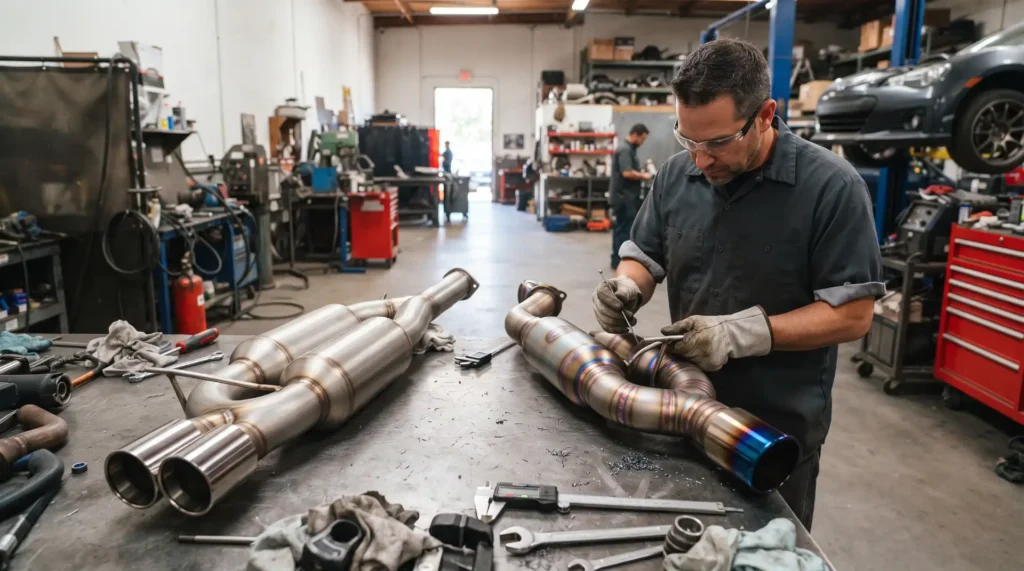 Should You Choose a Loud or Quiet Performance Exhaust?
The answer depends on how the car is used.
A weekend-only performance vehicle can tolerate more noise than a commuter.
A highway-driven grand touring car benefits from stronger sound control.
A vehicle regularly used at tracks with strict sound restrictions may need a surprisingly quiet system.
An owner living in a dense neighborhood may want active valves or high-quality resonators.
It is worth thinking about the least exciting moments of ownership before buying an exhaust.
Imagine starting the car at 6 a.m.
Imagine driving three hours on the interstate.
Imagine talking to a passenger at highway speed.
Imagine the engine sitting at exactly the rpm where the exhaust drones.
If the system still sounds appealing in those situations, it is probably a better fit for a street vehicle.
How to Choose the Right Performance Exhaust in 2026
Start with your objective.
If sound is the main goal, an axle-back or cat-back may be enough.
If you are supporting significantly higher horsepower, pipe diameter and overall flow capacity become more important.
If you own a turbocharged vehicle, downpipe design may affect performance more than the rear mufflers, but emissions requirements become more important as you move closer to the catalytic-converter system.
If weight reduction matters, material selection deserves attention.
If the car is driven every day, drone and cabin comfort should remain high priorities.
The best system should fit correctly without exhaust leaks, rattles, hanging too low, or contacting the chassis.
Quality welds, properly located hangers, durable hardware, and good corrosion resistance often matter more over several years of ownership than an impressive exhaust-tip design.
Performance Exhaust Systems Are About Balance
Performance exhaust systems remain one of the most satisfying modifications because drivers can experience the change every time they use the car.
But successful exhaust modification in 2026 requires more thought than simply making the vehicle louder.
A well-matched system can improve sound, reduce unnecessary restriction, support future engine modifications, lower weight, and enhance the personality of the vehicle.
A poorly chosen system may create drone, check-engine lights, excessive noise, reduced drivability, or emissions-compliance problems.
Modern performance vehicles are highly integrated machines.
The exhaust interacts with engine calibration, turbocharger behavior, oxygen sensors, catalytic converters, noise-control systems, and electronic diagnostics.
For U.S. enthusiasts, federal emissions rules and state-specific regulations add another layer to the decision.
EPA’s 2026 recognition of SEMA’s Certified Emissions program gives aftermarket companies another way to demonstrate federal compliance, but the fundamental Clean Air Act prohibition against bypassing or disabling emissions controls remains in place.
That makes the smartest approach relatively straightforward.
Choose a system designed for your exact vehicle and performance goals. Preserve required emissions controls on street-driven cars. Consider how the exhaust will behave during ordinary commuting, not just full-throttle acceleration. Match pipe size and component design to actual airflow requirements. Use professional installation when fabrication or emissions-sensitive components are involved.
The result should be a car that sounds better, performs as intended, remains enjoyable to drive, and avoids turning a simple performance upgrade into an unnecessary regulatory or mechanical problem.