
Why Engine Oil Can Reveal More Than You Think
Performance cars are engineered to deliver power, acceleration, responsiveness, and precision. Whether someone owns a turbocharged sports coupe, a modified muscle car, a supercharged V8, or a high-revving European performance sedan, keeping the engine healthy is essential to maintaining the driving experience. While many owners focus on horsepower figures, exhaust upgrades, turbocharger performance, and ECU tuning, one of the most valuable ways to monitor engine condition receives considerably less attention: laboratory engine oil analysis.
Engine oil does much more than lubricate moving components. It helps manage heat, reduces friction, carries away microscopic contaminants, protects metal surfaces from corrosion, and supports the operation of critical engine components. As oil circulates through an engine, it collects microscopic evidence of what is happening inside. Small quantities of metals, combustion byproducts, coolant, fuel, dirt, and other contaminants can enter the lubricant during normal operation or because a developing mechanical problem is present.
Engine oil analysis for performance cars uses laboratory testing to examine these substances and measure important properties of used lubricant. Instead of relying exclusively on dashboard warnings, unusual engine noises, or visible oil discoloration, owners can obtain a detailed report showing whether the lubricant is degrading, whether abnormal wear may be occurring, and whether contamination deserves further investigation.
This information is particularly useful for performance vehicles because their engines can experience demanding operating conditions. High engine speeds, elevated temperatures, turbocharger heat, aggressive acceleration, track sessions, and aftermarket modifications can place additional demands on lubrication systems. A car that operates perfectly during ordinary commuting may experience very different stresses during repeated high-load driving.
Used oil testing cannot predict every mechanical failure or guarantee that an engine will last longer. However, when performed consistently and interpreted correctly, it can provide an additional layer of preventive maintenance. It helps owners identify developing concerns, investigate mechanical symptoms, evaluate oil condition, and make more informed maintenance decisions.
For performance-car enthusiasts who want to protect an expensive engine, understanding laboratory oil testing is an important part of responsible ownership.
What Is Engine Oil Analysis?
Engine oil analysis is a laboratory procedure that evaluates the physical and chemical condition of used engine oil. The testing process identifies selected metals, contaminants, chemical changes, and lubricant properties that may reveal information about engine operation.
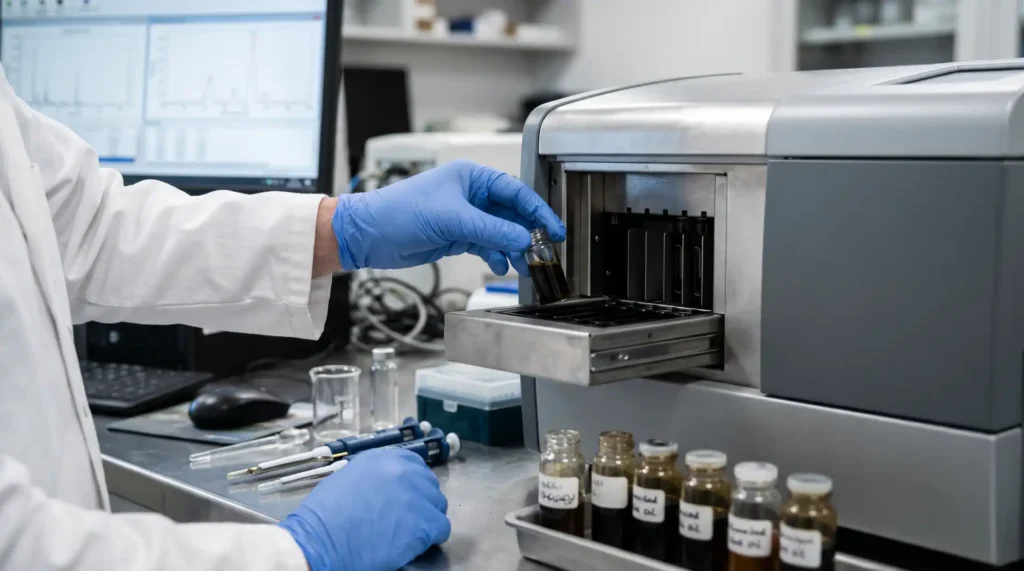
A sample of used oil is collected from the vehicle and sent to a specialized laboratory. Technicians use analytical instruments and established testing methods to measure different characteristics of the lubricant. Depending on the testing package, the final report may include viscosity, wear metals, fuel dilution, water contamination, coolant indicators, oxidation, nitration, and other measurements.
The laboratory compares these findings with established guidelines, lubricant specifications, and sometimes previous results from the same engine. The purpose is not simply to determine whether the oil is dirty. It is to understand whether the oil is still performing appropriately and whether the substances found inside it suggest a possible mechanical problem.
How Oil Becomes a Record of Engine Operation
During normal engine operation, oil moves through bearings, cylinder walls, camshafts, crankshafts, timing components, turbocharger bearings, and other lubricated surfaces. A thin protective film separates moving metal components and reduces direct contact.
Despite this protection, microscopic material can enter the oil through normal wear. Small amounts of iron, aluminum, copper, chromium, and other elements may appear in laboratory results. Their significance depends on the engine design, lubricant formulation, operating conditions, oil mileage, and previous test results.
Contaminants can also enter through combustion processes, damaged seals, coolant leaks, poor filtration, or improper maintenance. Fuel may reach the crankcase, moisture may accumulate, and fine dirt particles may enter through an intake or ventilation problem.
Because engine oil continuously circulates through the lubrication system, a properly collected sample can provide useful information about these conditions.
For example, a turbocharged performance car that regularly experiences high exhaust temperatures might show changes in oil oxidation over time. Another vehicle might show increasing iron levels after repeated track sessions. A third might have reduced viscosity because gasoline is entering the crankcase.
These findings do not automatically identify a failed component, but they provide reasons to investigate further.
 Why Performance Cars Benefit From Laboratory Oil Testing
 Why Performance Cars Benefit From Laboratory Oil Testing
Ordinary maintenance schedules are designed around expected operating conditions, manufacturer recommendations, and vehicle-specific requirements. They remain important, but they cannot always account for every modification or driving pattern.
A performance vehicle driven gently on highways experiences different conditions from the same vehicle used for weekend autocross events or repeated track sessions.
High Engine Temperatures and Increased Lubrication Demands
Performance engines frequently operate at higher loads than ordinary passenger-car engines. Turbocharged and supercharged vehicles can generate substantial heat, particularly during extended acceleration or high-speed driving.
Engine oil must maintain an appropriate protective film while exposed to elevated temperatures. Excessive heat can accelerate oxidation, change lubricant viscosity, and reduce the oil’s ability to protect critical components.
Oil analysis can help identify some of these changes. Testing viscosity and oxidation indicators may reveal that the lubricant is experiencing greater thermal stress than expected.
This is especially relevant for vehicles used in hot-weather environments such as Arizona, Nevada, Texas, Southern California, and other regions where high ambient temperatures can add to an engine’s cooling demands.
High RPM and Repeated Acceleration
High-revving engines place demanding conditions on crankshaft bearings, connecting rods, camshaft components, and other moving parts. Although properly engineered engines are designed to operate within their specified limits, repeated high-RPM use increases the importance of maintaining suitable lubrication.
Laboratory analysis can identify changes in selected wear-metal concentrations. A consistent increase in iron, copper, aluminum, or other elements may indicate a developing wear pattern.
The most useful information often comes from comparing several samples rather than interpreting one isolated result.
For example, if a vehicle consistently produces relatively stable iron readings over several oil changes and then shows a substantial increase under similar sampling conditions, the change deserves attention.
Turbocharger and Supercharger Applications
Forced-induction engines create additional lubrication challenges. Turbochargers can operate at extremely high rotational speeds and temperatures. Their bearing systems depend on an appropriate oil supply and effective heat management.
If oil quality deteriorates, contamination increases, or the lubrication system develops a problem, turbocharger components may be affected.
Oil analysis can help identify changes associated with heat exposure, contamination, or abnormal wear. It cannot independently confirm turbocharger bearing failure, but laboratory findings can support further inspection.
Supercharged engines also benefit from careful lubrication monitoring, especially when aftermarket modifications increase power output and operating temperatures.
Modified Engines and Aftermarket Upgrades
Aftermarket modifications can change how an engine operates. ECU tuning, larger turbochargers, higher boost pressure, upgraded fuel systems, internal engine modifications, and track-oriented setups may affect thermal loads and maintenance requirements.
An owner who increases engine output should not automatically assume that the original factory oil-change interval remains appropriate under the new operating conditions.
Laboratory testing can help establish a maintenance baseline after modifications. It can also provide information about how a particular lubricant performs under the vehicle’s actual operating conditions.
Owners interested in understanding how modifications affect overall vehicle behavior can also read Auto Sport Performance’s article, Top 5 Signs Your Car Needs Performance Tuning (And Why It Matters).
What Does a Laboratory Test Actually Measure?
An engine oil analysis report can contain several different measurements. Understanding these measurements makes it easier to interpret laboratory findings and recognize when additional investigation may be necessary.
Not every laboratory offers the same testing package. Basic services may concentrate on viscosity and elemental analysis, while more comprehensive programs include additional contamination and lubricant-condition measurements.
1. Wear Metals
Wear-metal analysis is one of the most recognized parts of used engine oil testing.
Laboratories commonly use inductively coupled plasma atomic emission spectroscopy, often abbreviated as ICP-AES or ICP, to identify and measure selected elements in oil.
The results are usually expressed in parts per million, or ppm. One ppm represents one part of a substance per million parts of the sample.
Commonly measured elements include iron, aluminum, copper, chromium, lead, tin, nickel, and other metals.
Different metals may be associated with different engine components, although their origins are not always straightforward.
Iron: Iron can originate from cylinder walls, crankshafts, camshafts, timing components, gears, and other ferrous metal surfaces. An increase may suggest abnormal wear, but it must be evaluated in the context of engine design and oil service history.
Aluminum: Aluminum may come from pistons, engine housings, cylinder heads, or other aluminum components. Elevated levels can justify additional investigation, particularly when accompanied by other unusual findings.
Copper: Copper can originate from bearings, bushings, oil coolers, and other components. Some new or recently serviced components may release small quantities during initial operation.
Lead and tin: These elements may be associated with certain bearing materials and other engine components. Their presence and concentration require interpretation based on the engine’s construction.
Chromium: Chromium may be associated with certain piston rings, plated surfaces, and other components. An unusual increase can indicate a need for further diagnosis.
The important point is that a single metal reading rarely identifies one specific failed part. Laboratory analysis provides clues rather than a complete mechanical inspection.
2. Oil Viscosity
Viscosity describes an oil’s resistance to flow. It is one of the most important characteristics of engine lubricant because it affects how oil moves through passages and maintains protective films between moving components.
Automotive engine oils are classified using the SAE viscosity system. Common grades include 0W-20, 5W-30, 5W-40, and 10W-60.
The first number and the W designation relate to low-temperature performance, while the second number describes viscosity at higher operating temperatures under standardized testing conditions.
During use, oil viscosity can change.
It may decrease because of fuel dilution or mechanical shearing. It may increase because of oxidation, contamination, or other degradation processes.
A laboratory measuring viscosity can identify whether the used lubricant has moved significantly away from the expected range.
For example, a turbocharged gasoline engine that experiences repeated fuel-rich operation may develop fuel dilution. Gasoline entering the crankcase can reduce oil viscosity, weakening the lubricant’s ability to maintain an appropriate protective film.
On the other hand, an oil sample with unusually high viscosity may suggest oxidation, contamination, or another condition requiring investigation.
Viscosity results should always be compared with the correct fresh-oil specification and the manufacturer’s requirements.
3. Fuel Dilution
Fuel dilution occurs when gasoline or diesel fuel enters the engine oil.
In gasoline engines, this can happen during repeated short trips, cold starts, incomplete combustion, certain direct-injection operating conditions, injector problems, or other fueling-related issues.
Performance engines may be particularly sensitive to fuel dilution because aggressive driving and specialized engine calibrations can create demanding operating conditions.
When fuel mixes with engine oil, it can reduce viscosity and weaken lubrication protection.
High fuel dilution may also contribute to increased wear, deposits, and other problems.
A laboratory can measure fuel dilution using methods such as infrared analysis or gas chromatography, depending on the testing service.
If the report identifies an elevated fuel concentration, the next step is to investigate the cause rather than simply changing the oil and ignoring the problem.
Potential causes include leaking fuel injectors, excessive enrichment, repeated cold operation, or engine-management problems.
4. Coolant and Water Contamination
Coolant contamination is a serious finding because engine oil is not designed to function as a mixture of lubricant and cooling-system fluid.
Coolant may enter the lubrication system through a damaged head gasket, cracked cylinder head, damaged engine block, oil cooler failure, or another internal leak.
Laboratory testing may look for water, glycol, sodium, potassium, boron, and other indicators depending on the coolant formulation and laboratory methods.
Water contamination can also occur through condensation, particularly when a vehicle is driven on repeated short trips without reaching and maintaining sufficient operating temperature.
The distinction matters because condensation and a major coolant leak require very different responses.
An oil sample containing confirmed glycol contamination should not be treated as an ordinary maintenance issue. The vehicle needs prompt mechanical evaluation.
5. Oxidation and Nitration
Oxidation occurs when oil reacts with oxygen under operating conditions. Heat, extended service, and other factors can accelerate this process.
As oxidation progresses, the lubricant may become thicker and contribute to deposits or sludge formation.
Nitration involves reactions between nitrogen-containing combustion products and lubricant. It can be influenced by combustion conditions, engine design, and operating temperature.
Laboratories may use Fourier-transform infrared spectroscopy, commonly called FTIR, to evaluate oxidation and nitration indicators.
These measurements help determine whether the oil is experiencing excessive degradation.
They are particularly relevant for vehicles subjected to repeated high-temperature operation, extended idling, and demanding driving conditions.
6. Silicon and Dirt Contamination
Silicon is commonly measured during used oil analysis because it can indicate dirt or other contamination.
Silicon may enter an engine through an improperly sealed intake system, damaged air filter, leaking intake connection, or contaminated maintenance equipment.
However, silicon can also originate from sealants and certain lubricant additives. Therefore, its presence does not automatically prove that dust is entering the engine.
When elevated silicon appears alongside increasing wear metals, the results may justify inspection of the air intake and filtration system.
For performance cars frequently driven on dusty roads, racetracks, or in desert environments, intake-system condition deserves particular attention.
How Laboratory Oil Testing Detects Early Engine Wear
One of the most valuable benefits of engine oil analysis is its ability to identify certain changes before they become obvious during everyday driving.
An engine may continue to run smoothly even while wear is developing internally. Dashboard warning systems do not directly measure every lubrication-related condition.
Oil testing provides another source of information.
Identifying Changes Before Mechanical Symptoms Appear
A developing bearing problem, abnormal cylinder wear, or contamination issue may not immediately produce an obvious noise or dashboard warning.
A laboratory report can reveal changes in wear-metal concentrations or lubricant condition that justify further investigation.
For example, consider a modified V8 performance car that has completed several months of normal street driving.
Its first oil analysis shows a relatively stable concentration of iron and copper. The second sample, collected after a similar mileage interval, shows a significant increase in both elements.
The owner should not immediately assume that the engine has suffered bearing failure. However, the change provides a reason to investigate oil pressure, filtration, operating temperatures, and possible mechanical wear.
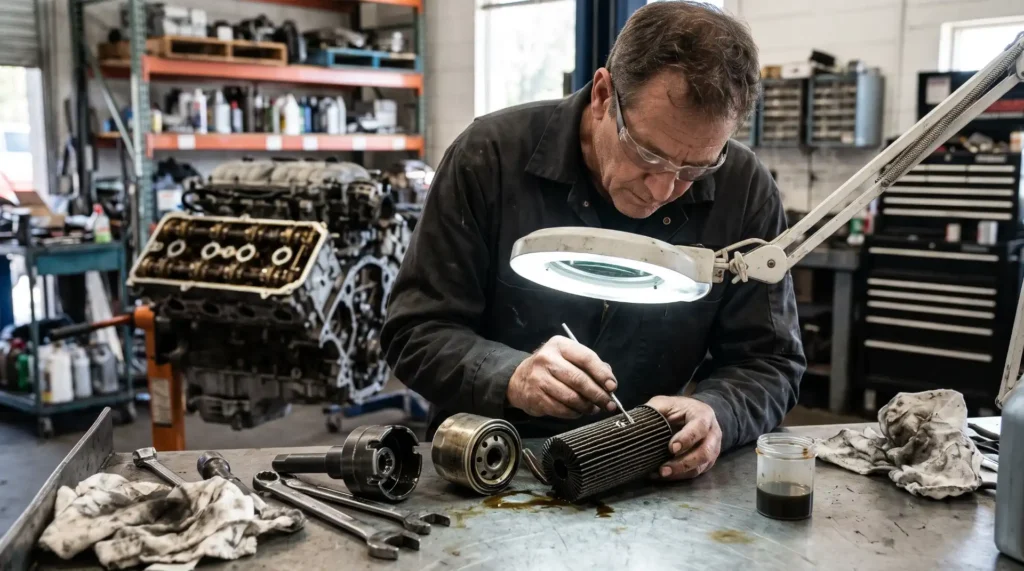
A technician may also inspect the oil filter for metallic debris and perform additional diagnostic procedures.
The earlier a developing problem is investigated, the more opportunities may exist to prevent further damage.
Detecting Abnormal Wear Trends
Trend analysis is generally more informative than relying on a single oil sample.
An isolated result can be influenced by sample collection, oil mileage, engine operating conditions, recent repairs, and lubricant formulation.
Repeated testing under reasonably consistent conditions creates a history that can help identify meaningful changes.
For example, a performance car might produce the following simplified iron measurements:
| Sample | Oil Mileage | Iron |
|---|---|---|
| First | 3,000 miles | 18 ppm |
| Second | 3,000 miles | 20 ppm |
| Third | 3,000 miles | 19 ppm |
| Fourth | 3,000 miles | 48 ppm |
These figures are illustrative, not universal diagnostic limits. Different engines and laboratories can produce different results.
However, the sudden increase in the fourth sample deserves attention, particularly if the vehicle’s operating conditions and sampling procedure have remained similar.
A technician should investigate the change rather than automatically concluding that a specific component has failed.
Understanding the Limitations of Wear-Metal Testing
Standard ICP analysis does not detect every particle equally well. It is particularly useful for relatively small suspended particles, but larger wear debris may not be represented accurately.
This limitation is important because serious mechanical damage can sometimes generate larger particles.
More advanced services may use particle counting, ferrous-density testing, analytical ferrography, or other specialized methods to examine wear debris.
If an engine has developed a knocking sound, sudden oil-pressure loss, or significant metallic debris in the oil filter, a normal-looking laboratory report should not be used to dismiss the problem.
Oil analysis is one diagnostic tool, not a substitute for mechanical inspection.
Understanding the Most Important Findings in an Oil Analysis Report
A laboratory report can appear complicated because it contains measurements, reference ranges, warning indicators, and technical abbreviations.
The best approach is to evaluate the report as a whole.
High Iron Levels
High iron concentrations may indicate increased wear involving ferrous engine components.
Possible sources include cylinder walls, crankshaft surfaces, camshafts, timing components, and other internal parts.
However, iron can also increase because of longer oil service intervals, recent engine work, break-in conditions, or differences in sampling.
A significant increase compared with previous results is generally more useful than an isolated number.
Elevated Copper Levels
Copper may be associated with bearing materials, bushings, oil coolers, and other components.
A recently installed oil cooler or rebuilt engine may produce different results from an established engine.
If copper levels rise unexpectedly, the technician should consider recent maintenance, component materials, oil history, and other supporting measurements.
Reduced Viscosity
A reduction in viscosity may indicate fuel dilution, lubricant shearing, or contamination with another fluid.
For a high-performance engine, this deserves attention because the lubricant must maintain an appropriate protective film under demanding operating conditions.
If fuel dilution is suspected, testing and inspection should identify why fuel is entering the crankcase.
Increased Oxidation
Higher oxidation readings can suggest that oil has experienced excessive thermal stress or extended service.
The correct response depends on the vehicle’s operating history, lubricant formulation, and laboratory reference information.
Changing the oil may address the lubricant condition, but it does not necessarily resolve the underlying source of excessive heat.
Coolant Indicators
A positive glycol finding or an unusual combination of coolant-related elements can indicate contamination.
This is one of the findings that should prompt immediate attention.
Continuing to operate an engine with significant coolant contamination can accelerate corrosion, sludge formation, bearing damage, and other failures.
How to Collect an Accurate Oil Sample
Even advanced laboratory equipment cannot compensate for a poorly collected sample.
The collection process matters because contamination, incorrect labeling, and inconsistent sampling can affect results.
Collect Oil at the Correct Time
Many vehicle owners collect a used-oil sample during a scheduled oil change.
The engine should generally be operated sufficiently to circulate the lubricant and bring it to normal operating temperature, following the laboratory’s collection instructions.
Warm oil is easier to collect and may provide a more representative sample than oil that has been sitting undisturbed for an extended period.
However, safety must come first. Hot oil and engine components can cause serious burns.
Always use appropriate protective equipment and follow the laboratory’s specific instructions.
Use a Clean Collection Container
Oil analysis laboratories typically provide sample bottles and collection kits.
These containers should be used rather than household jars, old lubricant bottles, or containers that may contain dirt, cleaning chemicals, or other fluids.
Even a small amount of contamination can affect the results.
The sample should be collected directly into the clean container without touching the inside of the bottle or cap.
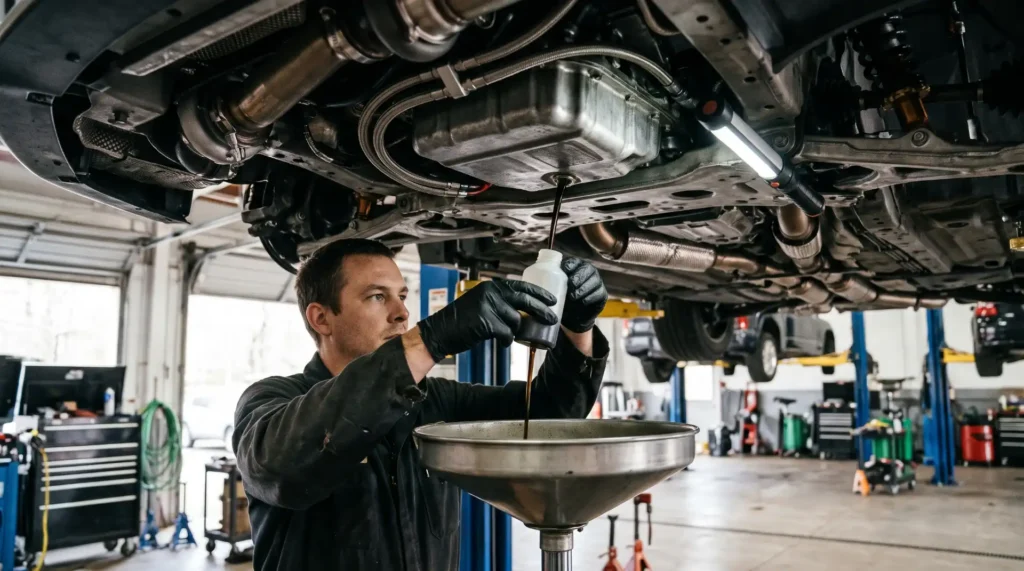
Avoid Sampling From the First Oil Draining From the Pan
When collecting a sample during an oil change, the first oil flowing from the drain plug may contain accumulated debris from the bottom of the oil pan.
Some laboratories recommend collecting a sample from the middle portion of the drain stream.
This reduces the possibility that the sample contains an unusually concentrated amount of settled material.
Follow the instructions supplied by the testing provider because collection recommendations can differ.
Keep Accurate Maintenance Records
Every sample should be associated with useful vehicle information.
Record the date, vehicle mileage, oil mileage, oil brand, viscosity grade, filter type, and any recent maintenance or engine modifications.
Also document unusual operating conditions, such as track sessions, extended high-temperature operation, or significant changes in boost pressure.
These details help the laboratory and technician interpret the findings.
For example, an oil sample collected after 500 miles of track use should not automatically be compared with one collected after 5,000 miles of ordinary highway driving.
How Often Should Performance-Car Owners Perform Oil Analysis?
 How Often Should Performance-Car Owners Perform Oil Analysis?
There is no universal testing interval that applies to every performance vehicle.
The appropriate frequency depends on engine design, vehicle age, operating conditions, oil formulation, modifications, and the owner’s maintenance objectives.
Daily-Driven Performance Vehicles
A relatively stock performance car used primarily for commuting and highway driving may benefit from occasional testing to establish a baseline.
Owners can begin with a sample taken during a normal oil change and repeat the process over subsequent service intervals.
If the findings remain stable, the data may help the owner understand how the engine and lubricant are performing.
Modified and Turbocharged Cars
Modified engines may justify more frequent monitoring, particularly after substantial increases in power or changes to the fuel and boost systems.
A newly installed turbocharger, revised ECU calibration, or rebuilt engine creates a reason to establish a fresh maintenance baseline.
The testing frequency should be discussed with a qualified technician and adjusted according to operating conditions.
Track-Day and Competition Vehicles
Track use can create substantially different thermal and mechanical demands from normal road driving.
Vehicles used for circuit racing, autocross, drag racing, or high-performance driving events may benefit from testing at shorter intervals.
Owners should consider testing after representative events or following a period of particularly demanding use.
Laboratory results can help evaluate whether the selected oil is maintaining suitable properties under those conditions.
However, testing should never replace the manufacturer’s required maintenance schedule or racing team’s inspection procedures.
Engine Oil Analysis and the Importance of Choosing the Correct Oil
Laboratory analysis is most useful when the owner starts with an appropriate lubricant.
The correct oil is not necessarily the thickest, most expensive, or most heavily marketed product.
Engine manufacturers specify viscosity grades and performance requirements based on engine design, operating tolerances, lubrication-system characteristics, and emissions-system requirements.
Why SAE Viscosity Grades Matter
SAE grades provide standardized information about an oil’s viscosity characteristics.
An owner should not automatically replace a manufacturer-recommended 5W-30 oil with 10W-60 simply because the vehicle has been modified or is driven aggressively.
The correct lubricant must meet the engine’s requirements and be suitable for its operating conditions.
Using an unsuitable viscosity may affect oil circulation, cold-start protection, hydraulic systems, and other important engine functions.
API and Other Performance Specifications
In the United States, the American Petroleum Institute provides an engine oil licensing and certification system.
Its certification marks help consumers identify oils that meet applicable performance requirements.
The API’s Engine Oil Licensing and Certification System provides information about oil certification, licensing, and related requirements.
Owners should consult their vehicle manufacturer’s documentation to confirm the correct oil specification.
Some European and other manufacturers also require additional approvals that go beyond a general API service category.
Synthetic Oil Does Not Eliminate the Need for Monitoring
Synthetic oils are widely used in modern performance vehicles because they can provide useful performance characteristics under demanding operating conditions.
However, synthetic oil is not immune to contamination, fuel dilution, oxidation, or mechanical degradation.
A premium synthetic lubricant can still become unsuitable for continued use if the engine develops a mechanical problem.
Oil analysis helps evaluate the condition of the lubricant rather than relying exclusively on its original product label.
Oil Analysis After Engine Modifications and Performance Tuning
Engine modifications can change the operating conditions that influence lubricant performance.
For this reason, oil analysis can be a useful part of the maintenance process after significant upgrades.
ECU Tuning and Increased Boost
ECU tuning can change ignition timing, fueling strategies, boost pressure, and other engine parameters.
These changes may increase engine output while also increasing thermal and mechanical demands.
A vehicle that receives a substantial performance tune should have its maintenance schedule reviewed.
Oil analysis can help monitor fuel dilution, oxidation, viscosity changes, and selected wear metals after the modification.
For a broader understanding of warning signs and engine calibration, see What Does a Check Engine Light Really Mean? A Technician’s Guide.
Rebuilt Engines
An engine that has recently undergone rebuilding may produce different oil analysis results during its initial operating period.
New rings, bearings, camshaft components, and other parts may release measurable material during initial operation.
The engine builder’s break-in instructions should always take priority.
Owners should document the first oil changes carefully and discuss appropriate sample timing with the builder or testing laboratory.
Once the engine has completed its specified break-in process, subsequent samples can help establish a more meaningful baseline.
Aftermarket Oil Coolers and Lubrication Upgrades
Oil coolers, upgraded pumps, modified oil pans, and other lubrication-system improvements may change oil temperature and circulation characteristics.
A new component can also introduce different materials into the system.
If an oil analysis result changes after a lubrication-system modification, the technician should consider the timing of the installation and the components involved before diagnosing internal engine wear.
Can Oil Analysis Help Determine the Right Oil Change Interval?
One of the most common questions among performance-car owners concerns oil-change frequency.
Some manufacturers specify service intervals based on time, mileage, driving conditions, or vehicle monitoring systems.
Owners who drive aggressively may need to follow more frequent service recommendations than those who operate their cars under ordinary conditions.
Laboratory oil analysis can provide additional information about lubricant degradation.
For example, if repeated testing shows stable viscosity and acceptable contamination levels after a particular operating period, the results may support a discussion about maintenance planning.
However, one favorable report does not prove that an extended oil-change interval is safe.
Oil analysis measures selected properties at the time of sampling. It cannot guarantee that the lubricant will remain suitable for another several thousand miles.
It also cannot measure every additive function or identify every possible failure mechanism.
Owners should follow the vehicle manufacturer’s requirements and seek professional advice before changing recommended service intervals.
How Much Does Engine Oil Analysis Cost?
The cost of engine oil analysis varies depending on the laboratory, testing package, number of measurements, and additional services requested.
A basic used-oil analysis package is generally less expensive than a comprehensive examination involving advanced particle analysis and specialized contamination testing.
Many providers offer online ordering and sample collection kits. Some automotive parts retailers and performance maintenance providers also help customers access laboratory testing services.
When comparing services, owners should consider more than the advertised price.
A useful testing package should provide understandable results, relevant reference information, and enough detail to support practical maintenance decisions.
Additional testing may be worthwhile for expensive modified engines, competition vehicles, or cars with suspected mechanical problems.
For a relatively stock daily driver, a basic package may provide an appropriate starting point.
The best choice depends on the vehicle’s value, operating conditions, and the information the owner wants to obtain.
Common Mistakes When Interpreting Oil Analysis Results
Laboratory testing can provide valuable information, but misinterpreting the report may lead to unnecessary repairs or false confidence.
Treating Every Metal Reading as a Mechanical Failure
Finding iron, aluminum, or copper in used oil does not automatically mean the engine is failing.
Some wear is expected during normal operation. Recent repairs, break-in periods, oil mileage, and lubricant additives can influence results.
The important question is whether the findings are unusual for that particular engine and whether they are increasing over time.
Comparing Different Oil Formulations Without Considering Their Additives
Different oils contain different additive packages.
Elements such as zinc, phosphorus, calcium, magnesium, and molybdenum may be present because of lubricant formulation rather than mechanical wear.
When changing oil brands or formulations, owners should provide the laboratory with the new product information.
This helps prevent additive chemistry from being mistaken for contamination or abnormal component wear.
Ignoring Fuel Dilution
Fuel dilution is sometimes overlooked because the engine may continue running normally.
However, gasoline entering the crankcase can reduce viscosity and weaken lubrication protection.
An owner should investigate an elevated fuel-dilution result rather than simply extending the next oil change or switching to a thicker lubricant.
Extending Oil Changes Based on One Good Report
A favorable analysis is not permission to ignore manufacturer maintenance recommendations.
Oil condition can change rapidly if a mechanical problem develops, particularly in engines exposed to extreme heat or demanding driving conditions.
Repeated testing and professional interpretation are essential when evaluating changes to maintenance schedules.
Ignoring Other Mechanical Symptoms
A clean-looking report does not guarantee that every engine component is healthy.
Oil pressure warnings, knocking, overheating, misfires, coolant loss, and sudden changes in engine behavior should be investigated independently.
Drivers should never continue operating a vehicle with serious warning signs simply because a previous oil analysis showed acceptable results.
Real-World Examples of How Oil Analysis Can Help
Understanding how laboratory testing works becomes easier when considering practical ownership situations.
Example 1: A Turbocharged Sports Car With Fuel Dilution
Imagine an owner of a modified turbocharged sports car that regularly makes short trips and occasionally participates in weekend performance events.
The owner notices that the engine oil level has increased slightly between services.
A laboratory report identifies elevated fuel dilution and reduced viscosity.
Instead of simply replacing the oil with a thicker grade, the owner arranges an inspection of the fuel system and engine operation.
The technician discovers an injector-related problem that allows excessive fuel to enter the cylinders.
The issue is repaired before prolonged operation with diluted lubricant creates more serious wear concerns.
In this situation, oil analysis helped identify a condition that might otherwise have remained unnoticed.
Example 2: A Track-Driven V8 With Increasing Iron Levels
A driver uses a high-performance V8 for occasional track events.
The first several oil samples show relatively consistent wear-metal readings. After a particularly demanding event, the next report shows a substantial increase in iron.
The owner provides the laboratory with information about the event, oil mileage, and engine temperatures.
A technician recommends inspecting the oil filter, reviewing oil pressure data, and examining the lubrication system.
Further inspection identifies a developing mechanical concern that deserves attention.
The important lesson is that changing laboratory trends can justify investigation before the engine develops obvious symptoms.
Example 3: A Daily-Driven Performance Sedan With Coolant Contamination
A performance sedan has no obvious overheating problem, but its owner notices that the coolant reservoir occasionally needs topping up.
An oil analysis identifies contamination indicators consistent with coolant entering the lubrication system.
The owner arranges an inspection rather than waiting for the engine to overheat.
The technician investigates the cooling system, checks for internal leakage, and determines the source of the contamination.
This example illustrates why laboratory oil analysis can be useful even when a vehicle appears to operate normally.
These examples are illustrative scenarios, not guarantees that every laboratory finding will identify a specific fault.
Choosing a Reliable Oil Analysis Laboratory
 Choosing a Reliable Oil Analysis Laboratory
The quality and usefulness of an oil analysis report depend on the testing methods, laboratory procedures, and interpretation provided.
Performance-car owners should choose providers with experience in automotive lubricants and used engine oil testing.
Look for Established Testing Methods
Laboratories may use recognized ASTM methods for viscosity, elemental analysis, water content, and other measurements.
For example, ASTM D5185 is used for determining selected elements in used lubricating oils through inductively coupled plasma atomic emission spectrometry.
A laboratory that clearly identifies its testing methods makes it easier for owners and technicians to understand what the report actually measures.
Check Whether the Laboratory Provides Trend Reports
Some laboratories offer online histories that allow customers to compare results from multiple oil samples.
This feature can be particularly useful for performance engines because it helps identify changes over time.
The ability to review previous measurements alongside current findings can provide more context than a single report.
Ask About Additional Testing
If the engine has a specific problem, basic testing may not be sufficient.
Advanced particle analysis, ferrography, particle counting, or additional contamination testing may provide useful information.
Owners should explain the symptoms and vehicle history before selecting a testing package.
Work With a Qualified Automotive Technician
Laboratory reports should be interpreted alongside mechanical inspections, diagnostic data, and vehicle history.
A technician familiar with performance engines can help determine whether an unusual measurement requires further testing or immediate action.
Combining Oil Analysis With a Complete Performance Maintenance Program
Oil analysis is most effective when it becomes part of a broader maintenance strategy.
A healthy engine depends on more than lubricant quality. Cooling-system performance, air filtration, fuel delivery, ignition operation, crankcase ventilation, oil pressure, and mechanical condition all contribute to reliability.
Performance-car owners should regularly inspect oil levels, monitor operating temperatures, use the correct oil filter, and follow manufacturer service recommendations.
They should also investigate leaks, abnormal noises, unexplained oil consumption, and dashboard warnings.
The vehicle’s maintenance history should include oil changes, laboratory reports, engine modifications, repairs, and significant driving events.
When these records are maintained consistently, they provide a more complete picture of the engine’s condition.
Owners comparing replacement components should also understand the differences between factory and aftermarket equipment. Auto Sport Performance discusses this subject in OEM vs Aftermarket Parts: What’s Best for Your Car’s Performance?.
The goal is not to replace ordinary maintenance with laboratory testing. It is to combine both approaches to make better decisions.
The Future of Engine Oil Analysis for Performance Vehicles
Engine oil analysis is becoming increasingly relevant as automotive technology continues to develop.
Modern engines use sophisticated fuel injection, variable valve timing, turbocharging, advanced thermal management, and electronic control systems.
These technologies can improve efficiency and performance, but they also create additional operating conditions that owners and technicians must understand.
Digital maintenance records and laboratory reporting platforms are making it easier to track oil condition over time.
Some advanced maintenance programs combine laboratory results with engine operating data, oil temperature measurements, pressure monitoring, and vehicle diagnostic information.
For performance vehicles, combining these sources can help technicians understand whether a change in oil condition is associated with driving habits, mechanical wear, or a developing system problem.
Even as hybrid and electrified vehicles become more common, many high-performance vehicles will continue to rely on internal combustion engines and conventional engine lubrication systems.
Laboratory analysis will therefore remain a useful tool for owners who want better insight into engine condition.
Frequently Asked Questions About Engine Oil Analysis
Is Engine Oil Analysis Worth It for a Performance Car?
It can be worthwhile, particularly for expensive, modified, turbocharged, supercharged, or track-driven vehicles.
Testing provides information about selected wear metals, contaminants, viscosity, and lubricant degradation. The value increases when owners establish a consistent testing history and use the results to guide maintenance decisions.
Can Oil Analysis Predict Engine Failure?
Oil analysis cannot predict every engine failure or guarantee advance warning.
It can identify certain changes associated with abnormal wear, contamination, and lubricant degradation. However, some failures produce large particles that standard testing may not detect, while other mechanical problems may not create measurable changes in the oil.
How Many Miles Should I Drive Before Sending an Oil Sample?
There is no universal mileage requirement.
Many owners collect samples during normal oil changes. The important factors are consistency, the engine manufacturer’s maintenance requirements, and the testing laboratory’s recommendations.
Does Black Engine Oil Mean It Needs to Be Replaced?
Not necessarily.
Engine oil can darken during normal operation as it suspends combustion byproducts and contaminants. Color alone cannot reliably determine whether the lubricant is still suitable for use.
Laboratory testing provides more useful information about viscosity, contamination, and selected degradation indicators.
Can Oil Analysis Detect a Bad Head Gasket?
It can identify certain indicators of coolant contamination that may be associated with a head gasket failure.
However, coolant contamination can also result from other problems, including oil cooler leaks and cracks in engine components. Additional diagnostic testing is necessary to identify the actual cause.
Should I Perform Oil Analysis After Installing a Turbocharger?
It can be a useful part of establishing a maintenance baseline after a significant forced-induction modification.
Testing may help monitor viscosity, fuel dilution, oxidation, and wear-metal trends. The owner should also review oil requirements, cooling-system capacity, and service intervals with a qualified technician.
Can I Use Oil Analysis to Extend My Oil Change Interval?
Laboratory results may provide useful information about lubricant condition, but they do not automatically justify extending the manufacturer’s recommended interval.
A decision should consider vehicle-specific requirements, driving conditions, repeated test results, and professional advice.
Does Synthetic Oil Need to Be Tested?
Yes, synthetic oil can also experience contamination, fuel dilution, oxidation, and other forms of degradation.
Its synthetic formulation does not eliminate the possibility of mechanical problems or lubricant deterioration.
Conclusion: Make Oil Analysis Part of Smarter Performance-Car Ownership
Performance-car ownership involves more than increasing horsepower or installing aftermarket upgrades. Protecting the engine that delivers that performance is equally important.
Engine oil analysis provides a practical way to examine lubricant condition and identify selected indicators of internal wear and contamination. By measuring wear metals, viscosity, fuel dilution, coolant indicators, oxidation, and other properties, laboratory testing can help owners recognize changes that may deserve attention.
The greatest benefit comes from consistent monitoring. A single report offers a snapshot, but multiple samples collected under comparable conditions can reveal trends that are more useful for long-term maintenance decisions.
For owners of modified, turbocharged, supercharged, and track-driven vehicles, this information can support better maintenance planning and more informed conversations with automotive technicians.
Oil analysis does not replace regular oil changes, professional inspections, or manufacturer recommendations. It adds another layer of information that can help identify potential problems before they become more expensive.
Ultimately, maintaining a performance engine requires attention to both power and protection. By understanding what laboratory oil testing can reveal, owners can make more informed decisions, reduce avoidable risks, and give their vehicles a better chance of delivering reliable performance for years to come.