
Introduction: Why Automotive Paint Protection Is Becoming More Important
A vehicle’s exterior finish is one of the first things people notice, whether it is a brand-new sports car, a customized pickup truck, a luxury SUV, or a classic automobile that has been carefully maintained for decades. Beyond its appearance, automotive paint plays an important role in protecting the underlying body panels from environmental exposure, corrosion, and everyday contamination. However, modern vehicles face numerous conditions that can gradually damage their exterior finishes. Road debris, ultraviolet radiation, bird droppings, tree sap, industrial fallout, road salt, automatic car washes, and improper cleaning techniques can all contribute to scratches, staining, fading, and deterioration.
For American vehicle owners, maintaining a vehicle’s appearance can be particularly challenging because driving conditions vary significantly across the country. Cars in Arizona and Nevada experience intense sunlight and high temperatures, while vehicles in states such as Michigan, Pennsylvania, and New York may encounter road salt, snow, and winter chemicals. Coastal environments introduce salt exposure and moisture, while urban driving increases the likelihood of paint contamination from construction dust, traffic pollution, and airborne particles.
These conditions have encouraged growing interest in automotive paint protection technologies. In 2026, vehicle owners have more options than traditional automotive waxes and sealants. Ceramic coatings, paint protection film, graphene-based treatments, advanced surface preparation, and professional detailing systems offer different approaches to preserving automotive finishes.
Two technologies are particularly important: ceramic coatings and paint protection film (PPF). Although both are designed to protect vehicle exteriors, they work differently. Ceramic coatings create a thin protective layer that improves surface properties, helps repel water, and makes routine cleaning easier. Paint protection film is a physical barrier designed to absorb certain forms of damage, including stone impacts, road debris, and surface abrasion.
Newer detailing technologies are also changing how these products are installed and maintained. Digital cutting systems, improved film materials, advanced polishing equipment, paint-thickness measurement tools, and specialized coating formulations allow professional detailers to approach vehicle protection with greater precision.
However, choosing the right protection system requires understanding what each technology can and cannot do. Not every vehicle needs full-body paint protection film, and ceramic coatings should not be considered a replacement for physical impact protection. The most effective solution depends on the vehicle’s value, driving conditions, ownership plans, budget, and expectations.
For automotive enthusiasts, understanding these technologies is increasingly important because exterior protection has become a significant part of vehicle customization, maintenance, and long-term ownership.
Understanding Ceramic Coatings: How They Protect Automotive Paint
Ceramic coatings have become one of the most recognizable developments in modern automotive detailing. They are popular among owners of luxury vehicles, sports cars, performance vehicles, daily drivers, and customized trucks because they provide a protective surface layer while enhancing the appearance of automotive paint.
Unlike traditional waxes, which generally sit on the surface and provide relatively temporary protection, professional ceramic coatings use chemical formulations designed to bond with the vehicle’s prepared exterior surface. Many products use silicon dioxide (SiO₂), silicon-based compounds, or other ceramic-related chemistries to create a thin protective layer after application and curing.
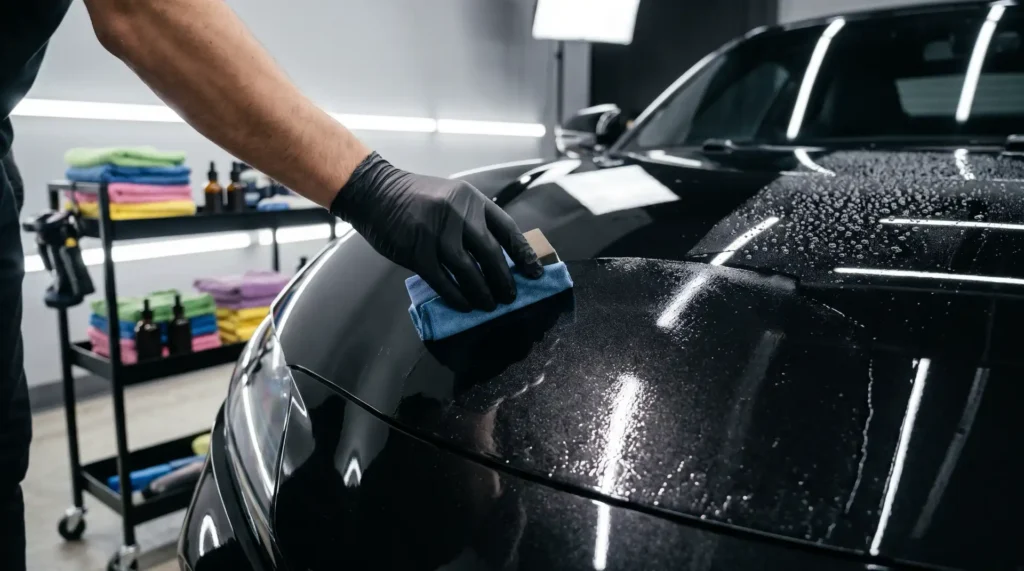
The resulting coating changes how water, dirt, and certain contaminants interact with the surface. Depending on the formulation, it can create a hydrophobic effect that encourages water to form droplets and move away from the paint. This can make washing easier and reduce the tendency of some contaminants to remain attached.
However, ceramic coatings should not be confused with physical paint protection film. Their primary purpose is surface protection and easier maintenance, not absorbing significant stone impacts or preventing deep scratches.
How Ceramic Coatings Bond to Vehicle Paint
The effectiveness of a ceramic coating depends heavily on the condition of the surface before application. Professional detailers generally begin by thoroughly washing the vehicle, removing embedded contaminants, and evaluating the paint under specialized lighting.
If the paint contains swirl marks, oxidation, scratches, or other defects, paint correction may be necessary before the coating is installed.
This preparation is important because ceramic coatings are designed to preserve the condition of the surface beneath them. They do not automatically eliminate existing scratches or restore damaged clear coat.
After preparation, the coating is applied in controlled sections using specialized applicators. The installer spreads the product across the panel, allows it to reach the appropriate flashing stage, and carefully levels the residue according to the manufacturer’s instructions.
Once applied, the coating requires a specific curing process. Temperature, humidity, ventilation, application thickness, and product chemistry can influence the result.
Professional installation is particularly valuable for expensive vehicles because uneven application or improperly removed residue can create visible high spots, streaks, and inconsistent gloss.
Hydrophobic Properties and Easier Vehicle Cleaning
One of the most noticeable characteristics of ceramic coatings is their interaction with water.
A properly maintained coating can encourage water to bead on the surface or move away more easily. This hydrophobic behavior can make routine washing more convenient because dirt and certain contaminants may release more readily.
For drivers who regularly travel through rainy regions such as Washington, Oregon, and the northeastern United States, this property can be attractive.
It can also be useful for vehicles exposed to road dust, pollen, and everyday environmental contamination.
Nevertheless, hydrophobic performance should not be mistaken for complete self-cleaning capability. Dirt can still accumulate on coated vehicles, and water droplets can leave mineral deposits when they evaporate.
A coated vehicle still requires regular washing, appropriate drying techniques, and periodic inspection.
Ceramic Coating Durability and Maintenance
Ceramic coating products are often marketed with durability claims ranging from a few years to considerably longer periods. However, actual performance depends on the formulation, installation quality, environmental exposure, maintenance routine, and vehicle usage.
A vehicle parked in a protected garage may experience different conditions from one exposed to intense sunlight, industrial fallout, road salt, and frequent highway driving.
Owners should also understand the difference between a manufacturer’s product warranty and the actual lifespan of the coating’s functional properties.
Some professional coating warranties require periodic inspections, approved maintenance products, and documented servicing. Failing to follow these conditions may affect warranty coverage.
A useful maintenance routine includes washing the vehicle with suitable automotive shampoo, avoiding abrasive cleaning materials, removing harmful contaminants promptly, and following the installer’s recommendations for maintenance treatments.
Ceramic coating is therefore best understood as a long-term detailing investment that still requires responsible vehicle care.
 Paint Protection Film: Physical Protection Against Road Damage
 Paint Protection Film: Physical Protection Against Road Damage
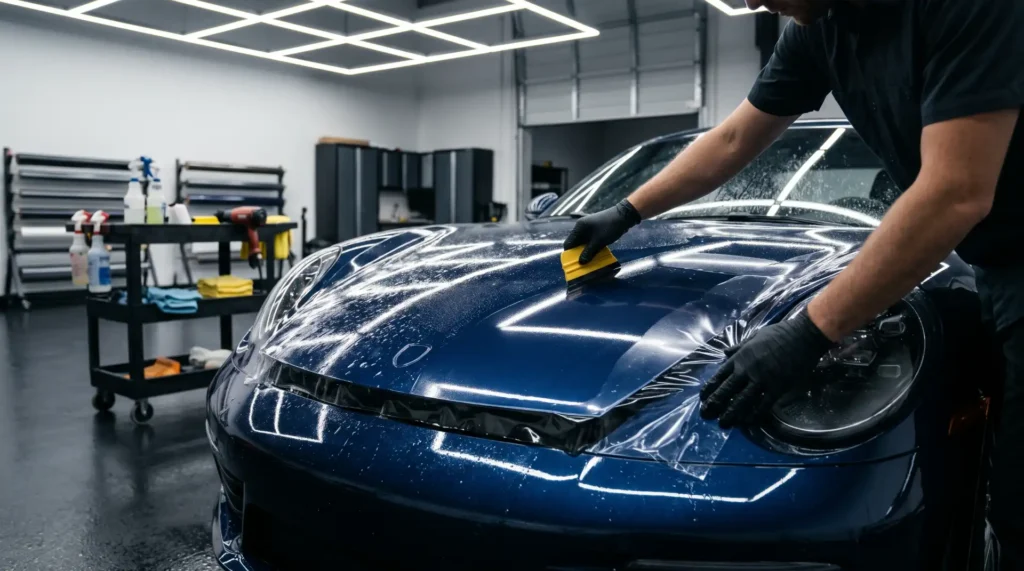
While ceramic coatings focus primarily on surface characteristics, paint protection film provides a physical barrier between automotive paint and the outside environment.
Commonly called PPF, paint protection film is a transparent or decorative film applied to painted vehicle panels. Modern products commonly use thermoplastic polyurethane (TPU), a flexible material selected for its ability to conform to complex vehicle surfaces.
PPF is particularly useful for areas exposed to repeated road debris, including front bumpers, hoods, fenders, side mirrors, rocker panels, and lower door sections.
During highway driving, small stones and other debris can strike the front of a vehicle at significant speeds. These impacts may chip the paint and expose underlying materials.
Paint protection film helps absorb and distribute some of that impact energy before it reaches the original finish.
For owners of expensive sports cars, performance vehicles, and trucks that frequently travel on highways or gravel roads, this physical barrier can provide valuable protection.
How Modern Paint Protection Film Works
Traditional automotive protection films have evolved considerably. Modern TPU-based PPF products are designed to combine flexibility, optical clarity, durability, and resistance to environmental contamination.
A typical film system includes several functional layers. These may include a protective topcoat, a polyurethane film layer, and an adhesive designed to secure the material to the vehicle’s painted surface.
The topcoat is particularly important because it determines many of the film’s visible and functional properties.
Depending on the product, the top layer may provide resistance to staining, environmental contamination, and minor surface abrasion. Some premium films also incorporate self-healing technology.
These materials are designed to reduce the appearance of certain minor surface marks when exposed to appropriate warmth.
For example, small scratches or light swirl marks in a self-healing film may become less visible after exposure to sunlight or controlled heat, depending on the manufacturer’s specifications.
This does not mean the film can repair deep cuts, punctures, or severe impact damage.
The underlying purpose is to help preserve the appearance and protective performance of the film itself while keeping the original paint underneath in better condition.
Self-Healing PPF Technology
Self-healing technology is one of the most interesting features of modern paint protection film.
Conventional protective films could develop visible surface marks after repeated washing, contact with debris, or exposure to environmental conditions.
Newer products use specially engineered topcoats that can respond to heat and allow certain minor imperfections to become less noticeable.
This technology is especially attractive to owners who want to maintain a clean finish on dark-colored vehicles.
Black, dark blue, and other deep-colored finishes can make light scratches and swirl marks particularly noticeable under direct sunlight or bright garage lighting.
Self-healing film can help reduce the visibility of some of these imperfections without requiring the film to be polished like conventional automotive paint.
However, buyers should ask installers exactly what the advertised self-healing capability covers. Different products use different materials and testing methods.
Gloss, Matte, and Colored Paint Protection Film
Modern PPF is no longer limited to transparent glossy finishes.
Manufacturers offer different appearance options that allow vehicle owners to protect their paint while changing the exterior’s visual character.
Gloss PPF is designed to preserve or enhance the appearance of conventional glossy automotive paint. It is particularly popular on luxury sedans, sports cars, and vehicles with premium factory finishes.
Matte PPF creates a satin or matte appearance while protecting the underlying paint. This option can be especially attractive to owners who want the appearance of a factory matte finish without permanently repainting the vehicle.
Colored and specialty films provide additional customization possibilities.
Some products feature distinctive colors, textures, or finishes that can create a different appearance from traditional automotive paint.
However, owners should carefully distinguish between vinyl wraps and paint protection films. Although both may be used to change a vehicle’s appearance, they are engineered for different purposes and can have different thicknesses, durability characteristics, and protective capabilities.
A reputable installer should explain the differences before recommending a product.
Full-Body PPF Versus Partial Paint Protection
One of the biggest decisions facing vehicle owners is how much of the vehicle should receive paint protection film.
Full-body PPF covers most or all painted exterior panels. It offers the most comprehensive coverage but also represents a considerably larger financial investment.
This approach may make sense for high-value vehicles, rare sports cars, collectible automobiles, and owners who want extensive protection.
Partial coverage focuses on areas most likely to experience damage.
Common packages include the front bumper, partial or full hood, front fenders, side mirrors, and headlights where permitted by product specifications and applicable regulations.
Some owners choose an extended front-end package that includes rocker panels, door edges, and additional lower-body sections.
For an everyday commuter, targeted coverage may offer a more practical balance between cost and protection.
A driver who frequently travels on highways may prioritize the front bumper and hood, while someone who regularly drives on gravel roads may also consider lower doors and rocker panels.
The correct coverage depends on actual exposure rather than simply selecting the largest available package.
Ceramic Coating vs. Paint Protection Film: Which Is Better?
One of the most common questions in automotive detailing is whether ceramic coating or paint protection film provides better protection.
The answer depends on what the owner wants to prevent.
Ceramic coatings and PPF serve different purposes, and comparing them as if they were interchangeable products can lead to unrealistic expectations.
Ceramic coatings primarily improve surface characteristics, including hydrophobic behavior, gloss, and resistance to certain forms of chemical contamination.
PPF provides a physical barrier designed to absorb road debris impacts and reduce the risk of paint damage from minor abrasions.
Consider a driver who regularly commutes on an interstate highway. The front of the vehicle may encounter small stones, road debris, and other objects that can chip the paint.
Ceramic coating may make the vehicle easier to clean, but it is not designed to absorb significant stone impacts.
Paint protection film is generally the more appropriate technology for that particular risk.
On the other hand, someone who primarily drives around town and parks in a garage may be more interested in maintaining gloss and reducing cleaning effort. A professionally installed ceramic coating may provide the characteristics that person values.
Comparing Protection, Appearance, and Maintenance
| Feature | Ceramic Coating | Paint Protection Film |
|---|---|---|
| Primary purpose | Surface protection and easier cleaning | Physical barrier against impacts and abrasion |
| Stone-chip protection | Limited | Designed to reduce stone-chip damage |
| Hydrophobic properties | Generally strong | Depends on film topcoat |
| Self-healing | Product-dependent and generally limited | Available in selected films |
| Scratch resistance | Limited surface resistance | Better protection against many minor abrasions |
| Appearance | Enhances gloss and surface clarity | Available in gloss, matte, and specialty finishes |
| Maintenance | Regular washing and coating care | Regular washing and film inspection |
| Application | Liquid coating applied to prepared paint | Flexible film applied to vehicle panels |
| Typical cost | Generally lower than full-body PPF | Higher, especially for extensive coverage |
These comparisons describe general product categories. Individual formulations and installation systems vary.
Can Ceramic Coating and PPF Be Used Together?
Yes. Many vehicle owners choose to combine both technologies because they offer complementary benefits.
A common approach is to install PPF on high-impact areas and apply a compatible ceramic coating to exposed paint and, where approved, the film surface.
For example, a sports car owner might install PPF on the front bumper, hood, front fenders, and side mirrors. A ceramic coating may then be applied to the remaining painted surfaces and to the film if its manufacturer permits that application.
This arrangement combines physical impact protection with easier surface maintenance.
However, installation order matters.
The painted surface should generally be prepared before the film is installed. Existing coatings may need to be removed or properly addressed to ensure the PPF adhesive bonds as intended. After installation, compatible coatings can be applied over the film when approved by the relevant manufacturers.
Owners should not assume every ceramic coating can be applied over every PPF product.
A professional installer should confirm compatibility, curing requirements, warranty conditions, and the recommended sequence.
Advanced Automotive Detailing Technologies in 2026
Automotive detailing has developed into a more technical field, particularly as manufacturers introduce increasingly complex paint finishes and protection materials.
Professional detailers now use specialized lighting, digital measurement tools, machine polishing equipment, precision cutting software, and controlled application environments.
These technologies help improve consistency and reduce the possibility of installation errors.
Digital PPF Cutting and Vehicle-Specific Templates
One of the most important developments in professional PPF installation is the use of digital pattern software.
Instead of manually cutting every piece of film directly on a vehicle, installers can use software containing vehicle-specific templates.
The system identifies the dimensions and contours of individual panels and produces patterns that can be cut using specialized plotters.
This approach can improve consistency and reduce the need for cutting film directly on painted surfaces.
It also allows installers to customize coverage around particular body lines, sensors, trim pieces, and vehicle configurations.
However, digital patterns are not automatically perfect.
Different model years, trim levels, optional body kits, and aftermarket accessories may change panel dimensions.
Professional installers should verify fitment before applying the film and make appropriate adjustments when necessary.
Paint Correction and Machine Polishing
Paint correction is an important step in many premium detailing projects.
Over time, automotive clear coat can develop swirl marks, fine scratches, oxidation, water spots, and other imperfections.
These defects can reduce gloss and make reflections appear inconsistent.
Machine polishing uses specialized polishing machines, pads, and compounds to refine the surface and reduce the appearance of certain defects.
The process generally involves evaluating the paint, selecting an appropriate combination of polishing products, and working through controlled stages.
Dual-action polishers are popular because their movement can help reduce certain risks associated with aggressive polishing techniques.
Rotary polishers may also be used by experienced professionals for particular correction requirements.
However, paint correction removes some clear coat material. It should not be performed aggressively or repeatedly without evaluating the remaining paint thickness.
A professional detailer may use a paint-thickness gauge to assess the condition of painted panels and identify areas that require additional caution.
For modern vehicles with delicate finishes or previous repainting work, this inspection is particularly important.
Infrared Curing and Controlled Application Environments
Some professional coating systems use infrared curing equipment to help manage the curing process.
Infrared lamps can deliver controlled heat to selected surfaces, depending on the equipment and manufacturer’s procedure.
This may help accelerate certain curing stages and provide a more controlled installation environment.
However, infrared curing is not appropriate for every product or application.
Detailers must follow the manufacturer’s recommended temperature limits, distance requirements, and curing procedures.
The application environment also matters.
Dust, moisture, poor lighting, and temperature fluctuations can affect coating application and film installation.
Professional detailing facilities increasingly focus on clean workspaces, controlled lighting, and appropriate ventilation to improve installation consistency.
Advanced Surface Inspection Technology
Paint inspection has become increasingly important because modern vehicles can have complex finishes and previous repair work that may not be obvious under ordinary lighting.
Detailers use different lighting angles and specialized inspection lamps to identify scratches, holograms, sanding marks, and uneven polishing.
Paint-thickness measurement tools can help determine whether a panel has been repainted or previously corrected.
More advanced measurement systems may provide additional information about the substrate and coating structure.
These inspections help professionals select appropriate correction methods and avoid unnecessary material removal.
The result is a more informed approach to paint preparation before ceramic coating or PPF installation.
Graphene Coatings and Other Emerging Paint Protection Products
 Graphene Coatings and Other Emerging Paint Protection Products
Graphene-based automotive coatings have attracted attention as another development in the vehicle detailing industry. They are often marketed as an alternative or enhancement to conventional ceramic coatings.
Graphene is a carbon-based material known for its unusual physical and electrical properties. In automotive detailing, graphene-related formulations are incorporated into certain protective products to modify surface characteristics.
However, the term graphene coating can describe different commercial formulations. Not every product contains the same concentration, structure, or quality of graphene-related materials.
What Makes Graphene Coatings Different?
Graphene coating manufacturers commonly emphasize water behavior, chemical resistance, reduced water spotting, and surface slickness.
Some formulations are designed to improve how water moves across the vehicle’s exterior, while others focus on durability and resistance to environmental contamination.
The actual performance depends on the complete formulation rather than the presence of graphene alone.
For consumers, this distinction is important because marketing descriptions can make products sound more advanced than their demonstrated capabilities.
A graphene coating should be evaluated using practical criteria, including installation requirements, chemical resistance, durability testing, maintenance recommendations, and warranty conditions.
Are Graphene Coatings Better Than Ceramic Coatings?
There is no universal answer.
Some graphene-based products may offer useful characteristics, but that does not mean every graphene coating outperforms every ceramic coating.
A professionally installed conventional ceramic coating from a reputable manufacturer may provide better results than an inexpensive graphene product with limited testing or unclear installation instructions.
Consumers should compare technical documentation rather than relying entirely on advertising claims.
Questions worth asking include:
What is the actual coating chemistry?
Is the product designed for professional or consumer installation?
What preparation is required?
How long is the stated durability period?
What maintenance products are recommended?
Are warranty conditions clearly documented?
For most vehicle owners, the quality of surface preparation and installation is likely to be more important than choosing a product based solely on whether it is marketed as ceramic or graphene technology.
Hybrid Paint Protection Systems
Another developing area involves products that combine characteristics associated with different protection technologies.
Some manufacturers offer films with ceramic-style topcoats, while others offer liquid protective systems designed to provide thicker surface protection than conventional ceramic coatings.
These products attempt to combine properties such as gloss, hydrophobic behavior, stain resistance, and surface durability.
However, they should not automatically be considered equivalent to conventional PPF.
Buyers should examine the product’s actual impact-resistance specifications, thickness, installation process, repairability, and warranty.
A liquid coating that advertises paint protection film-like characteristics may still perform differently from a physical TPU film when exposed to stone impacts.
The important principle is to understand what the material is engineered to protect against.
Environmental Factors That Damage Automotive Paint in the United States
Paint protection decisions should reflect the conditions in which a vehicle is driven and stored.
American drivers experience different environmental challenges depending on geographic location, seasonal weather, road conditions, and parking arrangements.
A vehicle regularly exposed to desert sunlight may need a different protection strategy from one driven through snowy northeastern states.
UV Radiation and Intense Sunlight
Ultraviolet radiation contributes to the gradual deterioration of automotive exterior materials.
Although modern automotive clear coats are designed to resist environmental exposure, prolonged sunlight can contribute to fading, oxidation, and changes in appearance over time.
Dark-colored vehicles can also become extremely hot when parked outdoors in direct sunlight.
Owners in Arizona, Nevada, California, and other high-sunlight regions may benefit from combining appropriate surface protection with practical parking habits.
Whenever possible, parking in a garage or shaded area can reduce unnecessary environmental exposure.
Ceramic coatings may improve surface maintenance and resistance to certain contaminants, while suitable PPF can provide additional physical protection to vulnerable panels.
Neither technology eliminates the effects of prolonged exposure, so regular inspection remains important.
Road Salt and Winter Chemicals
Winter driving creates another major challenge.
In states such as Michigan, Ohio, Pennsylvania, New York, and Illinois, road maintenance frequently involves salt and other deicing materials.
These substances can accumulate on vehicle exteriors and underbody components.
Although automotive paint protection products may improve resistance to certain surface contaminants, they should not be considered a substitute for regular winter washing.
Drivers should pay attention to lower body panels, wheel arches, rocker panels, and areas where salt and road grime accumulate.
A properly maintained vehicle should be washed regularly during winter, particularly after driving on heavily treated roads.
Underbody cleaning is also important because exterior ceramic coatings and conventional PPF do not automatically protect every exposed mechanical component.
Bird Droppings, Tree Sap, and Insect Residue
Organic contaminants can damage automotive finishes when they remain on the surface for extended periods.
Bird droppings may contain substances that can stain or etch paint, especially when exposed to heat.
Tree sap can become difficult to remove as it hardens, while insect residue may also leave marks if neglected.
Ceramic coatings and PPF can provide different levels of resistance to these contaminants, depending on their formulations.
However, neither technology makes a vehicle immune to staining.
The safest approach is to remove these substances promptly using appropriate automotive cleaning products.
Avoid aggressive scraping or rubbing because these methods can damage both paint and protective film.
Industrial Fallout and Airborne Contamination
Vehicles driven in urban and industrial environments may accumulate contaminants that are not always visible during ordinary washing.
Iron particles from rail systems, industrial processes, and brake dust can become embedded in automotive surfaces.
Construction dust, asphalt residue, and other airborne materials can also affect the finish.
Professional detailing may include chemical decontamination to remove embedded particles before polishing or applying protective products.
This process is particularly important before installing PPF because contamination trapped beneath the film can become visible after application.
Surface preparation should therefore be treated as a critical part of any serious paint protection project.
How Much Does Automotive Paint Protection Cost in 2026?
The cost of automotive paint protection varies considerably across the United States.
Vehicle size, paint condition, product quality, installation complexity, geographic location, and coverage level all influence pricing.
A small sedan may require less material and labor than a large SUV or pickup truck. Vehicles with complicated body contours may also require additional installation time.
Because prices vary among professional detailing businesses, vehicle owners should compare written estimates rather than relying on a single advertised starting price.
Ceramic Coating Installation Costs
Consumer-grade ceramic products are available at relatively accessible prices, while professional coating packages can represent a substantial investment.
Professional services may include washing, chemical decontamination, paint inspection, machine polishing, coating application, and curing.
The preparation stage can account for a significant portion of the total cost.
A vehicle with relatively new paint and few imperfections may require less correction than an older vehicle with extensive swirl marks and water spots.
Owners should ask whether the quoted price includes paint correction, because a low-cost coating package may involve limited preparation.
It is also important to understand the difference between a spray-on ceramic detailer, a consumer ceramic coating kit, and a professionally installed coating system.
These products may all use ceramic-related terminology, but they are not necessarily equivalent in chemistry, durability, or application requirements.
Paint Protection Film Pricing
PPF is generally more expensive than ceramic coating because it involves specialized material, vehicle-specific patterns, and labor-intensive installation.
Partial front-end coverage typically costs less than full-body protection.
The total price may increase when a vehicle has complex body lines, large front bumpers, extensive exterior modifications, or specialty film requirements.
Premium films with advanced topcoats, self-healing characteristics, and extended manufacturer warranties may also cost more.
When comparing quotes, ask which panels are included, what type of film will be installed, and whether edges will be wrapped where practical.
A written estimate should clearly identify the coverage area rather than simply describing a package as full front protection.
Is Paint Protection Worth the Investment?
Paint protection can be valuable, but its financial benefits depend on the vehicle and ownership situation.
For a new luxury sports car, preserving the original finish may be particularly important.
For a daily commuter with extensive highway use, protecting the front bumper and hood may help reduce visible stone-chip damage.
For an older vehicle with existing paint deterioration, extensive PPF may not provide the same practical value.
Owners should also consider how long they plan to keep the vehicle.
Someone who intends to own a car for ten years may place greater importance on long-term exterior preservation than someone who changes vehicles every two years.
The best protection package is the one that provides meaningful benefits without creating unnecessary expense.
Choosing a Professional Automotive Detailing and PPF Installer
Even high-quality paint protection products can produce disappointing results when installation is poor.
Ceramic coatings require careful surface preparation and controlled application. Paint protection film requires accurate cutting, proper positioning, appropriate adhesive handling, and careful finishing around edges and body contours.
For this reason, selecting a qualified installer is just as important as choosing the product.
Evaluate the Installer’s Experience and Workmanship
Before scheduling an installation, examine the shop’s previous projects.
Look for photographs showing finished vehicles from different angles, particularly around difficult areas such as bumper corners, mirror housings, door handles, and curved body panels.
PPF installation should generally produce a consistent appearance without excessive visible lifting, contamination, wrinkles, or trapped debris.
Ask whether the shop has experience with your particular vehicle model.
Some vehicles have complex front-end designs, unusual body contours, or expensive paint finishes that require additional installation experience.
A shop that regularly works with similar vehicles may be better prepared to handle those challenges.
Ask About the Actual Product Being Installed
Some detailing businesses advertise ceramic coating or PPF without clearly identifying the manufacturer or product series.
Consumers should ask for the exact product name, technical information, and written warranty documentation.
Different manufacturers offer products with different thicknesses, topcoat characteristics, durability claims, and installation requirements.
A transparent installer should be able to explain why a particular product is suitable for the vehicle.
This is also where understanding OEM and aftermarket product differences can help. Your existing article, OEM vs. Aftermarket Parts: What’s Best for Your Car’s Performance?, provides a useful starting point for understanding why product specifications, quality, compatibility, and manufacturer support matter when selecting automotive components.
Although paint protection products are different from conventional mechanical parts, the same purchasing principle applies: evaluate actual quality and suitability instead of choosing based on price or advertising alone.
Understand Installation Warranties
Warranty coverage is an important part of any professional paint protection purchase.
PPF warranties may address specific issues such as yellowing, cracking, bubbling, or delamination, depending on the manufacturer and product.
Ceramic coating warranties may involve different requirements, including approved maintenance products, periodic inspections, and restrictions on certain cleaning methods.
Consumers should ask:
What specific defects are covered?
How long does the warranty last?
Is the warranty issued by the manufacturer or installer?
Does it cover labor and replacement material?
Are annual inspections required?
What maintenance could invalidate coverage?
A warranty should never be evaluated based solely on its advertised duration.
A shorter warranty with clear coverage and a reputable manufacturer may be more meaningful than a longer warranty with numerous exclusions.
Maintaining Ceramic Coatings and Paint Protection Film
Installing protective products is only the beginning of long-term vehicle care.
Both ceramic coatings and PPF require maintenance to preserve their appearance and functionality.
The correct cleaning method depends on the product installed, but regular washing with suitable automotive products is generally important.
Safe Washing Techniques
Hand washing is often preferred because it allows the owner to control the cleaning process and reduce unnecessary contact with abrasive materials.
A good routine begins with rinsing loose dirt from the vehicle before touching the paint.
A suitable automotive shampoo and clean microfiber wash materials can help remove everyday contamination.
Many detailers recommend using separate wash materials for wheels and painted surfaces to reduce the possibility of transferring abrasive brake dust or road debris.
After washing, the vehicle should be dried using clean, soft microfiber towels or an appropriate drying system.
Avoid using household cleaning chemicals, abrasive sponges, or products that are not approved for the installed protection system.
Automatic car washes can also introduce risks, particularly when they use heavily contaminated brushes.
Caring for Paint Protection Film After Installation
Freshly installed PPF requires an initial stabilization period.
The exact waiting period depends on the manufacturer, film product, and installation conditions.
As one example, 3M’s official PPF installation guidance recommends waiting at least 72 hours before washing after installation. It also emphasizes checking for lifting and using suitable washing methods.
Owners should follow the specific instructions supplied by their installer rather than assuming every film has identical curing requirements.
After the initial period, routine cleaning should focus on preventing contamination from remaining on the surface.
Bird droppings, insect residue, road tar, and other substances should be removed using products compatible with the film.
Pressure washing requires particular care. Concentrated water pressure directed toward film edges can contribute to lifting or peeling.
If an edge begins to lift, it should be inspected by the installer rather than repeatedly pressed or pulled by the vehicle owner.
Maintaining Ceramic Coatings
Ceramic-coated vehicles still need regular washing.
A hydrophobic surface may make cleaning easier, but dust, mineral deposits, brake contamination, and road grime can still accumulate.
Owners should use appropriate automotive shampoos and avoid unnecessary abrasive polishing.
If water no longer beads as expected, the coating may not necessarily have failed.
Surface contamination can interfere with water behavior, and a proper maintenance wash or decontamination procedure may restore some of the original characteristics.
However, polishing a coated surface can reduce or remove the coating layer.
If the vehicle requires significant correction, a professional detailer should evaluate the situation before recommending further treatment.
Recognizing When Protective Products Need Attention
Paint protection products should be inspected periodically.
For PPF, warning signs include edge lifting, discoloration, cracking, persistent haze, and unusual bubbling.
Minor surface marks may be normal, particularly on a film designed to absorb everyday wear.
For ceramic coatings, changes in water behavior, unusual staining, and loss of surface slickness may indicate contamination or reduced coating performance.
These symptoms do not automatically prove that the product has failed.
A professional inspection can help determine whether the problem requires cleaning, maintenance, repair, or replacement.
Common Automotive Paint Protection Mistakes to Avoid
Many paint protection problems are caused not by defective products but by unrealistic expectations, inadequate preparation, or improper maintenance.
Understanding these mistakes can help vehicle owners avoid unnecessary expenses.
Assuming Ceramic Coating Makes Paint Scratch-Proof
Ceramic coatings are frequently marketed with impressive hardness claims.
However, a coating should not be considered a substitute for physical protection against stones, sharp objects, or significant abrasion.
A coated vehicle can still develop scratches, chips, and clear-coat damage.
Owners who frequently drive on highways or gravel roads should consider PPF for vulnerable panels if impact protection is a priority.
Choosing PPF Based Only on Thickness
Film thickness is an important specification, but it does not determine overall quality by itself.
Adhesive performance, flexibility, optical clarity, topcoat quality, installation characteristics, and long-term weather resistance also matter.
A thicker film is not automatically the best option for every vehicle.
Consumers should evaluate the complete product specification and consider the installer’s experience with that particular film.
Skipping Paint Correction
Applying a protective product over defective paint can preserve imperfections rather than eliminate them.
Ceramic coatings do not function as conventional polishing compounds, and transparent PPF does not hide every scratch or surface defect.
Before installation, the vehicle should be inspected under appropriate lighting.
Where necessary, paint correction should be completed before the protective product is applied.
Neglecting Regular Cleaning
Neither PPF nor ceramic coating eliminates the need for washing.
Allowing bird droppings, tree sap, road chemicals, and other contaminants to remain on the surface can eventually cause staining or deterioration.
Regular cleaning is especially important in hot climates, where contaminants may dry quickly and become more difficult to remove.
Selecting an Installer Based Only on Price
The lowest quote does not necessarily provide the best value.
An inexpensive installation may involve limited preparation, lower-quality materials, incomplete coverage, or insufficient warranty support.
Before choosing a shop, compare the products, preparation procedures, installation methods, coverage areas, and aftercare services.
A detailed quote is more useful than an advertised package price that does not explain what is included.
Paint Protection for Different Types of American Vehicles
Not every vehicle requires the same protection strategy.
The best combination of ceramic coating, PPF, and detailing depends on the vehicle’s design, usage, value, and driving environment.
Sports Cars and High-Performance Vehicles
Sports cars frequently have low front-end profiles and wide aerodynamic bodywork.
These characteristics can expose front bumpers, lower hoods, fenders, and rocker panels to road debris.
Owners of vehicles such as the Chevrolet Corvette, Ford Mustang, Porsche 911, and other performance models may consider PPF for vulnerable front-end areas.
Ceramic coatings can complement that protection by helping maintain gloss and making routine cleaning easier.
For vehicles with expensive paint finishes or extensive ownership plans, full-body PPF may also be worth considering.
Pickup Trucks and Off-Road Vehicles
Pickup trucks face a different range of exterior hazards.
Gravel roads, construction sites, outdoor recreation, towing, and work-related use can expose lower body panels to scratches and debris.
Owners of Ford F-150, Chevrolet Silverado, GMC Sierra, Toyota Tacoma, and similar vehicles may benefit from targeted PPF coverage.
Rocker panels, door edges, lower doors, and front-end sections can be particularly relevant.
Ceramic coatings may also make it easier to remove mud, road grime, and environmental contamination.
However, owners should understand that ceramic coating does not prevent damage from branches, rocks, or aggressive off-road contact.
Luxury Cars and Collectible Vehicles
Luxury and collectible vehicles often have a strong emphasis on exterior appearance.
Original paint condition can be particularly important for rare or limited-production models.
Owners may choose more comprehensive PPF coverage to reduce the likelihood of stone chips and surface damage.
Ceramic coatings can then be used to support easier cleaning and maintain a glossy finish.
For collectible vehicles, professional inspection is especially important because original paint may have historical or financial significance.
Aggressive polishing or unnecessary repainting can reduce the value of certain automobiles.
Daily Commuter Vehicles
Daily drivers encounter constant exposure to parking lots, road debris, weather, and ordinary transportation hazards.
A full-body PPF installation may not be financially practical for every commuter.
Instead, owners can consider targeted coverage for the hood, bumper, mirrors, and other frequently exposed panels.
A ceramic coating may also be a practical option for someone who wants easier washing and improved exterior appearance.
The best decision should reflect the vehicle’s age, condition, expected ownership period, and budget.
The Role of Automotive Paint Protection in Vehicle Resale Value
A vehicle’s exterior condition can influence how potential buyers perceive its overall quality.
Paint that has been maintained carefully may create a more positive impression than a vehicle with extensive scratches, faded panels, stone chips, and neglected surfaces.
Although paint protection does not guarantee a higher resale price, it can help owners preserve the vehicle’s original appearance and reduce certain forms of cosmetic deterioration.
Protecting Original Factory Paint
Original factory paint is often desirable because it reflects the vehicle’s original condition.
For certain collectible and enthusiast vehicles, preserving factory paint can be particularly important.
PPF can help reduce stone-chip damage and surface abrasion, while ceramic coatings can make routine cleaning easier.
Owners should retain installation records, product information, and warranty documentation. These records can help prospective buyers understand what protection was installed and how the vehicle was maintained.
Is Paint Protection Worth Installing Before Selling a Car?
The answer depends on the vehicle’s age and expected selling price.
Installing an expensive full-body protection system shortly before selling an ordinary used vehicle may not generate enough additional value to justify the expense.
However, targeted protection on a newer vehicle may help preserve its appearance during several years of ownership.
For someone planning to keep a vehicle long-term, the benefits may be more meaningful because the owner gets to enjoy the protection throughout the ownership period.
Paint protection should therefore be considered primarily as a preservation and maintenance investment rather than a guaranteed resale-value improvement.
The Future of Automotive Paint Protection Beyond 2026
 The Future of Automotive Paint Protection Beyond 2026
Automotive paint protection continues to evolve as material manufacturers develop more advanced polymers, coating formulations, and installation technologies.
The next generation of products will likely focus on improving durability, reducing maintenance requirements, and creating more versatile protection options.
More Advanced Self-Healing Materials
Self-healing technology is likely to remain an important area of development.
Manufacturers are continuing to improve protective film topcoats designed to recover from minor surface imperfections.
Future products may offer improvements in optical clarity, resistance to environmental staining, and long-term surface performance.
However, meaningful advances will depend on material engineering and real-world testing rather than marketing descriptions.
Improved Hydrophobic and Stain-Resistant Surfaces
Another area of development involves surfaces that better resist water, dirt, and environmental contamination.
Hydrophobic characteristics can improve cleaning convenience, while stain-resistant formulations may help reduce the effects of certain contaminants.
Manufacturers are also exploring ways to combine these characteristics with better resistance to UV exposure and chemical contamination.
For consumers, the most useful developments will be those that provide measurable improvements under everyday driving conditions.
Greater Integration With Vehicle Customization
Paint protection is also becoming more connected to vehicle customization.
Matte finishes, colored PPF, specialty textures, and customized exterior appearances allow owners to personalize vehicles while adding a protective layer.
This is particularly relevant to the aftermarket automotive industry because protection products are no longer viewed exclusively as invisible maintenance accessories.
They are increasingly part of a vehicle’s overall design.
As more owners invest in customized trucks, sports cars, and luxury vehicles, demand for products that combine appearance and protection may continue to grow.
More Precise Installation and Digital Manufacturing
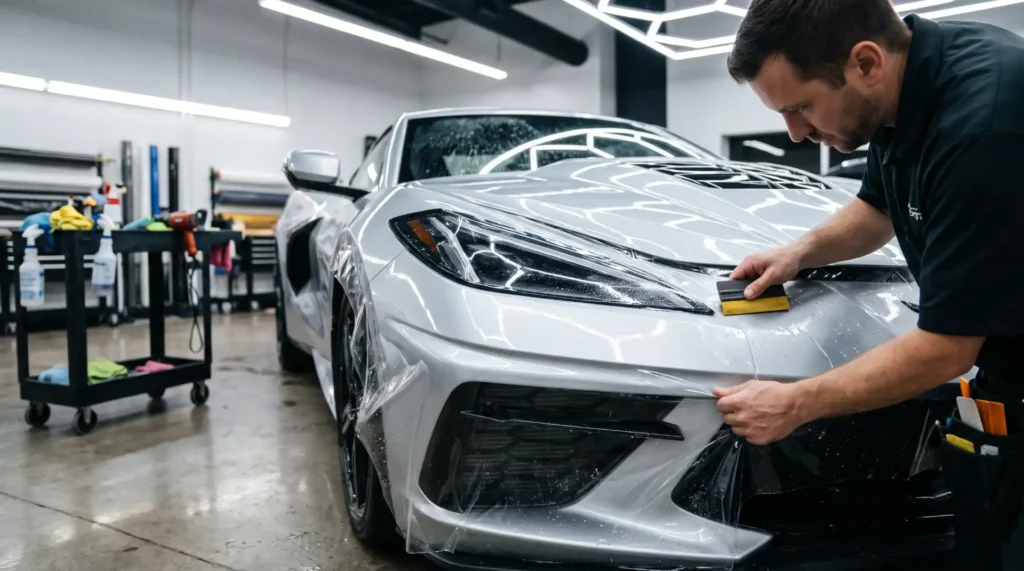
Digital pattern libraries, automated cutting equipment, and improved installation materials are likely to make professional PPF application more precise.
These technologies can reduce unnecessary material waste and improve consistency across different vehicle models.
More detailed vehicle-specific patterns may also help installers accommodate complicated body panels, aftermarket components, and specialty exterior designs.
The combination of improved materials and precision installation could make premium protection systems more accessible to a wider range of vehicle owners.
Conclusion: Choosing the Right Paint Protection for Your Vehicle
Automotive paint protection has become an important part of modern vehicle ownership, particularly for drivers who want to preserve their vehicle’s appearance and reduce the effects of everyday environmental exposure.
Ceramic coatings, paint protection film, graphene-based products, and advanced detailing technologies each provide different benefits. Understanding these differences helps vehicle owners make more informed decisions rather than purchasing products based entirely on advertising claims.
Ceramic coatings are particularly useful for improving surface characteristics, maintaining gloss, encouraging water repellency, and making routine cleaning more convenient. Paint protection film offers a different advantage by creating a physical barrier against road debris, stone chips, and certain types of surface abrasion.
For many owners, combining both technologies can provide a practical approach to exterior preservation. PPF can protect vulnerable panels, while a compatible ceramic coating can help maintain the appearance and cleaning characteristics of the remaining painted surfaces.
However, the quality of installation and ongoing maintenance should never be overlooked. Proper paint correction, surface preparation, product compatibility, and professional application all contribute to the final result.
American driving conditions also make protection choices particularly important. Vehicles exposed to intense desert sunlight, winter road salt, coastal moisture, highway debris, and urban contamination face different challenges. Selecting a protection system based on actual driving conditions is generally more practical than purchasing the most expensive package available.
As the automotive detailing industry continues developing, newer materials and installation technologies will provide additional choices for enthusiasts and everyday drivers.
Ultimately, the best automotive paint protection system is not necessarily the one with the most impressive marketing claims. It is the one that matches the vehicle, provides the type of protection the owner actually needs, and can be maintained properly throughout the vehicle’s ownership.
For drivers who care about automotive appearance, customization, and long-term vehicle maintenance, understanding paint protection technologies is an increasingly valuable part of making smart automotive decisions.