
Are 200-Treadwear Tires Still the Best Choice for Street and Track?
For years, 200-treadwear tires have occupied one of the most appealing positions in the performance-car world. They are usually street legal, available in sizes that fit popular sports cars, and capable of producing enough dry grip for autocross, time trials, and demanding track days. That combination has made them a default recommendation for drivers who want one set of tires to handle both weekday roads and weekend competition.
However, the modern 200-treadwear category is no longer a single, predictable group. Some current models are designed to deliver maximum grip for one autocross run or a short time-attack session. Others prioritize stable performance across longer track sessions. A third group provides a more balanced mix of road manners, wet-weather capability, tread life, and occasional circuit use.
As a result, asking whether 200-treadwear tires are still the best choice requires another question: best for what type of driver? They remain an excellent option for many American enthusiasts, but the treadwear number alone does not reveal how a tire will behave in rain, how quickly it will overheat, how many track sessions it may survive, or whether it will remain comfortable during a long highway trip.
What Does a 200 Treadwear Rating Actually Mean?
The number printed on the sidewall is part of the Uniform Tire Quality Grading system, commonly called UTQG. The system includes treadwear, traction, and temperature grades. According to the National Highway Traffic Safety Administration’s UTQG guide, a tire graded 200 is expected to wear twice as long under the prescribed test conditions as the 100-grade control tire.
That does not mean every tire carrying a 200 rating will last the same number of miles. The treadwear grade is a comparative laboratory and test-course indicator, not a mileage warranty. Tire manufacturers assign grades based on regulated testing, and differences in compounds, construction, testing interpretation, vehicle setup, road surface, climate, and driving style can produce very different real-world results.
The rating is therefore most useful as a broad classification. It tells buyers that the tire belongs near the aggressive end of the street-tire spectrum, but it should not be treated as a direct measurement of lap time or usable life. Two tires marked 200 can have dramatically different warm-up characteristics, wet grip, steering response, heat tolerance, and wear rates.
This distinction matters because modern tire development has advanced faster than the rating system can describe. Tire companies can use sophisticated compound chemistry and carefully engineered tread designs to pursue a particular type of performance while still meeting the requirements of a 200-treadwear category.
 Why 200-Treadwear Tires Became So Popular
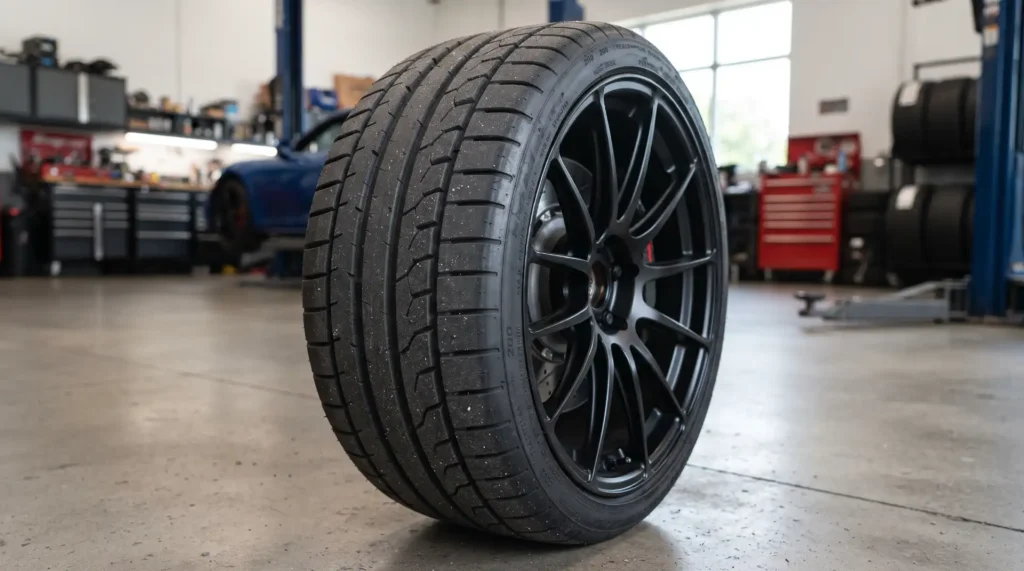 Why 200-Treadwear Tires Became So Popular
The rise of 200-treadwear tires was influenced partly by competition rules. Many American autocross and time-trial classes require a minimum 200 UTQG treadwear grade. For example, the current SCCA Time Trials Sport Category tire rules require eligible tires to have a minimum treadwear grade of 200, DOT approval, and a design intended for highway use on passenger cars.
Rules like these encouraged manufacturers to develop extremely capable tires that remained technically eligible for street-tire classes. Competition among tire companies then pushed dry grip, steering precision, warm-up speed, and construction technology forward. The result was a new generation of street-legal tires that could approach the performance of older competition products under the right conditions.
For enthusiasts, the appeal was easy to understand. A driver could travel to an event on the same tires used on the track, avoiding the expense and inconvenience of transporting a second wheel-and-tire package. The tires could also provide sharper handling during spirited road driving without requiring the compromises associated with a non-DOT racing slick.
That convenience remains relevant. Many drivers do not own a trailer or tow vehicle, and some lack garage space for an additional set of wheels. A well-selected 200-treadwear tire can make participation in performance-driving events simpler and more accessible.
The Category Has Split Into Different Types
The greatest mistake a shopper can make is assuming that all 200-treadwear tires serve the same purpose. Although they share a sidewall number, their intended uses may be very different.
One group is designed around rapid warm-up and maximum peak grip. These tires can be highly effective in autocross, where a run may last less than a minute and there may be limited opportunity to build temperature. They can also work well for time attack, in which a driver pursues one especially fast lap. The tradeoff is that some peak-grip tires may lose consistency as temperatures climb during a longer session.
A second group is designed for endurance and repeated laps. These tires may take longer to reach their best operating temperature and may not produce the category’s fastest single lap. Their advantage is greater consistency over a 20- or 30-minute session, better resistance to overheating, and potentially more predictable wear.
A third group emphasizes dual-purpose usability. These tires may provide additional tread depth, more channels for water evacuation, quieter operation, or a more forgiving ride. They can be a better fit for drivers who commute regularly, travel to distant events, or occasionally encounter rain. Their ultimate dry-track pace may be lower, but they can offer a more practical overall ownership experience.
This diversity is good for enthusiasts because it creates more choices. It also means selecting a tire by treadwear number or online lap-time ranking alone is less useful than it once was.
Advantages of 200-Treadwear Tires on the Street
A quality 200-treadwear tire can transform the response of a performance car. Stiff tread blocks and track-oriented construction often produce immediate steering feedback, reduced delay during direction changes, and stronger dry braking. On a lightweight sports car, those changes can make the chassis feel more precise and communicative.
The increased grip may also allow the driver to use other modifications more effectively. Upgraded springs, dampers, alignment settings, and aerodynamic components cannot deliver their full potential if the tires cannot transmit the resulting forces to the pavement. Readers planning a more complete chassis setup may also benefit from understanding how front splitters, diffusers, and rear wings work together.
Another advantage is road legality. Most tires in this category are DOT approved and designed for highway use, although owners must still verify the specifications of the exact model. Being street legal does not automatically make a tire appropriate for every road condition, but it allows a properly maintained vehicle to be driven to and from an event without changing to competition-only tires.
The disadvantages become more noticeable when the vehicle is used as a true daily driver. Aggressive tires may create more road noise, follow grooves in the pavement, ride more firmly, and wear quickly. Their sticky compounds can also collect gravel and throw it against the wheel wells or painted bodywork.
Drivers should also consider cost per mile rather than purchase price alone. A tire that is affordable initially may become expensive if track use consumes the shoulders after only a few events. Alignment, rotation options, heat management, and driving technique can have as much influence on the final cost as the price printed on the invoice.
Dry Track Performance: Where 200-Treadwear Tires Shine
 Dry Track Performance: Where 200-Treadwear Tires Shine
Dry grip remains the strongest argument for choosing this category. On a suitable car and track, the best 200-treadwear tires can generate impressive braking, cornering, and acceleration performance. Their relatively stiff constructions can also improve confidence by making the car respond more directly to steering inputs.
That grip can expose weaknesses elsewhere in the vehicle. Higher cornering forces increase loads on wheel bearings, suspension bushings, and oiling systems. Greater braking capability can create additional heat in pads, rotors, and fluid. Before installing aggressive tires, drivers should make sure the rest of the car is ready for the forces those tires can generate.
A track-ready setup should therefore be treated as a system. Fresh high-temperature brake fluid, suitable pads, adequate cooling, secure wheel hardware, and a careful mechanical inspection are more important than chasing the last fraction of a second. The Auto Sport Performance guide to high-performance brake upgrades for street cars explains how braking components can be matched to more demanding use.
Drivers should also be realistic about session length. A tire developed for fast warm-up may feel exceptional early in a session but become greasy after repeated hard laps. When that happens, adding steering angle or pushing harder normally creates more heat and wear rather than restoring grip. A short cool-down period may produce a faster and safer result.
Wet Roads Are the Major Compromise
Not every 200-treadwear tire is unsafe in rain, and some dual-purpose designs provide respectable wet performance when they have adequate tread depth. Nevertheless, aggressive tires often devote more of their surface area to large dry-grip tread blocks and less to channels that move standing water away from the contact patch.
The wet-weather problem becomes more serious as tread depth decreases. A tire that remains effective on damp pavement may become vulnerable to hydroplaning when deep water accumulates. Highway speeds, worn tread, low pressure, and heavy rainfall can create a dangerous combination.
Wet performance should be evaluated separately from the treadwear rating. Drivers who live in regions with frequent thunderstorms or must commute regardless of weather may be better served by a more road-oriented max-performance summer tire. Those who encounter near-freezing temperatures or snow need an appropriate all-season or winter solution rather than an extreme-performance summer tire.
Summer compounds are designed around warm-weather performance. Even if the road is dry, low temperatures can substantially reduce available grip. Owners must follow the tire manufacturer’s temperature and storage warnings because some specialized compounds can be damaged by exposure to extreme cold.
Heat Management Matters More Than the Sidewall Number
A tire’s performance changes as it moves through its temperature range. When cold, an aggressive compound may feel stiff and produce less grip than expected. As it warms, grip increases until the tire reaches its preferred operating window. Additional heat can then cause the compound to feel greasy, accelerate wear, or produce surface damage.
This is why warm-up behavior matters in competition. Autocross drivers generally prefer a tire that reaches useful temperature quickly. Drivers completing long track sessions may prioritize heat tolerance and consistency. A heavier, more powerful car can also place much more thermal stress on a tire than a lightweight roadster, even when both use the same size and compound.
Pressure is part of heat management, but there is no universal ideal pressure for every car and tire. The correct approach begins with the vehicle and tire manufacturers’ instructions, followed by careful observation of pressure growth, handling balance, and wear. Michelin’s track-day tire guidance recommends beginning with the vehicle manufacturer’s specified pressure, warming the tires progressively, inspecting them throughout the event, and returning them to the proper road pressure afterward.
Pressure should never be adjusted casually without an accurate gauge and an understanding of whether the measurement is hot or cold. Drivers must also reinstall valve caps, check for leakage, and verify pressures again after the tires have cooled.
Wear, Heat Cycles, and Performance Life
Tread depth is only one way to measure the life of a performance tire. Repeated heating and cooling can change how a compound behaves before the tread reaches the legal minimum. A tire may still look usable yet no longer deliver the grip or consistency it provided when new.
Track wear is rarely uniform. A car with insufficient negative camber may overload the outer shoulders. Too much toe can rapidly scrub the tread during ordinary driving. A powerful rear-wheel-drive car may consume its rear tires, while a front-heavy front-wheel-drive vehicle can place exceptional demands on the fronts.
Regular inspections should examine the entire tread, both shoulders, and both sidewalls. Drivers should look for cuts, bulges, cords, cracking, unusual discoloration, embedded debris, or localized wear. Tire condition should be checked before every event, between sessions, and again before driving home.
Rotation can help when the tire model is not directional or when its mounting design permits side-to-side or front-to-rear movement. Staggered wheel setups reduce those options. The manufacturer’s instructions and the tire’s directional arrows or inside-and-outside markings must always be followed.
Alignment is equally important. A street alignment prioritizes stable braking, predictable road behavior, and reasonable wear. A track alignment may use additional negative camber to keep the tread flatter during hard cornering. The best compromise depends on suspension design, vehicle weight, tire construction, driving frequency, and whether the car must cover substantial highway mileage.
Are Faster Tires Always Better?
Lap-time comparisons are valuable, but they do not tell the entire story. A test result applies to the specific car, wheel size, surface, temperature, pressure strategy, driver, and testing procedure used. The fastest tire in one comparison may not be the best tire for a heavier vehicle, a different climate, or longer sessions.
Testing also shows how much variation exists inside the category. Tire Rack’s 2025 extreme-performance summer and track-tire test, for example, compared tires through road driving and dry and wet track exercises. Evaluations like this are most useful when shoppers study the separate results rather than looking only at the overall finishing order.
A driver who values rain performance should focus on wet braking and wet handling. An autocross competitor may prioritize immediate response and peak dry grip. A track-day driver should pay attention to consistency, temperature behavior, and wear. A commuter may care more about noise and ride quality than a difference of a few tenths of a second.
Driver development can also produce a larger improvement than moving from one competitive tire to another. A predictable tire that communicates clearly may help a developing driver learn braking, weight transfer, and throttle control more effectively than an extremely fast tire with a narrow operating window.
When a 200-Treadwear Tire Is the Right Choice
A 200-treadwear tire remains a strong choice when a vehicle participates in autocross or time trials with a 200-UTQG minimum, when the owner attends several dry track days each year, or when responsive handling is more important than maximum mileage and quietness. It is particularly attractive for drivers who want to travel to events on the same tires they use on the circuit.
The best candidates usually understand the compromises and can avoid driving in snow, freezing temperatures, or severe standing water. They also have the time and equipment to monitor pressure, inspect wear, and maintain a track-appropriate alignment.
For a lightly used weekend car, a dual-purpose 200-treadwear model can provide an engaging road experience without requiring competition-only equipment. For a frequently tracked vehicle, a heat-tolerant 200-treadwear tire may offer a useful balance between pace, consistency, and event eligibility.
When Another Tire Category Makes More Sense
 When Another Tire Category Makes More Sense
A less aggressive summer or all-season tire is usually a better choice for a daily-driven vehicle that regularly encounters rain, cold mornings, rough pavement, or long interstate trips. The modest reduction in maximum dry grip may be worthwhile in exchange for improved comfort, lower noise, longer life, and broader weather capability.
At the other extreme, a dedicated track tire may make sense for an experienced driver with a separate wheel set and a vehicle transported to events or driven only in appropriate conditions. A competition tire can deliver performance designed specifically for circuit use, but it may require careful temperature management and may not be suitable for public-road travel.
Using two sets of wheels is often the best long-term solution for serious enthusiasts. The road set can be selected for weather, comfort, and mileage, while the track set can be chosen for the exact event format. This approach raises the initial cost but prevents daily mileage and adverse weather from consuming expensive track-oriented tires.
A separate track package also allows drivers to select wheel widths, offsets, and tire sizes that complement the chassis. However, changing wheel or tire dimensions can affect clearance, gearing, speedometer readings, and the operation of electronic driver-assistance systems. Fitment should be verified before purchase rather than assumed from diameter alone.
How Vehicle Setup Changes the Answer
The same tire can behave differently on two vehicles. Weight, weight distribution, horsepower, drive layout, suspension geometry, aerodynamic load, and electronic controls all influence performance. A tire that delivers long, consistent sessions on a lightweight coupe may overheat much sooner under a heavy, high-powered sedan.
Wheel width also changes how the tread is supported. Installing the widest tire that physically fits is not automatically the fastest solution. A tire squeezed onto a narrow wheel may respond slowly and distort under load. Excessively aggressive fitment can cause rubbing, alter steering behavior, or reduce clearance around suspension and brake components.
Reducing unnecessary vehicle mass can decrease the demands placed on tires and brakes, although changes must be made without compromising safety or legality. The article on why weight reduction matters in performance builds provides additional context for enthusiasts considering a more comprehensive setup.
Power modifications matter as well. More torque can increase rear-tire temperatures and accelerate wear, especially when drivers rely on the tires to control wheelspin. A balanced build matches power with cooling, braking, suspension, and tire capacity rather than treating each modification separately.
Choosing the Right 200-Treadwear Tire
Start with the vehicle’s real use. Estimate how many miles it travels on public roads, how many events it attends, the typical session length, expected weather, and whether competition rules limit tire eligibility. Then study the manufacturer’s stated purpose for each candidate rather than relying exclusively on its treadwear grade.
Fitment must be confirmed using load rating, speed rating, wheel-width range, overall diameter, and vehicle clearance. Owners should also check whether the tire is directional, asymmetric, or limited in rotation options. If an event is involved, its current rulebook and eligible-tire list should be reviewed before money is spent.
Independent testing can help distinguish between peak-grip, endurance-oriented, and dual-purpose designs. Give the greatest weight to tests that use a vehicle and conditions similar to your own. A result from a lightweight rear-wheel-drive car on a cool day may not predict performance on a heavy all-wheel-drive vehicle in summer heat.
Finally, calculate total ownership cost. Purchase price, mounting, alignment, expected road mileage, event life, and replacement frequency all matter. The tire with the quickest isolated lap is not necessarily the tire that delivers the most useful track time per dollar.
Safety and Maintenance Cannot Be Optional
High-performance tires do not eliminate the need for disciplined preparation. Drivers should use a reliable pressure gauge and torque wrench, inspect wheel studs or bolts, verify sufficient tread depth, and check for visible damage. Fluids, brakes, suspension joints, and wheel bearings should also be examined before a track event.
After every session, the driver should allow the car to cool and inspect the tires before returning to the circuit. Any vibration, pressure loss, steering change, unusual noise, or visible damage requires investigation. A questionable tire should not be used simply to complete another session.
Before driving home, pressures must be returned to appropriate road settings after the tires cool. Electronic safety systems and tire-pressure monitoring systems should be restored or checked if they were adjusted for the event. Track wear can also change wet-road capability, so conditions that were acceptable on the morning drive may not be safe after a full day of hard use.
The Verdict: Are 200-Treadwear Tires Still the Best?
Yes—for the right driver. A carefully selected 200-treadwear tire remains one of the most effective solutions for a street-legal car that regularly participates in autocross, time trials, or track days. It can deliver exceptional dry grip, precise response, and the convenience of traveling to an event without carrying another wheel set.
However, 200 is now a class label rather than a complete performance description. The category includes tires built for rapid warm-up, peak lap times, repeated sessions, wet-road versatility, and varying levels of daily usability. Buyers must look beyond the sidewall rating and select a model based on intended use, temperature behavior, rain performance, durability, fitment, and event rules.
For a commuter that only visits a circuit once a year, a road-focused summer tire may provide a better balance. For a dedicated track car, a separate competition package may be faster and more economical over time. For the enthusiast who genuinely divides driving between public roads and performance events, though, 200-treadwear tires remain a compelling middle ground.
The best tire is not necessarily the one that records the fastest lap in someone else’s test. It is the tire that suits the vehicle, works in the driver’s normal climate, remains consistent for the intended session length, complies with event requirements, and provides a manageable balance of grip, safety, wear, and cost.