
Building a Faster AWD Sport Sedan
Modern AWD cars and sport sedans have become some of the most capable performance vehicles available to American drivers.
Vehicles such as the Subaru WRX, Volkswagen Golf R, Audi S and RS models, BMW M cars with xDrive, Mercedes-AMG performance sedans, Cadillac performance models, and other turbocharged AWD platforms combine everyday practicality with impressive acceleration and handling.
However, buying a powerful AWD car is only the beginning for many enthusiasts.
Owners often want sharper handling, stronger braking performance, better acceleration, improved cornering confidence, or a more engaging driving experience. The challenge is determining which modifications actually provide meaningful improvements without making the vehicle uncomfortable, unreliable, or unsuitable for everyday U.S. roads.
The best performance build is rarely about installing the most expensive parts.
Instead, it is about creating a balanced combination of tires, wheels, brakes, suspension, cooling, powertrain upgrades, and tuning.
AWD systems add another layer of complexity because power must be distributed between multiple wheels and, depending on the vehicle, through sophisticated electronically controlled differentials and torque-management systems.
A modification that works extremely well on one AWD platform may not be appropriate for another.
This guide examines the most worthwhile performance upgrades for modern AWD cars and sport sedans, with an emphasis on American street driving, weekend canyon roads, highway use, and occasional track days.
Start With Tires Before Adding More Power
One of the most overlooked performance upgrades is also one of the most important: tires.
It is tempting to begin a performance project with an ECU tune, larger turbocharger, exhaust system, or intake. However, additional horsepower is not particularly useful if the tires cannot effectively transfer it to the road.
AWD provides an advantage because power can be distributed across four driven wheels, but AWD does not eliminate the limitations of tire grip.
High-performance tires can dramatically improve acceleration, braking, steering response, and cornering.
For a U.S. sport sedan used primarily on public roads, a quality summer performance tire can provide excellent dry-road grip. Drivers who experience cold temperatures, rain, or occasional snow should consider whether an all-season or dedicated winter setup better matches their environment.
The correct tire depends on the vehicle, climate, driving style, and intended use.
Tire width also deserves careful consideration. Installing extremely wide tires does not automatically make a car faster. Wheel width, offset, suspension geometry, fender clearance, tire compound, and drivetrain requirements all need to be considered.
For AWD vehicles, maintaining appropriate tire specifications and rolling circumference is particularly important.
Owners should follow the vehicle manufacturer’s recommendations and consult qualified professionals before making significant changes to tire dimensions.
 Lightweight Wheels Can Improve Responsiveness
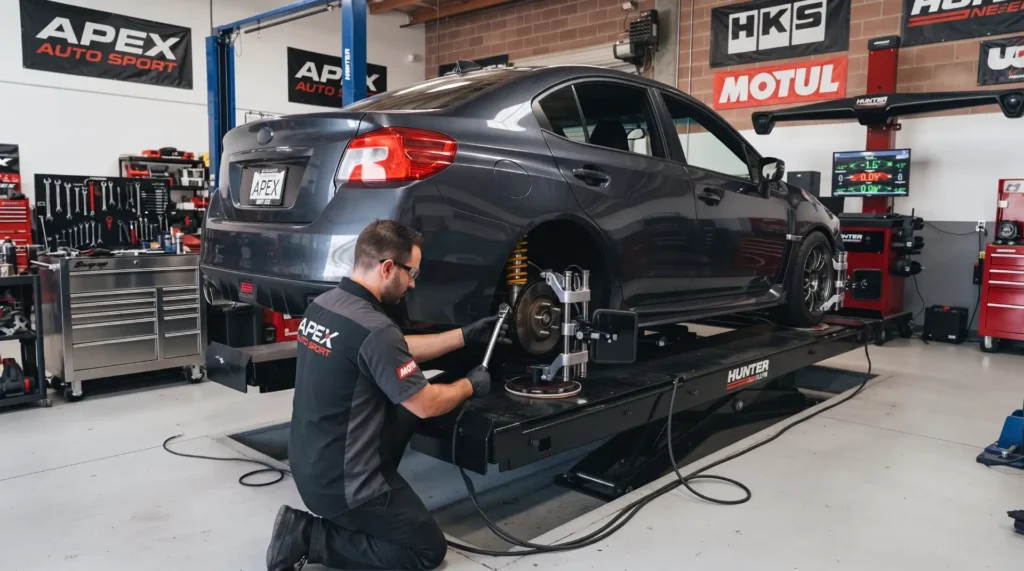 Lightweight Wheels Can Improve Responsiveness
Once the right tires are selected, wheels become the next consideration.
Large wheels may look impressive, but increasing wheel diameter and weight can negatively affect ride quality and responsiveness.
A lightweight wheel can reduce unsprung and rotational mass.
Reducing unsprung weight can help the suspension respond more effectively to changes in the road surface. Lower rotational mass can also improve the vehicle’s ability to accelerate and decelerate.
This does not mean the lightest wheel available is automatically the best choice.
Street-driven cars need wheels capable of handling potholes, rough pavement, road debris, and other conditions common on American roads.
Wheel construction, load rating, offset, diameter, and width all matter.
A slightly smaller lightweight wheel combined with a quality performance tire can sometimes provide a better real-world driving experience than an oversized wheel with an extremely low-profile tire.
The best choice depends on the specific AWD sedan.
Upgrade the Brakes Before Chasing Big Horsepower
More power can make an AWD sport sedan significantly faster, but increased acceleration also means the vehicle may reach higher speeds more quickly.
That makes braking performance an important part of any performance build.
The brake system should be treated as part of the overall performance package.
For many street-driven vehicles, high-quality performance brake pads, fresh high-temperature brake fluid, and appropriate rotors can provide a noticeable improvement without requiring a complete big-brake conversion.
Brake fluid deserves particular attention for vehicles used at track days.
Repeated hard braking generates substantial heat. If brake fluid becomes too hot, the pedal can become soft and braking performance can deteriorate.
Performance brake pads designed for the intended driving environment can improve consistency, but aggressive track-oriented pads may produce more noise, dust, or reduced cold performance than a street pad.
This is another reason to match components to how the vehicle is actually used.
A commuter vehicle that sees one track day each year does not necessarily need the same brake setup as a dedicated track car.
Suspension Upgrades Can Transform an AWD Sedan
Suspension modifications are among the most effective ways to change how an AWD sport sedan feels.
A well-designed suspension setup can improve steering response, reduce body roll, increase cornering confidence, and provide better control during acceleration and braking.
Coilovers are popular because they can combine adjustable ride height with damping control, depending on the design.
However, lowering a car excessively can create problems.
A very low vehicle may experience reduced suspension travel, altered suspension geometry, increased scraping, and compromised ride quality.
For an American daily driver, a moderate setup is often more effective than an extreme one.
Spring and damper combinations can also provide excellent results without the adjustability or complexity of coilovers.
The key is selecting components designed specifically for the vehicle.
Wheel Alignment Matters More Than Many Drivers Realize
After changing suspension components, alignment becomes extremely important.
Camber, caster, toe, and other alignment settings influence how the vehicle responds during cornering and braking.
A performance-oriented alignment can improve cornering behavior, but excessive settings may accelerate tire wear.
For street-driven sport sedans, alignment should reflect actual use.
A vehicle that spends most of its time commuting should not necessarily receive an aggressive track alignment.
Performance alignment should also account for the vehicle’s suspension design and tire characteristics.
A qualified performance shop can measure the vehicle and recommend settings based on whether the priority is street driving, autocross, canyon roads, or track use.
Improve Chassis Response With Sway Bars
Sway bars, also called anti-roll bars, can alter how a vehicle behaves during cornering.
They connect suspension components across the vehicle and help resist body roll.
On an AWD sport sedan, properly selected sway bars can make the car feel more responsive and controlled.
However, changing sway-bar stiffness can also alter handling balance.
Increasing stiffness at one end of the car can change how much grip that end maintains during cornering.
Therefore, sway bars should not be selected solely because they are advertised as “stiffer.”
The goal is to achieve the desired handling balance while maintaining predictable behavior.
This is especially important for street cars driven in wet conditions.
ECU Tuning Can Unlock More Performance
Once tires, brakes, suspension, and basic chassis components are addressed, ECU tuning becomes an attractive upgrade for many modern turbocharged AWD cars.
Turbocharged engines generally provide significant opportunities for software-based performance improvements.
An ECU calibration can modify parameters such as boost pressure, ignition timing, fuel delivery, throttle response, and torque management, depending on the vehicle.
The potential gains vary significantly by engine, fuel, factory calibration, and hardware.
A conservative tune designed around the vehicle’s existing hardware may provide a noticeable improvement without requiring extensive modifications.
However, tuning should always account for reliability and operating conditions.
More boost and aggressive ignition timing can increase engine temperatures and mechanical stress.
Fuel quality also matters.
A calibration developed for premium gasoline should not automatically be used with lower-octane fuel.
Drivers should also consider whether a tune is compatible with local emissions requirements and the vehicle’s intended use.
Consider an E85 or Flex-Fuel Setup Carefully
 Consider an E85 or Flex-Fuel Setup Carefully
E85 has attracted significant attention among American performance enthusiasts because ethanol fuel can provide useful characteristics for high-performance applications.
Depending on the vehicle and fuel system, ethanol’s properties can support increased power and knock resistance.
However, E85 is not universally available, and fuel composition can vary.
A vehicle must also have a fuel system and calibration capable of handling the intended ethanol content.
Flex-fuel systems can provide greater flexibility by allowing the vehicle to adjust calibration according to ethanol concentration, when properly designed and supported.
Drivers should verify local fuel availability before building a vehicle around E85.
Auto Sport Performance has previously discussed E85 and hybrid performance tuning, making this an appropriate internal topic for readers interested in taking an AWD build further.
Improve Cooling Before Increasing Power Aggressively
Power creates heat.
This is one of the most important principles to remember when modifying an AWD performance sedan.
A more aggressive tune can increase engine load and heat production.
Repeated high-load driving can expose weaknesses in the cooling system that may not appear during normal commuting.
Cooling upgrades can include improved intercoolers, radiators, oil coolers, transmission cooling, and better airflow management.
Turbocharged vehicles can particularly benefit from intercooling improvements.
An intercooler reduces the temperature of compressed intake air before it enters the engine.
Lower intake temperatures can help improve consistency under demanding conditions.
This becomes especially important during summer driving in parts of the United States where ambient temperatures can exceed 100°F.
Auto Sport Performance’s coverage of thermal management provides a useful related resource for readers looking to understand why cooling should be considered before chasing maximum output.
Upgrade the Intercooler on Turbocharged AWD Cars
Many modern AWD sport sedans use turbocharged engines.
Turbochargers compress incoming air, increasing the amount of oxygen available for combustion. However, compressing air also generates heat.
An intercooler helps remove that heat.
The factory intercooler is generally designed to balance cost, packaging, emissions requirements, reliability, and performance.
When power output increases, the factory intercooler may become a limiting factor.
A larger or more efficient intercooler can help reduce heat soak and maintain more consistent intake temperatures.
The ideal intercooler depends on the vehicle and intended use.
For a daily-driven car, rapid recovery and street manners may be more important than maximum cooling capacity.
For track use, sustained heat management becomes much more important.
Exhaust Upgrades Can Improve Sound and Flow
An aftermarket exhaust is another common modification.
Depending on the vehicle and system design, a performance exhaust can reduce restrictions, change exhaust sound, and potentially support increased power when combined with other modifications.
However, exhaust modifications should be approached carefully.
A system that sounds excellent during a short test drive can become tiring during long highway trips.
Drone is a common complaint with aggressive exhaust systems.
U.S. drivers should also be aware of noise regulations and emissions requirements applicable to their vehicle and location.
A high-quality cat-back system that maintains required emissions equipment can be a sensible street-oriented modification.
Intake Systems and Airflow Improvements
Cold-air and high-flow intake systems are popular because they can change engine sound and potentially improve airflow.
But intake modifications should be evaluated based on actual engineering rather than marketing claims.
A modern engine management system can compensate for many changes in airflow.
That means an intake may produce a noticeable change in sound without producing a large horsepower increase.
The best intake systems are designed to provide consistent airflow while controlling intake temperatures.
Avoid setups that draw hot air from the engine compartment unless the design specifically accounts for thermal conditions.
For turbocharged AWD vehicles, intake temperature can have a major impact on performance consistency.
Transmission and Drivetrain Considerations
Adding power to an AWD sport sedan affects more than the engine.
The transmission, differentials, driveshafts, axles, clutch or torque converter, and AWD system all experience additional loads.
Some modern vehicles use electronically controlled torque distribution systems that depend heavily on software.
This means an ECU tune should not be evaluated solely by its horsepower figure.
Torque delivery can be equally important.
A very aggressive torque increase at low RPM may place significant stress on the drivetrain.
A well-designed calibration can provide strong performance while controlling torque in areas where mechanical limitations exist.
Drivers considering substantial power increases should research the limitations of their specific transmission and AWD system before upgrading.
Performance Differential Upgrades
For some AWD platforms, differential upgrades can improve traction and cornering behavior.
Limited-slip differentials can help distribute torque more effectively when one wheel begins losing traction.
However, many modern AWD vehicles already use sophisticated electronic torque-vectoring systems.
The best upgrade depends on the factory drivetrain.
Installing a mechanical component without understanding how it interacts with the vehicle’s electronic systems can create unexpected behavior.
Professional installation and calibration are particularly important with drivetrain modifications.
Aerodynamic Upgrades Should Serve a Purpose
Splitters, spoilers, wings, diffusers, and other aerodynamic components are popular among sport-sedan owners.
Some provide primarily visual benefits.
Others can produce meaningful aerodynamic changes.
For a street-driven vehicle, aerodynamic modifications should be selected carefully.
A large wing designed for track use may generate significant drag and may not provide useful benefits at normal road speeds.
A properly designed front splitter, rear spoiler, or underbody component can provide more balanced results.
The key is to understand the purpose of the component rather than installing it simply because it looks aggressive.
Lightweight Performance Upgrades Can Add Up
Performance does not always come from adding power.
Reducing unnecessary weight can improve acceleration, braking, cornering, and efficiency.
Lightweight wheels are one example.
Other possibilities include lightweight battery systems, carefully selected seats, and other components designed specifically for weight reduction.
However, street cars need to remain practical.
Removing sound insulation, interior equipment, safety systems, or comfort features may make a vehicle faster but significantly less enjoyable as a daily driver.
For most American enthusiasts, moderate weight reduction combined with sensible performance upgrades offers a better compromise.
Track Preparation Requires a Different Approach
A sport sedan built for daily driving should not necessarily be modified like a dedicated track car.
Track use generates much higher thermal and mechanical demands.
A vehicle intended for regular track days may need upgraded brake cooling, higher-temperature brake fluid, more aggressive brake pads, additional engine and transmission cooling, track-focused tires, and suspension adjustments.
Tire pressures also require careful monitoring.
The driver should inspect the vehicle before and after each track session.
Track preparation is ultimately about consistency and reliability rather than simply maximizing horsepower.
A vehicle that produces huge power but overheats after several laps is less useful than a slightly less powerful car that can perform consistently throughout the session.
Don’t Ignore Maintenance
Performance upgrades cannot compensate for poor maintenance.
Before modifying an AWD sport sedan, owners should make sure the vehicle is mechanically healthy.
Oil should be changed according to appropriate service requirements.
Cooling systems should be inspected.
Brake components should be in good condition.
Tires should have adequate tread.
Suspension components should not have worn bushings or damaged joints.
Spark plugs and ignition components should be appropriate for the engine and calibration.
AWD systems also require attention to their specified fluids and service intervals.
Starting with a healthy vehicle provides a much stronger foundation for modifications.
The Best Performance Build Is Balanced
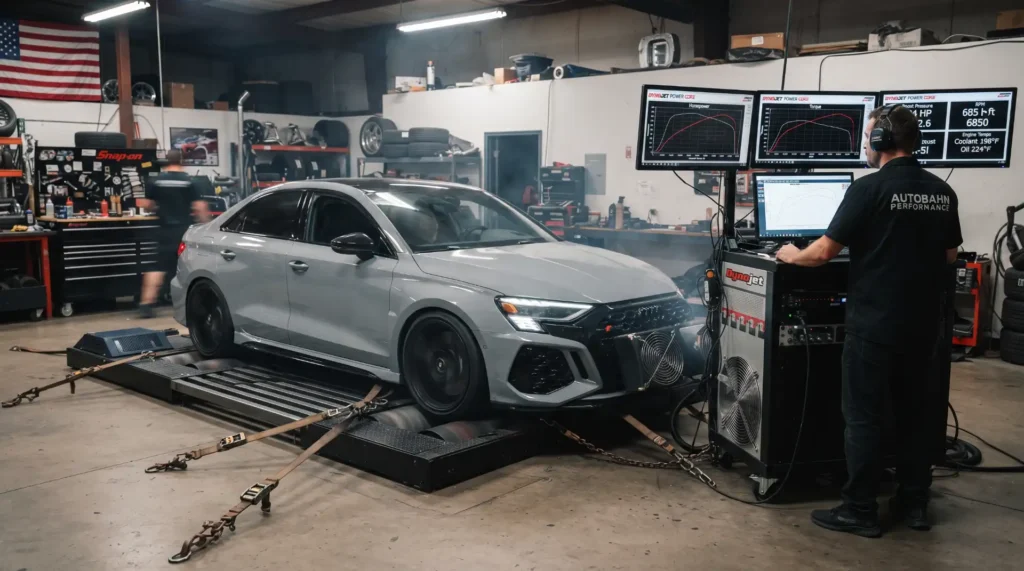 The Best Performance Build Is Balanced
The most effective AWD performance builds are balanced.
Imagine two identical sport sedans.
The first receives an aggressive ECU tune but keeps worn tires, factory brakes, and inadequate cooling.
The second receives quality performance tires, brake improvements, suspension upgrades, cooling improvements, and a conservative tune.
The second vehicle may deliver a better overall driving experience even if its peak horsepower number is lower.
That is because performance is more than acceleration.
A truly capable vehicle needs to accelerate, corner, stop, and manage heat consistently.
This is especially important for modern AWD sport sedans because their sophisticated systems work together.
Changing one part can affect the behavior of another.
A Sensible Upgrade Path for U.S. Drivers
For most American street-driven AWD sport sedans, a sensible modification strategy starts with maintenance and tires.
After that, brake pads and fluid can improve stopping performance, followed by suspension and alignment improvements.
Cooling upgrades become increasingly important as power levels rise.
Once the chassis and thermal systems can handle additional output, ECU tuning and supporting power modifications can provide stronger acceleration.
This approach also makes it easier to identify which modification actually improves the vehicle.
Instead of changing ten things simultaneously, owners can evaluate each stage.
That makes troubleshooting easier and reduces the likelihood of creating compatibility problems.
U.S. Legal and Emissions Considerations
Performance enthusiasts in the United States should always consider emissions compliance when modifying a street vehicle.
Some ECU tunes, exhaust components, catalytic-converter modifications, and emissions-related devices may not be legal for use on public roads.
The U.S. Environmental Protection Agency explains that tampering with vehicle emissions-control systems is prohibited under federal law.
Before purchasing a modification, owners should determine whether it is legal for their intended street use and whether the product has the appropriate emissions certification where required.
This is particularly important for drivers in states with strict emissions inspection programs.
The EPA’s official vehicle emissions resources are a useful starting point for understanding federal requirements. U.S. Environmental Protection Agency — Vehicle Emissions
How Much Should You Spend on AWD Performance Upgrades?
There is no universal budget.
A driver with limited funds can start with tires, brake pads, and alignment.
A larger budget can support suspension, cooling, wheels, and ECU tuning.
A serious track build may require significantly more investment.
The important point is to spend money where it improves the vehicle’s weakest area.
If the car cannot stop consistently, more horsepower should not be the priority.
If the vehicle overheats, an exhaust system should not be the priority.
If the tires cannot maintain traction, another 50 horsepower may not make the car faster in real-world conditions.
Performance modifications should solve problems rather than simply increase the parts list.
Final Thoughts
Modern AWD cars and sport sedans offer an impressive combination of speed, practicality, and technology.
With the right upgrades, they can become significantly more capable without sacrificing their usefulness as everyday vehicles.
The most important upgrades often begin with the basics: quality tires, effective brakes, properly selected suspension components, accurate wheel alignment, and reliable cooling.
From there, owners can explore ECU tuning, intake and exhaust upgrades, drivetrain improvements, lightweight wheels, and other modifications.
The key is balance.
A fast AWD sedan should also be able to stop, corner, manage heat, and remain reliable.
For American enthusiasts, the ideal performance build is one that matches the vehicle to its actual purpose. A daily driver needs comfort and reliability. A weekend canyon car needs responsive handling. A track vehicle needs thermal control and consistency.
There is no single perfect modification list.
The best setup is the one that improves the areas that matter most to the driver while respecting the limitations of the vehicle.
As AWD technology and turbocharged powertrains continue to evolve, performance upgrades will also become increasingly sophisticated. Software, thermal management, electronics, tires, suspension, and drivetrain technology will all play a role in determining how effectively modern sport sedans put power to the pavement.
Ultimately, building a better AWD performance car is not about chasing the biggest horsepower number.
It is about creating a vehicle that performs better as a complete package.