
Modern gasoline engines deliver more power and better fuel economy than many older engines of comparable size. Turbochargers, sophisticated engine computers, variable valve timing, and gasoline direct injection allow manufacturers to produce vehicles that accelerate quickly while meeting increasingly demanding efficiency and emissions targets. However, these technologies also create maintenance considerations that drivers need to understand.
One of the most frequently discussed issues among owners of modern performance cars is carbon buildup in direct-injection engines. Deposits can accumulate on intake valves and other internal engine surfaces, potentially contributing to rough idling, hesitation, misfires, reduced engine performance, and increased maintenance costs.
The problem is particularly relevant to owners of turbocharged sport sedans, hot hatchbacks, modern muscle cars, and other vehicles equipped with gasoline direct injection. Drivers may notice that an engine no longer feels as smooth or responsive as it once did. Before spending money on performance upgrades or an aggressive engine tune, it is worth determining whether deposits or another maintenance issue could be affecting the vehicle.
Carbon buildup is not inevitable at the same rate in every engine. Some vehicles operate for many years without significant deposit-related problems, while others develop symptoms that require professional inspection and cleaning. Engine design, crankcase ventilation, oil formulation, fuel-system configuration, driving patterns, and maintenance history can all influence the situation.
Understanding these factors helps owners distinguish between normal maintenance and a problem that deserves attention. It also prevents unnecessary spending on fuel additives, cleaning services, or replacement parts that may not address the actual cause.
This guide explains how direct injection works, why carbon deposits form, which symptoms deserve attention, how buildup can affect performance, what cleaning methods are available, and how drivers in the United States can make sensible maintenance decisions.
What Is Carbon Buildup in a Direct-Injection Engine?
Carbon buildup is the accumulation of deposits on internal engine surfaces. These deposits may contain carbonaceous material, oxidized oil, fuel-related residues, inorganic elements from lubricants and engine wear, and other combustion or ventilation byproducts.
The location of the deposits matters because different engine components perform different jobs. Deposits inside a combustion chamber, for example, are not necessarily the same problem as deposits on the backs of intake valves. The appropriate diagnostic and cleaning methods can differ considerably.
In gasoline direct-injection engines, the intake valves are a particularly important area. These valves open and close to control the flow of air into each cylinder. When deposits accumulate around the valve stems, valve heads, or intake ports, they can alter airflow. Depending on the engine and severity of the accumulation, this may contribute to rough operation, reduced performance, or other drivability concerns.
How Gasoline Direct Injection Works
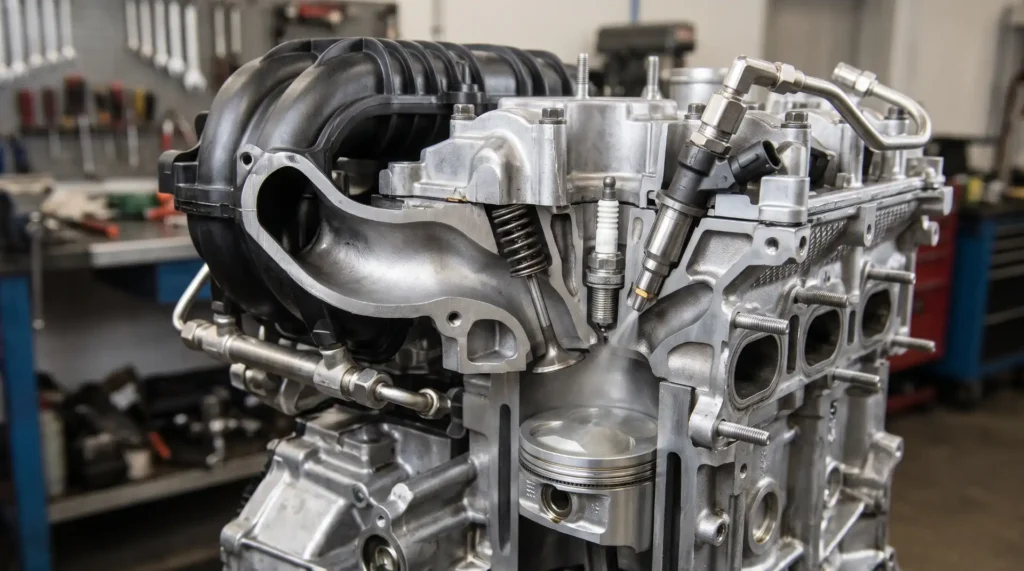
Traditional port fuel injection introduces gasoline into the intake port near the intake valve. The fuel mixes with incoming air before the mixture enters the cylinder. Because gasoline passes over the intake valves, it can help limit certain deposits on their surfaces.
Gasoline direct injection, commonly called GDI, operates differently. Instead of injecting gasoline into the intake port, the system sprays fuel directly into the combustion chamber. High-pressure injectors and precise electronic controls allow the engine computer to manage fuel delivery according to operating conditions.
This design offers several advantages. Direct injection can support efficient combustion, precise fuel metering, strong torque, and impressive output from relatively small engines. Combined with turbocharging, it allows manufacturers to build vehicles that deliver substantial power without relying on large engine displacements.
However, a direct-injection-only engine does not routinely spray gasoline over the backs of its intake valves. As a result, fuel cannot provide the same washing effect that occurs in a conventional port-injected engine.
Oil mist and other contaminants entering through the intake system can accumulate on those surfaces. Over repeated heat cycles, some contaminants form deposits that become increasingly difficult to remove.
Research published by SAE International examines how engine oil, wear-related materials, unburned fuel, and other contaminants contribute to intake-valve deposits in gasoline direct-injection engines. Read the technical overview in SAE International’s research on intake-valve deposit formation.
 Does Every Direct-Injection Engine Develop Serious Deposits?
 Does Every Direct-Injection Engine Develop Serious Deposits?
No. The presence of direct injection does not mean that an engine will inevitably develop a serious performance problem.
Deposit formation varies by engine architecture, valve and port design, crankcase ventilation strategy, lubricant formulation, fuel-system configuration, operating conditions, and maintenance history. Some engines also combine port injection with direct injection, allowing port injectors to wash the intake valves under certain operating conditions.
Mileage alone is not a reliable indicator of whether cleaning is necessary. One vehicle may develop significant deposits at a relatively low mileage, while another may accumulate deposits without noticeable symptoms over a much longer period.
The important distinction is between deposits that are present and deposits that interfere with normal engine operation. A technician should consider the vehicle’s symptoms, diagnostic information, service history, and physical inspection before recommending a repair.
Why Carbon Deposits Form on Intake Valves
Carbon buildup usually results from several interacting processes rather than a single cause. Understanding those processes helps explain why some popular prevention methods work only in limited circumstances.
Crankcase Ventilation and Oil Vapor
Engines naturally produce some combustion gases that pass the piston rings into the crankcase. This is known as blow-by. The positive crankcase ventilation system, or PCV system, manages these gases by routing them back into the intake system so they can be burned rather than released directly into the atmosphere.
The gases can carry fine oil droplets and vapor. Some of this material settles on intake surfaces. As the engine heats and cools, the residue can change chemically and combine with other contaminants, gradually forming deposits.
The PCV system is essential for controlling crankcase pressure and emissions, but it cannot eliminate every trace of oil vapor. A small amount of oil mist in the intake does not automatically mean that the system is faulty.
However, a damaged PCV valve, deteriorated hose, faulty separator, or other ventilation problem can increase oil consumption or contamination. If a vehicle has unexplained oil use, unusual crankcase pressure, oil leaks, or excessive intake oil, the ventilation system deserves attention.
Heat and Repeated Operating Cycles
Intake components experience changing temperatures throughout normal driving. A cold engine, a fully warmed engine, and an engine operating under heavy load do not have identical combustion or ventilation conditions.
Short trips can keep an engine in its cold-start operating phase for a greater portion of its use. Frequent starts, stop-and-go traffic, extended idling, and repeated heat cycles may influence how contaminants accumulate, although their effects vary by engine design.
This does not mean that highway driving will eliminate carbon deposits. Nor should owners deliberately drive aggressively to try to burn off deposits. Direct-injection intake valves are not routinely washed by gasoline, and excessive engine load can create unnecessary heat and mechanical stress.
Normal, appropriate driving and correct maintenance are better strategies than attempting to clean the engine through high-speed driving.
Engine Oil Formulation and Condition
Engine oil lubricates moving parts, helps manage heat, and protects internal surfaces from wear. Its chemistry can also influence the materials that enter the intake through crankcase ventilation.
Use the viscosity and performance specification required by the vehicle manufacturer. If the owner’s manual calls for a specific industry standard or manufacturer approval, choose oil that meets that requirement rather than selecting a product based only on price or marketing claims.
Expensive oil is not automatically a carbon-prevention solution, and changing oil more frequently than necessary does not guarantee clean intake valves. Nevertheless, correct oil selection and appropriate service intervals support overall engine health.
Modified engines may require additional consideration because changes in boost, operating temperatures, and engine load can affect service demands. Owners should consult a qualified technician who understands the engine and its modifications before changing oil specifications or service intervals.
Fuel Quality and Injector Deposits
Fuel quality can influence certain types of deposits, especially in the fuel system. Detergent additives in gasoline are designed to help control deposits on components that the fuel contacts.
However, fuel-system cleanliness and intake-valve cleanliness are not the same thing. In a direct-injection-only engine, gasoline is sprayed directly into the combustion chamber rather than across the backs of the intake valves. Therefore, an additive that helps clean fuel injectors should not automatically be expected to remove heavy intake-valve deposits.
Drivers should use the octane grade specified in the owner’s manual and purchase fuel from reputable suppliers. Premium gasoline is not inherently a carbon-cleaning treatment. Octane rating measures resistance to knock; it does not directly indicate how effectively fuel will remove deposits from intake valves.
Seven Symptoms of Carbon Buildup in Direct-Injection Engines
Carbon-related symptoms often develop gradually. A driver may notice a slightly uneven idle, a brief hesitation during acceleration, or a decline in responsiveness before a more obvious problem appears.
Carbon buildup is only one possible cause of rough idling, hesitation, and reduced engine response. Learn about other warning signs in our guide to the top five signs your car needs performance tuning.
The difficulty is that these symptoms can also result from ignition faults, vacuum leaks, injector problems, sensor failures, fuel-pressure issues, or other mechanical conditions. Symptoms are clues, not proof of carbon buildup.
1. Rough Idle and Engine Vibration
A rough idle is one of the symptoms commonly associated with intake-valve deposits. When the vehicle is stopped, the engine may shake more than usual, the RPM may fluctuate, or vibration may be felt through the steering wheel and seats.
Deposits that interfere with airflow can affect the amount of air entering individual cylinders. Uneven cylinder filling can contribute to unstable combustion, especially under conditions where the engine is already sensitive to airflow changes.
However, engine mounts, worn spark plugs, failing ignition coils, vacuum leaks, and fuel-delivery faults can produce similar symptoms. A damaged engine mount may make normal engine vibration feel excessive even when combustion is normal.
If rough idling persists, the vehicle should be inspected instead of immediately paying for carbon cleaning.
2. Hesitation When Accelerating
An engine with a drivability problem may hesitate when the accelerator is pressed. The car may stumble briefly, respond more slowly than expected, or struggle to build speed smoothly.
Drivers may notice the problem when entering a freeway, climbing a hill, or accelerating from a stop. In a turbocharged vehicle, the hesitation may be mistaken for turbo lag.
Carbon deposits can contribute to airflow problems, but a boost leak, faulty airflow sensor, ignition issue, or fuel-pressure problem can produce similar behavior. A technician should examine the relevant systems before recommending parts or cleaning.
3. Reduced Power and Throttle Response
Some owners notice that their vehicle feels less powerful than it did when it was newer. Acceleration may become less consistent, throttle response may feel dull, or the engine may struggle under heavier load.
Significant deposits can alter intake airflow and potentially affect cylinder filling. However, the amount of power lost depends on the engine, the location and severity of the deposits, and the operating conditions.
There is no universal horsepower-loss percentage that applies to every direct-injection engine. Claims that cleaning will restore a specific number of horsepower should be treated cautiously unless supported by relevant testing.
For performance enthusiasts, the better approach is to establish whether the engine is operating correctly before purchasing an ECU tune or other power upgrade.
4. Engine Misfires and a Check Engine Light
Misfires occur when combustion in one or more cylinders does not happen as expected. The vehicle may vibrate, hesitate, lose power, or illuminate the check engine light.
OBD-II trouble code P0300 generally indicates random or multiple-cylinder misfires. Codes P0301, P0302, and similar codes generally identify misfires associated with individual cylinders. These codes can guide diagnosis, but they do not prove that carbon deposits are responsible.
Worn spark plugs, faulty coils, injector problems, compression issues, and air leaks can all produce misfires. The technician should evaluate the codes alongside misfire data, fuel trims, ignition condition, and other test results.
A flashing check engine light may indicate an active misfire that could damage the catalytic converter. Reduce engine load and stop driving when it is safe to do so if the engine is shaking severely or the light is flashing. Arrange professional assistance instead of continuing to accelerate hard.
5. Difficult Cold Starts
A vehicle may start and run roughly after being parked overnight, then become smoother as it warms up. In some engines, deposit-related airflow problems may contribute to this behavior.
However, cold-start problems can also result from a weak battery, fuel-pressure loss, ignition faults, temperature-sensor problems, or mechanical issues. If the starter turns slowly, for example, the battery and starting system should be checked before focusing on intake deposits.
Take note of whether the problem occurs only after an overnight parking period, during every cold start, or even when the engine is warm. This information helps the technician identify likely causes.
6. Declining Fuel Economy
If an engine operates inefficiently, fuel economy may decrease. Deposit-related drivability problems can contribute in some cases, but fuel consumption is affected by many variables.
Cold weather, low tire pressure, short trips, aggressive acceleration, traffic congestion, extended idling, and changes in driving routes can all reduce miles per gallon.
Compare fuel economy over several tanks under reasonably similar conditions rather than relying on one fill-up. If the decline continues and is accompanied by hesitation, misfires, or rough running, arrange a diagnostic inspection.
7. Inconsistent Performance Under Load
Some vehicles operate reasonably well during light driving but develop hesitation or misfires under higher load. The problem may appear during uphill acceleration, highway merging, towing within the manufacturer’s limits, or track use.
Higher engine load places greater demands on the ignition and fuel systems. A weak ignition coil or worn spark plug may work acceptably at idle but fail under acceleration. Fuel-pressure limitations and boost leaks can also become more noticeable.
Carbon buildup is one possibility, but repeated full-throttle testing is not a sensible way to diagnose the problem. If symptoms are severe, arrange professional testing rather than risking engine or exhaust-system damage.
How Carbon Buildup Reduces Engine Performance
 How Carbon Buildup Reduces Engine Performance
Carbon deposits can affect performance in several ways, but the result depends on the engine’s design and the amount and location of the accumulation. Light deposits may have little noticeable effect. More substantial deposits can interfere with airflow, combustion stability, and drivability.
Understanding airflow restrictions is essential when diagnosing engine performance problems. Read our guide to optimizing intake and exhaust flow with data-driven upgrades to learn how airflow affects engine efficiency, throttle response, and performance.
Restricted Airflow and Cylinder Filling
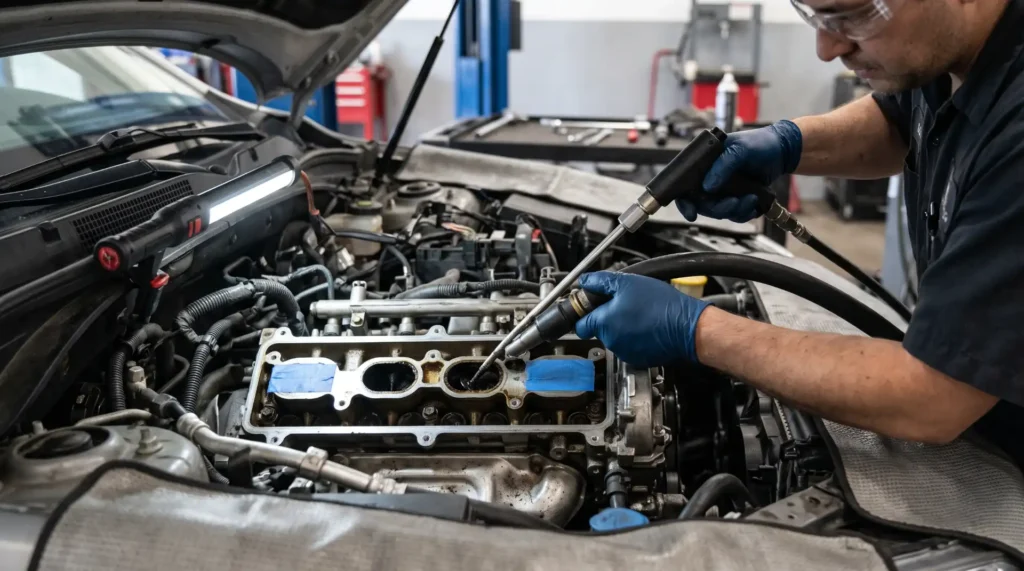
Intake valves control the movement of air into the cylinders. Deposits around the valve stems, valve heads, and intake ports can change the shape of the airflow path. If the deposits become substantial, they may reduce the effective area available for air to enter the cylinder.
This matters because an engine’s output depends on the amount of air it can process, the fuel delivered, ignition timing, and combustion efficiency. In a performance engine, predictable airflow is particularly important when the driver demands strong acceleration.
However, visible deposits do not automatically establish that airflow is restricted enough to affect performance. A technician must consider the deposit severity and the vehicle’s symptoms before deciding whether cleaning is necessary.
Combustion Stability and Misfire Risk
Engines need consistent airflow and reliable ignition to produce smooth power. When airflow becomes uneven or another combustion-related problem develops, the engine may misfire or operate less smoothly.
Persistent misfires should never be ignored. Unburned fuel can enter the exhaust and overheat the catalytic converter, potentially creating an expensive repair. Misfires can also cause unpredictable power delivery, which is particularly concerning when merging into traffic or accelerating on a busy road.
If the check engine light flashes, avoid heavy acceleration and seek professional assistance. Carbon cleaning may be appropriate if deposits are confirmed as the cause, but ignition, fuel, and mechanical faults must also be considered.
Turbocharged Engines and Boost Response
Turbocharged direct-injection engines are popular among American performance enthusiasts because they produce strong torque from relatively small displacements. Their output depends on several systems working together, including intake airflow, boost control, fuel pressure, ignition timing, and thermal management.
If deposits contribute to airflow or combustion problems, drivers may notice less consistent response. However, a boost leak, malfunctioning sensor, or protective engine-computer strategy can create similar symptoms.
Before installing a more aggressive ECU tune, confirm that the engine is mechanically healthy. Additional boost cannot repair restricted intake passages, worn ignition components, or a fuel-delivery problem. Increasing engine load while an unresolved fault exists may make the situation worse.
For a related discussion of airflow and performance, see Auto Sport Performance’s guide to optimizing intake and exhaust flow with data-driven upgrades.
Long-Term Reliability and Repair Costs
Carbon deposits do not automatically mean an engine is about to fail. Many engines continue to operate with some accumulation, and cleaning decisions should be based on the vehicle’s condition rather than fear.
Nevertheless, ignoring persistent misfires, rough running, or power loss can increase repair costs. A catalytic converter damaged by repeated misfires, for example, can be considerably more expensive to replace than the original problem.
The sensible approach is to identify the cause early and address it before secondary damage develops. If a vehicle is running normally, there is generally no reason to assume that every trace of carbon must be removed immediately.
How Mechanics Diagnose Intake-Valve Carbon Buildup
A reliable diagnosis combines the driver’s observations, maintenance history, diagnostic trouble codes, relevant manufacturer information, and physical inspection. Replacing parts based on symptoms alone can waste money without correcting the underlying problem.
Step 1: Review Symptoms and Service History
A technician should ask when the symptoms began, whether they occur during cold starts or warm operation, and whether the vehicle has recently been modified or repaired.
Maintenance history can provide useful context. Recent spark plug replacement, PCV-system repairs, oil consumption changes, software updates, or previous intake cleaning may be relevant.
Owners should mention changes in fuel economy, starting behavior, engine vibration, or acceleration. If the problem began shortly after an aftermarket intake or ECU tune was installed, that information may help identify an installation or calibration issue.
Step 2: Scan the Engine Computer
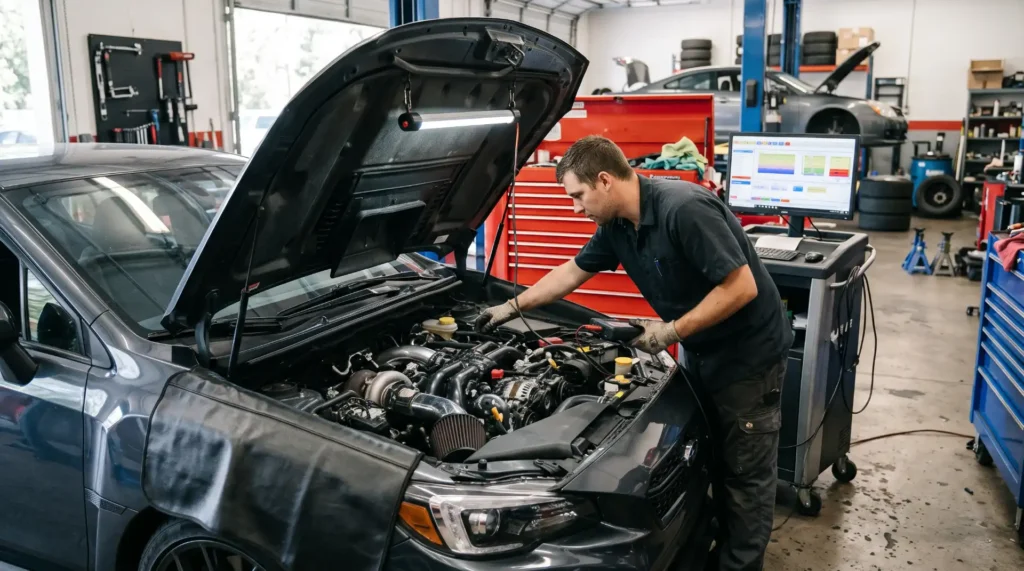
An OBD-II scan can reveal stored and pending fault codes, while more advanced diagnostic equipment may provide manufacturer-specific information and live operating data.
A technician may review misfire counters, fuel trims, airflow readings, fuel pressure, temperature data, and other relevant parameters. These measurements can help identify whether the problem is associated with combustion, fuel delivery, airflow, or another system.
A fault code is not always a direct identification of a failed component. A misfire code means that the engine computer has detected a combustion problem; it does not automatically mean that the intake valves are dirty.
Step 3: Inspect the Intake Valves
If the evidence suggests deposit-related problems, the technician may inspect the intake valves and ports. Depending on the engine design, access may require removing the intake manifold and associated components.
A borescope may help examine accessible surfaces, although visibility depends on the engine layout and inspection equipment. Some engines require more extensive disassembly for a reliable assessment.
The technician should determine whether the deposits are substantial enough to plausibly explain the symptoms. Discoloration alone does not prove that cleaning will restore power or eliminate a misfire.
Step 4: Rule Out Other Causes
Before recommending cleaning, the technician should consider other likely faults, including worn spark plugs, failing ignition coils, faulty injectors, fuel-pressure problems, vacuum leaks, intake leaks, sensor errors, and mechanical issues.
Manufacturer technical service bulletins can also be useful when an engine family has a documented concern or updated repair procedure. Such information applies to the models, conditions, and procedures identified by the manufacturer, not automatically to every vehicle with direct injection.
Owners should request an explanation of the findings before approving a major service. A reputable workshop should be able to explain why the proposed repair is appropriate and how it will be verified.
Carbon Cleaning Methods: Which Options Are Effective?
The right cleaning method depends on the deposit location, severity, engine design, and manufacturer recommendations. A treatment designed for fuel injectors may not remove heavy deposits from intake valves. Similarly, a process suitable for one engine may be inappropriate for another.
Before paying for a cleaning service, ask the shop which components will be cleaned, what method will be used, and why it is suitable for your particular engine.
Fuel-Tank Additives
Fuel additives are commonly marketed for cleaning injectors and controlling fuel-system deposits. Some formulations can help clean components that come into contact with the treated gasoline, depending on the product chemistry and engine design.
The main limitation is that fuel in a direct-injection-only engine does not routinely flow across the backs of the intake valves. A tank additive should therefore not be presented as a guaranteed way to remove heavy deposits from those surfaces.
An additive may have a role in maintaining other fuel-system components, but that is different from mechanically cleaning the intake valves. Follow the vehicle manufacturer’s guidance, and avoid combining chemicals or exceeding dosage instructions.
Professional Chemical Cleaning
Some professional services use specialized chemical treatments introduced through a controlled procedure. Depending on the product and engine, these treatments may help address certain deposits.
Results vary according to the chemistry, the deposit type, and the application method. A treatment suitable for light contamination may not be effective against heavy, hardened accumulation.
Ask whether the product is recommended for your engine and whether it targets the actual deposit location. The shop should also explain the procedure’s limitations and what improvement can reasonably be expected.
Be skeptical of claims that every direct-injection engine requires the same cleaning treatment at a fixed mileage or that one service will restore a guaranteed amount of horsepower.
Walnut-Shell Blasting
Walnut-shell blasting is a commonly used professional method for removing intake-valve deposits from engines for which the procedure is appropriate. Specialized equipment directs crushed walnut-shell media at the deposits while the technician follows precautions to prevent debris from entering the cylinders or other engine passages.
The intake system generally needs to be opened to access the valves. The engine must be positioned and prepared according to the applicable service procedure, and the technician must carefully control the process and remove remaining material.
Walnut-shell media is used because it can remove deposits without the same abrasive characteristics as many harder blasting materials. However, the procedure is not risk-free. Poor preparation, unsuitable equipment, or inadequate debris control can damage components or leave material where it should not be.
This is not a job to improvise using generic tools and an unverified online procedure. Proper equipment, engine-specific instructions, and relevant experience are essential.
Manual Cleaning During Intake Disassembly
In some cases, a technician may remove the intake manifold and clean accessible components using approved tools and methods. This approach may be appropriate when deposits are heavy or when disassembly is already required for another repair.
Manual cleaning also allows the technician to inspect related components while the intake system is accessible. However, the procedure can require substantial labor, particularly on engines where the intake manifold is difficult to remove.
The technician must protect sensitive surfaces, prevent debris from entering the engine, and replace required gaskets or seals. A low-cost procedure that fails to remove the deposits or causes a secondary problem may ultimately cost more than a properly performed repair.
What About Hydrogen and General Engine-Decarbonizing Services?
Drivers may encounter services advertised as hydrogen cleaning, engine decarbonizing, or carbon removal without disassembly. These labels can describe different processes, so ask exactly what the service does.
Do not assume that a general engine-cleaning treatment will remove heavy deposits from the backs of direct-injection intake valves. Ask for evidence that the method is effective for the specific deposit location and engine design.
A reputable shop should explain the process, its limitations, and the symptoms it is intended to address. Be cautious of guaranteed horsepower gains, universal claims that all engines need the service, or promises to fix a misfire without first identifying its cause.
How Much Does Carbon Cleaning Cost in the United States?
The cost varies by vehicle, engine layout, labor rates, deposit severity, and cleaning method. Some engines provide relatively straightforward access, while others require substantial disassembly to reach the intake valves.
As a broad budgeting estimate, drivers may encounter prices ranging from a few hundred dollars to more than $1,000 for specialized intake-valve cleaning on some vehicles. These figures are not guaranteed market prices, and complex engines or additional repairs can cost more.
A written estimate should explain what is included. Does the price cover diagnostic testing, intake-manifold removal, cleaning, replacement gaskets, reassembly, and post-repair verification? If the engine has a misfire, will the shop test the ignition and fuel systems, or is cleaning being recommended before the cause is confirmed?
Ask whether the shop has experience with your engine family. A technician familiar with the vehicle may be better prepared to identify access issues, follow the correct procedure, and recognize related problems.
Is Preventive Cleaning Worth the Expense?
Cleaning can be worthwhile when deposits have been confirmed and are reasonably likely to contribute to the symptoms. It may be unnecessary when a vehicle runs normally, no relevant problem has been identified, and the recommendation is based solely on mileage.
Consider two examples. A driver experiences persistent cold-start misfires, and an inspection reveals substantial deposits consistent with the symptoms. Professional cleaning may be a reasonable repair after other likely causes have been assessed.
Another driver owns a high-mileage vehicle that runs smoothly, has no relevant fault codes, and shows no evidence of a deposit-related problem. Paying for an expensive cleaning service simply because the vehicle has passed a certain mileage may offer little benefit.
The decision should be based on the engine’s condition and the available diagnostic evidence.
How to Prevent or Reduce Carbon Buildup
No maintenance routine can guarantee that an engine will never develop deposits. However, sound maintenance can reduce avoidable problems and help owners catch related faults before they become more expensive.
Follow the Correct Oil Specification and Service Schedule
Use engine oil that meets the viscosity, performance standard, and manufacturer approval specified for your vehicle. Do not select oil solely because it is marketed as a racing, high-mileage, or premium product.
Follow the manufacturer’s oil-change schedule while accounting for any severe-service conditions that apply to your driving. Frequent short trips, dusty environments, towing, and track use can place different demands on an engine than ordinary highway commuting.
For modified vehicles, discuss oil selection and service intervals with a qualified technician who understands the engine and its intended use. A more expensive oil or an arbitrarily shortened interval is not a guaranteed carbon-prevention strategy, but correct lubrication is essential to engine health.
Keep the PCV System in Good Condition
The PCV system helps manage crankcase gases and pressure. A damaged valve, deteriorated hose, or faulty ventilation component can contribute to unusual oil consumption, leaks, or abnormal intake contamination.
Ask whether the system needs inspection according to the manufacturer’s maintenance schedule. If the engine develops unexplained oil consumption, unusual crankcase pressure, or persistent drivability problems, include the PCV system in the diagnostic discussion.
Do not replace components at arbitrary intervals unless the manufacturer specifies that schedule or testing indicates a fault.
Use the Correct Fuel Grade
Always use the octane grade specified in the owner’s manual. A turbocharged engine calibrated for premium gasoline may be more susceptible to knock when operated on fuel with an insufficient octane rating.
Using the recommended fuel supports proper engine operation, but it does not guarantee clean intake valves. Premium gasoline should not be treated as a substitute for inspection or appropriate cleaning when deposits have already formed.
Choose fuel from reputable suppliers and follow any manufacturer recommendations regarding detergent standards. If a vehicle develops symptoms shortly after refueling, tell the technician, since fuel quality may be one factor worth investigating.
Maintain the Ignition and Fuel Systems
Worn spark plugs, failing ignition coils, and fuel-system problems can create symptoms that resemble carbon-related issues. Follow the manufacturer’s service schedule for ignition components and address warning lights promptly.
Replacing spark plugs does not prevent intake-valve deposits directly, but a healthy ignition system helps maintain proper engine operation and makes other faults easier to diagnose.
If the check engine light appears, have the vehicle scanned and investigate the cause rather than repeatedly clearing the codes. Stored diagnostic information may help a technician identify an intermittent issue.
Avoid Unnecessary Modifications
Performance modifications can change engine airflow, temperatures, fuel delivery, and operating load. An unsuitable intake, poorly installed component, or incompatible ECU calibration may introduce additional problems.
Before installing aftermarket parts, confirm that they are compatible with the vehicle and intended use. A modification that increases boost or changes airflow should be considered as part of the complete engine system, not as an isolated component.
Owners of street-driven vehicles in the United States should also check applicable emissions requirements before modifying emissions-related equipment. Removing or disabling required emissions controls is not a sound solution to carbon buildup and may create legal and mechanical problems.
Do Not Rely on High-Speed Driving to Clean the Engine
 Do Not Rely on High-Speed Driving to Clean the Engine
It is sensible to drive the vehicle normally and allow it to reach operating temperature according to the manufacturer’s guidance. However, deliberately revving a cold engine or driving aggressively to burn off intake deposits is not a reliable solution.
Because gasoline in a direct-injection-only engine does not routinely wash the intake valves, a high-speed drive cannot be relied upon to remove those deposits. Aggressive driving may also increase temperatures and load, potentially worsening an existing problem.
Drive smoothly, maintain the vehicle properly, and arrange an inspection if symptoms persist.
Consider Preventive Cleaning Only When Appropriate
Some engine families may have manufacturer guidance or a documented history of deposit-related concerns. In those cases, preventive inspection or cleaning may be reasonable under the conditions described by the manufacturer.
There is no single mileage interval that applies to every direct-injection engine. Ask why the service is recommended for your particular vehicle, what procedure will be used, and whether there is evidence of deposits or a known engine-specific issue.
For performance cars, maintenance spending should prioritize required service and the condition of critical systems. Preventive cleaning should not displace necessary repairs or be treated as a guaranteed horsepower upgrade.
Carbon Buildup in Turbocharged Performance Cars
Turbocharged direct-injection engines deserve particular attention because they combine high power density with additional demands on the fuel, ignition, and cooling systems.
A performance tune may increase boost pressure, adjust ignition timing, and change torque delivery. These changes can raise engine load and thermal demands. If the vehicle develops hesitation or misfires, it is tempting to blame carbon buildup, but the cause could instead be a boost leak, incorrect spark plug specification, weak ignition coil, fuel-pressure limitation, or unsuitable calibration.
Keeping a modified engine operating within its intended temperature range is an important part of long-term reliability. Explore our guide to coolant and thermal upgrades for your car for practical information about managing heat in performance applications.
A responsible tuner should verify that the engine is mechanically healthy before increasing power. If deposits are confirmed, addressing them may help restore proper operation, but cleaning will not correct unrelated mechanical or electronic faults.
Why Maintenance Should Come Before More Horsepower
Imagine a turbocharged sport sedan that has gradually developed rough idling and inconsistent acceleration. The owner plans to install a larger intercooler and purchase a more aggressive ECU tune.
Before spending money on performance parts, the owner should have the engine scanned and inspected. If testing identifies misfires and substantial intake-valve deposits, the sensible approach is to address the problem and confirm that the engine runs correctly before modifying it further.
This approach reduces the risk of building additional power on top of an unresolved fault. It also makes it easier to evaluate future modifications because the engine’s starting condition is better understood.
Cooling is another important part of reliable performance. Auto Sport Performance’s article on coolant and thermal upgrades for modified vehicles explains why temperature management matters when engines operate under demanding loads.
Direct Injection vs. Port Injection: Which Is More Resistant to Deposits?
Direct injection and port injection each offer advantages, and neither is automatically superior in every respect.
Port injection introduces fuel into the intake port. Because gasoline passes over the intake valve, it can help limit certain deposits on that surface. Port-injected engines are not immune to all deposits, however, and they can still develop other fuel-system or combustion-related problems.
Direct injection sprays fuel into the combustion chamber. This supports precise fuel delivery and can help improve efficiency and performance, but a direct-injection-only engine does not receive the same routine fuel washing on its intake valves.
Some modern engines combine port and direct injection. Depending on the operating strategy, port injection may help control intake-valve deposits while direct injection provides other combustion benefits. The effectiveness depends on the specific design and how the system operates.
For used-car buyers, the injection system should be only one consideration among many. Maintenance records, engine-specific issues, oil consumption, diagnostic results, and overall condition are also important. A well-maintained direct-injection vehicle may be a better purchase than a neglected port-injected car.
When Should You See a Mechanic?
Persistent rough idling, repeated misfires, unexplained power loss, difficult starting, or a sudden decline in fuel economy are good reasons to schedule an inspection. These symptoms may or may not be caused by carbon buildup, but they deserve attention.
If the check engine light flashes, the engine shakes severely, or the vehicle loses power unpredictably, avoid continued high-load driving. Stop in a safe location when appropriate and seek professional assistance. Severe misfires can damage emissions-control components.
You should also seek prompt diagnosis if the engine develops unusual knocking, overheating, excessive smoke, or a sudden increase in oil consumption. These symptoms may indicate problems more serious than intake-valve deposits.
When arranging service, describe exactly what you notice and when it happens. Explain whether the engine is cold or warm, whether the problem occurs during acceleration, and whether warning lights appear. Provide any recent repair or modification history.
Ask the mechanic to explain the diagnostic findings before approving a cleaning service. A trustworthy workshop should be able to distinguish confirmed deposits from other potential causes and explain why the recommended procedure is suitable.
Frequently Asked Questions About Carbon Buildup
Does every direct-injection engine develop carbon buildup?
No. Direct-injection engines can be susceptible to intake-valve deposits, but the amount and effect vary by engine design, operating conditions, and maintenance history. Some engines use dual injection or other design features that influence deposit formation. Direct injection alone does not mean a vehicle needs immediate cleaning.
At what mileage should intake valves be cleaned?
There is no universal mileage interval. Some engines may require attention relatively early, while others operate for a long time without meaningful deposit-related symptoms. Follow manufacturer guidance for your engine and use diagnostic evidence rather than mileage alone to decide whether cleaning is necessary.
Will premium gasoline remove carbon deposits?
Premium gasoline is not a guaranteed intake-valve cleaning treatment. Its higher octane rating relates to resistance to engine knock, not a promise to remove deposits. Detergent additives can help control certain fuel-system deposits, but gasoline in a direct-injection-only engine generally does not wash the backs of the intake valves.
Can an engine-cleaning additive fix rough idling?
It depends on the cause of the rough idle and the type of treatment. Some additives are intended for specific fuel-system deposits, but they may not remove heavy deposits from direct-injection intake valves. Rough idling can also result from ignition, fuel, vacuum, sensor, or mechanical problems. Diagnosis should come before treatment.
Is walnut blasting safe for my engine?
Walnut-shell blasting can be an effective professional method for certain engines when the procedure is appropriate and performed correctly. It requires access to the intake valves, careful engine preparation, and thorough debris control. Ask a qualified technician whether the method suits your vehicle and whether the manufacturer specifies a particular procedure.
Can carbon buildup damage the catalytic converter?
Carbon deposits on intake valves do not automatically damage the catalytic converter. However, if deposits contribute to persistent misfires, unburned fuel may enter the exhaust and overheat the converter. A flashing check engine light or severe misfire should be treated seriously.
Should I clean the intake valves before tuning my car?
Not every vehicle needs cleaning before a tune. However, a modified vehicle should be mechanically healthy before its calibration is changed. If symptoms or inspection findings indicate significant deposits, resolve the issue and verify engine operation before increasing power.
Can carbon buildup return after cleaning?
Yes. Cleaning removes existing deposits, but it does not permanently eliminate the conditions that allow them to form. Oil vapor, crankcase ventilation, engine design, and operating conditions continue to influence deposit formation. Correct maintenance can support engine health, but there is no guarantee that deposits will never return.
Final Thoughts: Protect Performance With Evidence-Based Maintenance
Carbon buildup in direct-injection engines is a genuine maintenance consideration, but it should not be treated as an inevitable failure or an automatic explanation for every performance problem. Deposits can accumulate on intake valves because direct-injection-only systems do not routinely wash those surfaces with gasoline. Significant accumulation may contribute to restricted airflow, rough idling, misfires, hesitation, or reduced performance.
The most effective response starts with accurate diagnosis. Warning lights, engine vibration, poor acceleration, and difficult cold starts can have several causes, so a technician should examine the evidence before recommending a cleaning procedure.
When cleaning is necessary, the method should match the engine and the location of the deposits. Fuel additives may help maintain certain fuel-system components, but they should not be assumed to remove heavy intake-valve deposits. Professional chemical treatments, walnut-shell blasting, or manual cleaning may be appropriate depending on the manufacturer’s guidance and the engine’s condition.
Prevention is primarily about sound maintenance rather than miracle products. Use the correct engine oil and fuel grade, maintain the PCV system, follow the manufacturer’s service schedule, and investigate unusual engine behavior early. Owners of modified and turbocharged vehicles should be particularly careful to confirm engine health before pursuing additional power.
Ultimately, the goal is not to eliminate every trace of carbon from an engine. It is to maintain proper airflow, reliable combustion, and consistent performance while avoiding unnecessary repairs. A measured approach based on inspection, sound technical information, and qualified service will usually serve drivers better than expensive treatments based on mileage alone.