
Lowering a vehicle is one of the most popular ways to change both its appearance and road manners. A lower stance can reduce the visual gap between the tires and fenders, make a car feel more responsive, and create a more aggressive street-performance look. However, choosing how to lower a vehicle is not simply a matter of selecting the least expensive parts or pursuing the lowest possible ride height.
For most street-driven cars, the decision eventually comes down to coilovers vs. lowering springs. Both options can lower a vehicle, but they do so in different ways. They also differ in cost, adjustability, ride quality, maintenance requirements, installation complexity, and suitability for daily driving.
Lowering springs are generally the simpler and more affordable choice. Coilovers provide substantially more control over ride height and, depending on the system, damping and suspension setup. Neither option is automatically better for every driver. The right choice depends on the vehicle, local roads, performance goals, budget, driving habits, and willingness to maintain and adjust the suspension.
This guide explains the differences between coilovers and lowering springs for U.S. street-performance vehicles. It also examines the compromises drivers should consider before changing factory suspension geometry.
Why Street Drivers Lower Their Cars
Drivers lower vehicles for a combination of appearance and performance. Reducing ride height can make a car look more planted by decreasing the space between the top of the tire and the fender. When properly engineered, a lower suspension may also reduce body movement and make the vehicle feel more immediate during steering, braking, and cornering.
Suspension changes can influence weight transfer, roll stiffness, wheel alignment, tire contact, steering response, and ride comfort. These factors are interconnected. Installing stiffer springs may reduce body roll, but excessive stiffness can make the tires skip over broken pavement instead of maintaining consistent contact with the road. Lowering a vehicle too far can reduce usable suspension travel and cause it to strike its bump stops over potholes or dips.
The goal for a street-performance build should therefore be balance. A car that looks impressive while parked but scrapes constantly, wears tires unevenly, or becomes unpredictable on rough pavement is not necessarily performing better.
Drivers interested in the relationship between springs, dampers, corner weights, and tire grip can also review Auto Sport Performance’s guide to suspension setup, springs, and dampers.
What Are Lowering Springs?
Lowering springs replace the factory coil springs while usually retaining the original-style struts or shock absorbers. They are shorter than the stock springs and often use a higher spring rate to limit excessive suspension movement after the ride height has been reduced.
Most street-oriented lowering springs produce a predetermined drop. Depending on the vehicle and spring design, the advertised reduction may be relatively mild or visibly aggressive. Because the height is built into the spring, the owner normally cannot raise or lower the car after installation.
Progressive-rate lowering springs are common in street applications. A progressive spring changes resistance as it compresses. Its initial movement may remain relatively compliant during ordinary driving, while the spring becomes firmer under heavier compression. This approach attempts to balance ride comfort with improved body control.
Some lowering springs use a linear rate, meaning the spring’s resistance increases in a more consistent manner throughout its travel. Linear springs can produce predictable behavior, but the result depends on how the spring rate works with the vehicle’s dampers, suspension geometry, weight, and intended use.
What Are Coilovers?
The term “coilover” describes a coil spring positioned around a shock absorber or strut. Many factory vehicles technically use a similar arrangement, but the aftermarket term generally refers to an integrated performance suspension assembly with adjustable spring perches.
A basic aftermarket coilover kit usually allows the owner or installer to adjust ride height. More advanced systems may provide adjustable rebound damping, compression damping, camber plates, separate preload adjustment, independent lower mounts, or remote fluid reservoirs.
Ride-height adjustment is one of the main reasons enthusiasts choose coilovers. A driver can often set the vehicle higher for difficult roads or winter use and lower it for shows, summer driving, autocross, or track events. The amount of practical adjustment depends on the design of the kit and the vehicle.
Some coilovers change height by moving the spring perch. Others use a separate threaded lower mount that can change the overall length of the assembly without substantially altering spring preload. These designs should not be adjusted in the same way. Owners should follow the manufacturer’s installation and setup procedures rather than relying on universal advice.
 How Coilovers and Lowering Springs Work With Dampers
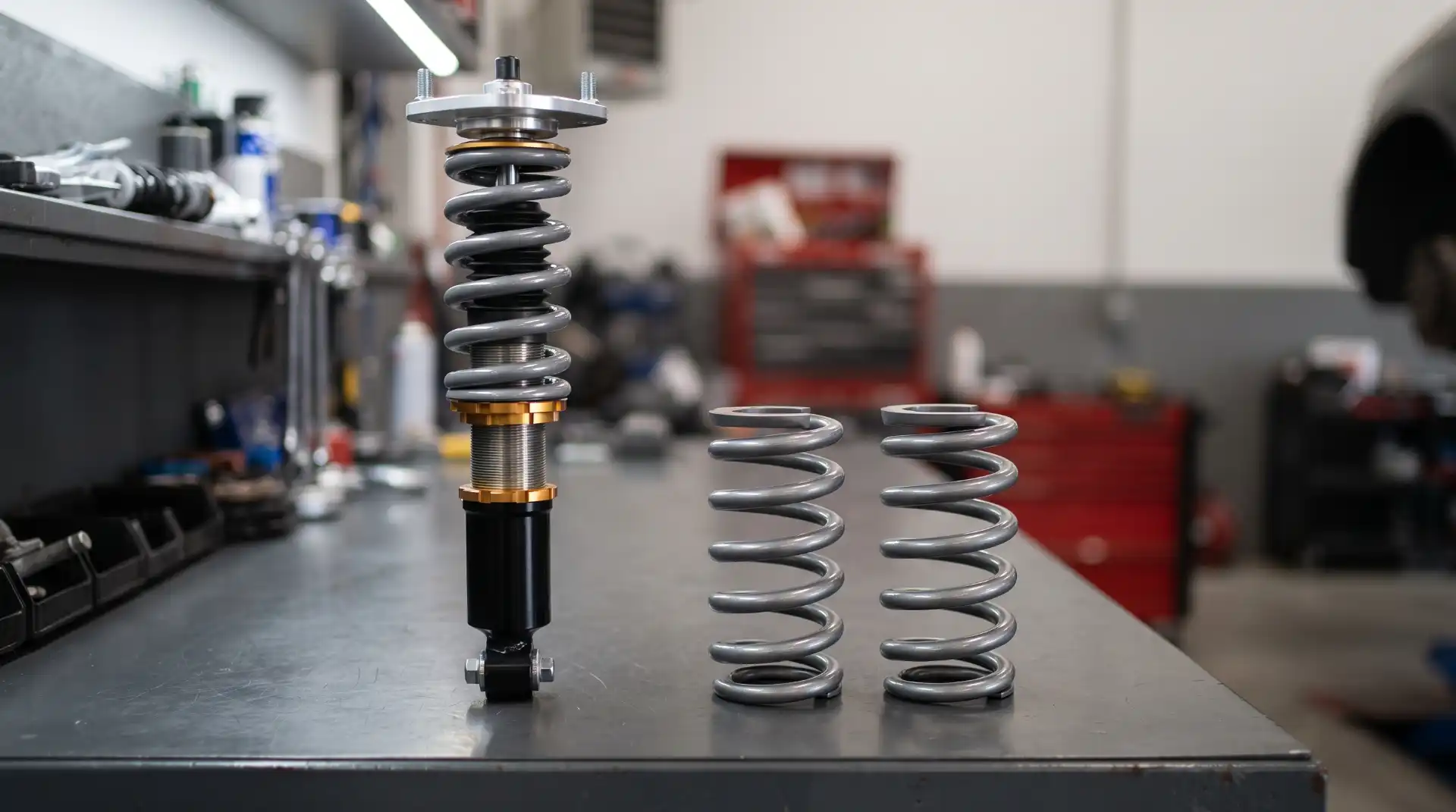 How Coilovers and Lowering Springs Work With Dampers
A spring supports the vehicle’s weight and allows the wheel to move when it encounters a bump. The damper controls the speed of that movement. Without appropriate damping, a spring can continue oscillating after being compressed, making the car feel unstable or bouncy.
When lowering springs are installed on factory dampers, the dampers must operate at a different resting position. The spring may also be stiffer than the original unit. Some factory dampers can work acceptably with a modest spring drop, particularly when the spring manufacturer designed the product for the original equipment. However, worn or lightly valved factory dampers may struggle to control significantly stiffer or shorter springs.
A matched spring-and-damper package may provide better results than placing aggressive lowering springs over aging original struts. Performance dampers designed for lowering springs can offer improved control while maintaining a fixed ride height.
Coilovers combine springs and dampers that are intended to work as a system. That does not guarantee that every kit will ride or handle well. The quality of the engineering, spring rates, damping, available travel, seals, bearings, mounts, and installation still matter. A carefully developed lowering-spring and sport-damper package may outperform a poorly designed coilover kit.
Advantages of Lowering Springs for Street Performance
The primary advantage of lowering springs is simplicity. Drivers who want a moderate, permanent reduction in ride height may not need numerous adjustment settings. A properly selected spring kit can provide a cleaner stance and more controlled body movement without introducing the complexity of adjustable coilovers.
Lowering springs also tend to cost less than complete coilover assemblies. The price difference may leave room in the budget for new dampers, replacement mounts, an alignment, upgraded tires, or other maintenance. These supporting items can contribute more to the final driving experience than spending the entire budget on suspension hardware.
For a daily driver that travels on pothole-damaged streets, steep driveways, speed bumps, and uneven highways, a conservative spring drop can be easier to live with than an aggressively lowered coilover setup. The vehicle remains lower than stock, but ground clearance and suspension travel may stay within a usable range.
Another advantage is that a fixed-height setup is more difficult to misadjust. Once the springs and compatible dampers are installed correctly, the owner does not need to determine ride height, preload, rebound, compression, or corner balance. This can be beneficial for drivers who want a straightforward upgrade rather than an ongoing tuning project.
Disadvantages of Lowering Springs
The main limitation is the lack of height adjustment. If the resulting drop is too low for a driveway, too high for the desired appearance, or uneven because of vehicle weight distribution, the springs cannot normally be adjusted to correct it.
Advertised lowering measurements are estimates rather than guarantees. Actual ride height may be influenced by vehicle trim, engine choice, optional equipment, existing suspension wear, wheel and tire dimensions, and the condition of spring pads or mounts.
Lowering springs may also perform poorly when paired with unsuitable factory dampers. A car can become bouncy if the damper cannot control the new spring. Reduced travel may cause the suspension to contact its bump stops more frequently. Over time, the different operating position and increased workload may contribute to faster wear of old dampers.
Because lowering springs provide limited tuning flexibility, they are less suitable for drivers who frequently alternate between street driving, autocross, track days, and appearance-focused events.
Advantages of Coilovers for Street Performance
Coilovers offer greater control over the vehicle’s stance and setup. Ride-height adjustment allows an installer to fine-tune fender clearance, reduce unwanted wheel gap, account for certain weight differences, and create a practical amount of ground clearance for the owner’s roads.
Damping-adjustable coilovers provide another level of tuning. A softer setting may be more appropriate for normal street use, while a firmer setting may help control body motion during autocross or track driving. Drivers should remember that the firmest setting is not automatically the fastest or safest setting. Tires need to remain in contact with the road, particularly over uneven surfaces.
Some systems include front camber plates, which may expand the available camber adjustment. Additional negative camber can help certain vehicles maintain tire contact during cornering, but excessive camber may accelerate inner-edge tire wear and reduce braking or straight-line traction.
Coilovers are particularly useful for dual-purpose vehicles. A driver who attends track days but still drives to work may value the ability to adjust the suspension rather than committing to a single fixed setup. Auto Sport Performance discusses this compromise further in its article about turning a motorsport-inspired car into a daily performer.
On vehicles with suitable suspension designs, adjustable spring perches can also support corner balancing. Corner balancing measures the load carried by each tire and adjusts the vehicle to produce a more consistent balance. This is generally more relevant to competitive driving than ordinary commuting, but it demonstrates the wider tuning potential of a coilover system.
Disadvantages of Coilovers
Quality coilovers usually cost more than lowering springs. The complete expense may also include installation, alignment, adjustable control arms, replacement top mounts, corrosion protection, periodic cleaning, and future rebuilding or replacement.
Low-priced coilovers may achieve an aggressive stance but offer limited damping quality and durability. A stiff spring rate can hide weak damping during a short test drive, yet the car may feel harsh, unsettled, or poorly controlled during longer use.
Adjustability can also become a disadvantage when settings are changed without understanding their effects. Unequal ride heights, incorrect spring preload, excessive lowering, or extreme damping settings may make a vehicle less predictable. Owners should record their baseline settings and make small, controlled changes rather than turning adjusters randomly.
Threaded components are exposed to road water, dirt, and deicing chemicals. In regions that use road salt, unprotected adjustment collars may corrode or seize. Regular cleaning and appropriate corrosion protection can help preserve adjustability, but the manufacturer’s maintenance directions should take priority.
Coilovers may also transmit more noise and vibration into the cabin, especially when fitted with solid or spherical upper mounts instead of compliant rubber mounts. The sharper response that feels desirable on a smooth road course can become tiring during a long commute.
Ride Quality: Which Option Is More Comfortable?
Neither suspension type is always more comfortable. Ride quality depends on spring rate, damping, suspension travel, tire sidewall, bushing compliance, vehicle structure, road quality, and the amount of lowering.
A mild lowering spring paired with well-matched performance dampers may ride better than an inexpensive coilover kit. Conversely, a high-quality street coilover system may provide better control and comfort than aggressive lowering springs installed over worn factory struts.
Suspension travel is particularly important. A vehicle can have expensive components and still ride badly if it is lowered until little compression travel remains. When the suspension reaches the bump stop, the effective spring rate rises sharply and the impact may be transmitted through the body.
Wheel and tire choices also matter. Installing low-profile tires at the same time as a stiff suspension can make it difficult to determine which change caused the increase in harshness. Heavy wheels and unsuitable tire pressures may further affect the result. Suspension upgrades should be considered as part of a complete chassis system rather than an isolated modification.
Handling Differences on Real U.S. Streets
On a smooth road, both lowering springs and coilovers can reduce body movement and sharpen steering response. Real U.S. streets, however, may include patched asphalt, expansion joints, drainage channels, potholes, steep parking entrances, and uneven lane surfaces.
A street suspension must allow the wheels to follow those surfaces without repeatedly disturbing the body. Excessive stiffness can reduce grip when the tire skips over bumps. Excessive lowering may cause the suspension to bottom out or create contact between the tires, fenders, liners, or suspension components.
The best street setup often feels controlled rather than extremely stiff. It should settle quickly after bumps, maintain predictable steering, and avoid excessive floating or bouncing. Drivers should evaluate performance on the roads they actually use instead of building exclusively around appearance or specifications from a smooth racetrack.
Vehicle weight also influences suspension behavior. Removing weight or installing lighter wheels changes the work performed by the springs, dampers, and tires. Additional information is available in Auto Sport Performance’s discussion of weight reduction in modern performance builds.
Ground Clearance and Daily Practicality
Ground clearance is one of the most important considerations for a street car. A vehicle that regularly scrapes its front bumper, exhaust, oil pan, subframe, or underbody panels may be too low for its environment.
Drivers should inspect the routes they use most often. Apartment ramps, parking garages, railroad crossings, speed bumps, snow accumulation, construction zones, and crowned intersections can all create problems for a lowered vehicle.
Lowering springs give the owner a fixed result, making careful product selection essential. Coilovers permit height changes, but that does not mean every position within the adjustment range is appropriate. The lowest physical setting may not preserve safe suspension travel, axle angles, tire clearance, steering range, or headlight aim.
A practical street-performance height should leave enough clearance for full steering lock and normal suspension movement. The tires should not rub when passengers or cargo are added. Brake hoses, wheel-speed sensor wiring, sway-bar links, and axle boots should also remain free from tension or interference.
Alignment and Suspension Geometry After Lowering
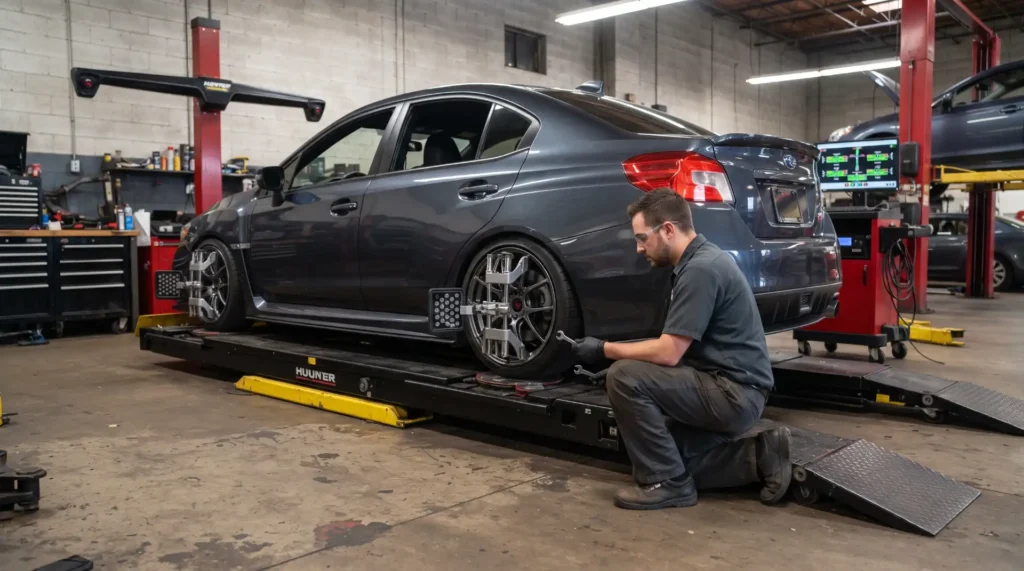 Alignment and Suspension Geometry After Lowering
Lowering changes the position of suspension components relative to the chassis. This can alter camber, toe, roll-center location, bump-steer behavior, and the angle of control arms or tie rods. The exact effects depend on the vehicle’s suspension design.
A four-wheel alignment should be performed after either lowering springs or coilovers are installed and the vehicle has settled. Alignment is not merely a tire-wear service. Toe and camber influence stability, steering response, braking behavior, and how the vehicle reacts during cornering.
Some vehicles have enough factory adjustment to return the alignment to an appropriate street specification after a mild drop. Others may require camber bolts, adjustable arms, plates, bushings, or other correction parts. These components should be selected carefully because poor-quality or incorrectly installed adjustable hardware can create new problems.
Ride height should be finalized before the alignment. Changing coilover height afterward may change alignment measurements and require another adjustment. Drivers should also request a printed alignment report and keep it as a baseline for future tire-wear or handling concerns.
Installation Considerations
Both upgrades require safe removal of suspension components, and lowering-spring installation commonly requires a spring compressor. Compressed springs store substantial energy. Improper tools or procedures can cause serious injury, making professional installation the sensible choice for owners without the appropriate equipment and experience.
The technician should inspect strut mounts, bearings, bump stops, dust boots, control-arm bushings, ball joints, tie-rod ends, sway-bar links, and dampers during the work. Installing new springs around worn components may save money initially but produce noise, looseness, or uneven performance shortly afterward.
Fasteners should be tightened according to the vehicle or component manufacturer’s procedures. Certain suspension bushings should be tightened at normal ride height rather than with the suspension hanging. Tightening them in the wrong position may preload the rubber and contribute to premature wear or an incorrect resting height.
Following installation, the vehicle should be checked for tire clearance through the full steering range. A careful road test should confirm that there are no unusual noises, brake-hose problems, warning lights, or contact between moving parts.
How Lowering May Affect Modern Vehicle Systems
Modern vehicles may use wheel-speed sensors, steering-angle sensors, adaptive dampers, self-leveling headlights, driver-assistance cameras, radar units, and electronic stability systems. Suspension changes may affect how some of these systems operate or how their sensors are aimed.
Vehicles with adaptive or electronically controlled dampers may require compatible coilovers, cancellation modules, software coding, or retention of factory electronics. A warning-light solution does not necessarily reproduce the original system’s function.
Substantial changes to vehicle rake or ride height may also affect headlight aim. Vehicles equipped with advanced driver-assistance systems may need inspection or calibration after changes that alter alignment, sensor position, or vehicle attitude. Requirements vary by vehicle, so owners should consult the automaker’s service information and a qualified calibration provider.
Street Legality and Safety Considerations
Suspension and vehicle-equipment rules can differ between states and local jurisdictions. Regulations may address minimum ground clearance, bumper height, tire coverage, lighting height, wheel contact, or other equipment. Owners should verify the rules that apply where the vehicle is registered and driven.
Federal Motor Vehicle Safety Standards regulate specified aspects of new vehicles and equipment, while states generally administer vehicle registration, inspection, and many on-road equipment requirements. Readers can review current federal vehicle-safety regulations through the authoritative National Highway Traffic Safety Administration.
Drivers should also tell their insurance provider about significant modifications when required by the policy. Standard coverage may not automatically reimburse the full value of aftermarket parts following theft or a collision. Documentation, receipts, photographs, and specialized coverage may be necessary.
Maintenance After Installing Coilovers or Lowering Springs
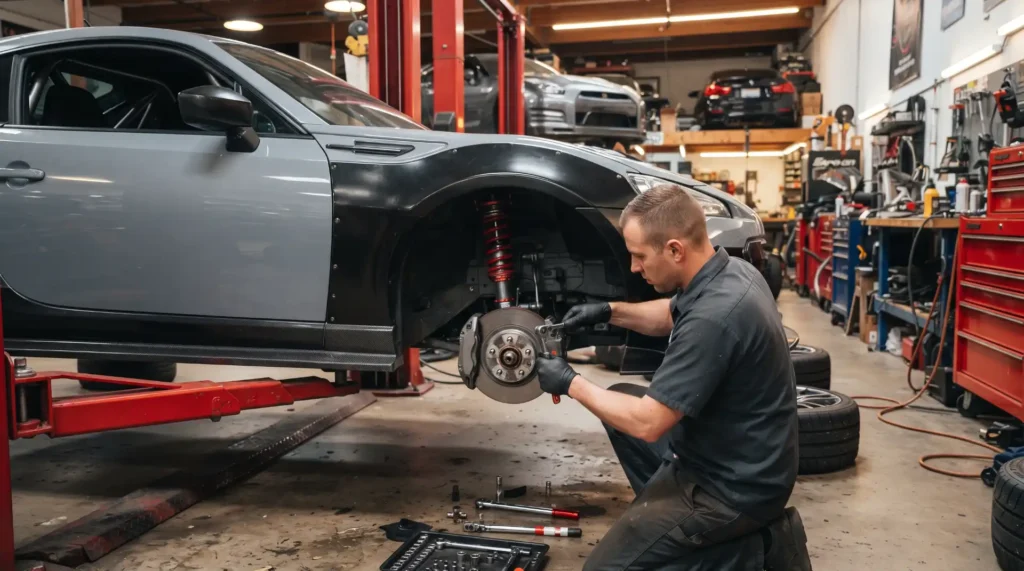 Maintenance After Installing Coilovers or Lowering Springs
A lowered vehicle should be inspected periodically. Owners should look for leaking dampers, damaged dust boots, loose locking collars, cracked bushings, abnormal tire wear, spring movement, corrosion, and evidence of tire contact.
Coilover owners should keep the threads clean and follow the manufacturer’s recommendations for lubrication or corrosion protection. Adjustment collars should not be forced when contaminated or seized. Owners who drive through winter conditions may need more frequent inspections.
Alignment should be checked when the car begins pulling, the steering wheel no longer sits straight, tires develop uneven wear, or ride height is changed. A hard pothole impact can alter alignment even when no suspension component appears visibly damaged.
Noise should not be dismissed automatically as a normal consequence of modified suspension. Clunks, binding, popping, or grinding may indicate loose hardware, damaged mounts, spring interference, worn bearings, or incorrect installation.
Cost Comparison
Lowering springs usually have the lower initial parts cost, but the total project may include new dampers, mounts, installation, and alignment. Reusing worn factory struts simply to reduce the initial bill can lead to duplicated labor when those struts fail later.
Coilovers cost more because they replace a larger portion of the suspension and may include adjustable features. High-end systems can also be serviced or rebuilt, while some entry-level kits are treated as replacement items when they wear out.
The least expensive option is not always the best value. Owners should compare complete installed costs and expected service life. A well-matched fixed-height suspension may be the better investment for a commuter, while a quality adjustable system may provide greater value to a driver who will genuinely use its tuning range.
Who Should Choose Lowering Springs?
Lowering springs are generally suitable for drivers who want a modest visual drop, improved body control, and a straightforward street setup. They make sense when the desired ride height is known, adjustment is unnecessary, and the owner prefers lower cost and limited maintenance.
They are particularly appealing for daily-driven vehicles that will not be corner balanced or frequently switched between street and track configurations. The best results usually come from conservative springs paired with healthy, compatible dampers.
A driver should avoid selecting springs based only on the largest advertised drop. Product quality, spring rate, damper compatibility, road conditions, and available suspension travel are more important than achieving the lowest stance.
Who Should Choose Coilovers?
Coilovers are better suited to drivers who need ride-height adjustment or want greater control over damping and alignment. They can be a strong choice for dual-purpose street and track cars, autocross builds, show vehicles that still need practical road settings, or enthusiasts who enjoy methodical chassis tuning.
They also make sense when a complete replacement system is preferable to combining separate springs and dampers. However, the owner must be willing to pay for a properly engineered kit, professional setup, alignment, and periodic maintenance.
Drivers who plan to install coilovers once, set the vehicle extremely low, and never inspect the system may not benefit from the extra adjustability. In that situation, a carefully selected fixed-height package could provide better street behavior with less complexity.
Coilovers vs. Lowering Springs: Which Is Better?
For a typical daily-driven street car, quality lowering springs with matched dampers often provide the best combination of cost, simplicity, comfort, and improved appearance. They can sharpen the vehicle without requiring the driver to manage multiple settings.
For an enthusiast who wants precise ride-height control, damping adjustment, corner balancing, or regular street-to-track changes, quality coilovers offer greater capability. That capability is valuable only when the system is selected, installed, adjusted, and maintained correctly.
The comparison should not be reduced to “coilovers are for performance and springs are for appearance.” Well-developed lowering springs can improve handling, while poorly chosen coilovers can make a car slower and less comfortable. Component quality and setup matter more than the category printed on the box.
Final Thoughts
The best street suspension is not necessarily the lowest or stiffest one. It is the setup that keeps the tires working, preserves usable travel, provides predictable control, and remains practical on the roads the driver uses every day.
Lowering springs offer affordability and simplicity for drivers seeking a fixed, moderate drop. Coilovers provide adjustability and broader tuning potential for enthusiasts with more specialized goals. Both can produce excellent results when matched to the vehicle and installed correctly.
Before purchasing either option, evaluate the condition of the existing suspension, decide how much ground clearance is genuinely usable, research the required alignment corrections, and include installation and maintenance in the budget. A balanced suspension build will deliver more real-world performance than an extreme setup chosen only for appearance.
Explore more guides in the Auto Sport Performance suspension section for information about improving handling, chassis response, and street performance.