
Over the past decade, E85 has become one of the most talked-about fuels in the performance automotive world. Once considered a niche option primarily for dedicated race cars and drag builds, E85 is now used by daily-driven sports cars, high-horsepower street machines, and professional competition vehicles across the United States.
Enthusiasts often describe E85 as one of the best horsepower-per-dollar upgrades available for turbocharged engines. Many dyno charts show gains of 40, 60, or even well over 100 horsepower after converting from premium pump gasoline to ethanol-based fuel with proper tuning.
However, these impressive numbers only tell part of the story.
Switching to E85 isn’t as simple as filling the tank and expecting instant power. The fuel requires significantly more volume than gasoline, often demands upgrades to the fuel system, and isn’t available at every gas station. It can also affect driving range and long-term maintenance if the vehicle isn’t properly prepared.
So, is an E85 performance build truly worth the investment?
The answer depends on your vehicle, your horsepower goals, your local fuel availability, and how you plan to use your car. Whether you’re modifying a Ford Mustang EcoBoost, Toyota Supra, Subaru WRX STI, Nissan GT-R, Chevrolet Camaro, Dodge Challenger, Volkswagen GTI, or BMW M model, understanding the advantages and limitations of E85 is essential before making the switch.
What Is E85?
E85 is a blend of ethanol and gasoline designed primarily for flex-fuel applications. Despite its name, E85 rarely contains exactly 85 percent ethanol year-round.
In the United States, ethanol content typically ranges between 51 and 83 percent depending on seasonal requirements. Winter blends often contain less ethanol to improve cold-weather starting, while summer blends generally contain higher ethanol concentrations.
Ethanol itself is produced primarily from corn in the United States, making it a renewable alternative to conventional gasoline.
For performance enthusiasts, the real appeal isn’t sustainability.
It’s octane.
E85 typically provides an effective octane rating between 100 and 105, depending on the exact ethanol content and testing method. This significantly exceeds standard premium pump gasoline, allowing engines to safely operate with more aggressive ignition timing and higher boost pressures.
 Why Performance Enthusiasts Love E85
 Why Performance Enthusiasts Love E85
Every turbocharged engine faces one unavoidable limitation.
Knock.
As boost increases, cylinder pressure rises dramatically. Higher temperatures increase the likelihood of uncontrolled combustion, forcing the ECU to reduce ignition timing in order to protect the engine.
Because E85 has much greater knock resistance than premium gasoline, tuners can safely optimize engine calibration without encountering detonation nearly as quickly.
The result often includes:
- Higher boost pressure
- More ignition timing
- Cooler combustion temperatures
- Improved turbo efficiency
- Greater horsepower
- More consistent power delivery
This is one reason why many factory turbocharged vehicles produce surprisingly large gains after converting to E85.
Unlike expensive engine modifications that require extensive labor, changing fuel and recalibrating the ECU can unlock substantial performance when the supporting hardware is already capable.
How E85 Produces More Power
Many people assume E85 simply burns “better.”
The reality is more interesting.
Ethanol contains oxygen within its molecular structure. It also evaporates more efficiently than gasoline, creating a significant cooling effect inside the intake charge and combustion chamber.
Lower temperatures help suppress knock while increasing air density.
The combination allows the engine to burn more fuel safely.
Turbocharged engines benefit especially because additional boost produces more heat. Since E85 helps control combustion temperatures, tuners can often increase boost pressure while maintaining safe operating conditions.
The higher octane rating further expands the engine’s tuning window.
Instead of pulling ignition timing under heavy load, properly tuned engines can maintain aggressive timing throughout the powerband.
The end result is stronger acceleration and improved top-end power.
Turbocharged Engines See the Biggest Gains
Although naturally aspirated engines can benefit from E85, turbocharged platforms often experience the most dramatic improvements.
Popular examples include:
- Ford EcoBoost Mustang
- Subaru WRX STI
- Mitsubishi Evolution
- Toyota GR Supra
- Nissan GT-R
- Volkswagen Golf R
- Audi S3
- BMW M340i
- Chevrolet Corvette with aftermarket turbo systems
These vehicles already rely heavily on boost pressure to generate power.
Adding E85 provides additional headroom for tuning.
Many professional dyno sessions demonstrate gains exceeding 70 horsepower with only fuel system upgrades and ECU calibration.
Higher horsepower builds frequently see even larger improvements.
Supporting Modifications Matter
One misconception is that every car can immediately switch to E85.
In reality, ethanol requires approximately 30 percent more fuel volume than gasoline.
This means many stock fuel systems eventually reach their limits.
Depending on horsepower goals, owners may need:
- Larger fuel injectors
- Higher-capacity fuel pumps
- Upgraded fuel lines
- Ethanol-compatible seals
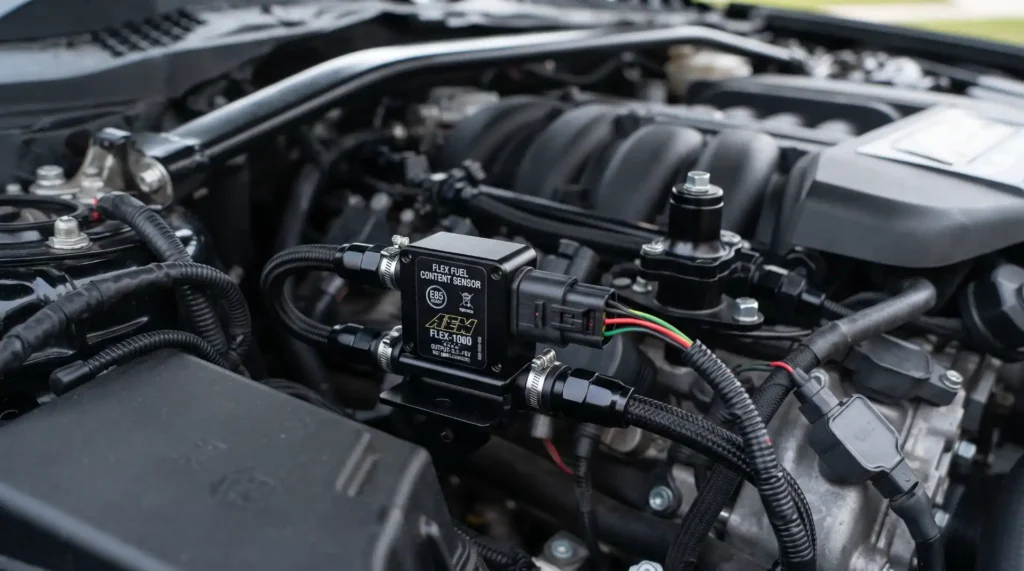
- Flex fuel sensor
- Professional ECU tuning
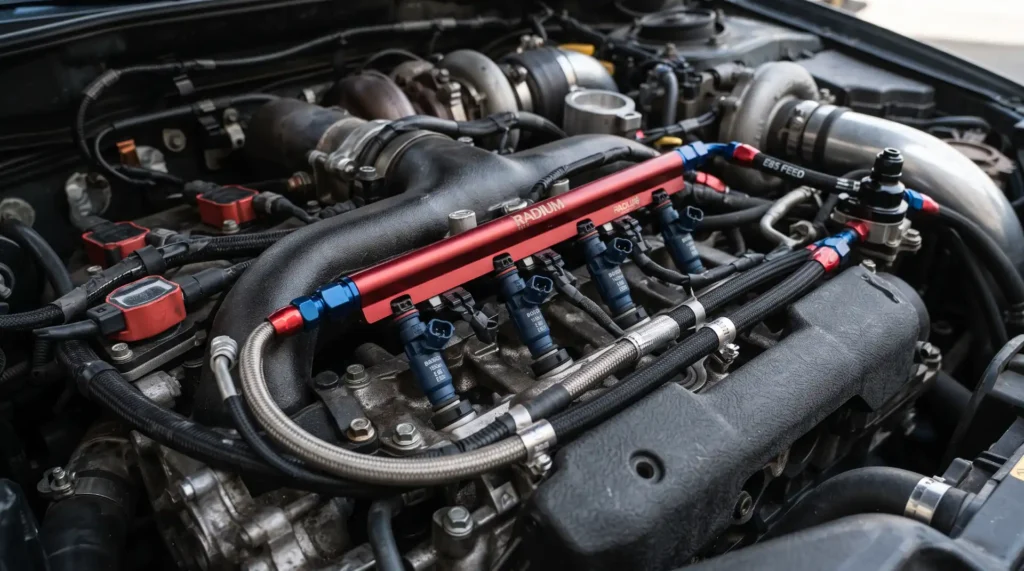
Direct-injection engines may require upgraded high-pressure fuel pumps, while older port-injected platforms often benefit from larger injectors and aftermarket fuel rails.
Without adequate fuel delivery, running E85 can actually create dangerously lean operating conditions.
Proper planning is essential before attempting a conversion.
Understanding Flex Fuel Systems
Some modern vehicles leave the factory with flex-fuel capability.
These vehicles use sensors that continuously monitor ethanol content inside the fuel system.
The ECU automatically adjusts:
- Fuel delivery
- Ignition timing
- Cold-start enrichment
- Air-fuel ratio
- Engine calibration
Many aftermarket tuning companies now offer similar systems for performance vehicles.
A flex fuel sensor measures ethanol concentration in real time, allowing the ECU to automatically switch between gasoline and E85 calibrations.
This flexibility is especially useful for drivers who don’t always have access to E85 stations.
Instead of committing to one fuel, the vehicle adapts automatically.
Fuel Economy: The Biggest Trade-Off
One downside of E85 is reduced fuel economy.
Because ethanol contains less energy per gallon than gasoline, engines consume significantly more fuel to produce the same amount of power.
Most drivers experience a reduction between 20 and 30 percent in miles per gallon.
For example, a sports car averaging 24 MPG on premium gasoline may achieve only 17–19 MPG after converting to E85.
While this doesn’t necessarily increase operating costs if E85 is priced significantly lower, fuel stops become more frequent.
Owners planning long-distance road trips should also verify fuel availability before traveling.
Reliability: Can E85 Hurt Your Engine?
One of the most common concerns about E85 is whether it damages engines. The short answer is that E85 itself is not harmful to a properly prepared engine. In fact, many professional race teams and high-performance street builds rely on ethanol because of its excellent knock resistance and cooling properties.
Problems usually arise when enthusiasts convert to E85 without making the necessary supporting upgrades.
Because ethanol requires a greater volume of fuel than gasoline, an undersized fuel pump or injectors may not keep up with demand under full throttle. When fuel delivery falls short, the engine can run lean, increasing combustion temperatures and raising the risk of engine damage.
Modern aftermarket components are generally designed to handle ethanol safely. Fuel pumps, injectors, hoses, O-rings, and seals that are specifically rated for ethanol resist corrosion and provide long-term reliability.
Routine maintenance also becomes more important. Fuel filters should be inspected regularly because ethanol can loosen deposits left behind by years of gasoline use. During the initial conversion period, replacing the filter after several tanks of E85 is often recommended.
When the fuel system is properly designed and the ECU calibration is professionally tuned, an E85-powered vehicle can be just as reliable as one running premium gasoline.
Daily Driving on E85
Many people assume E85 is suitable only for weekend race cars. In reality, thousands of enthusiasts across the United States drive E85-powered vehicles every day.
The driving experience is largely unchanged during normal commuting. Cold starts, idle quality, and drivability can all remain factory-like when the calibration is done correctly.
The biggest consideration is fuel availability.
While E85 has become much more common in the Midwest and many metropolitan areas, it is still unavailable in certain regions. Drivers who frequently travel long distances should verify station locations before leaving home.
Fortunately, modern flex-fuel tuning solves much of this problem.
A flex-fuel sensor continuously measures ethanol content and automatically adjusts engine calibration. If only premium gasoline is available during a road trip, the vehicle simply adapts without requiring a manual tune change.
This flexibility makes modern E85 builds far more practical than they were a decade ago.
How Much Does an E85 Conversion Cost?
The total investment varies depending on the vehicle and horsepower goals.
Some factory turbocharged platforms require only ECU tuning and a flex-fuel sensor.
Higher-horsepower applications often need upgraded injectors, fuel pumps, fuel rails, and supporting hardware.
A typical budget may include:
- ECU calibration
- Flex-fuel sensor kit
- High-flow fuel injectors
- High-capacity fuel pump
- Fuel system upgrades
- Installation and dyno tuning
Although the initial cost may appear significant, many enthusiasts consider E85 one of the most cost-effective horsepower upgrades because the fuel itself enables additional power from existing engine modifications.
Rather than purchasing a larger turbocharger immediately, some owners first maximize the performance of their current setup by switching to ethanol.
E85 Versus Premium Pump Gasoline
 E85 Versus Premium Pump Gasoline
Premium gasoline remains the most convenient fuel for everyday drivers.
It is available almost everywhere, offers consistent quality, and requires no special fuel system modifications for factory vehicles.
However, premium gasoline limits aggressive tuning.
Higher boost pressures often require conservative ignition timing to avoid knock.
E85 changes that equation.
The higher octane rating and superior cooling characteristics provide a much larger safety margin for performance tuning.
Drivers typically notice:
- Faster acceleration
- Improved throttle response
- Greater resistance to heat soak
- More consistent power during repeated acceleration
The trade-off remains reduced fuel economy and the need for greater fuel flow.
E85 Versus Race Gas
Race gasoline has long been the standard for high-performance applications.
It provides exceptional octane ratings and outstanding consistency.
However, race fuel is expensive.
In many parts of the United States, race gasoline costs several times more than premium pump fuel.
E85 offers an attractive middle ground.
While its ethanol content can vary seasonally, modern flex-fuel tuning compensates automatically.
Many street enthusiasts find that E85 provides performance approaching race fuel at a fraction of the operating cost.
Professional racing teams may still prefer specialized racing fuels for maximum consistency, but for street-driven turbocharged vehicles, E85 often represents an outstanding value.
E85 Versus Water-Methanol Injection
Enthusiasts frequently compare these two popular performance upgrades.
Although both improve knock resistance, they work differently.
E85 replaces the primary fuel with a higher-octane alternative that supports greater boost and more aggressive ignition timing.
Water-methanol injection supplements the existing fuel by reducing intake temperatures and suppressing knock during high-load operation.
Many high-horsepower builds actually combine both systems.
For example, a turbocharged vehicle running E85 may also use water-methanol injection to further reduce intake temperatures during extended track sessions or drag racing.
The best choice depends on the vehicle, budget, fuel availability, and horsepower goals.
Common Mistakes During an E85 Build
Successful E85 conversions require careful planning.
One of the most common mistakes is assuming the factory fuel system can support ethanol indefinitely.
As horsepower increases, fuel demand rises rapidly.
Another mistake involves ignoring ethanol content.
Not every station dispenses exactly the same percentage of ethanol.
Modern flex-fuel sensors solve this issue by allowing the ECU to continuously adjust fueling and ignition timing based on actual ethanol concentration.
Skipping professional dyno tuning is another costly error.
Generic calibrations rarely maximize performance while maintaining optimal safety margins.
Finally, some owners underestimate fuel consumption.
Because E85 burns at a higher volume than gasoline, running out of fuel becomes more likely if driving habits remain unchanged.
Is an E85 Build Worth It?
 Is an E85 Build Worth It?
For many enthusiasts, the answer is yes.
Turbocharged vehicles often experience dramatic improvements in horsepower, torque, throttle response, and overall consistency after switching to E85.
Drivers pursuing competitive track times, drag racing performance, or simply stronger street acceleration frequently consider ethanol one of the highest-value upgrades available.
However, it is not the right solution for everyone.
Drivers living in areas with limited E85 availability may find premium gasoline more practical.
Owners unwilling to invest in supporting fuel system upgrades should also approach the conversion carefully.
Ultimately, E85 provides the greatest value when viewed as part of a complete performance strategy that includes proper ECU calibration, adequate fuel delivery, quality maintenance, and realistic expectations.
The Future of E85 Performance
As automakers continue developing turbocharged engines and aftermarket tuning technology advances, ethanol is expected to remain an important performance fuel.
Modern ECUs have become increasingly sophisticated, allowing real-time adjustments based on ethanol content, ambient temperature, boost pressure, and engine load.
Aftermarket manufacturers continue introducing larger injectors, more efficient fuel pumps, and advanced flex-fuel integration kits that simplify installation and improve reliability.
At the same time, expanding E85 infrastructure in many parts of the United States is making ethanol more accessible than ever before.
For enthusiasts seeking affordable horsepower while maintaining street drivability, E85 is likely to remain one of the most influential performance fuels available.
Final Thoughts
Flex-fuel E85 has transformed the performance tuning landscape by offering enthusiasts a practical way to unlock substantial horsepower gains without immediately resorting to expensive race fuels. Its naturally high octane rating, superior cooling characteristics, and compatibility with modern turbocharged engines make it one of the most effective upgrades for drivers chasing more power.
Success with E85, however, depends on more than simply filling the tank. Proper supporting modifications, ethanol-compatible fuel system components, and professional ECU calibration are essential to achieving reliable performance.
Whether you’re building a weekend track machine, a high-powered street car, or a daily-driven turbocharged vehicle, E85 can deliver impressive results when approached with the right combination of planning, hardware, and tuning.