
Artificial intelligence is moving from science fiction into the automotive workshop.
For decades, performance tuning depended heavily on experienced technicians, dyno testing, mechanical knowledge, data logging, and countless hours of calibration. Those fundamentals remain important in 2026, but AI is changing how technicians collect information, identify problems, analyze vehicle behavior, and develop performance strategies.
Modern vehicles generate enormous amounts of data. Engine control modules, transmission controllers, sensors, battery management systems, turbochargers, fuel systems, braking systems, and other electronic components continuously monitor operating conditions.
The challenge is no longer simply collecting data. The challenge is understanding it quickly and accurately.
This is where artificial intelligence can provide an advantage.
AI-powered automotive systems can analyze large amounts of vehicle information, identify unusual patterns, compare current behavior with historical data, and help technicians investigate potential problems. Research presented through SAE International in 2026 is examining AI and machine learning for predictive diagnostics, legacy ECU applications, EV powertrain diagnostics, and in-vehicle edge AI.
For American car enthusiasts, this could have a significant impact on everything from daily-driver diagnostics to high-performance turbocharged builds.
AI will not eliminate the need for professional tuners. Instead, it is likely to become another tool that helps skilled technicians make faster, more informed decisions.
What Is AI Car Performance Tuning?
AI car performance tuning refers to the use of artificial intelligence and machine-learning technologies to analyze vehicle data and assist with performance calibration.
Traditional ECU tuning involves adjusting parameters that control how an engine operates. Depending on the vehicle, these parameters can include ignition timing, fuel delivery, boost pressure, throttle behavior, torque management, transmission behavior, and other strategies.
A professional tuner may collect data from a dyno session, road test, or data logger and then make adjustments based on the results.
AI can assist with this process by recognizing relationships between hundreds or thousands of variables.
Instead of examining each data point independently, an AI system can analyze the interaction between parameters and identify patterns that might otherwise take a technician much longer to recognize.
The technology is particularly useful because modern vehicles have become extremely complex.
A modern turbocharged vehicle is not simply an engine connected to a transmission. It may include multiple electronic control modules, dozens of sensors, electronically controlled turbochargers, direct fuel injection, variable valve timing, electronic throttle control, traction management, and sophisticated emissions monitoring.
AI gives technicians another way to interpret all of that information.
 How AI Is Improving Vehicle Diagnostics
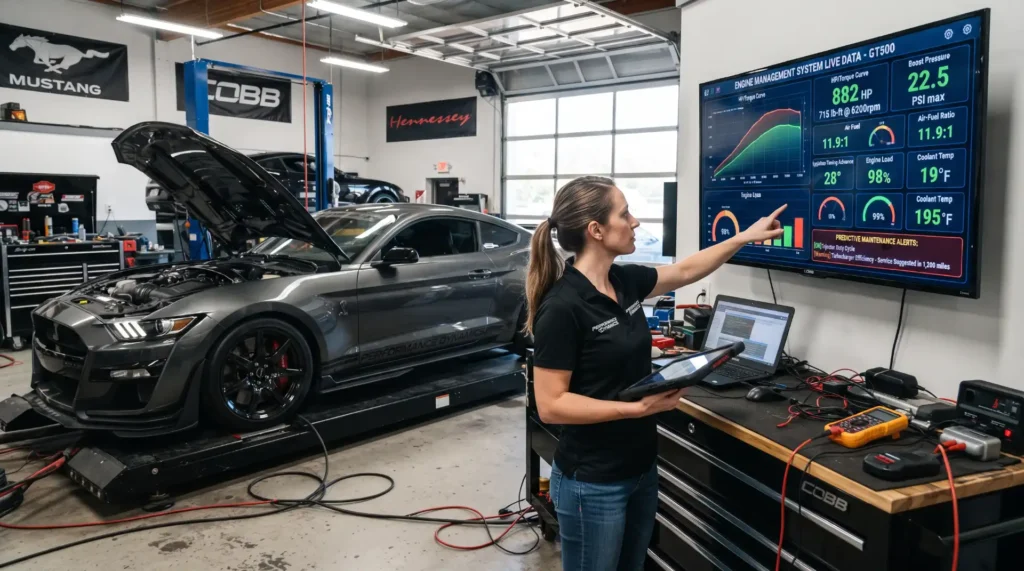 How AI Is Improving Vehicle Diagnostics
One of the most practical applications of AI is automotive diagnostics.
When a vehicle experiences a problem, the ECU may store diagnostic trouble codes, commonly called DTCs. These codes provide valuable information, but they do not always identify the exact component that has failed.
For example, a sensor-related fault does not necessarily mean that the sensor itself is defective. The underlying problem could involve wiring, vacuum leaks, fuel delivery, mechanical problems, temperature conditions, or another component affecting the sensor’s readings.
AI-based diagnostic systems can potentially examine the DTC alongside other vehicle information.
Instead of simply saying that a particular code exists, an intelligent diagnostic system can compare the code with sensor behavior, engine operating conditions, previous faults, and other available information.
Research published by SAE in 2026 has explored large-language-model-based approaches for EV powertrain diagnostics and prognostics, including using diagnostic trouble codes to improve fault interpretation and maintenance efficiency.
For performance-car owners, this can make troubleshooting more efficient.
A modified vehicle can be especially difficult to diagnose because aftermarket components may change how the engine behaves compared with its original factory configuration.
AI-assisted diagnostics could help technicians distinguish between normal behavior from a performance modification and a genuine mechanical or electronic problem.
AI and ECU Tuning
The ECU is the brain behind many modern performance engines.
It continuously makes decisions about fuel, ignition, airflow, boost, throttle position, and torque output.
Performance tuning changes how those decisions are made.
Historically, ECU tuning has relied heavily on the experience of individual calibration engineers and tuners. AI introduces another layer of analysis.
An AI system can evaluate data collected during multiple runs and identify patterns in engine behavior.
For example, a tuner may want to understand how a turbocharged engine responds to changes in boost pressure at different RPM levels.
Rather than examining individual data logs manually, AI can help identify relationships between boost, intake temperature, ignition timing, air-fuel ratio, throttle position, and engine load.
This does not mean an AI system should automatically make unlimited ECU changes.
Performance calibration involves safety-critical decisions. Excessive ignition timing, boost pressure, or fuel-system demands can cause serious engine damage.
The most practical approach is to use AI as an analytical assistant while an experienced tuner remains responsible for calibration decisions.
Research into AI deployment on legacy automotive ECUs also demonstrates how researchers are working to make AI models efficient enough for automotive environments with limited computing resources.
AI Can Help Find Performance Problems Earlier
Performance enthusiasts often notice that something is wrong before a warning light appears.
The vehicle may feel slower.
Throttle response may change.
Boost may arrive later than usual.
Fuel economy may decline.
Engine temperatures may increase.
A conventional diagnostic approach might wait until a fault code appears.
AI-powered predictive systems offer another possibility: detecting abnormal behavior before a major failure occurs.
Machine-learning systems can establish patterns of normal operation and identify deviations from those patterns.
For example, if an engine normally reaches a specific boost pressure at a certain RPM and throttle position, an AI system can monitor whether that relationship changes.
A small deviation might not mean immediate failure, but repeated changes could provide a reason for further inspection.
This approach is commonly called predictive maintenance.
SAE research published in 2026 has explored machine-learning systems that analyze vehicle operating data to predict maintenance requirements and identify whether a component may require repair or replacement.
For high-performance vehicles, predictive diagnostics could become particularly valuable.
Modified engines operate under higher loads, higher temperatures, and sometimes higher cylinder pressures than stock vehicles. Detecting abnormal behavior early can potentially help owners address problems before they become expensive failures.
AI and Turbocharged Performance Cars
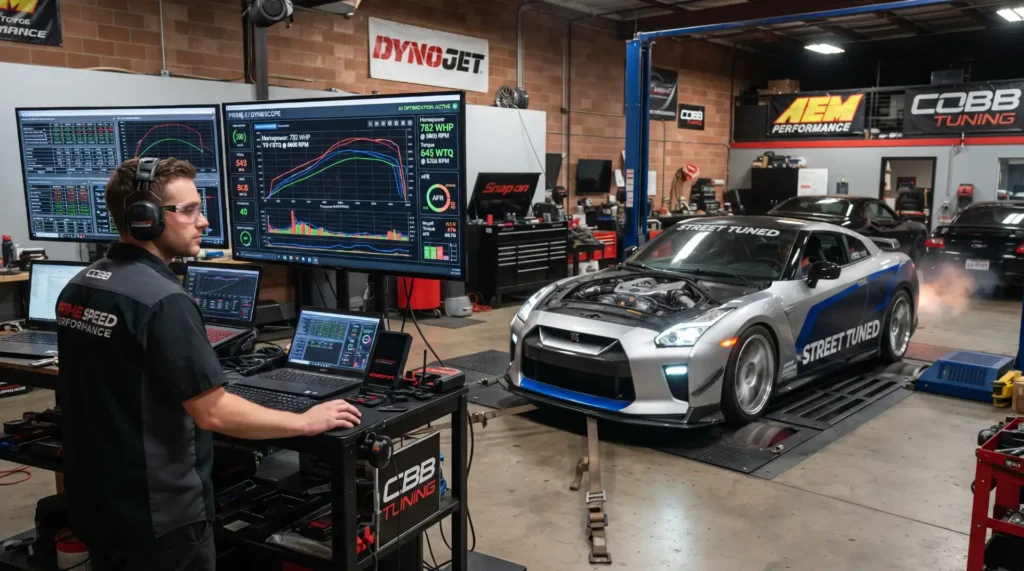 AI and Turbocharged Performance Cars
Turbocharged vehicles are an excellent example of where AI-assisted monitoring could provide value.
Modern turbocharged engines operate with complex relationships between boost pressure, intake temperature, exhaust energy, fuel delivery, ignition timing, and engine load.
A change in one area can affect several others.
For example, increasing boost can increase airflow and power, but it can also increase intake temperatures and cylinder pressure.
If the engine begins experiencing knock, the ECU may reduce ignition timing to protect the engine.
A driver might simply notice that the car feels slower.
AI-assisted analysis can examine the data and potentially identify the sequence of events that caused the performance reduction.
This becomes particularly useful during repeated track sessions.
A vehicle may produce strong power during the first few runs and then gradually lose performance as temperatures rise.
Auto Sport Performance already covers thermal management for performance vehicles, including the importance of managing intake, engine, oil, and brake temperatures during demanding driving.
AI can complement that approach by continuously analyzing temperature and performance data.
AI Can Help With Heat Management
Heat is one of the biggest enemies of performance.
Turbocharged engines generate significant heat, particularly when operating under sustained boost.
When temperatures rise, performance can become inconsistent.
AI monitoring systems can analyze intake temperature, coolant temperature, oil temperature, transmission temperature, exhaust temperature, and other available data.
Instead of looking at each number independently, an intelligent system can evaluate how they interact.
For example, it might identify that power begins declining after intake temperatures reach a particular range.
That information could help a tuner determine whether the vehicle needs a larger intercooler, improved airflow, additional cooling, or a revised calibration.
Water-methanol injection is another technology that performance enthusiasts sometimes use to address intake-charge temperature and knock resistance. Auto Sport Performance has previously covered how water-methanol injection can support turbocharged performance applications.
AI could eventually help monitor these systems as well, identifying changes in injection behavior or temperature response.
AI and Performance Dyno Testing
Dyno testing remains one of the most important tools in professional performance tuning.
A chassis dynamometer allows technicians to measure horsepower and torque while collecting information from the vehicle.
Traditional dyno tuning involves repeated runs followed by adjustments.
AI can help make the analysis process more efficient.
Instead of simply looking at peak horsepower and torque, an AI system can evaluate the entire power curve.
It can examine where torque rises, where power begins falling, how temperatures change between runs, and how the ECU responds to different operating conditions.
This can help identify inconsistencies that might not be obvious from a single horsepower number.
For example, two tunes might produce similar peak horsepower figures while behaving very differently through the middle of the RPM range.
For a street-driven American performance car, the second tune might actually provide a better driving experience if it delivers stronger midrange torque and smoother throttle response.
AI can help tuners evaluate these characteristics more efficiently.
AI and Electric Performance Cars
Artificial intelligence is not limited to gasoline-powered vehicles.
Electric vehicles are becoming increasingly sophisticated performance platforms.
EVs rely heavily on software, battery management systems, electric motors, inverters, thermal management, and electronic control systems.
That makes them particularly suitable for data-driven diagnostics.
AI can analyze battery temperature, charging behavior, voltage patterns, current demand, motor temperatures, and power output.
This information can help identify unusual behavior and potentially predict developing problems.
SAE researchers have already explored AI and machine-learning approaches for EV powertrain diagnostics and prognostics. Other 2026 research has examined predictive maintenance and self-supervised anomaly detection for electric vehicles.
For American EV enthusiasts, this could eventually lead to more sophisticated performance optimization.
Instead of focusing primarily on engine parameters, EV tuning will increasingly involve battery temperature, inverter performance, motor efficiency, regenerative braking, thermal management, and power delivery.
AI Could Change How Performance Parts Are Selected
Another interesting development is the possibility of AI-assisted modification planning.
Today, enthusiasts often research dozens of products before deciding what to install.
A vehicle owner might consider an intake, intercooler, exhaust, turbocharger, suspension components, wheels, brakes, fuel system, and ECU tune.
The challenge is determining how those components will work together.
AI could potentially analyze a vehicle’s current configuration and identify compatibility considerations.
For example, if an owner plans to increase turbocharger size, an AI-assisted system could identify supporting modifications that may become necessary.
That could include fuel-system capacity, cooling, intercooling, transmission limitations, brake upgrades, and tuning requirements.
The technology could therefore encourage enthusiasts to think about performance builds as complete systems rather than individual modifications.
AI and Personalized Performance Tuning
Every driver uses a vehicle differently.
One owner may prioritize maximum horsepower.
Another may want better throttle response.
A third may want improved fuel economy.
A fourth may use the vehicle for track days.
AI could help create more personalized performance strategies based on driving behavior.
For example, a daily driver might benefit from a calibration that emphasizes smooth torque delivery and fuel efficiency.
A track-focused vehicle might prioritize consistent performance under sustained high-load conditions.
A drag-racing build would have different requirements.
This type of personalization could become increasingly important as vehicles become software-defined.
AI could analyze how a vehicle is actually driven and help identify opportunities for optimization.
AI Does Not Replace the Human Tuner
Despite the rapid development of artificial intelligence, experienced automotive professionals remain essential.
AI can analyze data extremely quickly, but it does not automatically understand every mechanical limitation of a particular engine.
A technician can physically inspect a vehicle, listen for abnormal noises, examine components, recognize installation problems, and understand the practical limitations of aftermarket hardware.
The best approach is therefore not AI versus human expertise.
It is AI combined with human expertise.
A professional tuner can use AI to process large datasets, identify patterns, and generate possible explanations. The technician can then verify those findings through testing and mechanical inspection.
This combination could make professional tuning faster and more accurate without removing the human element.
The Importance of Data Quality
AI is only as useful as the information it receives.
Poor-quality sensors, incorrect calibration data, missing parameters, or inaccurate measurements can produce misleading results.
This is especially important with modified vehicles.
An aftermarket sensor may have a different calibration.
A poorly installed component may produce abnormal readings.
A damaged wiring harness can create intermittent signals.
If the AI system receives incorrect information, its conclusions may also be incorrect.
For this reason, technicians still need to verify sensor accuracy and vehicle condition before relying on AI-generated recommendations.
AI should be treated as a powerful analytical tool, not an infallible mechanic.
AI, Diagnostics and the Right to Repair
The increasing software content of vehicles also raises important questions about independent repair and access to diagnostic information.
In the United States, the EPA announced in July 2026 that it was implementing a “Freedom to Fix” initiative and stated that manufacturers must provide tools, software, and diagnostic information needed to repair modern vehicles. The EPA specifically references emissions-related service information, OBD data, enhanced diagnostics, and passthrough reprogramming information.
This matters because AI-powered diagnostics depend on access to useful vehicle information.
Independent performance shops need reliable diagnostic data if they are going to analyze modern vehicles effectively.
As cars become increasingly software-driven, access to diagnostic information could become just as important as access to mechanical components.
AI Tuning Must Still Respect U.S. Emissions Requirements
Performance enthusiasts should also understand that AI does not change federal emissions laws.
ECU tuning can affect emissions controls, and modifications designed to defeat or disable required emissions systems can violate the Clean Air Act.
The EPA specifically states that altering software or calibrations in ways that disable or circumvent emissions controls can constitute illegal tampering.
That means responsible AI-assisted tuning should focus on improving vehicle performance while maintaining applicable emissions compliance.
This is particularly important for street-driven vehicles in the United States.
Before installing a performance component or modifying an ECU calibration, vehicle owners should verify that the modification is legal for their intended use and location.
AI and Over-the-Air Updates
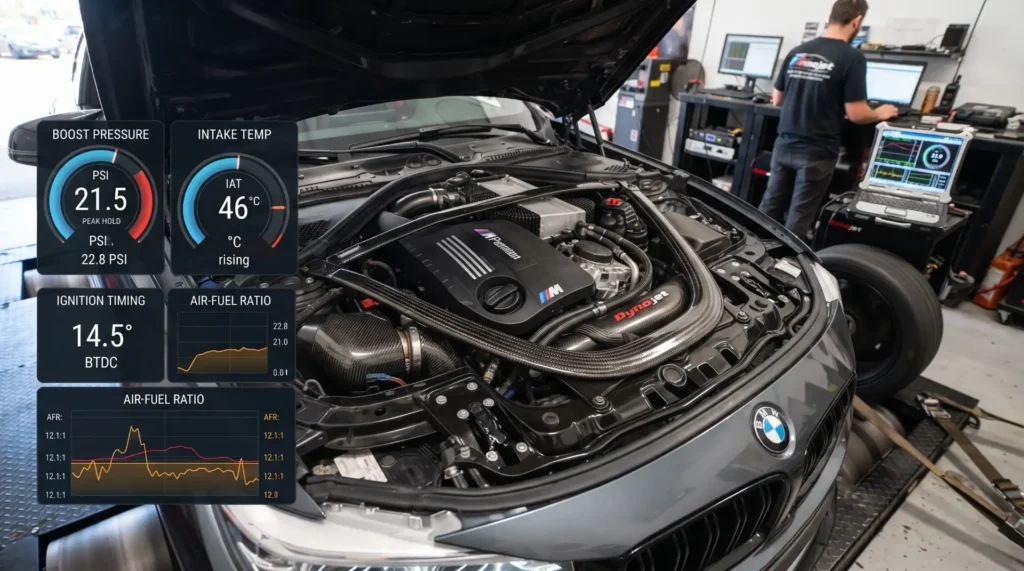 AI and Over-the-Air Updates
Modern vehicles increasingly receive software updates remotely.
For performance enthusiasts, this creates another consideration.
An over-the-air update can potentially change engine management, transmission behavior, diagnostics, or other software-controlled systems.
Auto Sport Performance has already covered how over-the-air software updates can affect tuned vehicles.
AI-based tuning tools could eventually monitor software versions and identify when a calibration may need to be reviewed after an update.
This could become increasingly important as manufacturers continue moving toward software-defined vehicles.
A performance tune that works correctly today may need to be reevaluated after a significant manufacturer software update.
What This Means for U.S. Car Enthusiasts
For American performance enthusiasts, the biggest change may be the amount of information available to them.
A modern vehicle can generate enormous amounts of data, and AI provides new ways to interpret that information.
Instead of relying exclusively on a warning light or a single diagnostic code, owners may increasingly have access to predictive information about engine behavior, thermal performance, battery health, and drivetrain operation.
This could make maintenance more proactive.
It could also make performance tuning more precise.
The result may be fewer unnecessary parts replacements, faster troubleshooting, better calibration decisions, and more personalized performance builds.
How Enthusiasts Can Prepare for AI-Based Tuning
Car enthusiasts do not need to become AI engineers to benefit from this technology.
The most useful step is understanding the data produced by their vehicles.
Learning the basics of air-fuel ratio, ignition timing, boost pressure, intake temperatures, coolant temperatures, fuel pressure, and engine load can help owners understand what their tuner is analyzing.
Keeping accurate maintenance records is also valuable.
An AI system can make better comparisons when historical information is available.
Owners should also work with qualified performance professionals when making significant ECU or mechanical changes.
The goal should be to combine modern technology with proven automotive fundamentals.
The Future of AI Car Performance Tuning
AI-assisted performance tuning is still developing, but the direction is clear.
Artificial intelligence is increasingly being explored for predictive diagnostics, ECU applications, EV powertrain analysis, edge computing, and real-time vehicle monitoring.
In the future, AI may become capable of continuously analyzing vehicle performance and identifying subtle changes before they become obvious to the driver.
Performance shops could use AI to compare thousands of data points during dyno testing.
EV owners could receive earlier warnings about battery or motor abnormalities.
Turbocharged vehicles could receive more sophisticated thermal and boost monitoring.
Tuners could use AI to simulate potential calibration changes before testing them on a vehicle.
However, the fundamental principles of performance engineering will remain important.
Good tuning still requires understanding airflow, combustion, fuel delivery, thermal management, drivetrain limitations, and mechanical reliability.
AI will make the analysis more powerful, but it does not eliminate the need for sound engineering.
Final Thoughts
AI is changing car performance tuning and diagnostics by making it easier to analyze the enormous amount of information produced by modern vehicles.
From ECU calibration and dyno testing to predictive maintenance and EV diagnostics, artificial intelligence is becoming another important tool in the automotive performance industry.
For U.S. enthusiasts, the biggest benefit may be better decision-making. AI can help identify patterns, detect unusual behavior, analyze performance data, and support technicians as they diagnose increasingly complicated vehicles.
The technology is especially promising for turbocharged performance cars, high-mileage vehicles, track builds, and modern EVs where software and electronic control systems play a major role.
Still, AI should complement—not replace—experienced automotive professionals.
The best performance results will come from combining intelligent software with quality components, accurate data, careful testing, proper maintenance, and knowledgeable tuning.
As vehicles become more software-driven, the future of performance tuning will increasingly involve both horsepower and data. The enthusiasts and shops that learn how to use both effectively will be better positioned for the next generation of American automotive performance.