
When enthusiasts talk about making a performance car faster, the conversation usually turns toward horsepower. Turbochargers, engine tuning, larger intercoolers, exhaust systems, fuel upgrades, and aggressive ECU calibration can all produce meaningful gains. But there is another approach that can improve several aspects of vehicle performance at the same time: reducing unnecessary weight with carefully selected lightweight performance parts.
Weight reduction does more than make a vehicle easier to accelerate. A well-planned lightweight build can improve braking, steering response, cornering behavior, suspension performance, tire loading, and even the overall feel of the car. Instead of simply adding more engine power, removing mass can allow the existing powertrain, brakes, suspension, and tires to work more effectively.
This is particularly important for modern performance vehicles in the United States. Many newer cars are larger and heavier than their predecessors because of increased safety equipment, technology, comfort features, larger batteries, more sophisticated cooling systems, and additional structural requirements. As a result, lightweight performance parts can provide an attractive way to improve driving dynamics without relying exclusively on additional horsepower.
However, not every lightweight part automatically makes a car better. A component still needs to be strong enough for its intended use, compatible with the vehicle, appropriate for the driving environment, and installed correctly. Removing weight from the wrong place can also create compromises in comfort, reliability, durability, or safety.
The goal, therefore, is not simply to make a vehicle as light as possible. The better strategy is to remove unnecessary mass while preserving the strength, balance, reliability, safety, and usability that make the car enjoyable to drive.
Why Vehicle Weight Has Such a Large Effect on Performance
A vehicle’s mass influences nearly every major performance measurement. When a car accelerates, the engine must overcome the vehicle’s inertia. When the driver applies the brakes, the braking system must convert the vehicle’s kinetic energy into heat. When the car enters a corner, the tires and suspension must control the forces created by the vehicle’s mass and speed.
Reducing mass can therefore benefit several systems simultaneously. A lighter car generally requires less force to accelerate, places less demand on its brakes, and can put less stress on suspension components and tires. The improvement becomes even more noticeable when weight is removed from components that rotate or move with the suspension.
This is one reason weight reduction can sometimes produce a more noticeable improvement in driving feel than a small increase in engine horsepower. Adding 20 horsepower may improve acceleration, but removing weight can influence acceleration while also changing braking, cornering, steering response, and suspension behavior.
Power-to-weight ratio is particularly important. A 300-horsepower engine in a lightweight sports car can deliver a very different experience from the same engine in a substantially heavier vehicle. The engine has less mass to move, while the chassis has less inertia to control during changes in speed and direction.
For enthusiasts building a street car, this does not mean stripping the vehicle down to a bare shell. Practical weight reduction can come from replacing individual components with lighter alternatives while maintaining the features that make the vehicle comfortable and usable.
For more background on this subject, see our guide to why weight reduction matters in modern performance builds.
Lightweight Performance Parts vs. Simply Removing Equipment
There is an important distinction between a lightweight performance build and simply removing equipment from a vehicle. Removing rear seats, interior panels, air conditioning components, sound insulation, or other equipment can reduce mass, but it may also make the vehicle less comfortable and less practical.
Lightweight performance parts take a different approach. Instead of eliminating a function, the goal is often to maintain that function while reducing the amount of material required to perform it.
A forged aluminum wheel can replace a heavier wheel while maintaining the vehicle’s basic wheel function. A lightweight exhaust can maintain exhaust flow while reducing mass. A carbon fiber body panel can replace a heavier metal panel without necessarily eliminating the panel itself.
This approach makes lightweight modifications especially attractive for street-driven performance cars. The owner can preserve air conditioning, interior comfort, safety equipment, and everyday usability while selectively reducing mass in areas where the performance benefit is meaningful.
 Lightweight Wheels: One of the Best Places to Start
 Lightweight Wheels: One of the Best Places to Start
Lightweight wheels are among the most popular weight-saving upgrades for performance vehicles, and there is a good reason. Wheels are part of the vehicle’s unsprung mass, and they also rotate whenever the car moves.
Reducing wheel weight can therefore provide benefits that go beyond simply removing the same amount of mass from a stationary body panel. The wheel must accelerate rotationally, and the suspension must control its movement as the vehicle travels over pavement irregularities.
A lighter wheel can contribute to sharper acceleration response, improved braking response, and more immediate steering feel. It can also help the suspension respond more effectively to bumps and changes in road surface.
Construction method matters. Cast aluminum wheels, flow-formed wheels, forged aluminum wheels, and other designs can provide different combinations of weight, strength, stiffness, cost, and durability. The lightest wheel is not automatically the best wheel for every application.
Street-driven vehicles regularly encounter potholes, expansion joints, broken pavement, curbs, and rough roads. A wheel that performs perfectly on a smooth racing circuit may not be the best choice for daily driving in areas with poor pavement.
Wheel diameter and tire selection must also be considered together. A lightweight wheel can lose some of its advantage if an extremely heavy tire is installed. The complete wheel-and-tire package is what matters in the real world.
Our detailed guide on lightweight wheels and their effect on vehicle performance explains why wheel construction, rotational mass, unsprung weight, tire selection, and fitment all matter when choosing a performance wheel.
Why Unsprung Weight Matters So Much
Unsprung weight includes components that are not supported directly by the vehicle’s springs. Wheels and tires are obvious examples, while portions of the brake assemblies, hubs, and suspension components also contribute to unsprung mass.
Reducing unsprung weight can help the suspension control the wheel more effectively. When the wheel encounters a bump, the suspension needs to move it while maintaining tire contact with the pavement. A lighter assembly generally gives the suspension less mass to control.
Maintaining tire contact is critical for performance. A tire can only generate useful acceleration, braking, or cornering forces when it remains properly connected to the road surface.
This is why reducing a few pounds from a wheel or other moving suspension component can sometimes produce a more noticeable improvement in vehicle response than removing the same amount of weight from a stationary interior component.
However, suspension geometry, damper calibration, spring rates, tire construction, and alignment all influence the final result. Lightweight components should be considered as part of the entire chassis system rather than as isolated upgrades.
Lightweight Brake Components Can Improve More Than Braking Feel
Braking is another area where reducing weight can provide multiple advantages. Performance brake upgrades often focus on larger rotors, larger calipers, additional pistons, and high-friction pads. These upgrades can provide more braking capacity, but they can also add weight.
A well-designed lightweight brake system attempts to balance braking capacity with mass. Two-piece rotors, aluminum components, optimized rotor designs, and motorsport-inspired construction can sometimes reduce unnecessary weight while maintaining the thermal capacity needed for the application.
The important word is “appropriate.” A lightweight brake component must still be capable of handling the vehicle’s speed, mass, tire grip, and intended use.
A street car used for commuting does not necessarily require the same braking hardware as a car that spends every other weekend at a road course. A track car can generate repeated high-energy braking events that place extreme thermal demands on rotors and pads.
Weight reduction should never come at the expense of brake safety. Performance parts should be selected according to the manufacturer’s specifications and the vehicle’s actual operating conditions.
How Weight Reduction Can Improve Acceleration
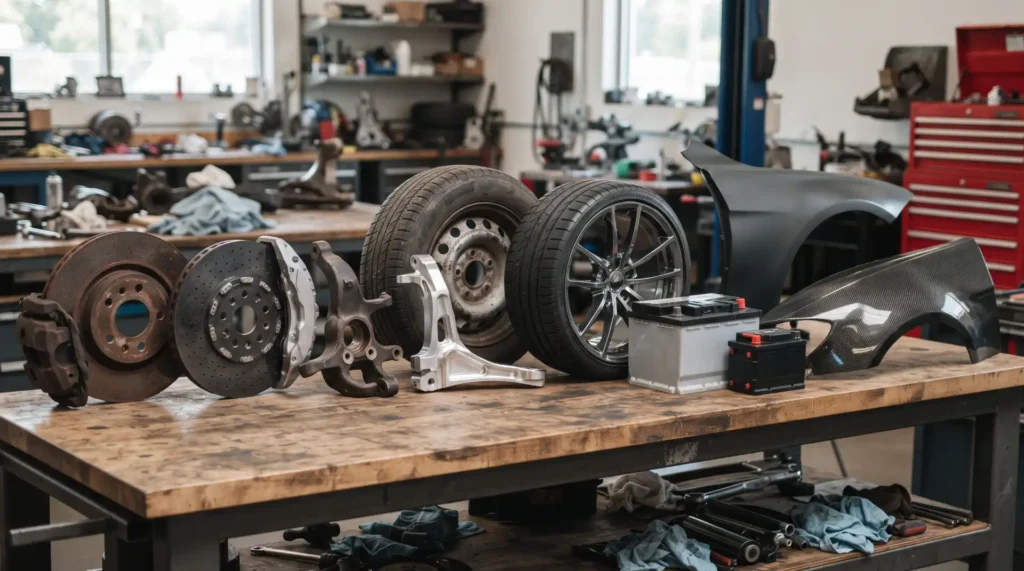 How Weight Reduction Can Improve Acceleration
Acceleration is one of the easiest benefits of weight reduction to understand. A lighter vehicle requires less force to increase its speed.
Imagine two otherwise similar vehicles using the same engine, transmission, gearing, and tires. The lighter vehicle has less mass to accelerate. This can improve throttle response and reduce the amount of time required to reach a given speed.
The advantage becomes particularly useful when weight is removed from rotating components. Lightweight wheels, tires, flywheels, driveshafts, and other rotating parts can influence how quickly the drivetrain changes speed.
A lightweight flywheel, for example, can allow engine speed to rise more quickly because the engine has less rotational inertia to overcome. The tradeoff is that an aggressively lightweight flywheel can also change drivability, launch behavior, idle characteristics, and clutch engagement.
As with most performance modifications, the best solution depends on the vehicle’s purpose. A race car may benefit from an aggressive reduction in rotating mass, while a daily-driven performance car may benefit from a more moderate setup.
Lightweight Driveshafts and Rotating Components
The driveshaft is another component that can be optimized for performance. Depending on the vehicle, a lighter aluminum or carbon-fiber driveshaft can reduce rotating mass while also offering potential benefits in strength and drivetrain response.
Because the driveshaft rotates at significant speed, reducing its mass can influence drivetrain behavior. A properly engineered driveshaft can also provide other advantages, such as reduced rotating inertia and improved torsional characteristics.
However, driveshaft modifications should never be approached as a simple “lighter is always better” exercise. The component must be correctly balanced and engineered for the vehicle’s power level, operating speed, drivetrain configuration, and intended use.
A poorly selected or improperly installed rotating component can create vibration, accelerated wear, or serious mechanical problems. Professional installation is especially important for high-speed drivetrain components.
Carbon Fiber: Lightweight and Strong, but Not Cheap
Carbon fiber has become one of the most recognizable materials in modern performance vehicles. Its combination of low mass and high stiffness makes it attractive for body panels, aerodynamic components, structural applications, seats, driveshafts, and other performance parts.
Replacing a steel or heavier composite component with a properly engineered carbon-fiber alternative can reduce mass while maintaining useful structural or aerodynamic characteristics.
Common carbon-fiber performance parts include hoods, trunks, roofs, front fenders, aerodynamic panels, interior components, and motorsport bodywork.
But carbon fiber should not be treated as a magic material. Quality, manufacturing process, fiber orientation, resin system, mounting design, and structural engineering all matter.
A cheap cosmetic carbon-fiber panel is not necessarily a meaningful performance upgrade. Some products use carbon fiber primarily as a visual finish while retaining a heavier underlying structure.
For serious weight reduction, enthusiasts should determine the actual weight of the original component and compare it with the replacement. A part that looks more advanced may not provide a meaningful mass reduction.
Forged Aluminum and Other Lightweight Metals
Carbon fiber receives much of the attention in performance circles, but lightweight metals remain extremely useful. Forged aluminum is especially popular for wheels and selected suspension components because it can provide an attractive combination of strength, weight, and durability.
Aluminum can also be used for brackets, suspension components, engine accessories, cooling-system components, and other parts where reducing mass is beneficial.
In many street builds, aluminum offers a more practical balance than exotic composite materials. It can be less expensive, easier to repair or replace, and better suited to repeated exposure to potholes, weather, road debris, and everyday use.
The important consideration is not simply whether a part is aluminum. The design, manufacturing process, thickness, alloy, and engineering determine the actual performance characteristics.
Lightweight Exhaust Systems
The exhaust system is another area where enthusiasts can remove significant weight. Factory exhaust systems are engineered around cost, emissions requirements, noise control, durability, comfort, and mass production.
Performance exhaust manufacturers can use thinner materials, optimized routing, lighter mufflers, and materials such as stainless steel, aluminum, or titanium to reduce mass.
A titanium exhaust can be especially attractive for a track-oriented build because titanium offers a strong strength-to-weight ratio. The downside is cost, making it more difficult to justify for a budget street build.
A lightweight exhaust can also influence weight distribution depending on where mass is removed. Removing weight from the rear of the vehicle, for example, can have a different effect on balance than removing the same amount from the center.
Exhaust design should therefore be evaluated according to sound level, emissions compliance, ground clearance, heat management, durability, and power goals rather than weight alone.
Lightweight Batteries for Performance Cars
The battery can be another surprisingly effective location for weight reduction. Traditional lead-acid batteries are relatively heavy, and performance-oriented alternatives can weigh substantially less.
A lightweight battery can remove several pounds from the vehicle without changing the engine’s output. Because the battery is often located toward the front of the vehicle, changing its mass can also influence weight distribution.
However, battery selection is particularly important for street cars. Cold-start performance, electrical demand, temperature range, charging behavior, reserve capacity, mounting requirements, and compatibility with the vehicle’s electronics all need to be considered.
Modern cars can have extensive electrical systems, including advanced driver-assistance technology, infotainment, electric steering, cooling fans, electronically controlled suspension, and numerous control modules. A battery must be capable of supporting the vehicle’s actual electrical requirements.
For a track-focused vehicle with simplified electrical demands, a lightweight battery can make more sense. For a daily driver, the best choice may be a moderate weight reduction rather than the lightest possible battery.
Lightweight Seats and Interior Components
Performance seats can provide another opportunity to reduce weight while improving driver support. Factory seats often contain motors, heating elements, extensive cushioning, power adjustments, and comfort features.
A fixed-back or manually adjustable performance seat can weigh considerably less than a fully equipped factory seat. It can also provide better lateral support during aggressive cornering.
But seats are safety-critical components. A performance seat should be correctly engineered for the vehicle and installed using appropriate mounting hardware. Airbag systems and seatbelt-related equipment must also be considered before replacing factory seats.
For a street-driven vehicle, preserving appropriate safety systems should take priority over achieving the lowest possible curb weight.
Suspension Components and Lightweight Handling Upgrades
Lightweight suspension components can provide benefits because they may reduce unsprung mass while also improving stiffness. Depending on the vehicle, aluminum control arms, lightweight hubs, optimized knuckles, and motorsport-oriented components can improve suspension response.
However, suspension modifications should be approached as a complete system. Springs, dampers, bushings, anti-roll bars, alignment settings, tires, wheel dimensions, and chassis stiffness all interact.
Installing one lightweight component without considering the rest of the suspension can produce limited benefits. In some cases, the vehicle may even require revised damper settings to take full advantage of reduced unsprung mass.
This is particularly important when combining lightweight wheels with aggressive suspension modifications. A chassis designed for comfortable street driving may react differently once heavier or lighter wheels, stiffer springs, and performance tires are introduced.
Weight Distribution Matters as Much as Total Weight
Removing 50 pounds from a vehicle is useful, but where those 50 pounds come from can be just as important as the total number.
Performance cars benefit from balanced weight distribution. Removing mass from a location that significantly affects front-to-rear balance can alter how the vehicle behaves during braking, acceleration, and cornering.
For example, removing substantial mass from the front of a front-heavy vehicle can potentially improve balance. On another vehicle, removing too much rear weight could change traction characteristics.
Center of gravity also matters. Lowering mass positioned high in the vehicle can reduce the amount of body roll and weight transfer that occurs during cornering.
This is one reason lightweight roofs, seats, batteries, and upper-body components can be valuable in a carefully engineered build. The objective is not simply a lower number on the scale but a better-performing vehicle.
Lightweight Performance Parts and Braking Performance
Vehicle mass has a direct relationship with the amount of energy that must be managed during braking. A heavier vehicle generally places greater demands on its tires and braking system.
Reducing mass can therefore help the braking system work with less overall vehicle energy. It can also reduce thermal stress during repeated braking events.
This does not mean a lightweight car automatically stops in a shorter distance. Tire grip, brake compound, rotor temperature, ABS calibration, suspension geometry, and road conditions remain extremely important.
In fact, tires may have a greater effect on braking performance than many weight-saving components. NHTSA emphasizes proper tire selection, inflation, tread condition, traction, temperature ratings, and maintenance as important parts of vehicle safety. Enthusiasts should therefore consider tire quality and condition whenever they make changes intended to improve braking or handling. NHTSA’s TireWise resource provides current guidance on tire safety, ratings, maintenance, and selection.
How Lightweight Parts Improve Cornering
Cornering performance is influenced by tires, suspension, aerodynamics, chassis stiffness, alignment, weight distribution, and vehicle mass. Reducing weight can help many of these systems operate with less demand.
A lighter vehicle generally generates less load on its tires during changes in direction. Reducing unsprung mass can help the suspension keep the tires connected to the road. Reducing high-mounted mass can lower the center of gravity and improve transient response.
The result can be a vehicle that feels more responsive when entering a corner, changing direction, or transitioning from braking to acceleration.
Drivers often describe this as a car feeling “lighter on its feet.” That sensation is not simply about horsepower. It comes from the way the chassis reacts to steering inputs and how quickly the vehicle responds to changes in direction.
Lightweight Parts and Performance Tires Must Work Together
One of the biggest mistakes in a weight-reduction project is treating wheels, tires, suspension, and brakes as completely separate systems.
A lightweight wheel paired with an excessively heavy tire may reduce the expected benefit. A lightweight suspension component combined with poorly matched dampers may not deliver the desired improvement. A powerful engine combined with lightweight wheels but inadequate tires can still produce poor real-world acceleration and braking.
The tire is ultimately the contact point between the vehicle and the road. Tire width, compound, construction, temperature range, sidewall characteristics, load rating, and inflation pressure all influence the result.
For U.S. street cars, the right tire also depends on climate. A vehicle driven in Arizona, Florida, Michigan, California, or the Pacific Northwest may experience very different pavement and temperature conditions.
Performance parts should therefore be selected around the actual environment in which the vehicle is used rather than around a theoretical maximum specification.
Street Cars Need a Different Weight-Reduction Strategy
A daily-driven performance car needs to remain comfortable, reliable, predictable, and practical. Extreme weight reduction may not make sense if it requires sacrificing air conditioning, sound insulation, interior equipment, safety features, or weather protection.
For many U.S. enthusiasts, the better strategy is selective weight reduction. Lightweight wheels, a properly engineered exhaust, a reasonable battery upgrade, performance seats where appropriate, and carefully chosen suspension components can produce meaningful improvements without turning the car into an uncomfortable race machine.
Our guide to daily-driver versus track builds explores how enthusiasts can increase performance without sacrificing the characteristics that make a car practical for everyday driving.
Track Cars Can Take Weight Reduction Further
Track-focused vehicles have different priorities. Comfort and convenience become less important while repeatable performance, thermal management, braking, cornering, and driver control become more important.
A track build may justify more aggressive weight reduction, including lightweight seats, simplified interiors, lighter body panels, racing wheels, motorsport exhaust systems, lightweight batteries, and other specialized components.
Even then, weight reduction should be strategic. A track car still needs sufficient structural strength, cooling, braking capacity, tire performance, and reliability.
Removing equipment that is not necessary for competition can make sense. Removing components that contribute to safety or reliability simply to reach an arbitrary weight target may not.
Lightweight Materials Can Be Worth the Cost in the Right Build
One of the biggest disadvantages of lightweight performance parts is price. Carbon fiber, titanium, forged aluminum, motorsport wheels, advanced brake components, and specialty batteries can cost substantially more than conventional alternatives.
The key question is whether the performance gain justifies the expense for the intended vehicle.
A $5,000 carbon-fiber component that saves only a modest amount of weight may not be the best investment for a street car. On a serious track build, however, the same component could be worthwhile if it also improves weight distribution, stiffness, or aerodynamic performance.
Budget-conscious enthusiasts should start with areas where the performance benefit per dollar is strongest. Lightweight wheels, sensible tires, a carefully selected exhaust, and other practical upgrades can often provide more real-world value than expensive exotic materials.
Why Lightweight Parts Should Not Be Chosen by Weight Alone
It can be tempting to compare two products solely by their listed weight. That is not enough.
Strength, stiffness, durability, corrosion resistance, heat tolerance, serviceability, fitment, and warranty support all matter. A lightweight component that fails prematurely is not a performance upgrade.
This is particularly important for wheels, brakes, suspension components, drivetrain components, seats, and structural body parts.
Performance enthusiasts should look for reputable manufacturers, documented specifications, appropriate testing, and components designed specifically for the vehicle and intended use.
Common Mistakes When Building a Lightweight Performance Car
One common mistake is removing weight without considering balance. Another is choosing an extremely lightweight component that is poorly suited to street conditions.
Another problem is spending heavily on weight reduction while ignoring tires, alignment, brake pads, dampers, or driver technique. A lightweight vehicle with poor tires and an improperly tuned suspension may not outperform a slightly heavier vehicle with a well-balanced setup.
Some enthusiasts also focus heavily on total curb weight while ignoring rotational and unsprung mass. The location and movement of the weight can be extremely important.
Finally, excessive weight reduction can make a vehicle unpleasant to drive. A car that loses too much insulation, comfort, practicality, and refinement may be impressive at the track but frustrating everywhere else.
How to Build a Balanced Lightweight Performance Package
A smart weight-reduction project begins by identifying the vehicle’s primary purpose. Is it a daily driver, weekend canyon car, autocross vehicle, road-course car, drag build, or dedicated race car?
Once the purpose is established, measure the existing vehicle rather than guessing. Weighing the complete wheel-and-tire package, battery, exhaust, seats, and other components can reveal where the greatest opportunities exist.
Next, prioritize modifications that provide more than one benefit. Lightweight wheels are a strong example because they can reduce rotational and unsprung mass. A properly selected lightweight exhaust can reduce mass while potentially improving exhaust flow. A lightweight battery can reduce mass without changing engine output.
After installing the parts, the vehicle should be evaluated as a complete system. Alignment, tire pressures, damping, spring rates, braking performance, and traction should be checked again after major changes.
Weight Reduction vs. Adding More Horsepower
There is no universal answer to whether enthusiasts should remove weight or add horsepower first. It depends on the vehicle and its goals.
If a car already has substantial engine power but feels heavy and slow to respond, weight reduction may provide a more noticeable improvement in driving character. If the vehicle is already lightweight but lacks power, engine modifications may offer greater benefits.
For many performance builds, the strongest solution is a combination of moderate weight reduction and sensible power upgrades.
A lighter vehicle does not need as much horsepower to feel fast. It can also place less demand on brakes, tires, suspension components, and drivetrain parts. That can create a more balanced and potentially more reliable performance package.
Lightweight Performance Parts for Modern Hybrid and Electrified Vehicles
Weight reduction is becoming particularly interesting as hybrid and electrified performance vehicles become more common. Batteries and electric motors can add substantial mass, creating new challenges for engineers and enthusiasts.
Because the powertrains in these vehicles can already provide impressive acceleration, reducing chassis and suspension weight can become an important way to improve handling and efficiency without sacrificing electric performance.
Lightweight wheels, optimized suspension components, lightweight body panels, and aerodynamic improvements can all help offset some of the mass associated with electrified powertrains.
However, hybrid and electric vehicles require additional care because battery systems, thermal management, high-voltage components, and electronic control systems can be safety-critical. Weight reduction should never involve improvised modifications to high-voltage components.
Why the Best Lightweight Build Is Usually a Balanced Build
 Why the Best Lightweight Build Is Usually a Balanced Build
The fastest car on paper is not always the fastest car in the real world. A performance vehicle must accelerate, brake, turn, put power down, manage heat, and remain predictable.
That is why balanced weight reduction is more valuable than chasing the lowest possible curb weight.
A vehicle with lightweight wheels, appropriately sized tires, capable brakes, properly tuned suspension, sensible weight distribution, and sufficient cooling can provide a much better driving experience than a vehicle that simply has an impressive number on the scale.
For street enthusiasts, the goal should usually be a car that feels sharper without becoming difficult to live with. For track drivers, the goal can be more aggressive, but reliability and safety should remain priorities.
Final Thoughts on Lightweight Performance Parts
Lightweight performance parts can be among the most effective modifications for enthusiasts who want a more responsive vehicle without relying entirely on additional horsepower. Reducing mass can improve acceleration while also reducing demands on the brakes, suspension, tires, and chassis.
The biggest opportunities often come from wheels, tires, brakes, suspension components, exhaust systems, batteries, seats, body panels, and selected drivetrain components. Lightweight wheels and other unsprung components can be particularly valuable because they influence both vehicle mass and suspension response.
However, successful weight reduction is about much more than buying the lightest parts available. Every component must be considered in the context of strength, durability, fitment, safety, weight distribution, driving environment, and the overall vehicle setup.
For U.S. performance enthusiasts, the ideal lightweight build is usually one that delivers measurable improvements while preserving reliability and usability. A daily driver does not need to become a stripped-out race car to benefit from thoughtful weight reduction. Likewise, a serious track car should not sacrifice essential reliability simply to achieve a lower scale reading.
The most effective strategy is to remove weight where it produces the greatest dynamic benefit, particularly from rotating and unsprung components, while pairing those changes with appropriate tires, suspension tuning, brakes, and alignment.
In the end, lightweight performance parts are not simply about making a vehicle lighter. They are about making the entire vehicle work more efficiently. When the engine has less mass to accelerate, the brakes have less energy to manage, the suspension has less mass to control, and the tires have a better-balanced chassis to work with, the result can be a performance car that feels quicker, sharper, and more connected every time you drive it.