
Modern performance cars are increasingly defined by software. Engine output, throttle response, boost pressure, transmission behavior, cooling strategies, traction control, emissions monitoring, and even exhaust sound may be managed by interconnected electronic modules. Changing the calibration in one of those modules can transform how a vehicle performs, which is why ECU and transmission tuning have become central to many modern builds.
At the same time, automakers are using over-the-air software updates to change vehicles without requiring a dealership visit. An over-the-air update, commonly abbreviated as an OTA update, may repair a fault, improve cybersecurity, update an infotainment system, change a driver-assistance feature, revise charging behavior, or install new calibration software. Some manufacturers can also use OTA technology to complete certain safety-recall remedies.
That convenience creates uncertainty for owners of tuned cars. A manufacturer update may have no effect on an aftermarket tune when it targets an unrelated infotainment module. However, an update involving the powertrain control module, transmission controller, battery-management system, or another component used by the tune can overwrite a calibration, create a compatibility problem, or change the operating assumptions on which the aftermarket software was based.
The result is not always immediate engine damage or a completely disabled vehicle. Effects can range from a tune simply disappearing to warning lights, drivability problems, rejected calibration files, changed transmission behavior, or the need for a tuner to develop a revised file. Understanding these possibilities can help enthusiasts protect their vehicles without automatically rejecting important manufacturer updates.
What Is an Over-the-Air Vehicle Update?
An OTA update delivers software to a vehicle through a wireless connection. Depending on the manufacturer and vehicle, the connection may use an embedded cellular modem, Wi-Fi, or a combination of both. The vehicle downloads an authenticated software package and installs it in one or more electronic modules, sometimes after the owner approves the update and parks the car under specified conditions.
OTA capability varies significantly among manufacturers and model years. Some vehicles receive only navigation and infotainment updates. Others support updates to systems that affect propulsion, braking, battery management, driver assistance, body controls, or the powertrain. Owners should therefore avoid assuming that every update is either harmless to a tune or certain to erase it.
Automakers use OTA delivery because software problems can sometimes be addressed faster than they could through a traditional dealership campaign. The National Highway Traffic Safety Administration maintains recall records that identify when a recall remedy may be delivered through an over-the-air update. Owners can use the agency’s vehicle recall lookup to check for unresolved safety recalls using a vehicle identification number.
An OTA update is different from an aftermarket ECU tune. The automaker’s update is designed for the vehicle’s original systems and approved configurations. An aftermarket tune alters selected calibration values to accommodate higher-octane fuel, increased boost, intake or exhaust changes, upgraded turbochargers, different injectors, transmission modifications, or other performance objectives.
 Why Tuned Cars Are More Sensitive to Software Changes
 Why Tuned Cars Are More Sensitive to Software Changes
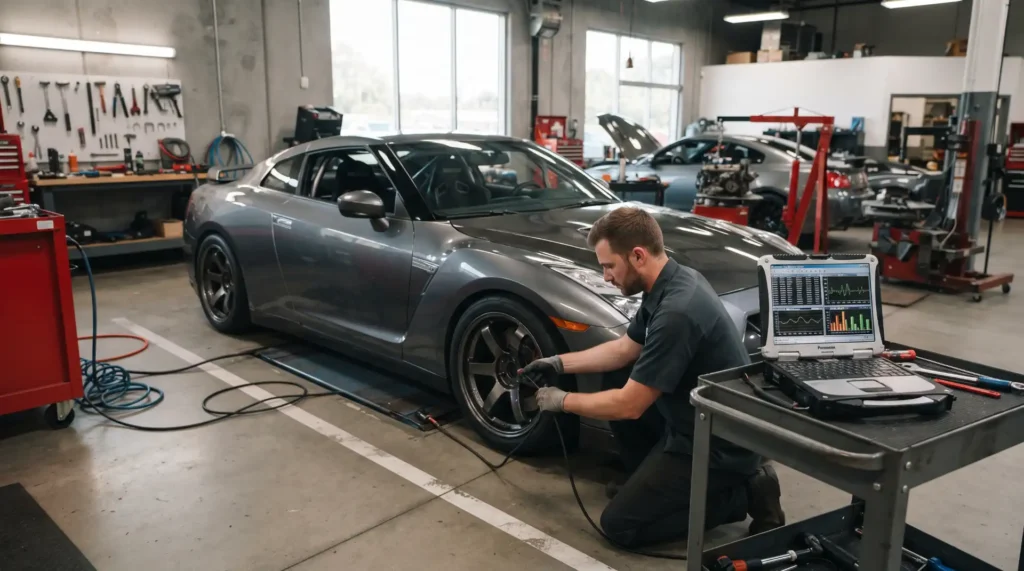
A stock vehicle operates with software, hardware, and validation developed to work together. A tuned vehicle changes part of that relationship. The aftermarket calibration may rely on a particular factory software version, module identifier, sensor configuration, transmission strategy, or set of operating tables. If the manufacturer changes that foundation, the existing tune may no longer match it.
For example, a manufacturer may revise torque calculations, throttle management, boost-control logic, knock response, transmission torque limits, thermal protection, diagnostic thresholds, or emissions-monitoring routines. A calibration built from the previous factory version may not automatically account for those changes.
The complexity increases because modern controllers communicate with one another. The engine controller may exchange torque data with the transmission, stability-control, all-wheel-drive, instrument-cluster, and advanced driver-assistance modules. A mismatch does not have to be severe enough to prevent the engine from starting before it creates a fault or changes vehicle behavior.
This is why a professional tuner generally needs more than the vehicle’s year, make, and model. The tuner may need the controller strategy, software version, calibration identifier, installed hardware, fuel type, diagnostic history, and information about previous updates. Readers unfamiliar with this process may find additional context in Auto Sport Performance’s guide to understanding vehicle diagnostics.
An Update May Overwrite the ECU Tune
The most recognizable risk is that a manufacturer update may overwrite the tuned calibration with new factory software. When this happens, the vehicle may return to stock power and torque targets. The owner might notice reduced boost, softer throttle response, lower rev limits, restored speed limiters, or different transmission behavior.
Whether an update overwrites a tune depends on which module is updated and how the tuning platform stores and installs its calibration. An infotainment update ordinarily should not rewrite the engine controller merely because both are delivered wirelessly. A powertrain update, however, may replace or reorganize the software areas altered by the tune.
Owners should not assume that they can immediately reinstall the same aftermarket file. If the automaker introduced a new software version, the tuning platform may need to recognize and support that version first. The tuner may also need to rebuild the calibration using the new factory file as its base.
Attempting to force an outdated or incompatible file onto a controller can create programming errors or improper operation. The safer approach is to stop, document the new software identifiers, and contact the tuner or tuning-platform provider before reflashing the vehicle.
The Tune May Remain but Behave Differently
Not every relevant update completely erases an aftermarket tune. An update to another module may still affect the tuned vehicle because that module exchanges information with the engine or transmission controller. New torque-management instructions, stability-control logic, battery-voltage behavior, or cooling commands can change how the complete vehicle responds.
A driver might experience altered shift timing, unexpected torque reduction, inconsistent throttle response, a new warning message, or a diagnostic trouble code. In some cases, the car may drive normally during light use but behave differently under boost, high temperature, or repeated acceleration.
These subtler changes make post-update testing important. The absence of a check-engine light does not prove that the performance calibration is operating exactly as it did before. Likewise, one short road test cannot confirm that fuel delivery, ignition timing, boost control, and temperature protection remain appropriate under load.
A review of diagnostic data can show whether commanded and actual values still agree. Depending on the vehicle, a tuner may examine air-fuel ratio, fuel trims, ignition timing, knock activity, boost pressure, throttle angle, intake-air temperature, coolant temperature, fuel pressure, torque intervention, and transmission behavior.
Manufacturer Updates May Change Security Access
 Manufacturer Updates May Change Security Access
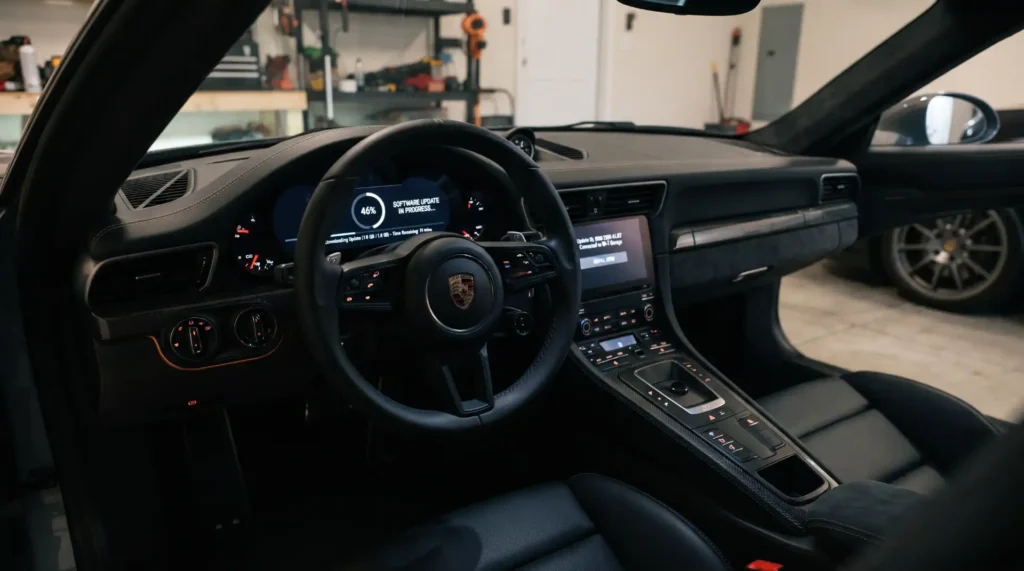
Automakers have increased cybersecurity protections as vehicles have become more connected. Updates can address vulnerabilities, revise authentication procedures, or change access to protected controllers. These improvements can be important for safety, privacy, and system integrity, but they may also affect aftermarket tuning tools.
A software revision might require a new unlocking method, prevent a previously supported flashing process, or cause a tuning device to report that the controller version is not recognized. In some vehicles, the controller may need to be unlocked again before a compatible calibration can be installed.
The National Highway Traffic Safety Administration’s vehicle cybersecurity guidance explains the agency’s approach to reducing risks in increasingly connected vehicles. Performance enthusiasts should recognize that a security update is not necessarily intended to target modified cars. Its effect on tuning access may be an indirect consequence of protecting the vehicle’s electronic architecture.
Trying to bypass security without understanding the controller, update, or applicable law can create serious problems. Owners should use reputable tools and work with specialists familiar with the exact vehicle platform rather than following an unverified procedure intended for a different software version.
OTA Updates Can Affect Transmission Tuning
Engine tuning receives most of the attention, but transmission software is equally important in many modern performance vehicles. An automatic or dual-clutch transmission controller may manage shift speed, line pressure, clutch pressure, torque limits, launch behavior, downshift logic, and temperature protection.
If an OTA update changes the transmission controller, a separate transmission tune may be overwritten. Even when only the engine controller changes, revised torque reporting can affect the way the transmission interprets load and protects its components.
A mismatch may produce early shifts, delayed shifts, reduced torque, harsh engagement, excessive clutch slip, or unexpected intervention. Some vehicles may also need an adaptive-learning procedure after software installation. During that period, shift quality may temporarily differ as the controller relearns operating values.
Drivers should avoid repeated full-throttle tests immediately after an update merely to determine whether the tune remains active. Initial checks should confirm diagnostic status, software compatibility, fluid temperatures, and ordinary drivability before the vehicle is tested under increasing load.
Electric and Hybrid Performance Cars Have Additional Variables
For electric and hybrid vehicles, software may influence far more than engine fuel and ignition tables. It can control motor output, inverter operation, battery temperature, state-of-charge limits, regenerative braking, charging behavior, torque distribution, and thermal protection.
An OTA update may revise how aggressively the battery can deliver or accept power under certain conditions. It may also change the relationship among the electric motors, friction brakes, and stability-control system. A modified calibration that depends on the previous battery-management or inverter behavior may require reevaluation.
Thermal management is especially important. Increased power can generate additional heat in the battery, motors, inverter, transmission, cooling system, and associated electrical components. If a manufacturer update changes temperature thresholds or power-reduction strategies, the modified vehicle may perform differently during repeated acceleration or track driving.
Owners should not disable protective strategies merely because an update appears to reduce peak output under difficult conditions. Power reduction may be protecting a component from excessive temperature, current, voltage, or mechanical stress.
Can an OTA Update Damage a Tuned Engine?
An OTA update does not automatically damage a tuned engine. In many cases, the direct result is limited to a factory calibration replacing the tune or the tuning tool temporarily losing compatibility. The greater risk appears when incompatible software, incorrect assumptions, or aggressive testing cause the engine to operate outside safe limits.
Suppose a vehicle has larger injectors, a different fuel system, an upgraded turbocharger, or hardware that requires specific calibration changes. If an update restores factory software, the stock calibration may not be suitable for those components. Driving under heavy load before confirming the calibration could then create unsafe air-fuel ratios, uncontrolled boost, poor drivability, or other mechanical risks.
The situation is particularly serious for modifications that cannot operate correctly on the original calibration. Owners should know in advance whether their vehicle can safely run stock software with its installed parts. The answer should come from the tuner or component manufacturer, not from assumptions based on another owner’s build.
A modified car that behaves abnormally after an update should not be subjected to wide-open-throttle acceleration. Warning lights, misfires, unusual boost, smoke, abnormal noises, overheating, fuel-pressure faults, or severe shift problems are reasons to stop testing and arrange a proper diagnosis.
What Happens to Custom and Off-the-Shelf Tunes?
An off-the-shelf tune is a predeveloped calibration designed for a defined group of vehicles and modifications. A custom tune is developed or adjusted for a specific car, hardware combination, fuel, and performance target. Both types can be affected by a manufacturer software revision.
A tuning company may release updated support for a new factory software version. Owners using an off-the-shelf product might then download a revised map. With a custom tune, the original tuner may need to merge or recreate the calibration using the updated factory file and review new data logs.
A custom tune should not be treated as a collection of numbers that can always be copied unchanged into a new software structure. The locations, definitions, scaling, logic, and interaction of calibration tables may change. A professional tuner needs to confirm that each intended modification remains appropriate.
Owners should retain invoices, the original stock file when available, tuner contact information, hardware details, fuel requirements, data logs, and copies of relevant calibration files. Good documentation can shorten the recovery process when an update changes the vehicle.
Updates Can Reset Learned Values
Modern controllers continuously learn from vehicle operation. They may adapt fuel trims, idle behavior, throttle position, transmission pressure, clutch engagement, and other operating values. Programming a module can reset some or all of this learned information.
Following an update, the car may idle differently or shift less smoothly while relearning. This does not necessarily mean the tune is damaged. However, an adaptation period should not be used to explain persistent misfires, severe hesitation, excessive knock, abnormal boost, or warning lights.
The correct relearning procedure varies by manufacturer and controller. Some vehicles require a scan-tool routine, while others relearn through ordinary driving under specified conditions. Owners should follow platform-specific instructions rather than repeatedly clearing codes or disconnecting the battery.
Clearing diagnostic information before a technician records it can erase valuable evidence. If a problem appears after an OTA update, save photographs of warnings and obtain a full diagnostic scan before codes or learned values are reset whenever practical.
Could a Software Update Affect the Warranty?
Vehicle warranty questions are highly fact-specific. An aftermarket tune does not automatically cancel every part of a new-car warranty, but a manufacturer or dealer may deny coverage for a particular failure when it determines that a modification caused or contributed to the problem.
The federal Magnuson-Moss Warranty Act restricts certain warranty practices, including conditioning warranty coverage on the consumer’s use of a branded part or service unless an applicable exception is met. The Federal Trade Commission provides an overview in its consumer guidance on auto warranties and service contracts.
That protection should not be interpreted as requiring a manufacturer to pay for damage caused by an aftermarket calibration. If excessive boost, altered torque management, improper fueling, or another tune-related change damages a covered component, the resulting dispute may focus on causation and documentation.
Returning the car to its stock calibration before a dealership visit does not guarantee that prior programming will be undetectable or that coverage will apply. Controllers may retain programming counters, event records, diagnostic information, or other data. Owners should review the written warranty, tuning-product terms, and applicable state and federal law before making assumptions about coverage.
Emissions Compliance Remains Important
Performance tuning can also create federal and state emissions issues. Under the Clean Air Act, removing or rendering inoperative emissions-control equipment is prohibited, and the manufacture, sale, or installation of parts intended to bypass those controls can be unlawful. The Environmental Protection Agency warns that tampering and aftermarket defeat devices can lead to enforcement.
An OTA update may revise onboard diagnostic monitors, fault thresholds, catalyst protection, or other emissions-related logic. A tune that suppressed a warning or altered a monitor may no longer behave the same way after the update. The vehicle could illuminate the check-engine light, fail an emissions inspection, or reveal a previously hidden fault.
Owners should use calibrations and components that comply with the laws applicable to their vehicle and location. A product marketed for competition use may not be legal on a street-driven vehicle. California requirements can be more restrictive than those in some other states, so a build considered acceptable elsewhere may not qualify for California road use.
Deleting fault codes is not a proper substitute for repairing a malfunction. Emissions monitors and diagnostic warnings can identify conditions that affect drivability, component life, fuel consumption, and public health as well as regulatory compliance.
Should You Refuse Every OTA Update?
Automatically refusing every update is not a good universal strategy. An update may address a safety recall, security vulnerability, braking problem, battery issue, or other important defect. Avoiding it could leave the vehicle exposed to a known risk.
The better approach is to identify what the update changes before installing it. Manufacturer release notes, recall notices, dealership service information, and communications from the tuning company may clarify whether the powertrain or another tune-sensitive module is involved.
Some vehicles permit owners to schedule an update. If so, a tuned-car owner can use that time to contact the tuner, save current files and data logs, connect an approved battery maintainer if required, and confirm what recovery options are available. Other updates may install automatically under particular conditions, making advance planning more difficult.
If the update is a safety-recall remedy, owners should contact the manufacturer or an authorized dealer for guidance. A recall should not be ignored merely to preserve a performance calibration. The owner and tuner can instead plan how to restore a compatible, lawful tune after the safety work is completed.
What to Do Before Installing an Update
Before installation, record the vehicle’s current condition. Save the tune name and version, factory software identifiers, tuning-device information, modification list, fuel requirement, and recent diagnostic scan. It can also be useful to save a normal data log so the tuner has a baseline for comparison.
Contact the tuner and provide the update notice when possible. Ask whether the update is known to overwrite the ECU or transmission tune, whether the current tuning platform supports the new software, and whether the vehicle should be returned to stock first. The correct answer varies by platform, so advice intended for a different make or model should not be treated as universal.
Follow the automaker’s installation instructions exactly. The vehicle may need to be parked, sufficiently charged, connected to Wi-Fi, locked, or left unused during programming. Interrupting power or communication during module programming can create serious problems.
Do not begin an update immediately before a track event, road trip, emissions test, or other situation in which there is no time for diagnosis. When scheduling is available, allow enough time to confirm the vehicle’s condition and obtain tuner support afterward.
What to Check After the Update
 What to Check After the Update
Begin with a complete diagnostic scan. Record all codes before clearing anything, including codes stored in modules that do not illuminate the check-engine light. Confirm the software identifiers and determine whether the aftermarket calibration remains installed.
Next, inspect the vehicle and perform a conservative road test. Check idle quality, throttle response, boost behavior, fuel pressure, temperatures, shifting, traction-control operation, and any warnings. Testing should progress gradually from light load only after basic operation is confirmed.
A data log can then be compared with the pre-update baseline. Any unexplained difference in boost, air-fuel ratio, ignition timing, knock response, fuel trims, torque intervention, or temperature should be reviewed by the tuner before aggressive driving.
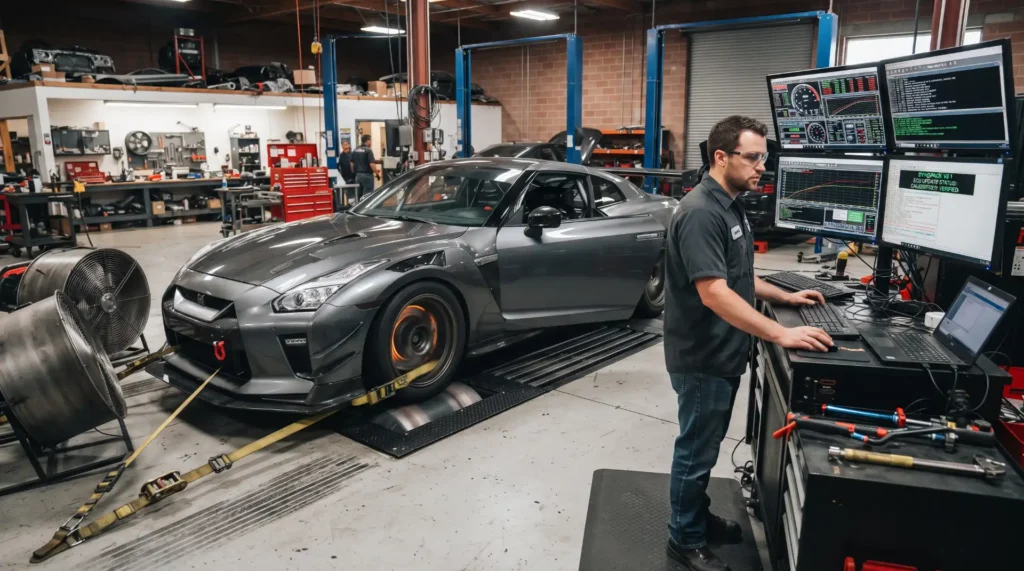
For a high-output or heavily modified vehicle, dyno testing may be appropriate after compatibility is established. A controlled test allows the tuner to monitor the car under load and revise the calibration when necessary. Auto Sport Performance’s discussion of dyno tuning versus street tuning explains the strengths and limitations of both approaches.
Why Backups and Documentation Matter
A well-documented build is easier to maintain. Store the original calibration, current tune, update records, dyno sheets, diagnostic scans, invoices, part numbers, and tuner correspondence in an organized location. Include the vehicle identification number and the dates on which major software changes were made.
Not every tuning device stores a usable copy of the factory file in the same way. Some retrieve the current calibration from the vehicle, while others obtain a matching factory file from a server. Owners should understand how their platform handles backups before an update occurs.
Documentation is also useful when the car changes owners. A buyer needs to know which modules were modified, what fuel the tune requires, whether emissions equipment remains compliant, and what steps may be necessary after future manufacturer updates.
Keep a written record of symptoms when problems arise. Note the update date, mileage, ambient conditions, fuel used, warning messages, and driving circumstances. Precise information is more valuable to a technician than a general report that the car has “felt different” since an update.
Can the Tune Simply Be Reinstalled?
Sometimes the solution is straightforward: the tuning platform supports the new factory version, and the tuner provides a revised compatible file. In other cases, the controller may require a new unlocking procedure, an update from the tuning-tool manufacturer, or additional development.
Reinstalling the old tune without verification is risky because the manufacturer update may have corrected an important defect or changed the base software. Blindly replacing the entire updated calibration could remove the manufacturer’s correction along with other changes.
A responsible tuner will determine which factory revisions should be preserved and which performance changes can be reapplied safely. This may require new data logging, drivability testing, or dyno validation rather than a simple file transfer.
Owners should also confirm whether the tuning company charges for update-related revisions. Some packages include limited revisions, while others treat a new factory software version as a separate tuning service. Understanding that policy before installation prevents unexpected cost and downtime.
Special Considerations for Track Cars and High-Power Builds
Track cars and high-output builds have less tolerance for calibration uncertainty. Repeated high-load operation produces heat and cylinder pressure that ordinary street driving may never reveal. A minor compatibility problem can become significant during a long session.
After a relevant update, verify boost control, fuel delivery, ignition behavior, oil and coolant temperatures, transmission operation, and protective strategies before returning to competition. If the vehicle uses multiple maps for different fuels or power levels, confirm each map separately.
Mechanical changes should also be rechecked. A software update does not cause a boost leak, worn spark plug, weak fuel pump, or overheating system, but those existing problems can be mistaken for an update conflict. Auto Sport Performance’s guide on how to check for boost leaks can help owners understand one common source of inconsistent turbocharged performance.
Do not disable factory safeguards solely to reproduce a previous dyno number. Torque reduction, temperature protection, knock control, and fuel-pressure monitoring exist to reduce risk. Any proposed change to those systems should be based on reliable data and a clear understanding of the consequences.
The Bottom Line
Over-the-air software updates can affect a tuned car in several ways. They may leave the tune untouched, overwrite the engine or transmission calibration, reset learned values, change communication between modules, introduce new security protections, or require the tuner to build a revised file from an updated factory calibration.
The degree of risk depends on the vehicle, update, tuning platform, installed hardware, and purpose of the calibration. A nearly stock car with a mild software tune presents a different situation from a vehicle with upgraded injectors, a larger turbocharger, altered transmission programming, or modified hybrid and electric-powertrain controls.
Tuned-car owners should not panic when an update notification appears, but they should not approve every installation without preparation. Identify the affected modules, consult the tuner, save documentation, follow the manufacturer’s instructions, and inspect and log the vehicle afterward.
Safety recalls, emissions compliance, cybersecurity, and warranty considerations should remain part of the decision. Preserving a performance tune is not a sound reason to ignore an important safety remedy. With advance planning and support from a qualified tuner, many enthusiasts can keep their vehicles current while maintaining reliable, lawful performance.