
Lift Kits and ADAS What Modified Truck Owners Need to Know
Lifting a modern pickup is no longer only a suspension and tire project. Many late-model trucks use cameras, radar units, ultrasonic sensors, steering-angle sensors, wheel-speed sensors, and other electronics to support advanced driver assistance systems. Changing ride height, tire diameter, rake, wheel alignment, or sensor position can affect how these technologies interact with the road.
That does not mean owners need to avoid suspension lifts. It means a modern truck build requires a more complete approach. Suspension geometry, alignment, tire sizing, electronic calibration, sensor placement, and ADAS functionality should all be considered together.
For US truck owners modifying newer Ford, Chevrolet, GMC, Ram, Toyota, Nissan, and other pickups, understanding the relationship between lift kits and ADAS can prevent a suspension upgrade from creating unexpected electronic problems.
What Is ADAS?
Advanced driver assistance systems, commonly shortened to ADAS, describe electronic technologies designed to assist a driver with certain driving and safety tasks.
A modern pickup may include several of these features. Depending on the trim and model year, systems can include forward collision warning, automatic emergency braking, adaptive cruise control, lane departure warning, lane keeping assistance, blind spot monitoring, rear cross traffic alert, parking assistance, automatic high beams, and surround-view cameras.
These features do not all rely on the same hardware.
A forward-facing camera is commonly mounted near the top of the windshield. Radar sensors may sit behind the grille, bumper, emblem, or other body panels. Blind spot radar units may be positioned behind the rear bumper. Ultrasonic sensors commonly appear across the front and rear bumpers.
The truck may also use information from wheel-speed sensors, steering-angle sensors, yaw sensors, suspension information, and other vehicle modules.
ADAS therefore functions more like a connected network than a single accessory.
This becomes important once the truck’s physical dimensions change.
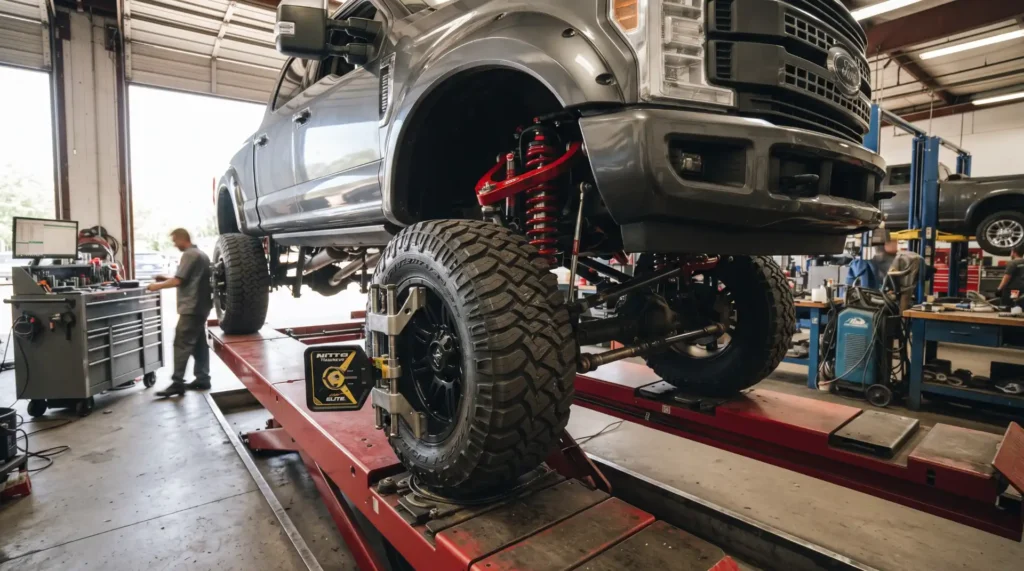
 Why Lift Kits Can Affect ADAS
 Why Lift Kits Can Affect ADAS
A suspension lift changes the relationship between the truck and the road.
The body may sit several inches higher. The front and rear ride heights may change by different amounts. Larger tires may increase the vehicle’s overall height even further.
These changes can alter the viewing angle of a windshield-mounted camera or the operating angle of radar sensors.
Imagine mounting a flashlight several feet from a wall. If the flashlight remains in exactly the same position but its angle changes slightly, the center of the light moves considerably farther away.
ADAS sensors can face a similar geometric issue.
A camera calibrated around the truck’s original ride height may now look at the road from a different angle. A radar system may also have a slightly different relationship with traffic ahead.
SEMA Garage research into lifted ADAS-equipped vehicles has examined this issue directly. Its work has included common modifications such as leveling kits, suspension lifts, larger tires, and different vehicle heights.
The important point is not that every lifted truck automatically develops an ADAS problem. The concern is that changing vehicle geometry creates another variable that owners and installers need to evaluate.
Ride Height Is Only One Part of the Equation
Truck owners sometimes focus entirely on lift height.
A two-inch leveling kit sounds mild compared with a six-inch suspension lift, but height alone does not describe the complete modification.
Tire diameter can change at the same time. Wheel width and offset may also change. Suspension components may move through a different operating range. Alignment angles can shift. The front-to-rear rake of the truck may change.
The relationship between all these changes matters.
A truck with a modest lift and significantly larger tires may experience different electronic and mechanical effects than one retaining near-stock tire dimensions.
This is one reason there is no universal statement such as “a three-inch lift never requires ADAS calibration.”
Requirements vary by truck, equipment package, model year, suspension design, ADAS hardware, and the modification itself.
Larger Tires Can Affect More Than Ground Clearance
Lift kits and larger tires often go together.
A truck owner may lift a pickup specifically to fit 33-inch, 35-inch, or even larger tires. Larger tires can improve ground clearance and off-road capability, but they also change several vehicle characteristics.
The effective gearing changes because each tire travels farther during one revolution. Acceleration may feel different. Braking demands can increase because of additional rotating mass. Speedometer accuracy may change if the vehicle does not compensate for the new tire diameter.
Tire size can also become relevant to electronic systems that depend on wheel-speed information.
Electronic stability control, traction control, antilock braking, transmission programming, and some driver assistance technologies share vehicle-speed and wheel-speed information.
This is why a modern lifted build should be viewed as a complete vehicle system rather than a suspension kit with bigger tires attached afterward.
For more information about modifying larger vehicles as a complete package, internally link the phrase performance upgrades for trucks and SUVs to your existing Auto Sport Performance guide.
Wheel Alignment Becomes Especially Important
Installing a lift kit changes suspension geometry.
Camber, caster, and toe may move away from their original specifications. Control-arm angles change. Tie-rod geometry can change. The steering wheel may no longer sit perfectly centered.
An alignment after suspension work helps correct these mechanical changes.
But alignment has another role in an ADAS-equipped truck.
Some systems use steering-angle information when calculating vehicle movement. If the truck travels straight while the steering-angle sensor reports something different, electronic systems may receive conflicting information.
The mechanical alignment should therefore be addressed before evaluating certain electronic calibration requirements.
A truck that pulls to one side or has an off-center steering wheel should not simply have its ADAS warning lights cleared while the underlying suspension geometry remains incorrect.
Your existing article The Science Behind Wheel Alignment for Performance Driving makes a useful internal link from this section.
Alignment and ADAS Calibration Are Not the Same
This distinction matters.
A wheel alignment adjusts the angles of the wheels and suspension.
ADAS calibration deals with sensors and electronic systems.
Completing an alignment does not automatically mean every ADAS sensor is calibrated correctly.
Likewise, calibrating a camera does not correct incorrect toe, camber, or caster.
On some vehicles, certain calibrations may depend on the mechanical alignment being correct first. Other systems may require steering-angle sensor initialization, tire-size programming, or related procedures.
Modern truck modification is therefore becoming a sequence rather than a single installation.
The physical parts go onto the truck. The suspension settles. Tire and wheel fitment gets checked. The alignment is corrected. Electronic systems are scanned. Required calibrations are identified. The truck can then be evaluated according to the applicable service procedures.
Static and Dynamic ADAS Calibration
 Static and Dynamic ADAS Calibration
Truck owners researching ADAS may encounter two common terms: static calibration and dynamic calibration.
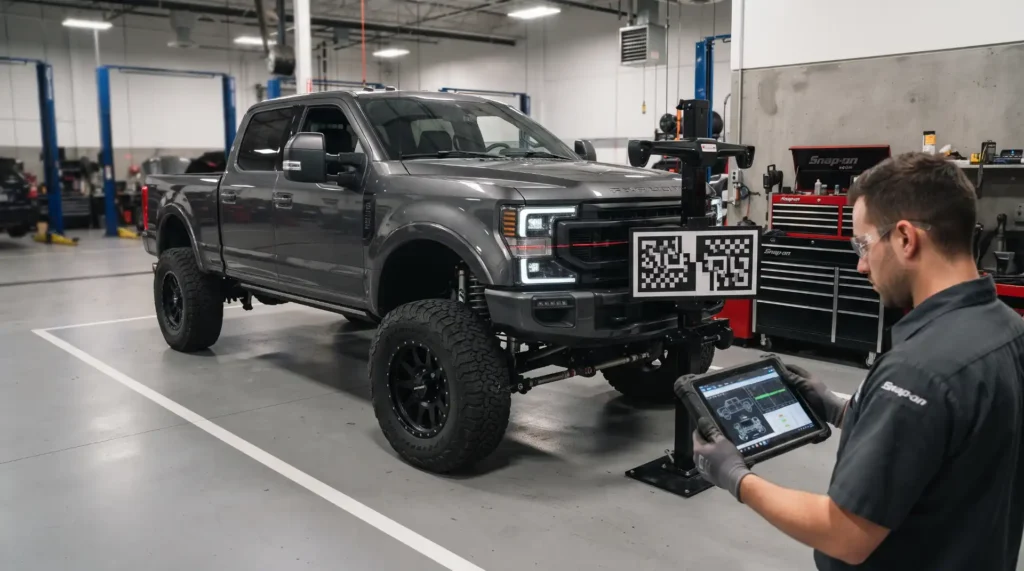
Static calibration generally takes place inside a controlled shop environment.
The vehicle is positioned according to specific measurements, and specialized targets or equipment are placed around it. Cameras or radar sensors use these references during the calibration procedure.
The workspace matters. Floor level, target position, lighting, distance, vehicle loading, tire pressure, and other conditions may affect the process.
Dynamic calibration uses a road-driving procedure.
A scan tool may place the system into a calibration or learning mode. The vehicle then needs to be driven under specified conditions so cameras or sensors can relearn their reference points.
Some trucks use one type. Others use both.
The correct procedure depends on the manufacturer and specific system.
A generic “ADAS calibration” process therefore does not exist for every vehicle.
Leveling Kits Can Also Affect ADAS
A leveling kit usually raises the front of a truck to reduce the factory rake.
Because the lift is smaller than many full suspension systems, owners may assume electronic systems are unaffected.
The important detail is that a leveling kit changes vehicle attitude.
The nose of the truck may sit higher relative to the rear. That changes the angle of the entire body, including windshield cameras and body-mounted sensors.
SEMA specifically included a two-inch leveling configuration in its research on a 2022 Chevrolet Silverado 1500. The organization also examined larger 3.5-inch and 6-inch suspension configurations. Testing covered functions including lane departure warning, lane keep support, automatic emergency braking, blind spot detection, and rear cross traffic alert.
Those results apply to the specific vehicle and configurations tested, so they should not be treated as proof that every truck responds identically.
They do demonstrate why even relatively common truck modifications deserve consideration when ADAS equipment is present.
What SEMA Learned From Lifted Truck Testing
The aftermarket industry has been studying this issue because lifted pickups remain extremely popular in the United States.
SEMA Garage tested a 2022 Chevrolet Silverado 1500 in stock form and with several common modification configurations.
The research found that some ADAS behavior changed under specific lifted configurations. SEMA reported that its six-inch lift configuration produced earlier lane departure warnings during the tests. The 3.5-inch and 6-inch configurations also produced later forward collision warning distances under certain test conditions.
At the same time, the organization emphasized that the results applied to that particular test vehicle and should not automatically be applied to every Silverado or other truck.
That distinction matters.
A 2026 Ford F-150, Toyota Tacoma, Chevrolet Silverado, Ford Bronco, and Ram 1500 can use different sensors, software, mounting positions, calibration methods, and electronic strategies.
SEMA has continued researching additional popular platforms, including the F-150, Bronco, Tacoma, and Ram 1500.
For truck owners, the lesson is simple. Test results from one build provide useful guidance, but vehicle-specific procedures still matter.
Bumpers, Grilles, and Winches Can Create Additional Issues
The lift itself may not be the only modification happening at the same time.
Off-road truck builds often include aftermarket bumpers, grille replacements, winches, brush guards, auxiliary lighting, skid plates, and recovery equipment.
Some factory radar sensors sit directly behind areas that owners commonly replace.
An aftermarket bumper could physically relocate a sensor. A grille insert could place new material in front of radar hardware. A winch assembly may occupy space near factory components.
Even when the sensor remains in its original location, the new material around it may change its operating environment.
This makes sensor compatibility an important consideration when shopping for exterior accessories.
The presence of a mounting hole or sensor bracket does not by itself prove that the completed setup matches every original calibration requirement.
Cameras Can Also Be Affected
Forward-facing cameras commonly sit behind the windshield near the rearview mirror.
Because the camera remains attached to the cab, lifting the vehicle also raises the camera.
A change in rake can alter its angle relative to the road surface.
These cameras may support lane departure warning, lane centering, traffic-sign recognition, automatic emergency braking, or other functions.
The truck may not immediately display a warning simply because the camera’s perspective changed.
That is one reason relying entirely on dashboard warning lights may not identify every calibration concern.
An absence of warning lights tells the driver that the vehicle has not detected certain faults. It does not automatically confirm that every system performs exactly as it did at factory ride height.
Blind Spot Monitoring and Rear Sensors
Modern trucks often place radar sensors behind the rear bumper corners.
These support functions such as blind spot monitoring and rear cross traffic alert.
A suspension lift changes their height relative to surrounding vehicles. Aftermarket rear bumpers can introduce another variable if sensors are moved or surrounded by different materials.
Large tires may also change the physical profile of the truck.
Truck owners commonly pay close attention to forward cameras and radar because they support obvious features such as adaptive cruise control. Rear sensors deserve similar consideration.
This becomes especially relevant for trucks frequently used for towing, parking in crowded areas, or driving in multilane highway traffic.
What About Automatic Emergency Braking?
Automatic emergency braking has become one of the most significant ADAS technologies.
The system can identify certain crash risks and apply braking when necessary.
In the United States, NHTSA established Federal Motor Vehicle Safety Standard No. 127 covering automatic emergency braking and pedestrian automatic emergency braking for light vehicles. The rule lists a September 1, 2029 compliance date for covered light vehicles, with additional timing provisions for certain manufacturers and alterers.
That direction makes ADAS compatibility increasingly relevant to the aftermarket.
The newer the truck, the more likely suspension, wheel, tire, bumper, grille, and accessory modifications need to coexist with integrated electronic safety technology.
Performance shops therefore need to understand both traditional suspension work and the electronic architecture surrounding it.
Signs an ADAS System May Need Attention
Some problems announce themselves clearly.
The dashboard may display a camera unavailable message, adaptive cruise control fault, lane assist warning, collision system error, or another notification.
Other signs can be less obvious.
A lane warning may activate earlier or later than expected. Adaptive cruise control may behave differently. Blind spot warnings may appear inconsistent. A surround-view camera image may no longer align properly after vehicle changes.
These symptoms should not automatically be blamed on the lift kit. Dirty cameras, snow, heavy rain, damaged sensors, windshield replacement, collision damage, electrical faults, and software issues can also affect ADAS operation.
The modification history simply becomes another part of the diagnostic process.
What Truck Owners Should Do Before Installing a Lift
Research should begin with the exact truck.
Model year matters. Trim level matters. Option packages matter.
Two trucks that look nearly identical from the outside may use different camera, radar, parking, or adaptive cruise systems.
Identify the ADAS equipment before purchasing suspension parts.
Then review whether the lift manufacturer provides compatibility information for that specific platform.
The installer should also understand the truck’s post-installation alignment requirements and whether specialized calibration equipment may be needed afterward.
This preparation is especially useful when several modifications happen together.
A lift kit, oversized tires, aftermarket wheels, and replacement bumper installed during the same build can create several variables at once.
A Better Way to Plan a Modern Lifted Truck Build
 A Better Way to Plan a Modern Lifted Truck Build
The traditional approach to building a truck often started with the biggest tire an owner wanted to fit.
Modern trucks benefit from a broader strategy.
Start with the purpose of the vehicle.
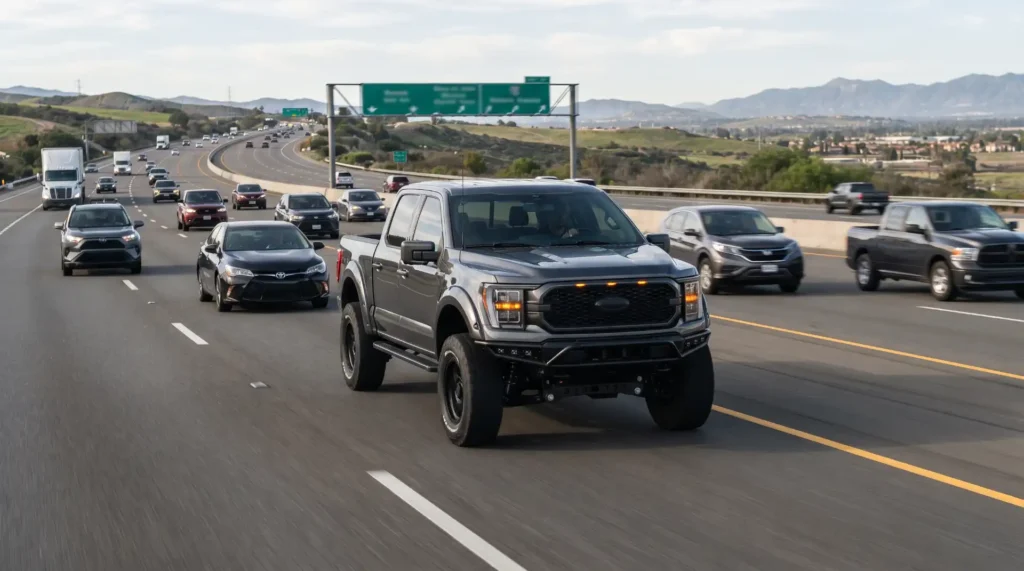
A daily-driven truck may need different suspension travel and tire characteristics than a dedicated off-road build. A towing truck has different priorities from a show truck. A vehicle spending thousands of miles on interstate highways places greater importance on predictable steering, braking, and driver-assistance behavior.
Choose the lift height around that purpose.
Then select wheels and tires that match the suspension, gearing, brakes, steering, and available clearance.
Consider ADAS compatibility before adding bumpers, grille components, winches, or other equipment near sensors.
After installation, address mechanical alignment and applicable electronic procedures.
This produces a more cohesive truck than selecting each aftermarket part independently.
Do Lift Kits Make ADAS Unsafe?
There is no useful universal answer.
The effect depends on the vehicle and modification.
SEMA’s testing has shown that properly researched and recalibrated modified vehicles can retain ADAS functionality under the specific conditions tested. It has also documented measurable differences in certain system responses after particular modifications.
That is why statements such as “lift kits always disable ADAS” or “ADAS works perfectly with any lift” are both too broad.
Modern trucks vary significantly.
The correct approach is to identify the system, understand the modification, follow applicable vehicle procedures, and verify the completed setup.
Why This Matters More in 2026
The American aftermarket continues to combine mechanical customization with increasingly sophisticated vehicle electronics.
Truck owners still want more ground clearance, larger tires, improved off-road capability, stronger suspension components, and distinctive styling.
Those goals are not disappearing.
What is changing is the technology underneath the truck.
A suspension modification now interacts with cameras, radar, vehicle networks, steering sensors, stability systems, and software.
The performance industry is adapting accordingly. ADAS calibration equipment, vehicle-specific scan tools, aftermarket testing, and sensor-compatible components are becoming part of modern modification work.
SEMA has identified ADAS calibration as a major issue for the aftermarket and continues researching how common modifications interact with factory systems.
Lift Kits and ADAS Can Coexist
A modern truck does not have to remain completely stock simply because it has adaptive cruise control, lane assistance, automatic emergency braking, or blind spot monitoring.
The key is treating electronics as part of the build.
A lift kit changes more than appearance. It can change ride height, suspension geometry, steering characteristics, tire dimensions, rake, and sensor relationships.
Those changes deserve the same attention that enthusiasts already give to alignment, brake clearance, driveshaft angles, gearing, and tire fitment.
For modified truck owners, ADAS awareness is simply another part of modern performance knowledge.
Final Thoughts
Lift kits remain one of the most popular ways to change the capability and appearance of a pickup truck. Modern vehicle technology, however, means suspension modification involves more than installing taller springs, shocks, or spacers.
ADAS cameras, radar units, steering-angle sensors, wheel-speed information, alignment, larger tires, bumpers, and electronic control systems may all become part of the conversation.
Truck owners planning a lift can benefit from researching the exact vehicle configuration, selecting compatible components, correcting suspension geometry, and identifying applicable calibration procedures after the work is complete.
The goal is not to discourage modification. It is to build a truck as a complete system.
As pickups become more electronically sophisticated, successful performance builds increasingly combine traditional mechanical knowledge with modern vehicle technology. That approach allows enthusiasts to pursue additional ground clearance, improved off-road capability, larger tires, and a more aggressive stance while accounting for the advanced systems built into today’s trucks.