
Performance cars are built to deliver more than ordinary transportation. Whether it is a turbocharged sports sedan, a naturally aspirated V8 muscle car, a modified Japanese import, or a European luxury performance vehicle, these machines are engineered to provide responsive acceleration, precise handling, and an engaging driving experience. However, as the odometer climbs, maintaining those characteristics becomes increasingly challenging.
A performance vehicle with 80,000, 100,000, or even 150,000 miles can still deliver impressive power and reliability when properly maintained. The challenge is that high-mileage performance cars often require more attention than standard commuter vehicles. Their engines may operate at higher temperatures, their transmissions may experience greater loads, and their suspension and braking components may have endured years of aggressive driving.
Many enthusiasts make the mistake of assuming that replacing worn components only when they fail is an acceptable maintenance strategy. While this approach might work temporarily for an inexpensive daily driver, it can become costly when applied to a performance vehicle. A neglected cooling system, aging fuel pump, deteriorating engine mounts, or worn suspension components can affect several connected systems and eventually lead to expensive repairs.
Specialized maintenance focuses on identifying potential problems before they become major failures. Preventive upgrades go a step further by improving the durability, efficiency, and consistency of components that experience significant stress. Together, these strategies help owners preserve engine performance, maintain driving safety, and extend the useful life of their vehicles.
For American drivers who want to keep their performance cars for many years, understanding high-mileage maintenance is an important part of responsible vehicle ownership.
Why High-Mileage Performance Cars Require Specialized Maintenance
Not every vehicle experiences mechanical wear in the same way. A standard family sedan used primarily for commuting may spend most of its life operating under relatively predictable conditions. A performance vehicle, on the other hand, may regularly experience rapid acceleration, higher engine speeds, increased transmission temperatures, and greater braking forces.
These operating conditions can accelerate wear on components that are already affected by age and accumulated mileage.
Performance Engines Experience Different Stress Conditions
Performance engines are designed to produce more horsepower and torque than conventional engines of similar displacement. Turbochargers, superchargers, high-compression designs, performance camshafts, and advanced fuel injection systems help generate additional power. However, these systems can also increase mechanical and thermal demands.
For example, a turbocharged engine generates substantial heat when the turbocharger operates under boost. The engine oil must lubricate moving components while helping manage heat. Coolant must maintain appropriate operating temperatures, and the fuel system must deliver the correct amount of fuel under different driving conditions.
As mileage increases, seals, gaskets, bearings, hoses, and other components gradually deteriorate. Even when an engine still produces strong power, small changes in oil pressure, cooling efficiency, or fuel delivery can indicate developing problems.
A vehicle that once accelerated smoothly may begin experiencing hesitation, inconsistent boost pressure, increased oil consumption, or rough idle conditions. These symptoms should not automatically be dismissed as normal aging.
Specialized maintenance considers the engine’s design, modifications, driving history, and current mechanical condition rather than relying exclusively on the odometer.
Previous Modifications Can Increase Maintenance Requirements
Many high-mileage performance cars have been modified during their lifetime. Previous owners may have installed aftermarket exhaust systems, upgraded turbochargers, performance air intakes, engine management software, suspension components, or larger wheels.
Although these modifications can improve performance, they may also change how the vehicle operates.
An engine with an aftermarket turbocharger may require different oil specifications or more frequent inspection of oil and coolant lines. A vehicle with an aggressive ECU calibration may place additional demands on ignition components, fuel delivery, and cooling systems.
The biggest concern with older modified cars is that owners do not always know exactly what has been changed. Some modifications may have been installed professionally, while others may have been completed without proper supporting upgrades.
Before spending money on additional horsepower, owners should establish a clear maintenance baseline. This includes reviewing available service records, identifying installed modifications, scanning the vehicle’s electronic systems, and inspecting critical mechanical components.
 The Importance of a Complete Mechanical Inspection
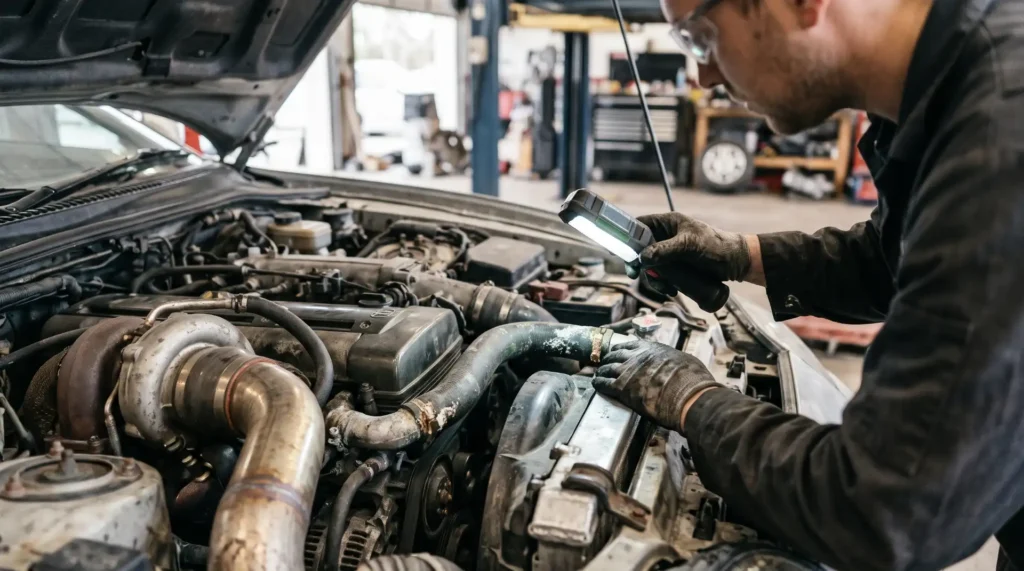 The Importance of a Complete Mechanical Inspection
One of the smartest investments an owner can make is a comprehensive mechanical inspection before beginning a major maintenance or upgrade project.
A basic oil change cannot reveal every developing problem. A high-mileage performance car may have hidden cooling leaks, deteriorating bushings, worn wheel bearings, electrical problems, or fuel delivery issues that are not immediately noticeable during normal driving.
Start With a Vehicle Condition Assessment
A proper inspection should begin with the vehicle’s overall condition. A technician should evaluate the engine, transmission, differential, suspension, steering, brakes, cooling system, fuel system, and electrical components.
The inspection should also consider how the vehicle is used. A performance car driven gently on highways has different maintenance needs from one that regularly participates in autocross events, track days, or spirited weekend driving.
Owners should provide information about unusual noises, fluid consumption, warning lights, overheating incidents, previous repairs, and modifications. Even minor symptoms can help a technician identify a developing problem.
A written inspection report is particularly useful because it separates immediate repairs from preventive maintenance and optional performance upgrades.
Use Diagnostic Equipment Instead of Guessing
Modern performance vehicles rely on electronic control modules to monitor engine operation, transmission behavior, emissions systems, and other vehicle functions.
An OBD-II diagnostic scanner can retrieve stored trouble codes and provide information about certain operating conditions. More advanced diagnostic equipment can access manufacturer-specific data, monitor sensor readings, and identify irregularities that may not activate a dashboard warning light.
For example, a technician may investigate fuel trim values, coolant temperature readings, misfire counts, oxygen sensor activity, and other available parameters.
A check engine light does not always mean the engine itself is failing. It may indicate a sensor problem, an ignition issue, an emissions-related fault, or an air-fuel mixture irregularity.
Owners who want to understand these warning signs can also read What Does a Check Engine Light Really Mean? A Technician’s Guide.
The important distinction is that a diagnostic trouble code identifies a condition the vehicle has detected. It does not necessarily identify the exact component that must be replaced. Proper diagnosis requires testing and interpretation.
Engine Oil and Lubrication: Protecting the Heart of a High-Mileage Performance Car
Engine oil is one of the most important elements of long-term engine protection. It lubricates moving parts, reduces friction, helps control temperature, carries contaminants toward the filtration system, and protects internal surfaces against wear.
For high-mileage performance cars, selecting the correct oil and maintaining an appropriate service schedule are especially important.
Choose Oil Based on Engine Requirements
Performance engines can have specific lubrication requirements depending on their design, operating temperatures, clearances, and intended use.
Some engines require particular viscosity grades, while others specify manufacturer-approved oil standards. Using a thicker oil simply because an engine has high mileage is not always beneficial.
An oil that is too thick may not circulate as intended during cold starts. An oil that does not meet the required specifications may provide inadequate protection under certain operating conditions.
Owners should consult the owner’s manual and manufacturer service information before selecting engine oil. They should also consider whether the engine has been modified, whether it regularly experiences high temperatures, and whether it is used for track driving.
High-quality synthetic oil can provide excellent protection when it meets the vehicle’s requirements, but a more expensive product is not automatically the correct choice.
Establish a Consistent Oil Change Schedule
Oil change intervals should reflect the manufacturer’s recommendations and actual driving conditions.
Frequent short trips, heavy traffic, extreme temperatures, towing, aggressive driving, and repeated high-load operation can create more demanding conditions than ordinary highway commuting.
A vehicle that regularly experiences these conditions may require closer oil monitoring and more frequent servicing than one used primarily for relaxed cruising.
Owners should check the oil level regularly, inspect for leaks, and pay attention to changes in consumption. Sudden increases in oil consumption deserve investigation because they may indicate external leakage, worn valve stem seals, piston ring problems, or other mechanical concerns.
Oil analysis can also provide useful information in certain circumstances. Laboratory testing may identify unusual concentrations of wear metals, fuel dilution, coolant contamination, or other indicators that justify additional inspection.
Inspect the Oil System Beyond the Oil Filter
A high-mileage engine may develop problems involving its oil pump, pickup tube, pressure sensors, seals, or internal lubrication passages.
An oil pressure warning should never be ignored. Low oil pressure can indicate insufficient oil quantity, excessive bearing clearance, a lubrication system problem, or another serious mechanical condition.
If the warning appears, the driver should safely stop the engine and investigate rather than continuing to drive in the hope that the warning disappears.
Preventive attention to the lubrication system can help protect expensive internal components and reduce the risk of catastrophic engine damage.
Cooling System Upgrades That Help Prevent Engine Overheating
Heat management becomes increasingly important as performance vehicles age.
High-output engines naturally generate substantial heat, particularly during hard acceleration, prolonged high-speed driving, and track use. A cooling system that once operated perfectly may become less effective as its components deteriorate.
Inspect Radiators, Hoses, and Thermostats
Radiators can develop corrosion, leaks, damaged fins, or internal restrictions. Rubber coolant hoses may become soft, brittle, swollen, or cracked after years of exposure to heat.
Thermostats can also fail. A thermostat stuck closed may cause overheating, while one stuck open can prevent the engine from reaching its intended operating temperature.
High-mileage performance cars should receive periodic cooling system inspections. A pressure test can help identify leaks that may not be visible during a routine visual inspection.
The technician should also examine the radiator cap, expansion tank, water pump, coolant temperature sensor, cooling fans, and associated electrical connections.
Consider an Upgraded Radiator When Appropriate
An upgraded radiator may be beneficial for a performance car that regularly experiences elevated temperatures.
Vehicles with modified engines, forced induction, or repeated track use may benefit from a radiator with improved heat rejection capacity.
However, a larger radiator is not automatically the solution to every overheating problem. A defective thermostat, failing water pump, restricted coolant passage, malfunctioning fan, or incorrect coolant mixture can create similar symptoms.
The cooling system should be diagnosed before replacing expensive components.
Maintain the Water Pump and Coolant
Water pumps circulate coolant through the engine and radiator. Depending on the vehicle, they may be driven by a belt, chain, or electric motor.
Worn bearings, damaged impellers, deteriorating seals, and electrical problems can reduce cooling system performance.
Coolant also requires attention. Over time, corrosion inhibitors and other protective additives can deteriorate. Using the correct coolant type and following the manufacturer’s replacement schedule helps protect internal cooling passages and prevent corrosion.
Different coolant formulations should not be mixed without confirming compatibility.
For owners who regularly drive in hot parts of the United States, including Arizona, Nevada, Texas, and Southern California, cooling system condition deserves particular attention during the summer months.
Transmission and Differential Maintenance for Aging Performance Cars
Engine maintenance often receives the most attention, but the transmission and differential are equally important to overall performance.
These components transfer engine power to the wheels. They also experience considerable stress when a vehicle produces substantial torque or is driven aggressively.
Automatic Transmission Service
Automatic transmissions depend on specialized fluid to provide lubrication, cooling, hydraulic pressure, and friction characteristics.
Over time, transmission fluid can deteriorate because of heat, oxidation, and contamination. A vehicle that experiences repeated hard acceleration or high-temperature operation may place additional demands on its transmission.
Symptoms of potential transmission problems include delayed engagement, slipping, harsh shifting, unusual noises, and inconsistent operation.
Owners should follow the manufacturer’s service requirements rather than assuming every transmission has the same maintenance needs.
Some vehicles require specific fluid types and service procedures. An incorrect fluid can affect shift quality and transmission operation.
A professional inspection should also check for leaks around the transmission pan, cooler lines, seals, and electrical connectors.
Manual Transmission and Clutch Inspection
Manual performance cars require attention to the clutch, hydraulic system, gear engagement, and transmission lubrication.
A slipping clutch may become noticeable during acceleration when engine speed rises without a corresponding increase in vehicle speed.
Other warning signs include difficult gear engagement, unusual vibrations, pedal changes, and grinding noises.
A clutch replacement can be expensive because labor may involve substantial transmission removal. Identifying early symptoms can help owners plan repairs before a complete failure leaves the vehicle undriveable.
Differential Fluid and Drivetrain Components
The differential transfers torque to the drive wheels while allowing them to rotate at different speeds during cornering.
Performance driving places additional demands on differential gears, bearings, and lubrication.
High-mileage vehicles should have their differential fluid inspected and serviced according to manufacturer recommendations. Limited-slip differentials may require specific lubricants or friction modifiers.
Technicians should also inspect driveshafts, CV joints, universal joints, axle boots, and drivetrain mounts.
A vibration during acceleration or a clunk when changing between drive and reverse may indicate a worn drivetrain component.
Addressing these problems early can prevent secondary damage and preserve smooth power delivery.
Suspension and Steering Upgrades That Restore Driving Precision
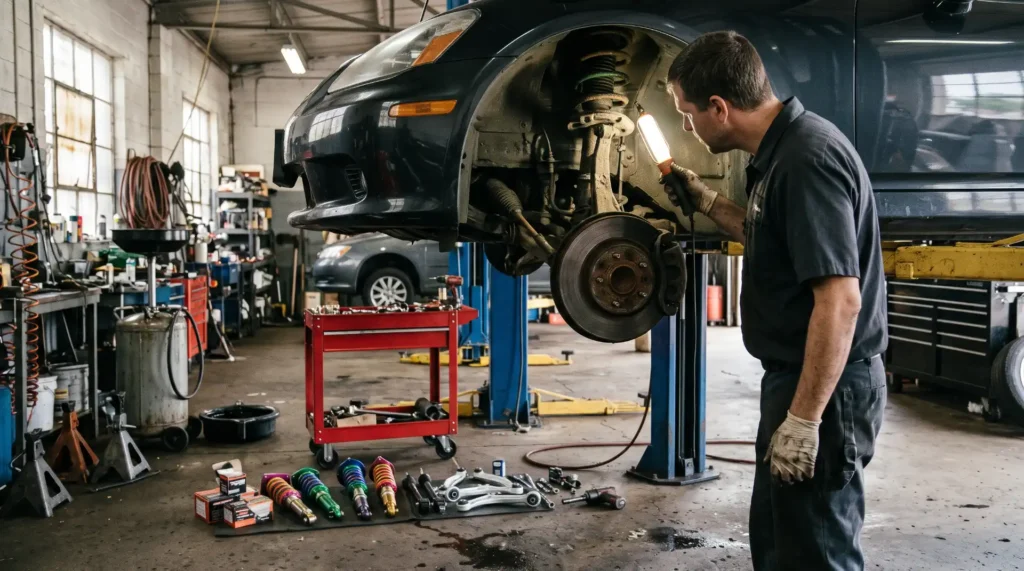 Suspension and Steering Upgrades That Restore Driving Precision
A performance car is not defined by horsepower alone. Its handling, steering response, and stability are equally important.
Unfortunately, suspension components gradually wear as mileage increases. This can make a once-responsive vehicle feel loose, unstable, or unpredictable.
Replace Worn Bushings and Ball Joints
Suspension bushings help isolate vibration and control movement between connected components.
Over time, rubber bushings can crack, harden, separate, or lose their original flexibility. Worn bushings may produce clunking noises, imprecise steering, uneven tire wear, or changes in vehicle alignment.
Ball joints and tie rod ends also require inspection. Excessive play in these components can affect steering accuracy and vehicle safety.
Replacing worn suspension parts with quality OEM-equivalent or appropriately engineered aftermarket components can restore much of the vehicle’s original behavior.
Inspect Shocks and Struts
Shock absorbers and struts control suspension movement and help maintain tire contact with the road.
When these components deteriorate, the vehicle may bounce excessively, dive during braking, squat during acceleration, or feel unstable over uneven pavement.
A performance vehicle with worn dampers can lose both comfort and handling precision.
Some owners choose adjustable coilovers or upgraded dampers when replacing suspension components. These products can offer improved control when properly matched to the vehicle and its intended use.
However, excessively stiff suspension is not always better. A setup that is too aggressive for public roads can reduce comfort, increase component stress, and compromise tire contact over rough surfaces.
Wheel Alignment Is Essential
After replacing suspension components, an appropriate wheel alignment is important.
Incorrect alignment can cause uneven tire wear, poor straight-line stability, and reduced cornering confidence.
Performance vehicles may have different alignment requirements depending on whether they are designed for street driving, autocross, or track use.
A qualified technician should consider the vehicle’s suspension design, tire specifications, and intended driving environment when selecting alignment settings.
Brake System Maintenance for High-Performance Driving
A vehicle capable of producing substantial acceleration must also be able to stop safely and consistently.
High-mileage performance cars may have experienced years of heavy braking, high temperatures, and repeated exposure to moisture and road contaminants.
Brake system maintenance should therefore be treated as a major safety priority rather than an optional performance upgrade.
Inspect Brake Pads, Rotors, and Calipers
Brake pads gradually wear as friction material is used during braking. Rotors may develop scoring, corrosion, heat-related damage, or thickness variations.
Calipers can also develop problems involving pistons, seals, guide pins, and hardware.
Uneven pad wear may indicate a sticking caliper or another underlying issue. A steering wheel vibration during braking may indicate rotor thickness variation or other brake-related problems.
A complete inspection should include pad thickness, rotor condition, caliper operation, brake hoses, and parking brake components.
Replace Old Brake Fluid
Brake fluid absorbs moisture over time, depending on its formulation and operating environment.
Moisture contamination can lower the fluid’s boiling point and contribute to corrosion inside the braking system.
During repeated hard braking, overheated fluid can produce a soft or inconsistent brake pedal.
Owners should follow the manufacturer’s recommended brake fluid replacement interval. Vehicles used for track events may require more frequent inspections and servicing.
Choose Performance Brake Upgrades Carefully
Upgraded brake pads, rotors, and fluid may improve braking consistency for certain performance applications.
However, components should be selected according to vehicle weight, brake system design, tire grip, and driving conditions.
A track-oriented brake pad may perform poorly when cold or produce excessive noise and dust during ordinary street driving.
The best brake upgrade is one that matches the vehicle’s real-world use while maintaining safe and predictable operation.
Fuel System Maintenance and Modern Engine Diagnostics
Fuel delivery problems can become increasingly common as high-mileage vehicles age.
The fuel pump, injectors, pressure regulators, filters, and associated electrical components all contribute to proper engine operation.
When one component begins to deteriorate, the engine may experience hesitation, reduced power, difficult starting, or inconsistent acceleration.
Inspect Fuel Pumps and Injectors
Fuel pumps must deliver adequate fuel pressure and volume under different engine loads.
A weak pump may allow the vehicle to operate normally during light driving but struggle when the engine demands more fuel.
Fuel injectors can also become restricted or develop spray pattern problems. This can affect combustion quality and engine smoothness.
Professional testing can help determine whether an issue involves fuel pressure, injector operation, electrical supply, or another component.
Replacing injectors without confirming the cause can waste money and fail to solve the original problem.
Maintain Ignition Components
Spark plugs and ignition coils are particularly important in modern performance engines.
A worn spark plug can contribute to misfires, reduced efficiency, and poor acceleration. Ignition coils may also deteriorate because of heat and electrical stress.
Turbocharged engines can be especially sensitive to ignition problems under boost because cylinder pressures are higher during increased engine load.
Owners should follow manufacturer recommendations for spark plug type, gap, and replacement intervals. Modified engines may require different specifications established by the engine builder or calibration specialist.
Carbon Buildup in Direct-Injection Engines
Some direct-injection gasoline engines can develop carbon deposits on intake valves because fuel is injected directly into the combustion chamber rather than washing over the intake valve surfaces.
Depending on engine design and operating conditions, these deposits may contribute to rough idle, reduced airflow, misfires, or changes in performance.
A technician should confirm whether deposits are present before recommending cleaning.
Possible cleaning methods depend on the engine design and manufacturer guidance. Preventive maintenance should focus on the actual condition of the intake system rather than assuming every direct-injection engine requires the same service at a particular mileage.
Electrical Systems and Sensors Need Attention as Vehicles Age
Modern performance cars rely on extensive electrical systems. Engine control modules, sensors, wiring harnesses, alternators, batteries, and electronic actuators work together to maintain vehicle operation.
As a vehicle ages, electrical problems may become increasingly difficult to diagnose.
Test the Battery and Charging System
A weak battery can cause starting problems, warning lights, communication faults, and inconsistent electronic behavior.
The alternator must also maintain appropriate charging voltage under different electrical loads.
Owners should have the battery, charging system, terminals, and ground connections inspected periodically.
Corrosion around battery terminals and deteriorating wiring connections can create intermittent problems that are difficult to reproduce.
Investigate Sensor-Related Performance Problems
Modern engines use sensors to monitor airflow, intake temperature, coolant temperature, oxygen levels, crankshaft position, and other operating conditions.
A faulty sensor can cause incorrect engine management decisions.
For example, an inaccurate airflow reading may affect fuel delivery, while a failing oxygen sensor can interfere with fuel mixture control.
Rather than replacing sensors based only on a trouble code, technicians should verify the electrical signal, wiring condition, and related mechanical systems.
Inspect Aging Wiring and Connectors
Heat, vibration, moisture, and previous modifications can damage wiring insulation and connectors.
Performance cars with aftermarket engine management systems or additional electrical equipment deserve particular attention.
Poorly installed wiring can cause intermittent faults, unexpected engine behavior, and potentially dangerous electrical problems.
A professional electrical inspection can help identify these issues before they affect vehicle reliability.
Preventive Upgrades That Make Sense for High-Mileage Performance Cars
Preventive upgrades should address identifiable weaknesses or improve reliability under the vehicle’s intended operating conditions.
They should not be selected simply because a product is marketed as a performance improvement.
The goal is to preserve the car’s capabilities while reducing the risk of expensive failures.
Upgrade Aging Engine Mounts
Engine mounts support the engine and transmission while controlling movement during acceleration, braking, and gear changes.
Worn mounts can create excessive vibration, clunking noises, and unwanted drivetrain movement.
Replacing deteriorated mounts can improve stability and restore a more controlled driving experience.
Some enthusiasts choose polyurethane or performance-oriented mounts. These may provide better movement control, but they can also transmit more vibration into the cabin.
For a street-driven vehicle, quality replacement mounts may provide a better balance between durability and comfort.
Improve Cooling Capacity When Necessary
A high-capacity radiator, improved cooling fans, or an appropriately engineered oil cooler may help vehicles that regularly experience elevated temperatures.
However, upgrades should be selected only after the existing cooling system has been inspected.
Adding an oil cooler without considering oil flow, thermostat control, and plumbing can introduce additional complications.
Every upgrade should be compatible with the vehicle’s engine design and intended operating conditions.
Replace Aging Rubber Hoses and Seals
Rubber components deteriorate with age and heat exposure.
Coolant hoses, vacuum lines, fuel hoses, and other flexible connections should be inspected for cracking, swelling, hardening, and leakage.
Replacing an aging hose before it bursts can prevent roadside breakdowns and reduce the risk of overheating.
The correct replacement material and pressure rating are important, especially in modified vehicles.
Consider Improved Suspension Components
High-quality replacement dampers, bushings, and steering components can restore handling precision.
Owners who regularly drive on rough roads may benefit more from durable street-oriented components than extremely stiff racing equipment.
The correct setup should provide predictable handling without creating unnecessary stress on the chassis.
Select Parts According to Vehicle Condition
A preventive upgrade should solve a specific problem or provide a measurable benefit.
Before purchasing components, owners should consider the vehicle’s condition, intended use, compatibility, installation requirements, and long-term serviceability.
Choosing between original equipment manufacturer parts and aftermarket alternatives is an important part of this process.
For additional guidance, see OEM vs. Aftermarket Parts: What’s Best for Your Car’s Performance?.
Why Performance Tuning Should Be Evaluated Carefully on Older Vehicles
Performance tuning can help optimize engine operation, but increasing power on an aging vehicle requires careful planning.
An engine that has accumulated substantial mileage may have worn seals, reduced compression, aging fuel system components, or cooling system limitations.
Adding more boost or changing ignition and fueling parameters without evaluating these conditions can increase the risk of mechanical failure.
Establish a Healthy Mechanical Baseline First
Before modifying engine calibration, a technician should evaluate engine health.
Depending on the vehicle, this may include compression testing, leak-down testing, fuel pressure checks, ignition inspection, and diagnostic data analysis.
The cooling and lubrication systems should also be in good condition.
If the engine already consumes excessive oil, overheats, or experiences misfires, those problems should be addressed before pursuing additional horsepower.
Consider Supporting Modifications
An increase in engine output may require improvements to fuel delivery, intercooling, exhaust flow, transmission capacity, or cooling.
The appropriate supporting modifications depend on the engine platform and the amount of additional power being pursued.
A responsible tuner should explain the expected benefits, limitations, and mechanical risks before making changes.
Maintain Emissions Compliance
Performance modifications must also respect applicable federal and state emissions requirements.
The U.S. Environmental Protection Agency explains its position on vehicle and engine tampering and aftermarket defeat devices in its official EPA Tampering Policy.
Owners should understand that removing or disabling emissions equipment is not an acceptable shortcut to improving performance. ECU tuning and aftermarket hardware must be evaluated for compliance with applicable requirements.
California drivers should pay particular attention to California Air Resources Board requirements and applicable smog inspection rules.
A performance upgrade that makes a vehicle difficult to register or operate legally on public roads can become an expensive mistake.
Tire Maintenance and Wheel Condition Are Often Overlooked
Tires are the only parts of a vehicle that make direct contact with the road. Their condition affects acceleration, braking, cornering, and stability.
High-mileage performance cars often use wider tires, lower-profile sidewalls, and larger wheels than ordinary passenger vehicles.
These setups can provide improved grip, but they may also be more sensitive to alignment problems, road damage, and incorrect inflation pressure.
Check Tire Age and Condition
Tire condition should not be judged by tread depth alone.
Rubber changes over time because of exposure to heat, sunlight, oxygen, and environmental conditions. Tires may develop cracks, deformation, or other age-related problems even when the vehicle has not accumulated many miles.
The National Highway Traffic Safety Administration provides guidance on tire aging, inflation, treadwear, and replacement considerations through its Tire Safety and Awareness resource.
Owners should inspect tires regularly and follow manufacturer guidance regarding replacement.
Maintain Proper Inflation and Alignment
Incorrect tire pressure can affect handling, braking, ride quality, and tire wear.
Drivers should use the recommended cold inflation pressure listed on the vehicle’s tire information placard or owner’s manual rather than relying on the maximum pressure printed on the tire sidewall.
Wheel alignment should also be checked when uneven tire wear, steering pull, or suspension repairs occur.
Performance tires can be expensive, making preventive alignment and pressure checks a practical way to protect an investment.
Inspect Wheels and Bearings
Performance vehicles may use lightweight alloy wheels that are vulnerable to damage from potholes and road impacts.
Cracked wheels, bent rims, and damaged wheel fasteners should be inspected promptly.
Wheel bearings should also be checked for excessive play, humming, grinding, or other unusual noises.
These components are essential to safe vehicle operation and should never be ignored.
How American Driving Conditions Affect High-Mileage Performance Cars
The United States has an enormous variety of driving environments. A performance car used in Arizona experiences different conditions from one driven in Minnesota, Florida, or the Pacific Northwest.
Maintenance decisions should reflect the vehicle’s local environment.
Hot Climates Increase Thermal Stress
Drivers in states such as Texas, Arizona, Nevada, and California may regularly encounter high ambient temperatures.
Heat can accelerate the deterioration of rubber hoses, seals, batteries, and other components.
Vehicles operating in heavy traffic may also spend extended periods with limited airflow through the radiator.
Cooling system inspections, battery testing, and fluid monitoring become especially important under these conditions.
Cold Weather Creates Different Challenges
Drivers in northern states experience freezing temperatures, snow, road salt, and seasonal storage conditions.
Cold starts place additional demands on engine lubrication and battery performance.
Road salt can accelerate corrosion on brake lines, suspension components, exhaust systems, and underbody structures.
Owners should inspect the underside of their vehicles regularly and address corrosion before it affects structural or mechanical components.
Stop-and-Go Traffic Can Be Hard on Performance Vehicles
Urban traffic in major metropolitan areas can create demanding operating conditions.
Frequent acceleration, braking, idling, and short trips may increase wear on certain components.
Vehicles that spend considerable time in congested traffic should receive maintenance based on their actual operating conditions rather than mileage alone.
Track Use Requires a Separate Maintenance Strategy
A performance car driven on a racetrack experiences substantially different demands from one used for commuting.
Repeated high-speed operation, hard braking, cornering loads, and sustained engine temperatures can accelerate wear.
Track-day vehicles may require more frequent inspections of brake pads, rotors, fluids, tires, wheel bearings, and suspension components.
Owners should consult the vehicle manufacturer and qualified performance specialists for appropriate track-use service recommendations.
Creating a Preventive Maintenance Schedule for a High-Mileage Performance Car
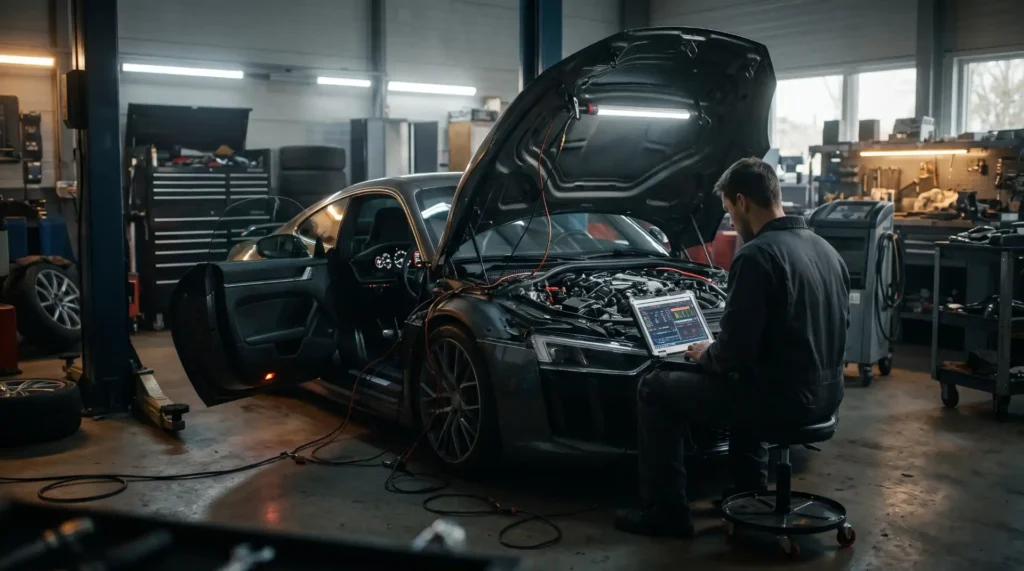 Creating a Preventive Maintenance Schedule for a High-Mileage Performance Car
A structured maintenance schedule makes it easier to monitor vehicle condition and plan expenses.
Instead of waiting for warning lights or mechanical failures, owners can organize inspections according to time, mileage, and driving conditions.
Monthly Condition Checks
A monthly inspection is a useful habit for performance car owners.
Check engine oil level, coolant level, tire pressure, visible fluid leaks, tire condition, exterior lights, and any unusual noises or vibrations.
Look for changes in the vehicle’s behavior. A new vibration, unusual exhaust smoke, or temperature fluctuation may indicate a problem that deserves professional attention.
These checks do not replace scheduled servicing, but they can help identify developing issues earlier.
Scheduled Professional Inspections
At appropriate service intervals, a qualified technician should inspect the brakes, suspension, steering, drivetrain, cooling system, battery, and engine.
The frequency should follow the manufacturer’s maintenance schedule and be adjusted for severe operating conditions.
High-mileage vehicles with performance modifications may need additional inspections depending on the parts installed and the way the vehicle is driven.
Keep Detailed Service Records
Documentation is particularly valuable for older performance vehicles.
Owners should record oil changes, fluid replacements, repairs, diagnostic findings, installed modifications, and component replacement dates.
This information helps identify recurring problems and makes it easier to determine which preventive services are due.
It can also support resale value by demonstrating that the vehicle has received consistent attention.
A well-documented 120,000-mile performance car may be a more attractive purchase than a lower-mileage example with no maintenance history.
Common High-Mileage Performance Car Maintenance Mistakes
Even knowledgeable enthusiasts can make maintenance decisions that unintentionally shorten vehicle life.
One common mistake is prioritizing horsepower upgrades over basic mechanical repairs. Installing a larger turbocharger on an engine with poor compression or an aging cooling system can create additional problems rather than improving the ownership experience.
Another mistake is ignoring small leaks. A minor oil leak may seem harmless, but it can worsen over time and allow lubricant to reach belts, electrical components, or hot exhaust surfaces. Coolant leaks can eventually lead to overheating.
Some owners also replace components without diagnosing the underlying issue. Replacing an oxygen sensor, ignition coil, or fuel pump may temporarily change symptoms without solving the actual cause.
Using incompatible fluids and low-quality replacement parts is another concern. Performance vehicles often have specific requirements, and incorrect parts can affect reliability, safety, and drivability.
Finally, owners should avoid assuming that a vehicle is healthy simply because it still produces strong acceleration. Mechanical wear does not always produce immediate changes in power. A vehicle can continue operating while internal components gradually deteriorate.
Preventive maintenance should focus on measurable condition, manufacturer requirements, and professional diagnosis rather than assumptions.
Is It Worth Investing in a High-Mileage Performance Car?
For many enthusiasts, keeping an older performance car is about more than financial value.
Some vehicles have unique engine characteristics, distinctive styling, manual transmissions, or driving experiences that newer models cannot easily reproduce.
Maintaining a familiar performance car may also be less expensive than purchasing another vehicle, particularly when the existing car has a known maintenance history.
However, the financial decision should be realistic.
Owners should compare the estimated cost of necessary repairs with the vehicle’s current market value, expected future maintenance, insurance, registration, and personal enjoyment.
A preventive upgrade that addresses a known weakness may be worthwhile. An expensive engine modification on a vehicle with extensive mechanical problems may not be.
The smartest approach is to prioritize safety and reliability before appearance or additional horsepower.
A properly maintained high-mileage performance car can remain enjoyable for years, but it requires informed decisions and realistic expectations.
Conclusion: Protect Performance Through Preventive Maintenance
High-mileage performance cars deserve maintenance strategies that account for their engineering, driving history, and accumulated wear.
Engine oil, cooling systems, transmission fluids, fuel delivery, ignition components, suspension, brakes, tires, and electrical systems all contribute to long-term vehicle reliability. Neglecting one area can affect several others, potentially turning a manageable repair into a major mechanical expense.
Preventive upgrades can also make a meaningful difference when selected for the vehicle’s actual needs. Better cooling capacity, quality replacement mounts, refreshed suspension components, reliable hoses, and properly selected brake parts can help restore confidence and maintain consistent performance.
However, more expensive parts and higher horsepower do not automatically create a better vehicle. Every modification should be supported by sound diagnostics, mechanical compatibility, and applicable emissions and safety requirements.
For American performance enthusiasts, the best long-term strategy is straightforward: understand the vehicle’s condition, follow appropriate service intervals, investigate warning signs early, and invest in upgrades that improve reliability rather than simply increasing output.
A high-mileage performance car does not have to become an unreliable project. With consistent maintenance, professional inspections, and thoughtful preventive improvements, it can continue delivering the performance and driving enjoyment that made it special in the first place.