
When enthusiasts build a faster car, horsepower usually gets most of the attention. Turbochargers, superchargers, exhaust systems, fuel systems, ECU tuning, and performance intakes are easy to talk about because their connection to power is obvious. Cooling systems, however, are often treated as supporting equipment rather than a central part of the performance build.
That approach can become expensive when an engine starts producing substantially more power than it did from the factory.
Increasing boost, raising engine speed, towing heavy loads, driving on a race track, or spending long periods at high throttle can dramatically increase the amount of heat that a vehicle must manage. A factory cooling system may work perfectly well during normal commuting but struggle when the same engine is repeatedly operated near its limits.
This is why performance cooling systems deserve the same level of attention as other major modifications.
A properly designed cooling system helps control engine coolant temperature, oil temperature, intake-air temperature, transmission temperature, and under-hood heat. It can also help maintain consistent power during repeated hard acceleration and reduce the risk of thermal-related failures.
Modern automotive engineering increasingly treats cooling as an integrated system rather than a single radiator. SAE International research published in 2026 continues to examine engine thermal management, coolant circuit design, flow control, radiator distribution, and temperature stability as important parts of modern engine development.
For American performance enthusiasts, this subject is particularly important because vehicles can be exposed to very different conditions across the United States. A modified car that performs well in mild Pacific Northwest weather may face very different thermal demands during a summer track day in Arizona, a long highway pull through Texas, or stop-and-go traffic in Florida.
Understanding how performance cooling systems work can help owners build engines that are not only powerful but also consistent and reliable under heavy load.
Why Modified Engines Generate More Heat
Every internal-combustion engine converts chemical energy into mechanical energy, but not all of that energy becomes useful motion. A substantial amount is released as heat through the exhaust, coolant, engine oil, intake system, and surrounding components.
When an engine is modified to produce more power, the thermal-management challenge generally becomes greater.
A turbocharged engine is a good example. Increasing boost allows the engine to force more air into the cylinders. More air allows the engine to burn more fuel, and that can produce significantly more power. However, higher boost also increases cylinder pressure and creates additional thermal demands.
A larger turbocharger can increase airflow and horsepower potential, but the turbocharger itself can also introduce additional heat into the engine bay and intake system.
Aggressive ignition timing, higher RPM, increased compression, additional fuel flow, and extended high-load operation can all influence the amount of heat generated.
This does not mean every performance modification automatically causes an overheating problem. Modern engines are engineered with substantial thermal-management capability. The problem appears when the engine’s thermal demands begin exceeding the capacity of the original system.
That can happen gradually.
A vehicle may run perfectly during a short acceleration pull but begin showing elevated coolant or oil temperatures after several consecutive pulls. A car may perform normally on the street but experience rising temperatures during a 20-minute road-course session. A truck may maintain normal temperatures while commuting but become much hotter while towing a trailer up a long mountain grade.
The difference is sustained load.
What a Performance Cooling System Actually Does
A performance cooling system is not simply a larger radiator.
The complete thermal-management system can include the radiator, coolant, water pump, thermostat, cooling fans, fan shroud, hoses, expansion tank, oil cooler, transmission cooler, intercooler, heat exchangers, airflow ducts, heat shields, sensors, and electronic control strategies.
Each component has a specific role.
The coolant absorbs heat from the engine and transfers that heat toward the radiator. The radiator then releases heat into the surrounding air. The water pump maintains coolant circulation, while the thermostat controls when and how coolant is routed through the system.
Cooling fans become especially important when vehicle speed is low and natural airflow through the radiator is limited.
An oil cooler manages another important source of heat. Engine oil does much more than lubricate moving parts. It also absorbs heat from bearings, pistons, turbochargers, and other components.
Turbocharged engines can place particularly high demands on engine oil because the turbocharger operates at extremely high speeds and temperatures.
The intercooler represents another thermal-management system. It removes heat from compressed intake air before that air enters the engine.
These systems work together.
Upgrading only one component may not solve the underlying problem if another part of the system remains restrictive.
 Why the Factory Cooling System May Not Be Enough
 Why the Factory Cooling System May Not Be Enough
Factory cooling systems are designed around a broad range of requirements.
Automakers need a vehicle to start in cold weather, operate in hot weather, survive traffic, deliver acceptable fuel economy, meet emissions requirements, remain quiet, fit within a specific engine bay, and maintain reliability over thousands of miles.
That means the factory system is generally designed around the vehicle’s intended operating envelope.
A modified engine can move outside that envelope.
Consider a turbocharged four-cylinder engine that originally produces 300 horsepower. If modifications and tuning increase output substantially, the engine may generate more heat during acceleration than the original cooling package was designed to manage continuously.
The same applies to a V8 that receives a larger supercharger, more aggressive calibration, and higher RPM limits.
The factory radiator may still be physically capable of removing a significant amount of heat, but its capacity may become insufficient during sustained high-load conditions.
This is why the question should not simply be, “Does my car overheat?”
A better question is, “Does my cooling system maintain stable temperatures under the conditions where I actually use the car?”
That distinction matters.
A vehicle that reaches elevated temperatures only after 30 minutes of hard track driving has a thermal-management problem even if it never overheats during normal commuting.
Upgrading the Radiator
The radiator is one of the most obvious upgrades for a high-output engine.
A performance radiator may use a larger core, more efficient fin design, improved tube construction, greater coolant capacity, or a more effective airflow path. Aluminum construction is common in the aftermarket because it offers useful strength and thermal characteristics while allowing manufacturers to create relatively large cores.
However, bigger is not automatically better.
A radiator must work with the vehicle’s airflow system. If a massive radiator is installed without sufficient airflow through the core, the additional surface area may not provide the expected benefit.
The airflow must enter the front of the vehicle, pass through the radiator, and then exit the engine bay effectively.
This is why radiator ducting is so important.
Air naturally follows paths of least resistance. If the radiator is surrounded by gaps, air may travel around the core rather than through it.
A properly designed duct or sealing system can force more incoming air through the radiator.
SEMA’s automotive aftermarket coverage has highlighted a wide range of high-performance radiators and cooling products designed specifically for modified vehicles, including larger aluminum radiator cores and applications intended for high-output engines.
Radiator Size Is Only Part of the Equation
Enthusiasts sometimes assume that adding a larger radiator automatically solves overheating.
The radiator can only reject heat effectively when coolant is flowing through it at an appropriate rate and sufficient air is moving across the fins.
If the water pump cannot maintain adequate circulation, a larger radiator may not solve the problem.
Likewise, if the vehicle’s front-end airflow is poorly managed, the radiator may not receive enough air.
This is why performance cooling should be approached as a system.
A properly sized radiator should be combined with appropriate coolant flow, adequate airflow, correctly controlled fans, and suitable ducting.
In some applications, a dual-pass radiator can change the coolant’s path through the core and increase the effective use of the radiator’s surface area. However, flow characteristics must be considered carefully because excessive restriction can create other problems.
The best configuration depends on the engine, vehicle packaging, power level, and intended use.
Water Pumps and Coolant Flow
The water pump is responsible for circulating coolant through the engine and radiator.
A modified engine can place greater demands on the cooling system, making coolant circulation especially important.
Mechanical water pumps are driven by the engine and provide coolant flow based on engine speed and pump design. Electric water pumps can provide more flexible control because their operation does not have to be directly tied to engine RPM.
Some modern vehicles use electronically controlled thermal-management systems that can vary coolant flow based on engine temperature and operating conditions.
SAE International’s 2026 research into engine cooling-system optimization highlights how modern thermal management can involve coolant circuit design, flow management, pump control, and radiator flow distribution rather than relying on a single component.
For aftermarket builds, the lesson is simple: coolant flow matters.
If an engine is generating significantly more heat, the cooling system must be able to move that heat from the engine to the radiator and then release it into the atmosphere.
Choosing the Right Coolant
Coolant is often overlooked because it seems simple.
However, coolant plays a critical role in heat transfer, corrosion protection, freeze protection, and system durability.
The correct coolant should always be compatible with the engine and cooling-system materials. Aluminum components, seals, hoses, water pumps, and other parts can be affected by incompatible fluids or poor maintenance.
Performance enthusiasts should avoid assuming that the coolant with the highest marketing claims is automatically the best choice.
The correct product depends on the engine manufacturer’s specifications, climate, intended use, and cooling-system design.
For a street-driven vehicle in the northern United States, freeze protection is obviously important during winter. A track-only car operated in a warm climate may have different requirements, although it still needs an appropriate fluid and maintenance schedule.
Coolant should also be changed according to the manufacturer’s recommendations or the requirements of the specific performance application.
Why Cooling Fans Matter During Low-Speed Driving
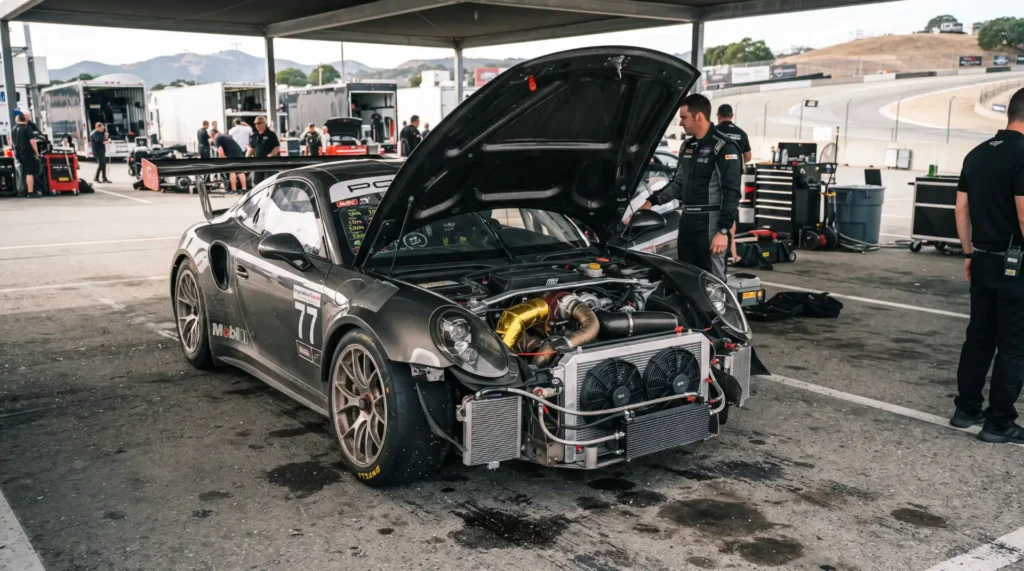 Why Cooling Fans Matter During Low-Speed Driving
A performance vehicle can have an excellent radiator and still struggle with temperature control at low speeds.
That happens because the radiator depends heavily on airflow.
At highway speeds, large amounts of air naturally pass through the grille. During stop-and-go traffic, staging lanes, pit lanes, or extended idling, that natural airflow decreases dramatically.
Cooling fans compensate for the reduced vehicle speed.
High-performance electric fans can move substantial amounts of air through the radiator when necessary. A properly designed fan shroud can further improve performance by encouraging air to pass through the radiator instead of around it.
Fan control is equally important.
The fans should operate according to coolant temperature and vehicle conditions rather than simply running continuously.
Modern electronic control systems can adjust fan operation based on coolant temperature, air conditioning demand, vehicle speed, and other inputs.
This can provide better temperature control while reducing unnecessary electrical load and noise.
Oil Cooling Is Critical for High-Output Engines
Many enthusiasts concentrate on coolant temperature and overlook engine oil temperature.
That can be a mistake.
Engine oil performs several important jobs simultaneously. It lubricates bearings and moving components, carries heat away from internal parts, protects surfaces from wear, and contributes to the thermal management of components such as pistons and turbochargers.
During heavy load, oil temperatures can rise significantly.
This is especially relevant for vehicles used on road courses, drag strips, mountain roads, towing applications, and repeated high-speed driving.
An external oil cooler can increase the system’s ability to reject heat.
The cooler needs to be positioned where it receives sufficient airflow while remaining protected from road debris.
A thermostat-controlled oil cooler can also be useful because oil that is too cold may not provide the operating characteristics intended by the engine manufacturer.
This is another example of why “colder” is not always the same thing as “better.”
The goal is controlled temperature.
Turbocharged Engines Need Special Attention
Turbocharged engines create a unique thermal environment.
The turbocharger operates using exhaust energy, which means it is exposed to extremely hot gases. The compressor side also increases intake-air temperature as it compresses incoming air.
The intercooler then has to remove heat from the compressed air.
At the same time, the engine’s cooling system has to control coolant and oil temperatures.
This creates several interacting thermal systems.
A turbocharged engine can therefore experience heat soak in multiple locations.
The intercooler may become heat soaked after repeated acceleration. The engine bay may become extremely hot after extended boost. Oil temperature can rise during sustained high-load operation. Coolant temperature may continue climbing if the radiator cannot reject heat quickly enough.
This is one reason why turbocharged performance builds often require a more comprehensive approach to cooling.
Auto Sport Performance’s article on water-methanol injection for turbo cars discusses another method of controlling intake-air temperatures in high-boost applications. That technology does not replace the engine’s primary cooling system, but it illustrates how different thermal-management strategies can work together.
Intercooler Upgrades and Heat Soak
An intercooler is designed to reduce the temperature of compressed intake air.
Cooler intake air is denser than hotter air, which can help the engine maintain performance while reducing thermal stress.
However, an intercooler can become heat soaked.
Heat soak occurs when the intercooler absorbs more heat than it can effectively reject to the surrounding air.
The result may be rising intake-air temperatures during repeated pulls.
An engine may produce excellent power on the first acceleration run but noticeably less power on subsequent runs.
Modern performance intercoolers can use larger cores, improved fin designs, better internal flow paths, and more efficient heat-exchange surfaces.
SEMA has highlighted high-performance intercooler systems specifically designed to reduce intake temperatures and combat heat soak in modified vehicles.
For a turbocharged performance build, the intercooler should therefore be considered part of the larger thermal-management strategy.
Heat Management Inside the Engine Bay
Not all heat needs to be removed through the radiator.
Some heat should be prevented from spreading throughout the engine compartment in the first place.
Turbochargers, exhaust manifolds, downpipes, and catalytic converters can create extremely high surface temperatures.
Heat shields can reduce radiant heat reaching nearby components.
Thermal barriers can protect wiring, hoses, intake components, fuel lines, and other sensitive equipment.
In some applications, exhaust insulation or thermal wraps can help control radiant heat, although these products should be selected and installed carefully.
The goal is not simply to make the exhaust system hotter.
The goal is to control where heat goes.
A well-designed engine bay allows hot air to escape while protecting sensitive components from excessive temperatures.
Hood vents can sometimes help extract hot air from the engine compartment, but their effectiveness depends heavily on location and vehicle airflow.
Poorly positioned vents can actually disrupt pressure distribution or allow water into areas where it creates problems.
Cooling and Airflow Through the Front of the Car
The front of the vehicle plays a major role in cooling performance.
Air enters through the grille and must be directed toward the radiator, intercooler, condenser, oil cooler, and other heat exchangers.
Modern performance vehicles often contain several cooling devices stacked behind the front bumper.
That creates a packaging challenge.
The air may pass through an air conditioning condenser before reaching the radiator. A transmission cooler or intercooler may also be positioned in the same airflow path.
If one heat exchanger becomes extremely hot, it can raise the temperature of the air entering another heat exchanger.
This is why simply adding more coolers does not always solve a thermal problem.
The airflow path must be engineered carefully.
Ducting, sealing, heat-exchanger placement, and airflow exit paths can all affect the final result.
Why Hot U.S. Weather Changes the Equation
A cooling system does not operate in a vacuum.
The hotter the outside air, the smaller the temperature difference between the heat exchanger and the surrounding environment.
That can make heat rejection more difficult.
This is particularly important in parts of the United States where summer temperatures regularly become extreme.
A modified vehicle operating in Phoenix, Las Vegas, Houston, Dallas, Miami, or Southern California may face significant thermal challenges during summer driving.
Humidity also changes the operating environment, while high-altitude locations introduce additional considerations related to air density.
A performance build should therefore be evaluated according to its actual operating environment.
A cooling package that performs adequately in a mild climate may require additional capacity when the same vehicle is used in a hot region.
This is particularly relevant for track enthusiasts.
A car may remain stable during a cool morning session and struggle during a hot afternoon session when ambient temperatures have increased substantially.
Track Driving Creates Different Cooling Demands
Track driving is one of the hardest tests for a performance cooling system.
On the street, drivers rarely maintain maximum engine load continuously.
On a road course, however, the engine can spend extended periods at high RPM and high throttle.
Braking and acceleration occur repeatedly.
Vehicle speed changes constantly.
Cooling systems must deal with sustained heat generation while also managing changing airflow.
The driver may also encounter periods of low-speed traffic, pit-lane operation, or a red-flag stoppage.
This combination makes track driving very different from highway cruising.
A performance cooling system should therefore be evaluated over an entire session rather than during one acceleration run.
Monitoring temperature trends can reveal whether the system is actually working.
If coolant temperature rises steadily from lap to lap, the system may have insufficient heat-rejection capacity.
If oil temperature continues climbing while coolant remains stable, the oil cooler may be the limiting component.
If intake temperature rises rapidly, the intercooler or charge-air cooling system may be struggling.
The solution depends on which part of the system is reaching its limit.
Towing and Heavy Loads Can Stress Cooling Systems
Performance cooling is not limited to sports cars.
Modified trucks and SUVs can experience significant thermal stress while towing.
A heavy trailer increases the load on the engine, transmission, drivetrain, brakes, and cooling systems.
Long uphill grades are particularly demanding because the engine may operate under high load for an extended period.
Transmission temperatures can become especially important.
A vehicle can have a stable engine coolant temperature while the transmission fluid becomes excessively hot.
For truck owners, thermal management should therefore include the engine, transmission, oil, and intake system where applicable.
Auto Sport Performance’s guide to performance upgrades for trucks and SUVs also discusses cooling as an important part of preparing these vehicles for demanding uses such as towing and heavy-duty driving.
Monitoring Temperature Is Just as Important as Upgrading Hardware
A cooling system can only be properly evaluated when temperatures are monitored.
Factory temperature gauges often provide limited information.
A gauge may remain in the normal range while the actual coolant temperature changes significantly.
Performance enthusiasts may therefore use additional sensors or data logging to monitor coolant temperature, oil temperature, intake-air temperature, transmission temperature, exhaust gas temperature, and other parameters depending on the vehicle.
Modern ECU systems can record substantial amounts of information.
Data logging allows the driver or tuner to identify trends rather than relying on a single gauge reading.
For example, a vehicle might maintain coolant temperature at a stable level for the first ten minutes of a track session and then begin climbing steadily.
That pattern provides more useful information than simply knowing the vehicle “runs hot.”
Temperature data can also help determine whether an upgrade actually worked.
If a larger radiator is installed, the vehicle should be tested under comparable conditions before and after the modification.
Signs Your Modified Engine Needs Better Cooling
Some thermal problems are obvious.
An overheating warning, coolant boiling, visible coolant loss, or repeated temperature spikes should never be ignored.
Other symptoms can be more subtle.
A performance car that becomes noticeably slower after several acceleration runs may be experiencing heat-related power reduction. A turbocharged engine that produces strong power when cold but feels progressively weaker during repeated pulls may be suffering from intake-air heat soak.
Oil pressure changes at high temperature can also indicate that the oil system needs closer attention, although diagnosing oil pressure problems requires vehicle-specific measurements and professional evaluation.
Cooling fans that run excessively, coolant odors, unexplained coolant loss, or repeated expansion-tank pressure issues can also indicate a problem.
Drivers should not assume that installing a larger radiator is automatically the solution.
The underlying cause should be identified first.
Do You Need a Bigger Radiator or Better Airflow?
This is one of the most important questions when diagnosing a cooling problem.
Sometimes the radiator is too small.
Sometimes the radiator is perfectly adequate but does not receive enough airflow.
Sometimes the fan system is inadequate.
Sometimes the thermostat, water pump, coolant mixture, or cooling-system plumbing is the problem.
In other cases, the engine is producing so much heat that several upgrades are necessary.
This is why diagnostic testing is more valuable than simply purchasing the largest radiator available.
A professional shop can evaluate coolant temperatures, pressure, airflow, fan operation, and other relevant parameters.
Computational modeling can also help engineers understand airflow and heat transfer. SAE research into under-hood thermal management demonstrates how simulations can evaluate radiator, charge-air cooler, fan, coolant pump, and engine combinations.
For serious performance builds, this engineering approach can save time and prevent unnecessary modifications.
Cooling System Maintenance Still Matters
Even the best performance cooling system requires maintenance.
Coolant levels should be checked regularly.
Hoses should be inspected for cracks, swelling, abrasion, or other damage.
Clamps should remain secure.
Radiator fins should be kept free of dirt, debris, insects, and other material that can restrict airflow.
Fans should operate correctly.
The radiator cap or expansion-system components should be inspected if the vehicle experiences unexplained pressure or coolant-loss issues.
Track vehicles deserve particular attention because repeated heat cycles can expose weak components more quickly.
A reinforced hose that looks perfect during normal street use can still fail after repeated exposure to high temperatures and pressure.
Preventive inspection is usually less expensive than repairing an overheated engine.
Cooling System Upgrades Should Be Matched to the Build
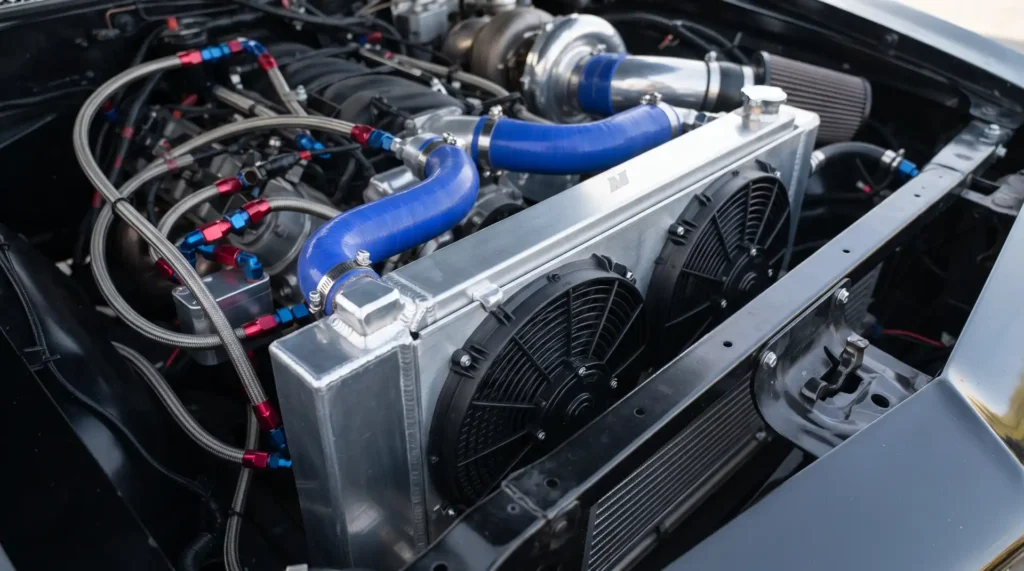 Cooling System Upgrades Should Be Matched to the Build
A 400-horsepower street car does not necessarily need the same cooling system as a 1,000-horsepower drag car.
Likewise, a road-course car needs a different strategy from a vehicle used primarily for short acceleration runs.
Drag racing can involve extremely high power output over a relatively short period.
Road-course driving creates longer periods of sustained heat.
Autocross typically involves shorter runs but repeated heat cycles.
Towing creates sustained engine and transmission loads.
Daily commuting may generate relatively modest thermal demands.
The intended use should therefore determine the cooling strategy.
The same principle applies to vehicle weight and overall performance. Auto Sport Performance’s article on why weight reduction matters in modern performance builds explains how reducing vehicle weight can lower demands on acceleration, braking, and other systems. A lighter vehicle may therefore place different demands on its thermal systems than a heavier one performing the same task.
How Tuning and Cooling Work Together
Engine tuning and cooling should be considered together.
A tune that increases boost, ignition timing, or engine output can increase thermal demand.
That does not mean a conservative tune eliminates the need for cooling, but it does mean the calibration and hardware should be developed as a complete package.
A tuner may monitor coolant temperature, intake temperature, knock activity, oil temperature, air-fuel ratio, boost pressure, and other data during calibration.
If temperatures begin exceeding the desired range, the tuner may need to adjust the calibration or recommend hardware improvements.
This is particularly important for turbocharged engines.
Auto Sport Performance’s article on checking for boost leaks explains how problems in a turbocharged intake system can affect performance and engine operation. A boost leak can also complicate tuning because the engine may not receive the expected airflow under load.
The larger lesson is that reliable performance comes from making different systems work together.
Don’t Ignore Transmission Cooling
Performance enthusiasts often focus almost entirely on engine temperature.
The transmission can be just as important.
Automatic transmissions and dual-clutch transmissions can generate considerable heat during aggressive driving.
Repeated launches, hard acceleration, towing, and high-speed operation can raise transmission fluid temperatures.
A transmission cooler can provide additional heat-rejection capacity where appropriate.
However, transmission cooling must be designed around the specific transmission.
Some vehicles already use sophisticated thermal-management systems that route transmission fluid through heat exchangers shared with other systems.
Changing that arrangement without understanding the factory design can create unexpected results.
The correct strategy is therefore vehicle-specific.
Balancing Cooling With Aerodynamics
Performance cars also have to balance cooling airflow with aerodynamic efficiency.
Large openings can increase airflow through heat exchangers, but they can also increase aerodynamic drag.
Modern performance cars increasingly use active aerodynamic and airflow-management systems to control this balance.
Air shutters, ducts, grille openings, and underbody panels can change how air travels through the vehicle.
For a street car, this can help maintain efficiency during normal driving while allowing greater airflow when thermal demands increase.
This becomes particularly important as manufacturers develop higher-output turbocharged, hybrid, and electric performance vehicles.
The cooling system is therefore increasingly connected to the vehicle’s aerodynamic design.
Building a Reliable Performance Cooling Package
A reliable cooling package should start with the vehicle’s actual requirements.
For a mildly modified street car, maintaining the factory radiator while improving airflow, monitoring temperatures, and ensuring proper maintenance may be enough.
A moderately modified turbocharged vehicle may benefit from a larger radiator, improved intercooler, better oil cooling, and more effective fan control.
A dedicated track car may require even more extensive changes, including larger heat exchangers, dedicated oil and transmission coolers, ducting, improved airflow exits, and extensive data monitoring.
A high-horsepower build may require all of these systems to operate together.
The goal should be controlled temperatures rather than simply the lowest possible temperature.
An engine designed to operate at a specific temperature range should remain within that range.
Running excessively cold can create its own problems, including inefficient combustion, increased wear during certain conditions, poor fuel economy, and calibration issues.
Thermal management is therefore about control, not simply maximum cooling.
Common Cooling Upgrade Mistakes
One common mistake is installing a huge radiator without improving airflow.
Another is adding multiple heat exchangers without considering their position relative to one another.
Installing a high-flow water pump without understanding the engine’s coolant-flow requirements can also create problems.
Some enthusiasts replace thermostats with much colder versions without considering how the engine-management system was designed to operate.
Others concentrate on coolant temperature while ignoring oil or transmission temperatures.
A further mistake is using aftermarket components that are poorly matched to the vehicle.
Cooling hardware should be selected according to the engine’s power level, intended use, available space, airflow requirements, and operating environment.
The most expensive component is not necessarily the most effective one.
Performance Cooling for Modern Hybrid Builds
Hybrid performance vehicles introduce additional thermal-management challenges.
Instead of managing only an internal-combustion engine, hybrid vehicles may need to control temperatures in the engine, electric motors, inverter, battery, transmission, and other electronics.
Higher performance can increase thermal demands across several of these systems.
Auto Sport Performance’s article on hybrid performance tuning in 2026 examines how modern hybrid performance builds have to balance power and efficiency.
For hybrid vehicles, cooling is therefore becoming even more integrated.
A performance modification that increases power may also increase heat generation in components that traditional engine builds did not have to manage.
This trend is likely to make thermal management an even more important part of performance tuning over the coming years.
Why Thermal Consistency Matters More Than Peak Numbers
A dyno sheet can show a powerful number, but performance on the road or track is often about consistency.
Suppose a modified car produces 600 horsepower on its first pull but loses significant output after several repeated runs because temperatures climb.
Another vehicle may produce slightly less peak power but maintain nearly the same output throughout an extended session.
For a track enthusiast, the second vehicle may provide a more useful performance experience.
Thermal consistency allows the engine, tires, brakes, transmission, and driver to operate predictably.
That is particularly important during competition or long track sessions.
Performance cooling systems are therefore not simply reliability upgrades.
They can be performance upgrades because they help the vehicle maintain the power it already has.
When Should You Upgrade Your Cooling System?
There is no universal horsepower number at which every vehicle suddenly requires a larger radiator.
The need depends on the platform and how it is used.
An engine producing 500 horsepower on a short drag pass may have different thermal requirements from a 400-horsepower engine running a 30-minute road-course session.
A truck producing moderate power while towing a heavy trailer through mountainous terrain may also require significant cooling capacity.
The best time to upgrade is before thermal problems become severe.
If modifications are expected to substantially increase power or load, cooling should be considered during the planning stage rather than after the engine begins overheating.
This approach can also make installation easier because multiple components can be designed around one another.
Final Thoughts on Performance Cooling Systems
Performance cooling systems are one of the most important parts of building a reliable modified engine.
Increasing horsepower without considering thermal management can create a vehicle that performs impressively for a short period but struggles under sustained load.
The cooling system must be capable of managing coolant, oil, intake air, transmission fluid, and under-hood temperatures according to the vehicle’s specific requirements.
For many builds, that means starting with a properly sized radiator and making sure coolant circulation and airflow are adequate. More demanding applications may require upgraded fans, ducting, oil coolers, intercoolers, heat shielding, transmission cooling, and additional temperature monitoring.
The most important principle is to treat cooling as an integrated system.
A larger radiator cannot compensate for poor airflow. A powerful intercooler cannot solve excessive engine oil temperatures. A high-flow water pump cannot fix an obstructed radiator. An oil cooler cannot compensate for inadequate engine coolant capacity.
Every component has to work together.
This becomes especially important for U.S. drivers because operating conditions vary dramatically across the country. A modified car used in hot Southern California, Arizona, Texas, Florida, or Nevada may face very different thermal demands from one operating in a cooler region. Track use, towing, stop-and-go traffic, high-altitude driving, and repeated acceleration can all increase the demand placed on the cooling system.
Modern automotive engineering is moving toward increasingly sophisticated thermal management. SAE International’s current research demonstrates that manufacturers are optimizing coolant circuits, flow management, radiator distribution, and electronic control as part of broader engine-efficiency and temperature-control strategies.
For the performance enthusiast, the takeaway is straightforward: horsepower is only useful when the vehicle can sustain it.
A well-built performance car should not merely produce impressive power on one dyno pull. It should maintain stable temperatures, consistent power, predictable behavior, and reliable operation when the engine is actually being asked to work.
That is why performance cooling deserves to be planned alongside the turbocharger, fuel system, ECU calibration, exhaust, suspension, brakes, and tires.
The fastest build is not necessarily the one with the biggest horsepower number.
It is the one that can use its power consistently without allowing heat to become the limiting factor.