
Electric vehicles have changed the definition of automotive performance.
For decades, performance modifications revolved around engine displacement, turbochargers, exhaust systems, fuel systems, camshafts, transmissions, and engine tuning. Electric vehicles approach performance from a completely different direction. Instead of extracting more power from combustion, EV performance depends on electric motors, battery output, power electronics, software, thermal management, traction, aerodynamics, and vehicle weight.
That difference is creating a new performance aftermarket in the United States.
In 2026, EV owners have more ways than ever to personalize the driving characteristics of electric cars. Some upgrades are relatively simple, such as high-performance tires and lightweight wheels. Others involve suspension components, brake systems, cooling improvements, aerodynamic changes, or software-based optimization.
The most important thing to understand is that an electric car should not be modified exactly like a gasoline-powered vehicle.
The battery is not simply an alternative fuel tank. It is one of the central performance components of the vehicle. Battery temperature, state of charge, power limits, inverter temperature, motor temperature, and software calibration can all affect how much performance an EV can deliver.
The U.S. Department of Energy describes the EV powertrain as a system that includes the battery pack, traction motor, wiring, power electronics, and thermal-management systems. That integrated architecture is one reason thermal management and electronics are so important when discussing EV performance.
For American enthusiasts, this means the best EV upgrades in 2026 are not necessarily the most aggressive-looking parts. The strongest builds are the ones that improve traction, handling, cooling, braking, efficiency, and consistency while respecting the vehicle’s original engineering.
Why EV Performance Is Different in 2026
The instant torque of an electric motor changes how an enthusiast experiences acceleration.
A gasoline engine generally needs to build power through a rev range. An EV can deliver substantial torque from very low motor speeds, depending on the vehicle’s control strategy and motor design.
That means many electric vehicles already have impressive straight-line performance without aftermarket modifications.
The challenge is not always producing more peak acceleration.
Instead, performance EV owners increasingly want better repeatability, improved cornering, stronger braking, sharper steering response, better tire grip, reduced weight, and more consistent performance during demanding driving.
This is especially relevant for EVs because repeated high-load driving can create substantial heat in the battery, motors, inverters, and other components.
A vehicle may deliver a spectacular acceleration run and then reduce available power after repeated hard use if temperatures reach protective thresholds.
That makes thermal management one of the defining areas of electric performance.
The Department of Energy notes that thermal control is critical for electric machines and power electronics because it affects power density, reliability, and system performance.
For the enthusiast, the lesson is straightforward: improving an EV is about making the entire system work together.
 Performance Tires Are Still the First Upgrade
 Performance Tires Are Still the First Upgrade
Regardless of whether a vehicle uses gasoline, diesel, hybrid technology, or electric power, tires remain the connection between the car and the road.
This is especially important with performance EVs.
Electric vehicles can be heavy because of their battery packs, while instant torque can place substantial demands on the driven tires. A tire that cannot handle the vehicle’s power and weight can limit acceleration, braking, and cornering.
A high-performance tire upgrade can therefore transform an EV without changing its motor output.
For a U.S. street-driven EV, the correct tire depends on climate, road conditions, driving style, and vehicle weight.
An enthusiast living in Southern California may prioritize dry-weather performance, while a driver in the Midwest or Northeast may need a tire that offers more predictable behavior in cooler temperatures and wet conditions.
Ultra-high-performance summer tires can provide excellent grip in appropriate temperatures, but they may not be ideal for year-round driving in colder climates.
All-season performance tires can provide a broader operating range, although their ultimate dry grip may not match specialized summer tires.
EV owners should also consider the tire’s load rating.
The weight of an electric vehicle makes load capacity particularly important. Choosing a tire simply because it has an attractive tread pattern or high performance rating is not enough.
The tire needs to be correctly matched to the vehicle’s weight and manufacturer specifications.
Lightweight Wheels Can Improve EV Handling
Wheels are another important performance upgrade.
Electric vehicles can benefit from lightweight wheels because reducing unsprung and rotational mass can improve the way the suspension responds.
A lighter wheel can help reduce the work required from the suspension when the vehicle encounters bumps. It can also reduce rotational inertia, potentially improving acceleration and braking response.
However, EV owners should avoid choosing wheels based purely on appearance.
A lightweight wheel with the wrong dimensions can create clearance issues, alter steering geometry, or fail to provide the appropriate load capacity.
Wheel strength is particularly important for heavier performance EVs.
The ideal wheel should combine appropriate load capacity, correct fitment, reasonable weight, and compatibility with the vehicle’s brake package.
For enthusiasts building an EV for street performance, autocross, or track use, wheel and tire selection should be treated as a complete system.
Suspension Upgrades Can Transform a Performance EV
Suspension is one of the most effective areas for improving handling.
Many factory EVs are designed to provide a balance between comfort, efficiency, stability, and performance. That makes sense for a mass-market vehicle, but an enthusiast may want a different balance.
Performance springs, adjustable dampers, coilovers, sway bars, upgraded bushings, and other suspension components can change the vehicle’s behavior.
The objective should not simply be to lower the car as much as possible.
Excessive lowering can reduce suspension travel, create clearance issues, change suspension geometry, and make the vehicle less comfortable.
A well-engineered suspension setup should improve body control without destroying everyday usability.
This is where the philosophy behind conventional performance tuning still applies.
Auto Sport Performance already focuses on suspension and wheel setup as part of its performance services, making suspension a natural extension of the site’s existing performance content.
For EV owners, the suspension also has to account for battery-pack placement.
Many electric vehicles have a low center of gravity because the battery is mounted low in the chassis. That can already provide excellent stability.
The goal of an aftermarket suspension should therefore be to complement the factory platform rather than simply imitate the setup of a traditional sports car.
Better Brakes Still Matter on Electric Cars
Regenerative braking changes how EVs slow down.
When the driver lifts off the accelerator or applies the brake, the electric motor can operate as a generator and recover some kinetic energy. The recovered energy is sent back toward the battery.
The Department of Energy explains that regenerative braking reduces conventional brake use and can help reduce brake wear.
That does not mean friction brakes are unimportant.
Performance driving can place significant demands on the braking system, particularly when a heavy EV is repeatedly slowed from high speeds.
A performance brake setup can include higher-performance pads, improved rotors, high-temperature brake fluid, and appropriately designed cooling.
The correct setup depends on the vehicle and intended use.
A daily-driven EV does not necessarily need an extreme racing brake package. Track-focused vehicles have very different requirements from commuter cars.
Brake pads should also be selected according to operating temperature.
A pad designed primarily for track use may not be the best choice for a vehicle driven mostly around town.
For many EV owners, the best starting point is a quality performance pad and fresh brake fluid combined with appropriate tires.
Brake Cooling for Track-Focused EVs
EV track driving introduces an additional challenge.
Regenerative braking can reduce the workload placed on friction brakes, but its effectiveness can vary according to battery state of charge, temperature, driving mode, and vehicle software.
If the battery is already highly charged, there may be less opportunity to recover energy through regeneration.
That means friction brakes can become more important during demanding sessions.
Brake cooling can therefore be valuable for serious track users.
Ducting, airflow management, performance rotors, appropriate pads, and high-temperature fluid can help maintain brake performance.
The exact solution should be designed around the individual vehicle rather than copied from an internal-combustion performance car.
Thermal Management Is the Heart of EV Performance
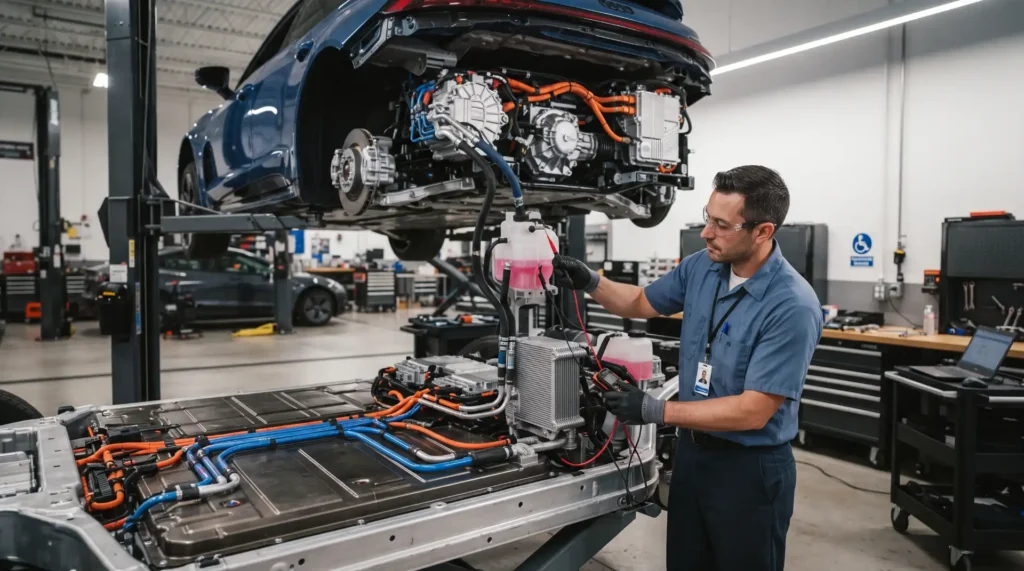
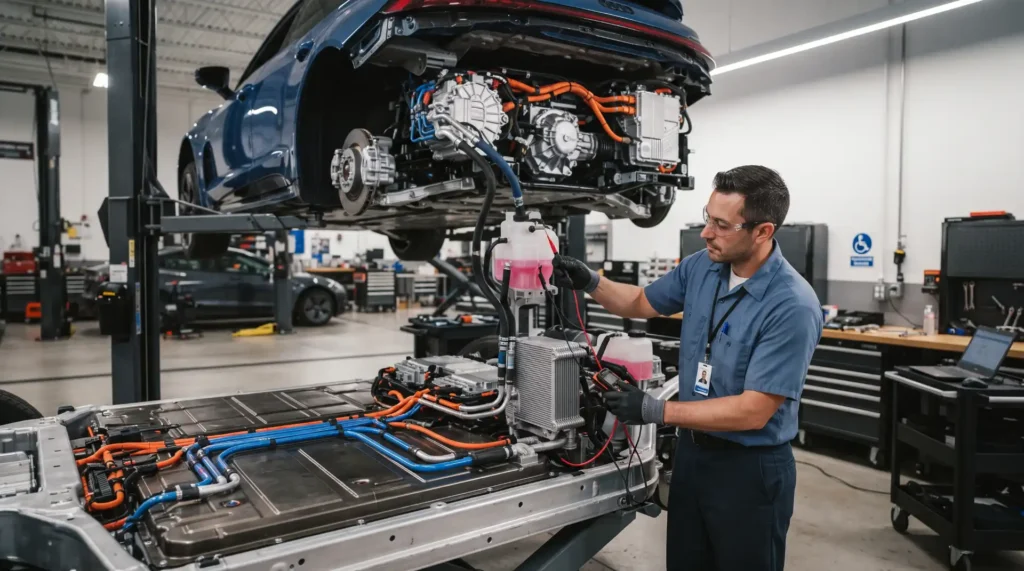
If there is one area that separates EV performance from traditional tuning, it is thermal management.
A gasoline performance car has an engine cooling system, transmission cooling, intercooling for turbocharged applications, and sometimes differential or oil cooling.
An EV has its own thermal network.
The battery, electric motor, inverter, power electronics, and cabin can all generate or require heat management.
The battery in particular operates within a temperature range where performance, charging capability, efficiency, and durability can be optimized.
The Department of Energy’s EV research emphasizes battery performance, durability, power capability, and thermal considerations as important areas of development.
This means aftermarket thermal upgrades can become increasingly important as EVs are pushed harder.
Battery Cooling and Performance Consistency
Battery cooling is not simply about preventing overheating.
Temperature affects the battery’s ability to deliver power.
When an EV is driven aggressively, the battery can generate heat. If temperatures rise beyond the vehicle’s preferred operating range, software may reduce power to protect the system.
An enthusiast who wants consistent performance therefore has a strong reason to pay attention to thermal management.
Depending on the vehicle, upgrades could involve improved cooling components, heat exchangers, coolant systems, or software changes designed to optimize thermal behavior.
However, battery modifications are considerably more complex than installing an aftermarket radiator on a gasoline engine.
High-voltage systems can present serious safety hazards.
Battery cooling systems should therefore be approached with professional expertise and manufacturer-specific knowledge.
Owners should not attempt to open, modify, or bypass high-voltage battery safety systems simply to chase more performance.
Preconditioning Can Be a Performance Tool
One of the easiest ways to improve EV performance may already be built into the vehicle.
Battery preconditioning allows the vehicle to bring the battery toward a preferred operating temperature before demanding maximum performance or fast charging.
This can be particularly useful in cold weather.
The Department of Energy recommends preconditioning an EV while it is still connected to charging when possible, helping warm the battery and cabin before driving.
For performance enthusiasts, the principle is similar.
A battery at an appropriate temperature is generally in a better position to deliver consistent performance than a battery that has just been exposed to extreme cold.
Some vehicles automate this process, while others provide driver-selectable settings.
Learning how the factory thermal system works can therefore be just as important as buying aftermarket hardware.
Software and ECU-Like Tuning for EVs
EV tuning does not work exactly like gasoline ECU tuning.
There is no conventional fuel map or ignition map in the traditional sense.
Instead, electric powertrains use software to control systems such as torque delivery, inverter behavior, battery limits, regenerative braking, thermal protection, traction control, and other vehicle functions.
That creates opportunities for software-based performance optimization.
However, software tuning can also create risks.
The vehicle manufacturer may have designed power limits around battery temperature, motor temperature, inverter capacity, drivetrain durability, and safety requirements.
Increasing a software limit without addressing those systems can create excessive heat or stress.
A responsible performance tune therefore needs to consider the complete vehicle.
In some cases, software can improve throttle response or change the way torque is delivered without dramatically increasing peak output.
For a street car, that type of optimization can be more useful than simply chasing the highest possible dyno number.
Torque Management Is Different From Horsepower
Traditional performance culture often focuses on horsepower.
EVs make torque management particularly important.
Because electric motors can generate strong torque at low speeds, manufacturers use sophisticated software to control how much torque reaches the wheels.
This protects the drivetrain and helps maintain traction.
An aftermarket software calibration that increases torque delivery can therefore have consequences beyond acceleration.
The tires may spin more easily. Driveshafts, half-shafts, differentials, and other components can experience greater loads.
On all-wheel-drive EVs, torque distribution between the front and rear motors can also influence vehicle behavior.
For performance applications, a carefully calibrated torque curve can be more useful than an unrestricted power increase.
All-Wheel Drive EVs Offer Unique Tuning Opportunities
All-wheel-drive EVs are particularly interesting from a performance perspective.
Some vehicles use separate electric motors for different axles. This gives manufacturers considerable flexibility in controlling torque distribution.
Traditional all-wheel-drive systems use mechanical components to distribute power.
A multi-motor EV can potentially change front-to-rear torque distribution electronically.
That creates possibilities for sharper cornering behavior, improved traction, and different drive modes.
However, these systems are deeply integrated into vehicle software.
Aftermarket modifications should therefore be designed around the manufacturer’s architecture.
Changing suspension, tires, and alignment may provide significant handling benefits without interfering with the vehicle’s high-voltage control systems.
Alignment Is an Affordable Performance Upgrade
A performance alignment can make a surprisingly large difference.
Camber, caster, toe, and other alignment settings influence how the tires contact the road.
An EV enthusiast interested in improved cornering may benefit from a performance-oriented alignment, provided it remains appropriate for street use.
Too much negative camber, for example, can accelerate inner-edge tire wear during everyday driving.
Aggressive toe settings can also make a vehicle less stable or cause rapid tire wear.
The best alignment is therefore the one that matches the vehicle’s intended use.
For a daily driver, a mild performance setup may be ideal.
For an autocross or track car, more aggressive settings may make sense.
Aerodynamic Upgrades for Performance EVs
 Aerodynamic Upgrades for Performance EVs
Aerodynamics becomes increasingly important as performance increases.
A front splitter, rear spoiler, diffuser, underbody panel, or other aerodynamic component can influence airflow around the vehicle.
However, aerodynamic parts should be engineered rather than selected purely for appearance.
A poorly designed wing can increase drag without producing useful downforce.
An oversized body kit can also add weight and affect efficiency.
EVs make aerodynamic efficiency particularly important because reduced drag can influence energy consumption and highway range.
For a dual-purpose performance EV, the best aerodynamic upgrade may be a component that improves high-speed stability while maintaining reasonable efficiency.
Lightweight Body Components
Weight reduction remains relevant for electric cars, even though removing battery mass is generally impractical.
The battery is one of the most substantial components of an EV, so owners should not expect traditional weight-reduction techniques to transform an EV in the same way they can transform a lightweight gasoline-powered sports car.
However, there are still opportunities.
Lightweight wheels can reduce unsprung mass.
Carbon-fiber or composite body components can reduce weight in certain applications.
Lightweight seats may help in track-focused builds.
Removing unnecessary interior components can also reduce mass, although this is usually more appropriate for dedicated track vehicles.
The Department of Energy has identified vehicle weight as an important factor in EV efficiency and has highlighted lightweight vehicle components as one avenue for improving electric-drive performance.
EV Drivetrain Cooling
The electric motor and inverter can generate significant heat during high-load operation.
This becomes particularly important in high-performance driving.
An upgraded cooling system may help maintain consistent motor and inverter temperatures, depending on the vehicle.
The exact architecture varies significantly between EV manufacturers and models.
Some systems use dedicated coolant loops, while others integrate components into broader thermal-management networks.
That means an aftermarket cooling modification must be designed around the specific platform.
Generic cooling solutions are not automatically appropriate for every EV.
Charging Upgrades for Performance Owners
Charging may not seem like a performance modification, but it becomes important for EV enthusiasts.
A vehicle that can charge efficiently and consistently spends less time waiting between drives.
The Department of Energy explains that Level 2 charging is commonly suitable for overnight home charging, while DC fast charging is designed for faster charging during longer trips.
For a performance-oriented EV owner, a properly installed Level 2 home charger can be one of the most practical upgrades.
It allows the vehicle to start the day with a predictable charge level and can make frequent performance driving more convenient.
Charging equipment should be installed according to applicable electrical codes and manufacturer requirements.
Improving EV Range Through Efficiency
Performance and efficiency are not always opposites.
Some modifications can improve both.
Low-rolling-resistance performance tires can help preserve efficiency while offering more grip than standard tires, depending on the specific tire.
Lightweight wheels can potentially improve efficiency as well as handling.
Improved aerodynamic components can reduce drag.
Correct tire pressure is another simple factor that affects both efficiency and handling.
The best performance EV setup therefore does not necessarily require sacrificing range.
The key is selecting upgrades that provide useful performance benefits without creating unnecessary energy losses.
Cooling and Performance in Hot U.S. Climates
American EV owners face a wide range of climates.
A performance setup that works well in Washington State may experience very different conditions in Arizona, Texas, Florida, or Southern California.
High ambient temperatures can increase the thermal load on an EV.
This makes cooling and heat management particularly important for enthusiasts in hot-weather regions.
An EV driven aggressively on a hot summer day can generate considerable heat in the battery, motor, inverter, and brakes.
The vehicle’s thermal-management system must dissipate that heat.
For this reason, performance owners should pay attention to temperature data whenever the vehicle provides it.
If the car consistently reaches thermal limits during hard use, the solution should focus on managing heat rather than simply increasing power.
Cold Weather Performance Upgrades
Cold weather creates a different set of challenges.
Battery performance can be affected by low temperatures, and charging speed can be reduced until the battery reaches a suitable operating temperature.
The Department of Energy specifically recommends preconditioning in cold weather and notes that charging behavior can change as the battery approaches higher states of charge.
For performance enthusiasts in states such as Michigan, Minnesota, Colorado, New York, and other cold-weather regions, understanding battery temperature is essential.
Winter tires may also be more important than summer performance tires.
A performance EV needs to maintain traction in the actual environment where it is driven.
Choosing Upgrades for Tesla and Other Popular EVs
The U.S. EV market includes a wide range of platforms.
Tesla models have developed an extensive aftermarket, while performance-oriented EVs from Ford, Hyundai, Kia, Porsche, BMW, Mercedes-Benz, Lucid, Rivian, Chevrolet, and other manufacturers have created additional opportunities.
Each platform has different limitations.
A Tesla Model 3 performance build will have different suspension, tire, software, and cooling considerations than a Ford Mustang Mach-E, Hyundai IONIQ 5 N, Porsche Taycan, Chevrolet Blazer EV, or Rivian R1T.
This is why platform-specific research matters.
A modification that works on one EV should not automatically be transferred to another vehicle simply because both are electric.
Performance EVs and Track Days
Track driving is one of the most demanding environments for an EV.
The combination of repeated acceleration, high-speed braking, cornering, and sustained electrical load can expose thermal limitations.
Before taking an EV to a track, owners should understand the manufacturer’s operating recommendations.
Tires, brakes, alignment, cooling, and battery state of charge should all be considered.
Track use can also accelerate wear on components.
A dedicated performance setup may require more frequent inspections than a normal street vehicle.
The goal should be consistency.
A slightly slower lap time that can be repeated reliably may be more valuable than a single fast lap followed by significant power reduction.
EV Performance Mods That Are Not Worth the Risk
The EV aftermarket is expanding, but owners should remain cautious around high-voltage systems.
The battery pack can contain extremely high electrical energy.
Improper modifications to battery modules, high-voltage wiring, contactors, charging systems, or safety systems can create serious hazards.
This is very different from installing an intake or exhaust system on a gasoline vehicle.
Performance EV owners should therefore distinguish between modifications that are accessible to experienced enthusiasts and systems that require qualified technicians.
Tires, wheels, alignment, suspension, brake components, and some aerodynamic parts are generally easier to approach than high-voltage battery modifications.
When working on electrical systems, the vehicle’s service procedures and manufacturer requirements should be followed.
The Department of Energy notes that EV batteries are designed for extended service but can eventually wear, and some battery systems use liquid coolant that may require inspection or maintenance.
How Much Should You Spend on an EV Performance Build?
The answer depends heavily on the vehicle and the owner’s objectives.
A street-focused build does not need to become an expensive engineering project.
A reasonable starting point is tires.
After that, wheels, alignment, suspension, and brakes can be addressed according to the owner’s needs.
Only after those fundamentals are handled should an owner consider more complicated thermal or software modifications.
The advantage of this approach is that each upgrade can be evaluated independently.
If better tires solve a traction problem, there may be no reason to immediately modify the powertrain.
If suspension and alignment significantly improve cornering, a larger horsepower increase may not be necessary.
Performance is about the entire vehicle, not one specification.
A Practical 2026 EV Performance Build
For an American enthusiast building a street-performance EV in 2026, a logical progression might begin with high-quality performance tires and a proper alignment.
The next stage could involve lightweight wheels and upgraded suspension.
Brake pads and fluid can then be selected according to how aggressively the vehicle is driven.
For owners who regularly participate in autocross or track events, additional brake cooling and thermal monitoring may become useful.
Only after the chassis is capable of handling the vehicle’s existing power should software optimization or powertrain modifications become a priority.
This approach mirrors the philosophy used in successful gasoline performance builds: establish a reliable foundation before chasing maximum output.
The difference is that an EV’s foundation includes software and thermal management as well as mechanical components.
The Role of Diagnostics in EV Performance
Diagnostics are becoming increasingly important in the EV aftermarket.
A modern EV generates extensive amounts of data.
Battery temperatures, motor temperatures, state of charge, charging rates, power output, regenerative braking behavior, and other parameters can provide valuable information about vehicle performance.
Performance tuning without diagnostics is essentially guesswork.
Before changing a system, an owner should understand how the vehicle behaves in factory form.
After an upgrade, the same measurements can show whether the modification produced the intended result.
This is another area where Auto Sport Performance’s existing emphasis on diagnostics and precision tuning fits naturally into the EV performance conversation. The site’s current service structure includes diagnostics, performance tuning, and vehicle-performance work.
The Future of EV Performance in the United States
Electric performance vehicles are still evolving.
Battery technology continues to advance, power electronics are becoming more sophisticated, and manufacturers are developing increasingly advanced electric motors and thermal systems.
The Department of Energy continues to support research into battery cost, performance, durability, power capability, and charging technology.
That means the aftermarket is likely to evolve alongside the vehicles.
Today’s popular EV modification may eventually be replaced by a more sophisticated solution.
Software could become increasingly important.
Thermal management may become a major performance category.
Lightweight materials could help offset some of the mass associated with large battery packs.
Advanced tires may be designed specifically around the unique combination of EV weight, torque, efficiency, and regenerative braking.
The definition of a performance upgrade is therefore expanding.
The Best EV Upgrade Depends on Your Goal
There is no single best performance modification for every EV.
A daily driver has different needs from a weekend canyon carver.
A drag-racing EV has different requirements from an autocross car.
A performance SUV or electric pickup has different priorities from a lightweight sports sedan.
For many street drivers, tires and suspension will provide the biggest improvement in driving feel.
For track enthusiasts, brakes, cooling, alignment, and thermal management may matter more.
For owners seeking additional acceleration, software and powertrain modifications may be attractive, but they should be approached with a clear understanding of the battery, motor, inverter, and drivetrain limitations.
The best build is the one that improves the characteristics the owner actually wants to change.
Final Thoughts: Building a Better Performance EV in 2026
Performance EVs are changing the automotive aftermarket in the United States.
The basic principles of performance remain familiar: traction matters, weight matters, suspension matters, braking matters, cooling matters, and reliability matters.
What has changed is the technology behind those principles.
Instead of focusing primarily on engines and exhaust systems, EV enthusiasts need to understand batteries, electric motors, inverters, software, regenerative braking, and thermal management.
That creates an entirely new performance landscape.
The best upgrades for an electric car in 2026 are therefore not necessarily the parts that promise the biggest headline number.
Performance tires can improve acceleration, braking, and cornering.
Lightweight wheels can improve suspension response.
Suspension upgrades can sharpen handling.
Brake upgrades can provide greater confidence during repeated hard stops.
Aerodynamic components can improve high-speed stability when properly designed.
Thermal upgrades can help maintain consistent performance.
Software optimization can potentially change how an EV delivers its existing power.
And careful diagnostics can help owners understand what the vehicle is actually doing before and after modifications.
For American EV enthusiasts, the opportunity is significant.
The EV performance market is moving beyond the question of whether electric cars can be fast. That question has largely been answered by the vehicles already on U.S. roads.
The more interesting question now is how much better those vehicles can become when enthusiasts apply the same engineering mindset that has driven decades of gasoline-powered performance.
A well-built performance EV does not need to imitate a gasoline car.
It can use the advantages of electric propulsion—instant torque, low center of gravity, precise electronic control, and powerful motors—while improving the areas that matter most to the driver.
In 2026, the smartest EV performance build is a balanced one.
Start with the road. Choose the right tires. Improve the suspension. Make sure the brakes match the vehicle’s intended use. Pay attention to temperature. Understand the software. Monitor the vehicle. And treat the battery and high-voltage system as sophisticated engineering components rather than areas for experimental modifications.
That approach can turn an already quick electric vehicle into a more capable, predictable, and enjoyable performance machine.
For additional U.S. information on electric vehicles, batteries, charging, and electric-drive technology, the U.S. Department of Energy’s electric-vehicle resources provide authoritative background and technical information.
Related Auto Sport Performance Content
Readers interested in taking their vehicle’s performance further can also explore Auto Sport Performance’s existing content and services. The site currently covers Performance Tuning, Diagnostics, Vehicle Performance, Suspension & Wheel Setup, and related automotive performance topics.
A natural internal-link placement is to connect the discussion of suspension, wheel selection, and alignment to your existing Suspension & Wheel Setup content.
The section on software and tuning can link naturally to your existing Performance Tuning and Diagnostics pages.
The discussion of brakes can also connect to your site’s Performance Brake Tuning content, while the broader maintenance discussion can link to your Maintenance section. These internal links help readers move from informational content toward related automotive performance resources without interrupting the article’s flow.