
Modern performance cars are no longer defined by horsepower alone. Engine output remains an important part of performance, but today’s fastest and most capable vehicles depend on sophisticated systems that determine how effectively that power reaches the pavement. One of the most important technologies in this evolution is torque vectoring.
Torque vectoring allows a vehicle to actively control how driving torque is distributed between wheels. Rather than simply sending power to an axle and allowing conventional differentials to manage the difference in wheel speed, an advanced torque-vectoring system can influence how much driving force reaches individual wheels. Depending on the design, the system can help reduce wheelspin, improve cornering response, increase traction, manage understeer, and make a powerful AWD vehicle easier to control.
This technology has become particularly important in modern AWD performance vehicles sold in the United States. High-performance sedans, sports cars, crossovers, SUVs, hot hatches, hybrids, and electric vehicles can all use different forms of torque management to improve acceleration and handling. Some systems are relatively simple and use the brakes to influence wheel behavior, while more advanced systems use electronically controlled differentials or independently controlled electric motors.
For performance enthusiasts, understanding torque vectoring is valuable because AWD and torque vectoring are not the same thing. Two vehicles can both have all-wheel drive and still deliver dramatically different handling characteristics. The difference often comes down to how intelligently the drivetrain can distribute torque and how effectively that system works with the tires, suspension, brakes, steering, and stability controls.
What Is Torque Vectoring?
Torque vectoring is a technology that changes the distribution of driving force between wheels or axles according to the vehicle’s operating conditions. The system uses information from sensors and electronic control units to determine what the vehicle is doing and how torque should be managed.
Modern vehicles can monitor wheel speeds, steering angle, throttle position, brake pressure, yaw rate, lateral acceleration, longitudinal acceleration, vehicle speed, and other parameters. The control system can use this information to determine whether the vehicle is accelerating, cornering, braking, or beginning to lose traction.
When the vehicle enters a corner, the outside wheels travel farther than the inside wheels. At the same time, weight transfers toward the outside of the vehicle. The tires therefore have different levels of available traction. If the drivetrain sends too much torque to a lightly loaded inside wheel, that tire may spin without contributing much useful acceleration.
Torque vectoring gives the vehicle another option. Instead of treating every driven wheel the same, the system can redistribute driving force to make better use of the available traction. In a performance application, that can help the car rotate into a corner and accelerate out of it more effectively.
AWD and Torque Vectoring Are Not the Same
It is easy to assume that every AWD vehicle automatically has torque vectoring, but that is not correct. AWD simply describes a drivetrain capable of delivering power to all four wheels under certain operating conditions. The way that power is distributed can vary substantially from one vehicle to another.
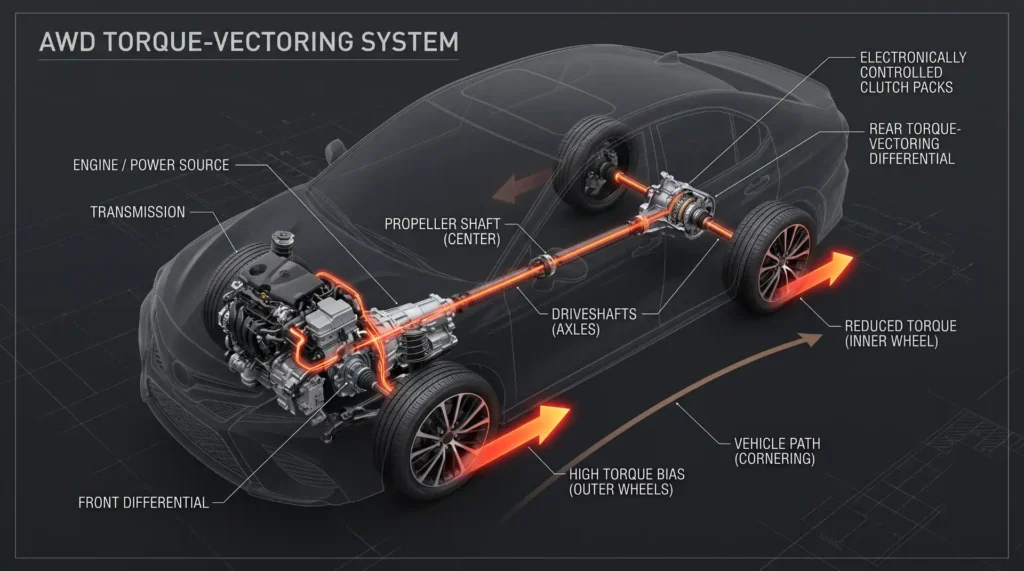
A basic AWD system may use a relatively simple coupling to send power between the front and rear axles. Another vehicle may use electronically controlled clutch packs that continuously change the front-to-rear torque split. A more advanced performance car may have an active rear differential capable of varying torque between the left and right rear wheels.
These systems can produce very different driving experiences.
An AWD system that primarily focuses on traction may be excellent on slippery roads but provide relatively little assistance with corner rotation. A performance-oriented torque-vectoring system can be calibrated specifically to influence vehicle yaw and handling balance.
This distinction is one reason enthusiasts should research the actual drivetrain hardware and software instead of relying solely on an AWD badge.
 Why Torque Vectoring Improves Cornering
 Why Torque Vectoring Improves Cornering
The biggest advantage of torque vectoring for performance driving is its ability to influence how the vehicle rotates through a corner.
When a driver turns the steering wheel, the vehicle begins rotating around its vertical axis. This movement is called yaw. A performance vehicle needs to manage yaw carefully because too little rotation can produce understeer, while too much can result in oversteer.
Torque vectoring can influence this balance by changing the driving force applied at different wheels.
For example, during a corner, the system may direct more torque toward an outside driven wheel and reduce torque at an inside wheel. Because the forces acting on the two sides of the vehicle are different, the drivetrain can create a yaw moment that encourages the car to rotate toward the corner.
The driver may experience this as sharper turn-in, better cornering response, or improved ability to maintain the desired line when accelerating.
The system is not creating additional tire grip. Instead, it is using the available grip more intelligently.
How Torque Vectoring Can Reduce Understeer
Understeer occurs when the front tires reach their available grip limit before the rear tires. The vehicle then tends to continue toward the outside of the corner instead of following the driver’s intended steering path.
Performance cars can experience understeer for many reasons. Front weight distribution, tire characteristics, suspension geometry, alignment, speed, road conditions, and throttle application all contribute to the vehicle’s handling balance.
AWD can sometimes increase the potential for power-related understeer because the front wheels are also responsible for transmitting driving force. If the driver accelerates aggressively while turning, the front tires may have to manage both lateral cornering forces and longitudinal acceleration forces.
A sophisticated torque-vectoring system can help by changing where the driving force is applied. Reducing torque at the front wheels or shifting more torque toward the rear can reduce the demand on the front tires. Some systems can also distribute torque from one side of an axle to the other to encourage vehicle rotation.
This can produce a more neutral and responsive cornering experience.
Torque Vectoring During Corner Entry
Corner entry is one of the most complicated phases of performance driving because the vehicle is transitioning from braking toward cornering and acceleration.
During heavy braking, weight transfers toward the front axle. The front tires therefore have a major role in slowing and steering the vehicle. As the driver releases the brakes and turns into the corner, the balance of forces changes again.
Modern torque-vectoring systems can work alongside braking, stability control, steering, and suspension systems during this transition.
The objective is generally to keep the vehicle stable while providing a responsive steering response. In a performance mode, the calibration may allow greater rotation than it would in a normal driving mode.
The best systems operate without becoming distracting. Rather than feeling as though the computer is constantly correcting the car, the driver may simply experience a more controlled and predictable response.
Torque Vectoring During Corner Exit
Corner exit is where torque vectoring can become particularly valuable for high-powered AWD cars.
As the driver begins applying throttle, the tires must convert engine torque into forward acceleration while continuing to generate lateral grip. This is sometimes described through the tire’s friction circle or combined-slip behavior. A tire already working hard to turn the vehicle has less available capacity for additional acceleration.
If too much torque is applied to a tire, it can begin to spin. Once a tire exceeds its available traction, additional torque does not necessarily create additional forward acceleration.
Torque vectoring can help manage this situation by distributing available torque toward wheels that can use it more effectively.
The result can be earlier and stronger acceleration out of a corner. For a high-output performance vehicle, this can make a substantial difference because modern engines and electric motors can produce enormous amounts of torque.
Brake-Based Torque Vectoring
Not every torque-vectoring system uses a specialized differential. Some vehicles use the braking system to influence wheel behavior.
In a brake-based system, the electronic stability-control system can apply braking force to an individual wheel. If that wheel begins spinning or the vehicle requires additional yaw control, the system can use the brake to change the forces acting on the vehicle.
This approach has an important advantage because manufacturers can integrate it with existing stability-control hardware. It does not necessarily require an expensive active differential.
However, brake-based torque vectoring has limitations. Repeated brake intervention can generate additional heat, which can become significant during aggressive track driving.
For a street-driven vehicle, brake-based torque management can provide meaningful benefits. For a dedicated track car, enthusiasts may prefer a mechanical or electronically controlled differential capable of redistributing torque without relying primarily on friction brakes.
Active Differentials and Clutch-Based Systems
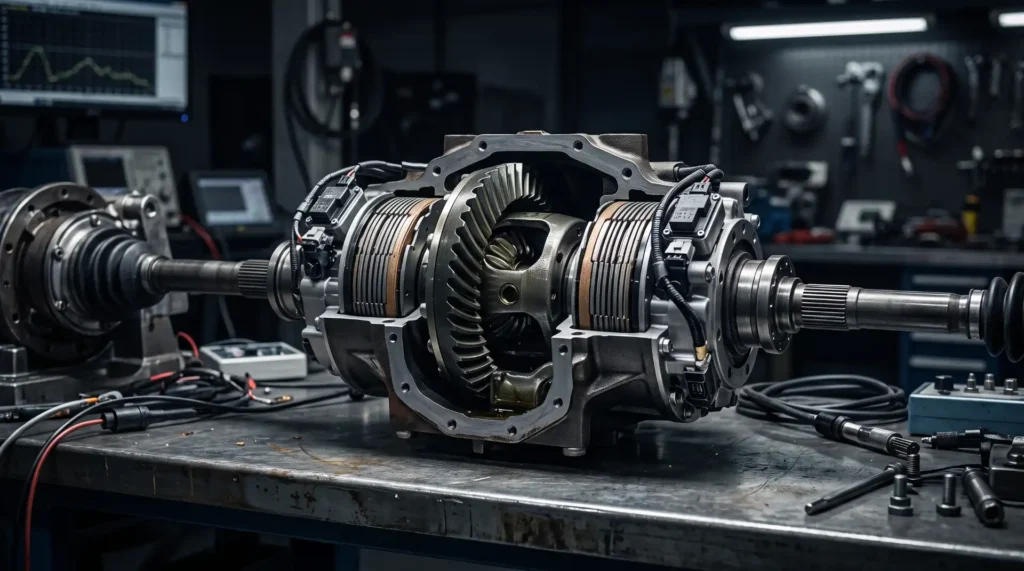
More advanced torque-vectoring systems use electronically controlled clutch packs or active differentials.
These systems can vary the amount of torque transmitted between the left and right sides of an axle. A control unit receives information from vehicle sensors and adjusts clutch engagement according to the desired handling behavior.
During aggressive cornering, the system may send more torque to the outside wheel. During low-traction conditions, it may prioritize traction and stability instead.
The advantage of this approach is that the system can influence the drivetrain directly rather than relying primarily on braking intervention.
SAE International has documented an AWD system using electronically controlled couplings to independently distribute torque between the rear wheels. The research describes how this approach can improve cornering performance while also supporting efficiency. Read the SAE International technical paper on dynamic torque-vectoring AWD systems.
How Torque Vectoring Creates a Yaw Moment
 How Torque Vectoring Creates a Yaw Moment
The term yaw moment can sound complicated, but the basic idea is relatively straightforward.
Yaw is the rotation of the vehicle around its vertical axis. When the driver turns into a corner, the vehicle needs to rotate in the direction of the turn.
If the drivetrain applies different amounts of longitudinal force to the left and right wheels, those forces can create a rotational effect around the vehicle’s center of gravity.
Torque vectoring uses this principle to influence vehicle behavior.
Consider a vehicle making a left-hand turn. The outside wheels are on the right side of the vehicle. If the system increases useful driving force at the outside rear wheel while reducing force at the inside rear wheel, the difference can encourage the vehicle to rotate toward the left.
This is one of the fundamental ways torque vectoring can improve cornering response.
Why Tires Are Still the Foundation
Even the most sophisticated torque-vectoring system cannot overcome the physical limits of the tires.
The tires are the only components that actually contact the road. Every braking, steering, and acceleration force eventually has to pass through those four contact patches.
That means tire selection remains one of the most important decisions for an AWD performance vehicle.
A high-performance tire can provide the grip required to take advantage of an advanced drivetrain. A worn or inappropriate tire reduces the amount of traction available to the torque-vectoring system.
Auto Sport Performance’s guide on 200-treadwear tires for street and track driving provides additional information for enthusiasts comparing tire characteristics, dry grip, track use, durability, and street performance.
For AWD vehicles, tire matching is especially important. Differences in rolling circumference can affect the operation of the AWD system and its differentials. Drivers should follow the vehicle manufacturer’s recommendations regarding tire size, tread depth, replacement practices, and rotation.
Torque Vectoring and Suspension Setup
The drivetrain cannot be considered separately from the suspension.
Suspension determines how consistently the tires remain in contact with the road as the vehicle brakes, accelerates, and corners. Spring rates, damping, anti-roll bars, alignment, ride height, and suspension geometry all influence how much grip is available at each wheel.
When a car corners aggressively, weight transfers toward the outside wheels. The inside tires may become relatively lightly loaded. If the suspension is poorly matched to the vehicle, the inside wheel can lose a significant amount of available traction.
Torque vectoring can help manage this situation, but it cannot replace proper suspension engineering.
For enthusiasts setting up a car for American road courses, Auto Sport Performance’s article on suspension setup, corner weights, springs, and dampers provides useful background on how chassis balance affects handling.
A balanced suspension setup allows torque vectoring to work with the tires instead of constantly fighting poor mechanical balance.
Torque Vectoring and Weight Distribution
Vehicle weight distribution also affects torque-vectoring behavior.
A front-heavy car places greater demands on its front tires during braking and cornering. A more balanced vehicle may have a different natural handling response.
Torque vectoring can compensate for some of these characteristics, but it cannot completely eliminate the influence of vehicle mass and weight distribution.
This is one reason performance engineers consider the entire vehicle when developing an AWD system. Engine placement, transmission position, differential location, battery placement, suspension geometry, and chassis stiffness all contribute to the final driving experience.
Weight also affects braking and acceleration. A heavy vehicle requires more energy to accelerate and more braking force to slow down. It can also generate greater tire loads during cornering.
For enthusiasts, this means torque vectoring should be viewed as one piece of the performance puzzle rather than a magic solution.
Torque Vectoring and Performance Braking
Modern performance cars increasingly combine torque management with sophisticated brake-control systems.
During corner entry, the vehicle may use the brakes to stabilize individual wheels. During acceleration, the AWD system can redistribute torque. During corner exit, stability controls can intervene if the vehicle begins exceeding the desired yaw rate.
All of these systems have to communicate quickly.
Brake-based torque vectoring also makes brake thermal management important. If a vehicle repeatedly uses the brakes to control wheel behavior during aggressive driving, brake temperatures can rise.
That is particularly relevant for drivers who take AWD performance cars to U.S. road courses. A system that works perfectly on a short mountain-road drive may behave differently after repeated laps when brake and tire temperatures are significantly higher.
Performance braking therefore remains an important part of a balanced AWD build.
Torque Vectoring and Thermal Management
Heat is one of the biggest challenges in high-performance driving.
The engine produces heat, the transmission produces heat, the differentials produce heat, the brakes produce heat, and the tires generate heat through deformation and friction.
AWD systems can also create additional thermal demands because more drivetrain components are involved in transmitting power.
This is especially important when a vehicle is modified for higher output.
More horsepower can increase drivetrain loads and temperatures. Repeated acceleration and cornering can also increase the workload on the differentials and transmission.
Auto Sport Performance’s article on performance cooling systems for modified engines under heavy load provides useful background on radiators, oil cooling, intercooling, airflow, and thermal management.
Although the article focuses heavily on engine cooling, the broader lesson applies to AWD performance builds: a vehicle must be capable of managing the heat generated by sustained performance driving.
Torque Vectoring in High-Performance SUVs
Torque vectoring is not limited to low sports cars.
Performance SUVs increasingly use advanced AWD systems to manage the challenges created by greater weight and a higher center of gravity.
An SUV that produces several hundred horsepower needs to control that power during acceleration while maintaining stability through corners.
Torque vectoring can help make these vehicles feel more responsive than their size might suggest.
However, the basic laws of physics still apply. A taller and heavier vehicle will generally have different weight-transfer characteristics than a low sports coupe.
Torque vectoring can improve the vehicle’s response, but it cannot completely transform its fundamental chassis characteristics.
Torque Vectoring in Electric Performance Cars
Electric vehicles have opened another chapter in torque-vectoring technology.
A traditional gasoline-powered AWD vehicle usually relies on one engine, a transmission, differentials, driveshafts, and mechanical connections to distribute power.
An electric performance vehicle can potentially use separate motors for the front and rear axles or even individual motors for different wheels.
This creates new opportunities for extremely precise torque control.
An electric motor can respond very quickly to electronic commands. If software determines that one wheel needs less torque and another can use more, the system can make that adjustment rapidly.
This architecture can allow engineers to control acceleration, traction, yaw, and stability with a level of precision that is difficult to achieve with traditional mechanical systems alone.
As electric performance cars become more common in the United States, torque vectoring will likely become an increasingly important part of how manufacturers differentiate their vehicles.
Torque Vectoring and Drive Modes
Many modern performance vehicles allow the driver to select different driving modes.
Normal or Comfort modes typically prioritize predictable behavior, smoothness, and stability. Sport modes may increase throttle response, modify transmission behavior, change steering characteristics, and adjust torque distribution.
Track or Race modes can be more aggressive.
In some vehicles, the AWD system can send a greater percentage of available torque toward the rear axle in performance modes. An active rear differential may also be programmed to encourage greater rotation during cornering.
The same hardware can therefore produce very different driving experiences depending on software calibration.
This is one of the most important developments in modern performance vehicles. Software increasingly determines how mechanical hardware behaves.
Why Torque Vectoring Does Not Make a Car Invincible
Torque vectoring can improve vehicle performance, but it does not eliminate the laws of physics.
A vehicle can still exceed the available traction of its tires. It can still hydroplane. It can still understeer when driven too quickly into a corner. It can still overheat its brakes, tires, transmission, or drivetrain components during sustained track use.
This is particularly important for U.S. drivers because public roads are unpredictable.
Wet pavement, standing water, debris, potholes, traffic, pedestrians, changing road surfaces, and unexpected driver behavior can all create hazards.
Advanced AWD technology should therefore be considered a tool for improving vehicle control, not a reason to exceed safe road conditions.
What Enthusiasts Should Look for in an AWD Performance Car
When comparing AWD performance cars, enthusiasts should look beyond horsepower and acceleration figures.
It is worth investigating how the AWD system works, whether it uses an active center coupling, electronically controlled differential, brake-based torque vectoring, mechanical limited-slip differential, or independently controlled electric motors.
Drivers should also examine how the system behaves in different driving modes.
A vehicle designed primarily for stability may feel very different from one designed to encourage rear-biased rotation.
Tire specifications also deserve attention. The best drivetrain in the world cannot compensate for inadequate tires.
Suspension calibration, brake capacity, cooling, vehicle weight, and alignment should also be considered when evaluating the overall performance package.
Torque Vectoring for Street Cars vs. Track Cars
A street-driven AWD vehicle does not necessarily need the same torque-vectoring behavior as a dedicated track car.
Street vehicles need to operate smoothly in traffic, on highways, in rain, during cold weather, and across changing road surfaces. Predictability and comfort are important.
A track car can prioritize cornering response and lap-time performance.
Track-oriented software may permit more yaw movement and more aggressive torque distribution. Stability controls may allow the driver greater freedom before intervening.
This difference is important because enthusiasts sometimes assume that the most aggressive setting is automatically the best setting.
That is not necessarily true.
The ideal calibration depends on the driver, tires, road conditions, track layout, and vehicle setup.
The Relationship Between Torque Vectoring and Active Aerodynamics
Modern performance cars are increasingly combining torque vectoring with active aerodynamic systems.
These technologies operate in different areas, but both are designed to manage vehicle behavior dynamically.
Torque vectoring controls propulsion forces at the wheels. Active aerodynamics controls aerodynamic forces acting on the vehicle.
During a high-speed corner, the aerodynamic system can increase downforce while the AWD system manages torque distribution. The result can be a vehicle that is simultaneously using aerodynamic grip and drivetrain control to maintain stability and acceleration.
This trend is part of a larger movement toward integrated vehicle dynamics. Performance cars are becoming systems in which the engine, transmission, AWD hardware, brakes, suspension, steering, aerodynamics, and software all communicate with one another.
The Future of Torque Vectoring
Torque vectoring is likely to become even more sophisticated as vehicles become increasingly electrified and software-controlled.
Traditional mechanical differentials will continue to exist, but electric motors create opportunities for much faster and more precise control.
A future performance vehicle could potentially monitor tire behavior, steering input, road conditions, yaw rate, acceleration, and power demand continuously and adjust individual wheel torque almost instantaneously.
This could allow engineers to create performance characteristics that were difficult to achieve with traditional drivetrains.
Hybrid systems may also combine gasoline engines with electric motors to provide additional torque-control possibilities.
The result is likely to be a new generation of performance cars where acceleration, cornering, braking, aerodynamics, and energy management are controlled as one integrated system.
Why Balanced Performance Still Matters
 Why Balanced Performance Still Matters
Despite all of this technology, the fundamentals of performance remain important.
A torque-vectoring system cannot create grip where the tires have none. A powerful AWD system cannot make worn brakes effective. Sophisticated software cannot compensate completely for poor suspension geometry.
The best performance cars remain balanced.
That means using appropriate tires, maintaining the suspension, keeping the brakes in good condition, managing temperatures, and making sure drivetrain modifications are compatible with the vehicle.
For enthusiasts building an AWD performance car, this balanced approach can produce a faster and more predictable vehicle than simply increasing engine output.
Is Torque Vectoring Worth It?
For performance enthusiasts, torque vectoring can be one of the most valuable technologies available in a modern AWD vehicle.
Its benefits become particularly noticeable when a car has substantial power and is driven aggressively through corners.
On ordinary city streets, the difference may be relatively subtle. On a winding road or closed road course, however, the system can provide sharper turn-in, improved traction, better corner-exit acceleration, and greater confidence when applying power.
The value ultimately depends on the vehicle and how it is used.
A commuter may place greater importance on reliability, comfort, fuel economy, and predictable traction. A weekend performance driver may value cornering response and acceleration. A track enthusiast may prioritize repeatability, thermal control, and precise handling behavior.
Torque vectoring can support all of these objectives when properly calibrated.
Final Thoughts
Torque vectoring represents one of the most important developments in modern AWD performance technology. Instead of simply distributing power between four wheels, an advanced system can actively influence how much driving force each wheel receives according to vehicle speed, steering input, acceleration, traction, and driver intent.
The result can be a vehicle that corners more effectively, reduces unwanted understeer, manages wheelspin, and accelerates more strongly out of turns.
There are several ways to achieve these results. Brake-based systems can use individual wheel braking to influence vehicle behavior. More sophisticated AWD platforms can use electronically controlled clutch packs and active differentials to distribute torque directly. Electric performance cars can take the concept even further by controlling separate motors independently.
However, torque vectoring should never be viewed as a substitute for good vehicle engineering.
The tires still determine the ultimate connection between the vehicle and the road. The suspension controls how those tires interact with the pavement. The brakes must manage speed and heat. The cooling system must maintain reliable temperatures. The chassis must provide a stable foundation, and the driver must operate the vehicle appropriately for the conditions.
That is why the best AWD performance cars are not necessarily the vehicles with the most complicated technology. They are the vehicles in which all of the systems work together effectively.
For U.S. performance enthusiasts, torque vectoring is especially relevant as AWD sports sedans, performance SUVs, hybrids, and electric performance cars continue to become more powerful. As horsepower increases and electric motors provide faster torque response, controlling where that power goes becomes just as important as generating it.
The future of performance will therefore be about more than adding horsepower.
It will be about controlling power with greater precision.
Torque vectoring is an important part of that future because it allows a modern AWD vehicle to use its available traction more intelligently. When combined with the right tires, suspension, brakes, cooling, aerodynamics, and driver inputs, it can turn a powerful car into a much more capable performance machine.
For enthusiasts considering their next AWD performance vehicle or planning a modification project, understanding torque vectoring provides an important advantage. Instead of looking only at horsepower numbers, acceleration times, or drivetrain badges, drivers can evaluate how effectively a vehicle actually puts its power to the ground.
That is ultimately what modern performance engineering is about: not simply making more power, but making better use of the power that is already available.