
Modern performance cars can accelerate from a standstill with a level of consistency that would have been extremely difficult for even an experienced driver to achieve a few decades ago. A major reason is launch control, an electronic performance system designed to coordinate the engine, transmission, traction control, drivetrain, and tires during hard acceleration from rest.
For American performance enthusiasts, launch control has become increasingly common across sports cars, muscle cars, sport sedans, performance SUVs, hybrid vehicles, and high-performance electric cars. The technology is no longer limited to exotic supercars or specialized track machines. Vehicles ranging from high-output American muscle cars to sophisticated AWD performance sedans and electric performance vehicles can use computer-controlled launch strategies to improve acceleration.
Launch control is much more than simply holding the brake while pressing the accelerator. The system is designed to determine how much engine torque or electric-motor output the tires can use without producing excessive wheelspin. It also manages drivetrain components and, depending on the vehicle, can control engine speed, clutch engagement, transmission shifts, torque distribution, suspension settings, and traction intervention.
The result is a carefully managed acceleration event. Instead of asking the driver to coordinate multiple inputs perfectly, the vehicle’s electronic systems perform much of that work in milliseconds.
What Is Launch Control?
Launch control is a factory-engineered electronic system that helps a performance vehicle achieve strong and repeatable acceleration from a standing start. It is generally activated through a specific drive mode or combination of controls, although the procedure varies considerably between manufacturers and individual models.
The basic objective is straightforward: produce maximum usable acceleration without wasting too much engine or motor power through wheelspin.
That sounds simple, but launching a powerful vehicle is a complex traction problem. A performance engine can produce more torque than the tires can immediately transfer to the pavement. If the driver applies too much throttle too quickly, the tires can spin. If the driver applies too little throttle, the vehicle may not use all of its available power.
Launch control attempts to find the balance between those two extremes.
The system can raise or hold the engine at a predetermined launch speed, manage clutch engagement, control transmission behavior, monitor wheel speeds, and adjust torque delivery as the car begins moving. On AWD vehicles, it can also help distribute available power between the axles.
Modern systems are increasingly sophisticated because vehicle manufacturers have access to enormous amounts of real-time data. Wheel-speed sensors, throttle-position sensors, engine-speed sensors, transmission information, accelerator position, brake pressure, steering angle, and stability-control data can all contribute to the vehicle’s launch strategy.
 Why Launching a Performance Car Is Difficult
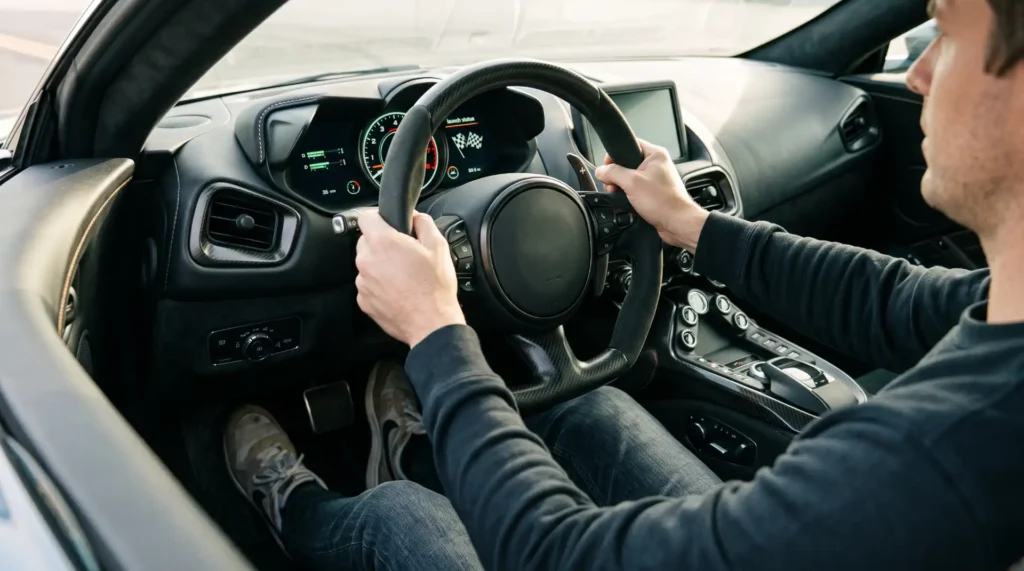 Why Launching a Performance Car Is Difficult
A standing start places unusual demands on a vehicle. At zero mph, the tires have to transition from being stationary to transmitting enormous amounts of force to the road. During that process, weight transfers toward the rear of the vehicle as the car accelerates.
This weight transfer can increase the load on the driven tires, which can be helpful for traction. However, the amount of available grip is still limited by the tire compound, road surface, tire temperature, suspension setup, drivetrain layout, and environmental conditions.
Rear-wheel-drive cars can be particularly sensitive to throttle application because a powerful engine may overwhelm the rear tires before the vehicle has built enough forward momentum. Front-wheel-drive cars face their own challenges because acceleration transfers weight away from the front axle, reducing the load available to the driven wheels.
AWD vehicles have a major traction advantage because torque can be delivered through four tires instead of two. However, AWD does not eliminate traction limitations. The tires still have a finite amount of grip, and the drivetrain has to distribute torque effectively.
This is where launch control becomes valuable. Instead of relying entirely on the driver’s ability to balance throttle and traction, the vehicle can monitor the launch and make adjustments while the car is accelerating.
How Launch Control Works
Although every manufacturer uses its own software and hardware strategy, most launch-control systems follow the same basic concept.
The driver first selects an appropriate performance mode. Depending on the vehicle, this may involve selecting Sport, Sport Plus, Track, Race, Drag, or another performance-oriented setting. The vehicle may then require the driver to apply the brake and accelerator simultaneously while stationary.
The computer recognizes the launch-control conditions and prepares the powertrain for maximum acceleration. In a gasoline-powered vehicle, the engine may be brought to a predetermined rpm. The transmission may select an appropriate gear and prepare its clutch packs or torque converter for rapid power delivery.
Once the driver releases the brake, the system begins the launch. Engine torque is delivered according to the programmed strategy while wheel-speed sensors continuously monitor traction.
If the tires begin to spin excessively, the computer can reduce torque or modify power delivery. If the tires maintain traction, the system can allow additional torque to reach the pavement.
The exact strategy varies significantly from one vehicle to another. Some systems allow a small amount of controlled wheelspin because completely eliminating wheelspin is not necessarily the fastest approach. Others prioritize maximum traction with extremely precise torque management.
The objective is not simply to prevent wheelspin. The objective is to achieve the quickest acceleration possible.
The Relationship Between Launch Control and Traction
Traction is at the heart of launch control.
Horsepower figures can attract attention, but horsepower alone does not determine how quickly a vehicle accelerates from rest. A 700-horsepower car with inadequate traction can lose to a less powerful car that can efficiently transfer its power to the pavement.
This is why tires are so important in performance builds. Your existing guide to AWD performance upgrades emphasizes that tires should be considered before simply adding more power. A similar principle applies to launch performance: the engine can only be as effective as the tires and drivetrain allow.
Launch control therefore operates at the intersection of power and grip. It attempts to deliver as much usable torque as possible without exceeding the available traction envelope.
Road conditions can make this especially complicated. A clean, dry, prepared drag strip provides dramatically different traction from a cold public road, dusty pavement, wet asphalt, or a surface contaminated by sand or debris.
This is also why factory acceleration figures should not be interpreted as guarantees for every situation. Published performance numbers are normally achieved under controlled testing conditions using specific tires, temperatures, surfaces, vehicle configurations, and procedures.
Why Tires Matter So Much
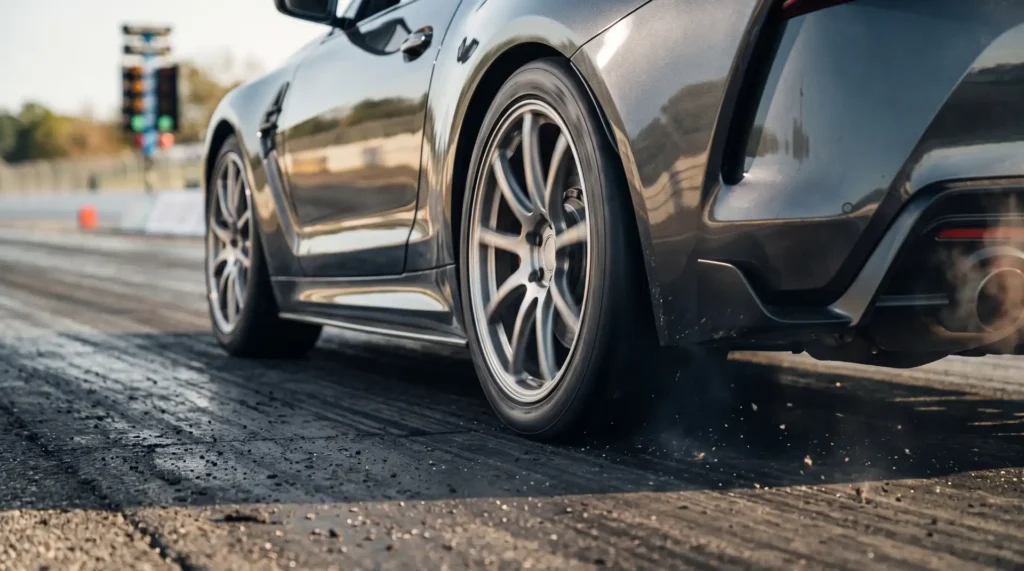 Why Tires Matter So Much
Performance tires are one of the most important components in a successful launch. The tire is the final connection between the vehicle and the road, meaning every pound-foot of torque ultimately has to pass through that contact patch.
A powerful engine cannot overcome an unsuitable tire indefinitely.
Tire compound, temperature, construction, width, pressure, and condition all influence traction. A summer performance tire at the appropriate operating temperature can behave very differently from an all-season tire on a cold morning.
This is particularly important for American enthusiasts who use their cars on both public roads and track days. A tire optimized for comfortable highway driving may not provide the same launch performance as a dedicated performance tire.
Wheel selection also matters. Auto Sport Performance’s guide to wheel size and unsprung weight explains how wheel and tire mass can influence acceleration, suspension response, braking, and handling. For a launch-focused performance build, the wheel-and-tire combination should be evaluated as part of the entire vehicle rather than simply as an appearance upgrade.
Launch Control and Automatic Transmissions
Launch control is particularly effective when paired with modern automatic transmissions because the transmission can execute shifts far faster and more consistently than a human driver.
Traditional automatic transmissions use torque converters, while modern performance vehicles may use sophisticated multi-speed automatic transmissions with electronically controlled clutch packs. Dual-clutch transmissions use two clutches to prepare different gears and can perform extremely rapid gear changes.
During a launch, the transmission has to balance rapid acceleration with drivetrain protection. The first gear must provide enough mechanical advantage to accelerate the vehicle, but the available torque cannot exceed what the tires can use.
Once the vehicle is moving, the transmission must determine the best moment to shift. A shift that occurs too early can reduce acceleration. A shift that occurs too late can push the engine beyond its most effective operating range.
Launch control coordinates these decisions with engine management and traction control. This is one reason modern performance cars can produce extremely consistent acceleration numbers.
Car and Driver has documented how launch control transformed the performance potential of vehicles equipped with modern transmissions. The technology has helped make sub-three-second 0–60-mph acceleration accessible in production vehicles that would have been extraordinarily difficult to launch consistently using only human inputs.
Launch Control and Manual Transmissions
Manual-transmission cars present a different challenge.
A skilled driver can manage clutch engagement, engine speed, and throttle position manually, but achieving the same launch repeatedly requires considerable experience. The clutch must be released quickly enough to avoid excessive bogging while avoiding excessive wheelspin or clutch slip.
Some manual performance vehicles offer electronic assistance, but launch control is much more commonly associated with automatic, dual-clutch, and electronically controlled transmissions.
That does not make manual cars slower in every situation. A skilled driver can produce impressive launches, and many enthusiasts prefer the involvement of manually controlling the vehicle. However, electronic launch systems provide a major advantage in repeatability.
For drag racing or controlled acceleration testing, repeatability is extremely important. The difference between a good launch and a poor launch can represent several tenths of a second, particularly in the first portion of an acceleration run.
AWD Gives Launch Control Another Advantage
All-wheel drive can dramatically change the launch equation.
Instead of sending engine torque through only the front or rear tires, an AWD system can distribute torque between all four wheels. This gives the vehicle more opportunities to convert power into forward motion.
Modern AWD performance systems are also much more sophisticated than traditional mechanical four-wheel-drive systems. Electronic controls can vary torque distribution depending on wheel speed, throttle position, steering angle, acceleration, and available traction.
This makes AWD particularly useful for high-performance launches.
However, AWD is not a substitute for good tires or good vehicle setup. More driven wheels do not automatically mean unlimited grip. The road still determines how much force the tires can transmit.
Your existing article on Best Performance Upgrades for AWD Cars and Modern Sport Sedans provides useful context here because it explains why tires, suspension, brakes, cooling, and powertrain modifications should be considered together rather than treating horsepower as the only performance metric.
How Launch Control Uses Engine Torque
Engine torque management is another critical component.
Modern engines can generate enormous torque, particularly turbocharged engines that produce strong output at relatively low rpm. If all of that torque were delivered immediately at the instant the driver released the brake, the tires could easily lose traction.
Launch control can therefore manage torque as the vehicle begins moving.
The system may temporarily limit engine output before allowing torque to increase as the vehicle gains speed and traction improves. This can feel slightly less dramatic than simply dumping maximum power onto the tires, but it can produce a faster result.
This illustrates an important principle in performance engineering: maximum power is not always the same thing as maximum acceleration.
The fastest launch is the one that converts the greatest possible amount of available power into forward motion.
Launch Control in Hybrid Performance Cars
Hybrid performance vehicles have added another dimension to launch technology.
Electric motors can produce torque extremely quickly, which makes them exceptionally useful during acceleration from rest. A hybrid performance car can combine an internal-combustion engine with one or more electric motors to provide a highly controlled torque delivery strategy.
Electric motors can also provide torque independently at different axles in some advanced architectures. This can give engineers additional control over traction and acceleration.
The Chevrolet Corvette E-Ray demonstrates how hybridization and AWD can change the launch equation. In testing by Car and Driver, the E-Ray achieved a 2.5-second 0–60-mph time with optimized launch control and 2.9 seconds without launch control.
The difference illustrates why launch software can be just as important as raw power. The vehicle’s electric front axle, gasoline engine, AWD system, traction management, and launch strategy work together to produce the final result.
Launch Control in Electric Performance Cars
Electric vehicles have pushed launch performance even further.
Because electric motors can produce strong torque almost immediately, EVs do not need to build engine rpm before generating substantial acceleration. However, that does not mean launch control is unnecessary.
Electric performance vehicles still have to manage tire traction, battery temperature, motor temperature, inverter limits, drivetrain protection, and power delivery.
Software therefore plays an enormous role in EV acceleration.
Car and Driver testing of high-performance electric vehicles has demonstrated how software changes can influence acceleration performance. In one Tesla Model S Performance test, software changes altered the vehicle’s launch behavior and allowed the car to achieve quicker and more consistent acceleration.
Modern EV launch systems can coordinate battery output, motor torque, traction control, thermal management, and suspension behavior. This is another example of how performance engineering is moving beyond traditional engine modifications.
Launch Control and Suspension Setup
Suspension behavior can influence how effectively a performance car launches.
During hard acceleration, weight transfers toward the rear. A well-designed suspension system allows the tires to maintain useful contact with the pavement while controlling excessive body movement.
If the suspension is too soft, excessive movement can compromise consistency. If it is too stiff, the tires may struggle to follow imperfections in the road surface.
This is why suspension tuning must consider the environment in which the car is driven. Your guide to suspension setup, corner weights, springs, and dampers explains how suspension balance affects tire contact, weight transfer, and overall performance on U.S. tracks.
For a street-driven performance car, the ideal setup may be very different from that of a dedicated drag car. American roads can contain potholes, expansion joints, uneven pavement, and changing surfaces. A suspension setup that works on a smooth drag strip may not be appropriate for everyday driving.
Why Weight Still Matters
Launch control cannot eliminate the effects of vehicle mass.
A heavier vehicle requires more force to achieve the same acceleration as a lighter vehicle, assuming all other factors are equal. Modern performance vehicles have become heavier because of safety equipment, larger brakes, technology, luxury features, battery systems, and more complex drivetrains.
This is one reason weight reduction remains important for performance enthusiasts.
Auto Sport Performance’s article on why weight reduction matters in modern performance builds explains how reducing mass can improve acceleration, braking, handling, and tire performance.
Weight reduction should not be viewed as simply removing interior components. Effective performance engineering means considering where weight is located and how it affects the vehicle’s overall balance.
A lighter wheel and tire package, for example, can influence both acceleration and suspension response. Reducing unnecessary mass from the body can improve the vehicle’s power-to-weight ratio. Reducing mass from other components can lower demands on brakes, tires, and suspension.
Launch control can optimize the power that reaches the road, but a well-balanced vehicle gives the system a better platform from which to work.
Why 0–60 MPH Is Not the Whole Story
Zero-to-60-mph acceleration is one of the most popular performance measurements in the United States, but it does not tell the entire story.
Two vehicles can have similar 0–60-mph times while behaving very differently at higher speeds. One might have a stronger midrange, while another may accelerate more aggressively after the first gear change.
Quarter-mile performance can provide another perspective because it evaluates acceleration over a longer distance. Trap speed can also indicate how much power a vehicle is producing once traction becomes less dominant.
Rolling acceleration tests are useful as well because they reduce the influence of launch technique. A vehicle with an impressive launch may not necessarily be the quickest from 40 to 80 mph.
For enthusiasts building cars for real-world U.S. roads and track days, acceleration should therefore be considered alongside braking, cornering, thermal management, suspension behavior, and tire performance.
Why Launch Control Does Not Always Produce the Fastest Run
It may seem strange that a feature specifically designed for maximum acceleration does not always produce the quickest result, but real-world conditions can make that possible.
Tire temperature, pavement conditions, drivetrain temperature, battery state of charge, vehicle temperature, and repeated use can all influence performance.
Some launch systems also adapt their behavior after repeated launches to protect mechanical components or manage heat. This is particularly important because launching a high-output vehicle places significant stress on the clutch, transmission, axles, differentials, tires, and other drivetrain components.
Car and Driver’s testing of high-performance vehicles has repeatedly demonstrated that acceleration consistency can change when vehicles are subjected to repeated hard runs. Electric vehicles can be especially sensitive to thermal conditions because battery and motor output can change as temperatures rise.
Does Launch Control Wear Out a Car?
Launch control is a performance feature, but it is not mechanically free.
A hard launch places substantial stress on the drivetrain. Depending on the vehicle, the system may subject the clutch, transmission, driveshafts, axles, differentials, engine mounts, tires, and other components to very high loads.
Repeated launches can also increase heat.
This does not mean launch control is inherently harmful when used as the manufacturer intended. Modern performance vehicles are engineered with these systems in mind. However, routine repeated launches can accelerate wear compared with normal driving.
Porsche, for example, describes launch control as a feature intended for controlled performance environments and notes that repeated use can add mechanical stress to the drivetrain.
Owners should therefore follow the specific instructions in their vehicle’s owner’s manual. The correct procedure, allowable conditions, cooldown requirements, and limitations can vary significantly between models.
Where Launch Control Should Be Used
Launch control is designed for controlled performance situations rather than ordinary public-road driving.
A prepared drag strip, closed course, private test facility, or sanctioned motorsports environment provides the appropriate conditions for evaluating a vehicle’s launch performance.
Using launch control on public roads creates unnecessary safety risks. The rapid acceleration of a modern performance vehicle can quickly exceed normal traffic conditions and leave very little room for correcting an unexpected problem.
For American enthusiasts who want to experience launch control properly, a sanctioned drag-racing event or closed-course performance facility provides a much safer environment.
Launch Control and the Future of Performance Cars
Launch control represents a broader transformation in automotive performance.
For much of automotive history, acceleration depended heavily on the driver’s ability to coordinate throttle, clutch, gear selection, and traction. Modern vehicles increasingly perform those calculations electronically.
Today’s performance cars can monitor dozens of vehicle parameters while accelerating. The engine, transmission, AWD system, stability control, suspension, brakes, battery, and electric motors can communicate with one another through sophisticated control systems.
This trend will become even more important as hybrid and electric performance vehicles become more sophisticated.
Modern performance engineering is increasingly about controlling energy rather than simply producing more of it.
A high-output powertrain is only useful when the vehicle can effectively transfer that energy into motion. Tires, suspension, aerodynamics, drivetrain control, thermal management, and software all contribute to that process.
Launch control is one of the clearest examples of this philosophy.
How Enthusiasts Can Improve Launch Performance
For owners interested in improving acceleration, the first step should not necessarily be adding horsepower.
A balanced approach is usually more effective. Start with healthy tires, proper tire pressures, good alignment, reliable brakes, appropriate suspension components, and a properly maintained drivetrain. Once the vehicle has a strong mechanical foundation, power upgrades can be considered.
Cooling is also important for performance vehicles that are repeatedly driven hard. Your existing guide to performance cooling systems explains why maintaining appropriate temperatures becomes increasingly important as engine output and workload increase.
For AWD vehicles, tire matching is particularly important because the drivetrain depends on consistent rolling characteristics across all four corners. Performance modifications should also take the manufacturer’s drivetrain limitations into account.
Finally, owners should understand the launch-control procedure for their particular vehicle rather than assuming that every system works the same way. Some systems require specific temperatures or drive modes. Others may have limitations on repeated use.
The Difference Between Launch Control and Traction Control
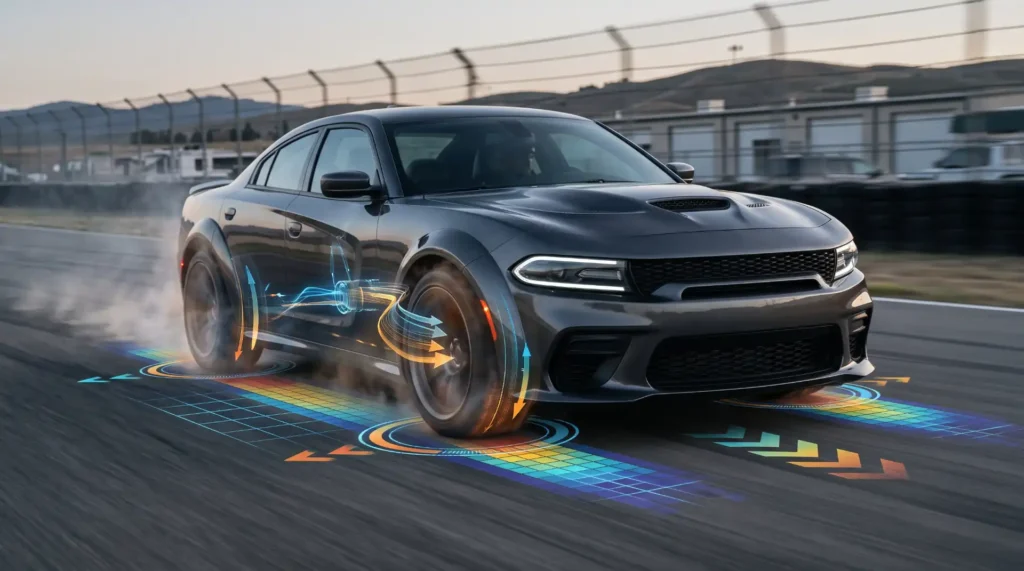 The Difference Between Launch Control and Traction Control
Launch control and traction control are related but serve different purposes.
Traction control generally monitors wheelspin and intervenes when it detects a loss of traction. Its primary purpose is to help maintain vehicle control during acceleration.
Launch control is more specialized. It prepares the vehicle specifically for maximum acceleration from a standstill and coordinates multiple systems to achieve that objective.
A launch-control system may use traction-control information, but it is not simply a more aggressive version of ordinary traction control.
Modern performance vehicles can use both systems simultaneously. The result is a carefully managed acceleration event in which the vehicle attempts to maximize forward force while maintaining sufficient stability.
Launch Control Is About More Than Horsepower
The popularity of launch control illustrates one of the most important lessons in modern automotive performance: speed is created by the entire vehicle, not by a single specification.
Horsepower matters, but so do tires. Tires matter, but so does suspension. Suspension matters, but so does weight. The transmission must deliver the available power effectively, while the drivetrain must survive the loads created by acceleration.
Software ties many of these systems together.
This is why modern performance cars can sometimes produce acceleration numbers that seem extraordinary when compared with older vehicles that had similar power outputs. The modern car is not simply producing power. It is controlling that power with remarkable precision.
Final Thoughts
Launch control has changed the way modern performance cars accelerate from a standstill. By coordinating engine or electric-motor output, transmission behavior, traction control, drivetrain systems, and sometimes suspension and AWD torque distribution, launch control helps convert available power into usable acceleration.
The technology is particularly valuable because it provides consistency. An experienced driver can perform an impressive launch, but reproducing that launch perfectly over and over is difficult. Electronic control systems can monitor vehicle conditions continuously and make adjustments within fractions of a second.
For U.S. performance enthusiasts, launch control is another example of how modern vehicles are becoming sophisticated electronic performance machines. American muscle cars, sports cars, sport sedans, performance SUVs, hybrids, and EVs are all benefiting from increasingly advanced torque-management strategies.
However, launch control should not be viewed as a substitute for a properly engineered vehicle. Tires, suspension, wheel selection, drivetrain condition, cooling, weight, and alignment still determine how effectively a car can use its available power.
The fastest performance car is rarely the one with the biggest horsepower number alone. It is the vehicle that can efficiently turn its available power into acceleration while maintaining traction, controlling heat, and protecting its mechanical components.
That is ultimately what launch control does. It brings together many of the vehicle’s most important performance systems and coordinates them for one demanding task: moving the car from a complete stop to high speed as efficiently and consistently as possible.
As performance vehicles continue to adopt hybrid powertrains, electric motors, advanced AWD systems, sophisticated transmissions, and software-controlled chassis systems, launch control will likely become even more intelligent. The future of acceleration is not simply about making more power. It is about controlling every bit of that power more effectively.