
Pickup trucks have become some of the most versatile performance platforms in the American automotive market. Modern trucks combine turbocharged engines, advanced transmissions, sophisticated four-wheel-drive systems, electronic suspension technology, and powerful onboard computers with the towing and hauling capability drivers expect.
That combination has created enormous opportunities for enthusiasts. A pickup can be modified into a quicker street truck, a stronger tow vehicle, a capable off-road machine, or a balanced daily driver without turning it into an impractical project.
The truck aftermarket is particularly important in 2026. According to the Specialty Equipment Market Association, pickup-related accessories and performance products represented about 30 percent of total specialty-equipment sales during 2025. American consumers spent more than $15 billion modifying pickups for performance, recreation, utility, and lifestyle applications.
However, adding parts without a clear plan does not necessarily create a better-performing truck. Power, cooling, transmission behavior, suspension geometry, tire weight, braking capacity, towing demands, and electronic systems all interact.
The most effective performance upgrades for pickup trucks in 2026 are therefore those that improve the entire vehicle rather than chasing one impressive horsepower number.
Decide What Type of Performance Truck You Want
Before purchasing parts, decide what performance means for your pickup.
A driver building a street-focused Ford F-150, Chevrolet Silverado, Ram 1500, Toyota Tundra, GMC Sierra, Ford Ranger, Toyota Tacoma, Chevrolet Colorado, or Nissan Frontier may prioritize acceleration, throttle response, handling, and exhaust sound.
Someone pulling a travel trailer might care more about low-rpm torque, transmission temperatures, braking consistency, and stability.
An off-road enthusiast may prioritize suspension travel, ground clearance, traction, underbody protection, and tire durability.
Those goals can conflict.
A massive wheel and tire package might look ideal on an off-road build but add rotational mass to a street truck. An aggressive engine tune may create impressive peak output but place additional stress on a truck that regularly operates near its towing limits.
Think about the truck as a complete system.
Auto Sport Performance’s existing guide to performance upgrades for trucks and SUVs provides a broader overview of these modification categories. This guide focuses more closely on pickup-specific trends and considerations for 2026.
ECU Tuning Remains One of the Biggest Performance Changes
Modern pickups rely heavily on software.
The engine control module can manage boost pressure, ignition timing, throttle behavior, fuel delivery, torque limits, cooling strategies, and other parameters. The transmission controller may also adjust shift timing, gear selection, torque management, and converter behavior.
As a result, calibration changes can dramatically influence the personality of a modern truck.
Turbocharged engines are especially responsive to software optimization because their factory control systems regulate boost and torque electronically.
A properly developed calibration may improve throttle response, midrange torque, shifting behavior, and overall drivability.
However, more aggressive does not automatically mean better.
A pickup that regularly tows in hot weather needs a different calibration strategy than a lightweight street truck used primarily for weekend driving. Higher cylinder pressure, additional boost, and increased torque can create more heat and place greater loads on transmissions, axles, differentials, and cooling systems.
Modern performance tuning should therefore account for the vehicle’s actual workload.
Software has also become more complicated because manufacturers increasingly update vehicle control modules electronically. Auto Sport Performance covers this emerging issue in its article on over-the-air software updates and tuned cars.
An update from an automaker could potentially change calibration behavior or overwrite certain aftermarket modifications, depending on the vehicle and tuning platform.
Transmission Tuning Can Transform a Modern Pickup
An engine upgrade receives most of the attention, but transmission behavior often determines whether additional power actually feels useful.
Many newer pickups use eight-speed or ten-speed automatic transmissions. Their control software constantly decides when to shift, how much torque the drivetrain should receive, and which gear is appropriate.
A carefully matched transmission calibration may change shift points, reduce unwanted gear hunting, alter converter behavior, or improve response during acceleration.
This can be especially valuable for trucks that have received engine tuning or larger tires.
Increasing tire diameter effectively changes overall gearing. The truck may feel slower to accelerate, and the transmission may select gears differently than it did with the factory tire diameter.
For heavily modified trucks, proper calibration can help the drivetrain work more naturally with those changes.
Transmission temperatures should also remain part of the conversation, particularly on vehicles used for towing or heavy hauling.
Power that cannot be managed reliably by the transmission is not particularly useful.
Turbocharged Pickup Engines Are Changing the Modification Market
The American pickup market is no longer dominated exclusively by naturally aspirated V8 engines.
Turbocharged four-cylinder, V6, and inline-six engines now appear across compact, midsize, and full-size trucks. Hybrid-assisted turbocharged powertrains have also become more common.
This shift changes the modification path.
Traditional naturally aspirated builds often relied on intake, exhaust, camshaft, cylinder-head, displacement, and forced-induction upgrades.
Factory turbo engines already contain the hardware needed to generate boost. That makes tuning, intercooling, airflow, fuel quality, and thermal management increasingly important.
Turbocharged engines can produce substantial torque at relatively low engine speeds, which suits pickup trucks particularly well.
Additional power also creates additional heat.
Drivers considering higher boost levels should look at the complete system, including intercooler efficiency, coolant temperature, oil temperature, transmission temperature, fuel delivery, and intake-air temperature.
Upgraded Intercoolers Can Improve Consistency
A turbocharger compresses incoming air, and compression increases temperature.
An intercooler reduces that temperature before the air enters the engine.
During repeated acceleration, towing on a grade, off-road driving, or operation in hot climates, intake temperatures can rise considerably. Once temperatures increase, the engine management system may reduce ignition timing or boost to protect components.
A larger or more efficient intercooler can help manage those temperatures on some turbocharged trucks.
The primary advantage may not always be a dramatic peak horsepower gain.
Consistency matters.
A truck that performs strongly during one acceleration run but loses performance as temperatures climb is less useful than one capable of delivering repeatable output.
This becomes particularly relevant for heavily loaded pickups operating during hot U.S. summers.
Cooling Upgrades Matter More as Power Increases
Cooling should be treated as a performance modification rather than merely a maintenance concern.
Engines, transmissions, differentials, turbochargers, and lubricants all operate within temperature ranges.
Higher output, towing, large tires, off-road driving, and sustained highway loads can increase thermal stress.
Depending on the truck, useful upgrades may include a larger radiator, improved intercooler, transmission cooler, engine oil cooler, upgraded cooling fans, improved ducting, or higher-capacity cooling components.
Drivers interested in the topic can also read Auto Sport Performance’s guide to coolant and thermal upgrades.
Cooling capacity may not be visually exciting, but it can determine whether a modified truck performs consistently during demanding conditions.
Intake Systems Can Support Other Modifications
Cold-air intakes remain among the most common pickup modifications.
Modern factory intake systems are generally far more efficient than the restrictive designs found on some older vehicles. As a result, installing an aftermarket intake does not automatically produce a major horsepower increase.
Its value depends on the engine and the rest of the build.
A good system may reduce restriction, improve airflow characteristics, increase induction sound, or support higher airflow requirements after tuning.
Turbocharged trucks may respond differently than naturally aspirated trucks because the intake system sits upstream of the compressor.
Filter quality should also receive attention.
A pickup frequently driven through deserts, farms, construction sites, gravel roads, or dusty trails requires effective filtration. Maximum airflow is not useful if the filter allows excessive contamination into the engine.
Exhaust Upgrades Still Have a Place in 2026
Exhaust systems remain popular because they can change both sound and appearance while potentially reducing restriction.
Cat-back systems are particularly common because they replace components behind emissions-control hardware.
The ideal exhaust depends heavily on the truck.
An aggressive system may sound impressive during acceleration but become unpleasant during long interstate drives because of cabin drone.
This matters even more in pickups frequently used for towing, where the engine may remain under sustained load for extended periods.
Pipe diameter, muffler design, resonators, engine configuration, cab length, and exhaust outlet location can all influence the final result.
Owners should also distinguish between ordinary performance exhaust modifications and changes involving federally required emissions equipment.
The U.S. Environmental Protection Agency states that the Clean Air Act prohibits tampering with or defeating emissions controls on EPA-certified vehicles.
Before modifying emissions-related components, owners should research federal requirements as well as the laws in their state.
Suspension Upgrades Can Make a Truck Faster Without Adding Horsepower
Pickup performance is not only about engine output.
A truck that controls its weight effectively under braking, acceleration, and cornering can feel dramatically more capable even with factory horsepower.
Upgraded dampers are one of the most useful starting points.
Better shock control can reduce excessive bouncing and improve stability over uneven pavement. Street-focused trucks may benefit from performance dampers, springs, sway bars, or carefully designed lowering systems.
Off-road trucks require a different approach.
Longer-travel dampers, stronger control arms, appropriate springs, and suspension components designed around increased ride height may provide more useful capability.
Lift height alone does not define off-road performance.
Suspension travel, damping quality, tire contact, alignment geometry, ground clearance, and drivetrain angles matter just as much.
Extremely tall lifts can alter steering geometry and driveshaft angles, while excessively stiff suspension can reduce traction on rough surfaces.
A balanced suspension should match the truck’s real use.
 Wheel and Tire Choices Have a Major Effect on Performance
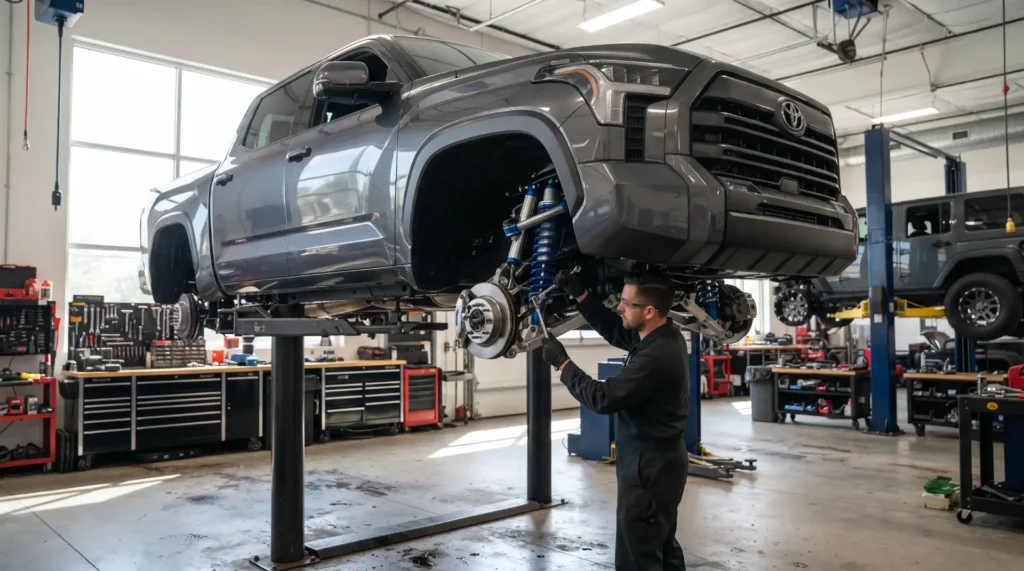 Wheel and Tire Choices Have a Major Effect on Performance
Few modifications change a pickup’s behavior as dramatically as tires.
The tire influences acceleration, braking, steering, ride quality, traction, road noise, and off-road capability.
Street trucks benefit from performance-oriented tires designed for pavement grip. Off-road trucks may require all-terrain or mud-terrain patterns capable of handling loose surfaces.
Towing trucks need tires with appropriate load ratings.
Size also matters.
Large wheels and oversized tires are common in the truck market, but extra size can add substantial rotational and unsprung mass.
That additional weight must be accelerated, stopped, and controlled by the suspension.
Auto Sport Performance examines this relationship in detail in How Wheel Size and Unsprung Weight Affect Real World Performance.
A larger wheel is not automatically worse because construction matters. A high-quality forged wheel can sometimes weigh less than a smaller, inexpensive cast wheel.
The complete wheel-and-tire assembly matters more than diameter alone.
Increasing overall tire diameter also changes effective gearing.
The truck travels farther with each wheel revolution, which can make acceleration feel softer. Calibration changes or differential gearing may become useful on builds using significantly oversized tires.
Brake Upgrades Should Follow Power and Tire Changes
A quick pickup should also be able to manage repeated braking.
Truck weight makes brake performance particularly important.
The brake system must convert vehicle motion into heat, and heavier vehicles generate significant thermal energy during repeated stops.
Towing adds even more demand.
Performance-oriented pads may improve heat tolerance. Higher-quality brake fluid can support consistency under demanding conditions. Larger rotors and calipers may increase thermal capacity on builds that genuinely require them.
However, braking is a system.
Installing enormous brakes while using low-grip tires does not automatically shorten stopping distances dramatically because the tires ultimately transfer braking force to the road.
Tires, pads, rotors, fluid, cooling, and brake balance all contribute.
Differential Gearing Can Restore Performance With Larger Tires
Gear ratios are often overlooked during pickup builds.
Owners may add considerably larger tires and then wonder why acceleration feels weaker.
The reason is mechanical leverage.
A taller tire effectively makes the final drive ratio taller. The engine and transmission must work harder to generate the same force at the road.
Changing differential gears can restore some of that leverage.
This is particularly relevant for lifted off-road pickups running tires several inches larger than stock.
Correct gearing can improve drivability, low-speed control, towing behavior, and acceleration.
The appropriate ratio depends on tire diameter, transmission gearing, engine characteristics, highway use, towing requirements, and desired cruising rpm.
Towing Performance Requires a Different Modification Strategy
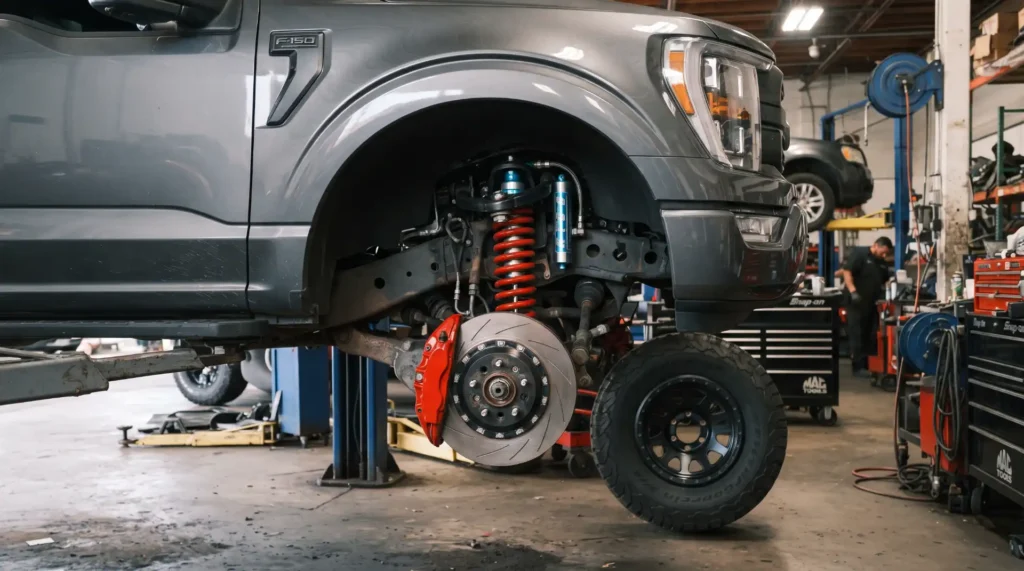 Towing Performance Requires a Different Modification Strategy
A high-output street truck and a strong tow truck are not necessarily built the same way.
Towing places sustained loads on the powertrain.
Rather than briefly accelerating at full throttle, a tow vehicle may climb a long grade while carrying thousands of pounds for several minutes.
That creates heat.
Useful towing-oriented performance upgrades often emphasize cooling capacity, stable transmission behavior, braking consistency, tire load capability, and predictable torque delivery.
Suspension components may help manage additional rear load, but owners should understand that aftermarket suspension equipment does not automatically increase the manufacturer’s rated payload or towing limits.
Those ratings depend on vehicle engineering, chassis configuration, brakes, axles, cooling, certification, and other factors.
A performance modification should therefore improve operation within the appropriate limits rather than being treated as permission to exceed them.
Street Trucks Are Returning to the Spotlight
Off-road builds have dominated pickup customization for years, but street-performance trucks are gaining renewed attention.
Modern compact and midsize pickups have helped expand the category.
Lowered suspension, lightweight wheels, performance tires, responsive turbocharged engines, upgraded intercoolers, software tuning, and improved brakes can create a truck that combines practical cargo space with sports-car-inspired handling characteristics.
The trend also reflects the flexibility of modern electronic powertrains.
A relatively small turbocharged pickup can respond significantly to carefully integrated software and hardware changes without requiring the enormous displacement once associated with performance trucks.
This does not mean the traditional V8 truck is disappearing. Instead, enthusiasts now have more types of performance platforms to choose from.
Off-Road Performance Is About Control Rather Than Maximum Power
Horsepower attracts attention, but off-road performance depends heavily on control.
A truck must maintain traction while its suspension moves across uneven surfaces.
Differential behavior, tire construction, gearing, ground clearance, shock damping, approach angle, and underbody protection may matter more than peak engine output.
Extremely high horsepower can even make traction more difficult on loose terrain.
For trail-focused pickups, a moderate power increase combined with properly selected suspension, tires, gearing, cooling, and protection may create a far more useful build than an engine-first approach.
Recovery points, skid plates, differential protection, and reliable cooling systems also deserve consideration when a vehicle travels far from paved roads.
Do Not Ignore Alignment After Suspension Changes
Suspension modifications change geometry.
Lift kits, lowering springs, control arms, wheels, and tire changes can alter camber, caster, toe, scrub radius, and steering behavior.
An alignment should therefore be part of the modification process rather than an afterthought.
Incorrect geometry may create uneven tire wear, unstable highway behavior, poor steering response, or reduced traction.
This becomes particularly expensive on pickups running large premium tires.
The more extensive the suspension change, the more important it becomes to verify that geometry remains appropriate.
Modern Driver Assistance Systems Add Another Layer
New pickups increasingly rely on cameras, radar sensors, steering sensors, wheel-speed sensors, and stability-control programming.
Suspension and tire modifications can interact with these systems.
Changing ride height may alter sensor angles. Different tire diameters can affect wheel-speed calculations. Alignment changes can influence steering-angle calibration.
Some modifications may require recalibration of advanced driver-assistance equipment.
That does not mean modern trucks cannot be modified.
It means the installation process now extends beyond nuts, bolts, springs, and engine parts.
Electronics have become part of chassis tuning.
Reliability Should Be Considered a Performance Upgrade
The fastest truck in the parking lot is not particularly impressive if it constantly overheats, breaks drivetrain components, or goes into reduced-power mode.
Reliability matters.
A sensible build considers spark plugs, fluids, belts, cooling components, filters, drivetrain condition, battery health, sensors, and maintenance intervals alongside performance parts.
Before adding significant power to an older pickup, inspect the existing vehicle.
A tune cannot repair worn ignition components. A larger turbo cannot correct a weak transmission. Larger tires cannot compensate for damaged suspension bushings.
Establishing a healthy baseline allows performance parts to work as intended.
Emissions Compliance Matters for U.S. Performance Builds
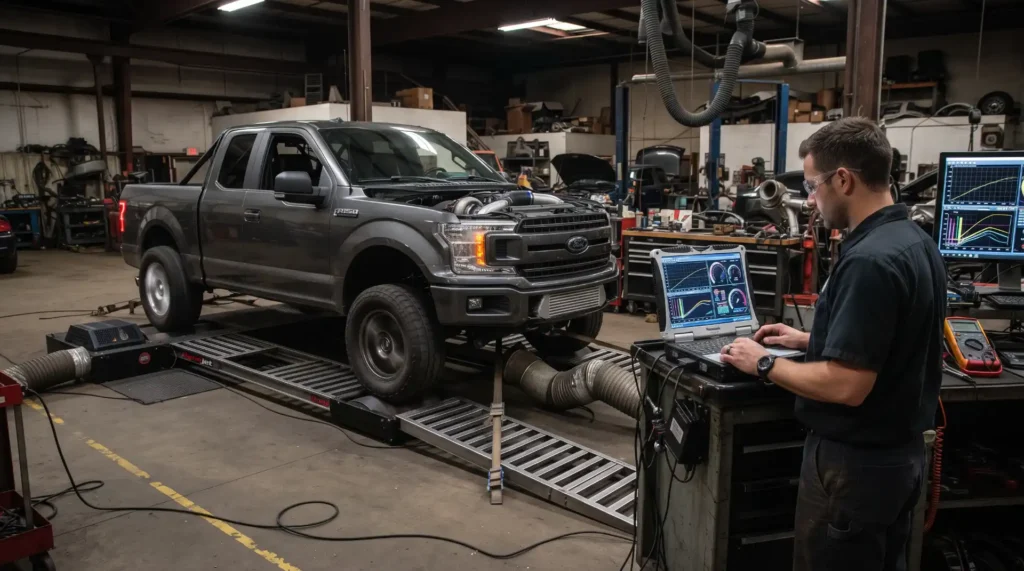 Emissions Compliance Matters for U.S. Performance Builds
Performance enthusiasts should understand that not every part marketed online is necessarily legal for street use.
Federal emissions requirements remain relevant when modifying modern trucks.
According to the EPA, the Clean Air Act prohibits knowingly removing or rendering inoperative emissions-control equipment from certified motor vehicles. The agency also describes ways aftermarket manufacturers and installers may establish a reasonable basis that a modification does not adversely affect emissions performance.
California and some other states can have additional requirements.
Drivers should research whether specific components are appropriate for road use in their jurisdiction before installation.
A properly planned street build should produce better performance while keeping legal and practical considerations in mind.
Avoid Building Around Peak Horsepower Alone
Horsepower numbers are easy to market because they provide a simple comparison.
Real-world performance is more complicated.
Imagine two pickup trucks.
One produces substantially more peak horsepower but has heavy wheels, overheated intake temperatures, weak brakes, poor transmission behavior, and tires that struggle for traction.
The other makes less power but has better cooling, responsive gearing, lightweight wheels, strong tires, controlled suspension, and a carefully matched calibration.
The second truck may feel better in nearly every real driving situation.
Acceleration, consistency, cornering, braking, towing stability, and driver confidence all contribute to performance.
A truck is a complete machine, not an engine dyno sheet.
A Balanced Upgrade Order for Most Pickup Trucks
Although every build is different, many owners can benefit from starting with the truck’s condition and intended use.
Maintenance and diagnostics should come first.
Tires and alignment can follow because they affect nearly every aspect of vehicle behavior.
Drivers looking for sharper handling may then consider suspension and brake improvements.
Engine tuning, intake, intercooling, exhaust, and supporting cooling components can be added according to the power goal.
More aggressive builds may eventually require drivetrain, differential, axle, transmission, or fuel-system upgrades.
This staged approach allows each modification to solve a specific problem.
It also gives the owner a chance to evaluate the truck after each phase instead of installing a large collection of unrelated parts at once.
Performance Pickup Trucks in 2026 Are More Diverse Than Ever
The modern American pickup market provides enthusiasts with a remarkable range of platforms.
There are compact turbocharged trucks, hybrid pickups, traditional naturally aspirated V8 models, twin-turbo full-size trucks, heavy-duty diesels, dedicated off-road models, and increasingly powerful electric pickups.
The aftermarket is adapting to all of them.
SEMA’s 2026 market research indicates that internal-combustion vehicles remain dominant while hybrid and electric models continue growing their share of new-vehicle sales.
That creates a performance landscape where traditional mechanical modification exists alongside software calibration, electrification, electronic suspension control, and advanced thermal management.
The definition of a modified truck is becoming broader.
Final Thoughts
The best performance upgrades for pickup trucks in 2026 depend on what the truck actually needs to do.
A street-oriented pickup may benefit from responsive tuning, lighter wheels, performance tires, suspension improvements, and stronger brakes. A towing truck may gain more from cooling, transmission management, appropriate tires, and controlled torque delivery. An off-road build may prioritize suspension travel, gearing, protection, traction, and durability.
Modern trucks are highly integrated machines. Engine software communicates with transmissions, stability systems, sensors, driver-assistance technology, and emissions controls.
That means successful modifications require more planning than simply bolting on the largest available part.
Start with a clear objective. Establish a reliable mechanical baseline. Match tires, brakes, suspension, cooling, drivetrain, and engine upgrades to one another.
The result can be a pickup that feels quicker, more controlled, more capable, and more enjoyable without sacrificing the qualities that made it useful in the first place.
For additional modification ideas, explore Auto Sport Performance’s guide to the best performance upgrades for trucks and SUVs and its broader collection of performance tuning and vehicle technology articles.