
Modern performance cars are becoming faster, more sophisticated, and increasingly dependent on technology that can adapt to changing driving conditions. One of the most interesting developments is active aerodynamics, a technology that allows a vehicle to change its aerodynamic shape while it is moving. Instead of relying entirely on fixed spoilers, wings, splitters, and diffusers, active aerodynamic systems can adjust their position to produce different aerodynamic characteristics depending on speed, acceleration, braking, cornering, and selected driving modes.
For performance enthusiasts in the United States, active aerodynamics represents an important shift in how manufacturers approach speed. A traditional aerodynamic package generally requires a compromise. A large rear wing can create substantial downforce during cornering, but it can also create additional drag on a straightaway. A smaller wing can reduce drag and improve top speed, but it may provide less aerodynamic grip when the car is pushed through a high-speed corner.
Active aerodynamics attempts to reduce that compromise. The system can increase downforce when the vehicle needs additional stability and reduce aerodynamic drag when straight-line efficiency becomes more important. Modern systems can involve movable rear wings, adjustable front spoilers, active grille shutters, variable underbody elements, airbrake functions, and other electronically controlled aerodynamic components.
The technology is no longer limited to exotic race cars. High-performance production vehicles now use sophisticated active aerodynamic systems, while motorsport is also developing new approaches. The FIA’s 2026 Formula 1 regulations introduced active front and rear aerodynamic systems designed to allow cars to use higher-downforce configurations for corners and lower-drag configurations on straights.
For anyone interested in performance tuning, understanding active aerodynamics is important because it demonstrates how modern vehicles are moving beyond the simple idea of adding a larger wing. Today’s aerodynamic engineering is increasingly about managing airflow dynamically and creating the right amount of aerodynamic load at the right time.
What Is Active Aerodynamics?
Active aerodynamics refers to aerodynamic components that can change position, shape, angle, or airflow characteristics while a vehicle is operating. The adjustments are typically controlled electronically and can respond to information from vehicle speed, throttle position, braking, steering angle, acceleration, drive mode, and other sensors.
A conventional spoiler or wing has a fixed aerodynamic position. Once installed, its angle and physical shape remain essentially unchanged while the vehicle is moving. That makes the component predictable, but it also means engineers have to select a compromise that works across many different conditions.
An active system adds another layer of flexibility. The aerodynamic component can be positioned differently for a highway cruise, high-speed acceleration, hard braking, or aggressive cornering.
Porsche’s active aerodynamic technology provides a useful production-car example. Its Porsche Active Aerodynamics system can adjust aerodynamic characteristics according to driving conditions, vehicle speed, and selected driving mode. Porsche has used active front spoilers, rear wings, and cooling-air flaps to create different aerodynamic configurations.
This basic concept is becoming increasingly important as performance vehicles become faster. At high speeds, aerodynamic forces become much more significant than they are at ordinary street speeds. A performance car traveling around a race track may need considerable aerodynamic grip in one section and low drag only a few seconds later on a straight.
Active aerodynamics gives engineers a way to address both requirements with one vehicle.
Why Downforce Matters on a Performance Car
Downforce is an aerodynamic force that pushes a vehicle toward the road surface as air flows around and underneath the car. Unlike additional mass, aerodynamic downforce can increase with vehicle speed without permanently increasing the car’s static weight.
That distinction is extremely important in performance driving.
A tire can generate more grip when additional vertical load is applied, provided the tire and vehicle dynamics remain within an appropriate operating range. Aerodynamic downforce therefore allows engineers to increase high-speed cornering capability without simply making the vehicle heavier.
This is one reason race cars use front wings, rear wings, diffusers, floors, splitters, and carefully shaped bodywork.
The objective is not simply to create the largest possible amount of downforce. The aerodynamic package must also maintain a useful balance between the front and rear axles. If the rear of the vehicle receives significantly more aerodynamic load than the front, the handling characteristics can change. If the front receives too much relative load, the vehicle may become less stable at the rear.
SAE International research on vehicle spoilers emphasizes that race-car aerodynamic development is not simply about maximizing downforce. Engineers must consider the balance of forces and the relationship between downforce and drag across different operating conditions.
That is where active aerodynamics becomes especially valuable.
The Downforce and Drag Trade-Off
The central challenge in aerodynamic engineering is that downforce and drag are closely connected.
A wing generates aerodynamic load by changing the way air moves around the vehicle. However, generating more aerodynamic load generally creates additional resistance to forward motion. That resistance is aerodynamic drag.
During a corner, additional downforce can be extremely valuable because it helps the tires maintain greater vertical loading and can improve high-speed stability. On a long straight, however, excessive drag can reduce acceleration and top speed.
A fixed wing must therefore be selected around a particular compromise.
An active wing can change that compromise as conditions change.
During cornering, the system may move toward a higher-downforce position. When the vehicle enters a straight section, the wing can move toward a lower-drag configuration. During heavy braking, it may adopt a different position again to provide additional aerodynamic resistance and stability.
This approach is especially useful for modern high-performance vehicles because electronic controls allow aerodynamic changes to be coordinated with other vehicle systems.
Porsche, for example, describes an airbrake function in which its active aerodynamic system increases drag and downforce during high-speed braking. Its system also includes configurations intended to balance efficiency and performance.
 How Active Rear Wings Work
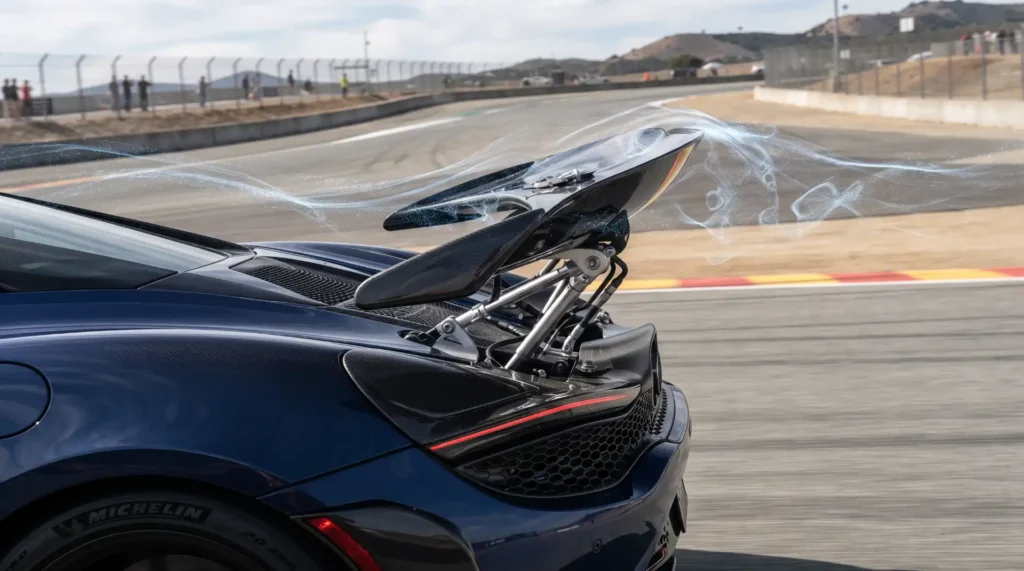 How Active Rear Wings Work
The active rear wing is one of the easiest active aerodynamic systems for enthusiasts to understand because its movement can often be seen from outside the vehicle.
A fixed rear wing remains at one aerodynamic angle. An active rear wing can change its angle of attack or move between deployed and retracted positions.
The mechanism usually involves electric motors, hydraulic actuators, mechanical linkages, or a combination of these technologies. Sensors and vehicle-control software determine when the aerodynamic component should move.
At lower speeds, the wing may remain retracted because the aerodynamic benefit is relatively small. As speed increases, the system can deploy the wing to create additional stability and downforce.
Under heavy braking, some systems can move the wing into a more aggressive position that increases drag. This can supplement the vehicle’s conventional braking system by using aerodynamic resistance to help slow the car.
The exact strategy differs between manufacturers and vehicle platforms. The important point is that the wing is no longer simply a passive component. It becomes part of the vehicle’s overall control strategy.
A modern performance car can therefore use its rear wing differently during acceleration, cornering, cruising, and braking.
Active Front Aerodynamics Are Just as Important
Rear wings receive most of the attention because they are visually obvious, but front aerodynamic components can be equally important.
The front of a performance car determines how much aerodynamic load reaches the front tires. Front splitters, active flaps, adjustable spoiler elements, air curtains, cooling shutters, and other components can influence airflow around the nose and front wheels.
An active front spoiler can change its position depending on speed or driving conditions. In one configuration, it may remain relatively conservative to minimize drag. In another, it can extend or change its aerodynamic profile to increase front-end load.
This matters because aerodynamic balance is critical.
Imagine a vehicle entering a high-speed corner. If the rear of the car gains substantially more aerodynamic load while the front remains relatively unloaded, the vehicle may not respond as intended to steering inputs. Engineers therefore have to manage the entire aerodynamic package rather than treating the front and rear independently.
The FIA’s 2026 Formula 1 regulations are a particularly visible example of this philosophy. The new regulations use active front and rear wing elements so that the car can operate in different aerodynamic configurations depending on whether it is cornering or traveling down a straight.
Although a street car and an F1 car operate under very different rules and conditions, the engineering principle is similar: aerodynamic performance is increasingly being treated as something that can be actively managed.
How Underbody Aerodynamics Creates Downforce
Not all aerodynamic performance comes from visible wings.
The underside of the vehicle can be one of the most important areas for generating downforce. Splitters, flat floors, tunnels, diffusers, and carefully managed airflow can create lower pressure beneath the vehicle.
As air moves underneath a properly designed vehicle, its speed and pressure can be manipulated through the shape of the floor and surrounding bodywork. The resulting pressure difference can help generate aerodynamic load.
This is commonly associated with the ground-effect philosophy used in motorsport.
Modern production performance cars are increasingly adopting more sophisticated underbody aerodynamics. Some systems even incorporate active components beneath the vehicle.
Mercedes-AMG, for example, describes active underbody aerodynamic elements within its AMG.EA technology program. The system changes the underbody contour to manage airflow and use the Venturi effect to create a low-pressure region beneath the vehicle, increasing aerodynamic load when required.
The advantage of underbody aerodynamics is that engineers can generate meaningful aerodynamic performance without relying exclusively on large external wings.
This can be particularly useful for road-going vehicles because designers must consider styling, visibility, noise, efficiency, ground clearance, and everyday usability.
Active Aerodynamics and Ride Height
Aerodynamics does not operate independently from the suspension.
Ride height can have a major effect on airflow underneath a vehicle. Lowering the car changes the relationship between the floor, road surface, diffuser, splitter, and surrounding air.
At a race track, aerodynamic engineers may carefully control ride height to maintain predictable airflow under the vehicle.
Some advanced production vehicles combine active aerodynamic systems with electronically controlled suspension. The vehicle can lower itself at higher speeds to reduce drag or change its aerodynamic characteristics.
This is another reason performance enthusiasts should think about the entire vehicle rather than modifying one component in isolation.
Your suspension setup, tire characteristics, ride height, alignment, and aerodynamic package can all influence one another. For additional background, Auto Sport Performance’s guide to coilovers vs. lowering springs for street performance explains how ride height and suspension changes can influence handling, tire contact, and suspension geometry.
A street car needs a different approach from a dedicated race car. Excessive lowering can reduce suspension travel and create problems on potholes, driveways, speed bumps, and uneven American roads. Aerodynamic performance should therefore be matched to the environment where the vehicle will actually be driven.
Active Aero Can Also Improve Braking Stability
 Active Aero Can Also Improve Braking Stability
One of the most interesting applications of active aerodynamics is braking.
When a vehicle is traveling at high speed, aerodynamic forces become much larger. An active wing can be positioned to increase aerodynamic drag during heavy braking.
This is sometimes called an airbrake configuration.
The aerodynamic system does not replace the vehicle’s conventional brakes. Instead, it can supplement the braking process by increasing resistance through the air while also changing aerodynamic load distribution.
Porsche has specifically described an airbrake function for its active aerodynamic system, designed to increase drag and downforce during full braking at high speed.
This can also improve stability because the aerodynamic balance of the car can be managed while the vehicle is undergoing significant longitudinal weight transfer.
For track driving, where braking zones may begin from high speeds and repeat throughout a session, aerodynamic stability can be an important part of overall vehicle behavior.
Active Aerodynamics and Modern Performance EVs
Electrification is also changing the role of vehicle aerodynamics.
Electric vehicles are highly sensitive to aerodynamic drag because reducing resistance can improve energy efficiency and driving range. At the same time, high-performance EVs need excellent high-speed stability and cornering performance.
That creates a familiar engineering challenge: low drag is beneficial for efficiency, while higher aerodynamic load can improve high-speed handling.
Active aerodynamic systems provide a way to manage both objectives.
Porsche’s engineering discussions around electric vehicles highlight the importance of aerodynamic efficiency and the use of active elements such as cooling-air shutters and retractable spoilers.
This trend is important for U.S. performance enthusiasts because the growing number of electric and hybrid performance vehicles means aerodynamic engineering is becoming increasingly connected to energy management.
The same basic principle applies to hybrid vehicles. A hybrid performance car can benefit from strong aerodynamic efficiency during highway driving while using additional aerodynamic load when performance demands it.
For more background on how electrification is changing performance builds, Auto Sport Performance also covers hybrid performance tuning in 2026.
Why Active Aerodynamics Is Becoming More Common
Several developments are pushing active aerodynamics into more performance vehicles.
The first is the continuing increase in vehicle speed and performance capability. Modern sports cars can accelerate extremely quickly and reach speeds at which aerodynamic forces become significant.
The second is the increasing sophistication of vehicle electronics. Modern performance cars already use computers to manage engines, transmissions, traction control, stability control, adaptive suspension, steering systems, and braking. Adding aerodynamic control to that network is a natural progression.
The third factor is the need for efficiency.
A fixed high-downforce aerodynamic package can hurt fuel economy and electric range when the additional aerodynamic load is not needed. Active components allow manufacturers to reduce drag during ordinary driving and increase aerodynamic performance when appropriate.
The fourth factor is motorsport.
Motorsport has always been an important testing ground for aerodynamic technology. The 2026 Formula 1 regulations are particularly notable because active front and rear aerodynamic systems have become a central part of the new aerodynamic philosophy. The FIA describes a higher-downforce cornering configuration and a lower-drag straight-line configuration.
Technologies developed in racing do not automatically become appropriate for street vehicles, but motorsport continues to influence production-car engineering.
Active Aerodynamics Is Not Just About Bigger Downforce Numbers
It is tempting to judge aerodynamic performance by asking how many pounds of downforce a vehicle can generate. That number can be useful, but it does not tell the entire story.
Where the downforce is generated matters.
How it changes with speed matters.
How it is distributed between the front and rear axles matters.
How stable the aerodynamic balance remains during braking and cornering matters.
How much drag is produced to achieve the aerodynamic load also matters.
A vehicle that generates a huge amount of downforce but experiences significant balance changes as speed increases may not be as predictable as a vehicle with lower peak downforce and a more consistent aerodynamic balance.
The quality of the aerodynamic system is therefore more important than one headline number.
This is one reason modern active systems are so sophisticated. The goal is not simply maximum aerodynamic force. The goal is to provide useful aerodynamic characteristics under specific operating conditions.
Active Aero and the Importance of Vehicle Weight
Aerodynamics is only one part of performance engineering.
Vehicle weight still plays a major role in acceleration, braking, tire loading, suspension behavior, and overall responsiveness. A heavy vehicle may generate impressive aerodynamic load, but that does not eliminate the effects of mass.
This is particularly important as performance vehicles become more technologically complex.
Hybrid and electric platforms can carry substantial battery mass, while modern gasoline performance cars can also be heavier because of safety equipment, luxury features, larger brakes, larger wheels, and additional electronics.
For this reason, aerodynamic upgrades should be considered alongside weight management.
Auto Sport Performance’s article Why Weight Reduction Matters More Than Ever in Performance Builds explains how reducing vehicle mass can improve acceleration, braking, handling, and tire performance.
The strongest performance builds usually focus on balance rather than maximizing one specification.
How Active Aerodynamics Changes the Street Performance Experience
For everyday U.S. street driving, most active aerodynamic systems operate within a much more conservative range than race-car systems.
Drivers may not notice the system moving during normal commuting. At highway speeds, however, the vehicle may automatically adjust cooling flaps, ride height, spoilers, or other aerodynamic components.
The primary objectives are usually efficiency, stability, cooling, and controlled performance.
On a closed road course, the system can become much more noticeable. A driver may select a performance mode that changes the aerodynamic configuration, allowing the vehicle to prioritize cornering stability and braking performance.
This illustrates an important distinction between street performance and motorsport.
A road-going car has to work in traffic, rain, heat, cold weather, rough pavement, parking lots, and highway conditions. A race car is designed around a controlled environment.
Active aerodynamic technology allows engineers to give a road car a wider range of operating characteristics without permanently sacrificing efficiency or everyday usability.
What Performance Enthusiasts Should Consider Before Adding Aero
Aftermarket aerodynamic modifications require careful planning.
Adding a large fixed wing to a street car does not automatically make it faster. If the front and rear aerodynamic components are poorly matched, the vehicle can develop undesirable handling characteristics.
The same applies to splitters and diffusers. An aerodynamic component works as part of the airflow around the entire vehicle. Changing one area can affect another.
Mounting strength is also critical. A wing that generates substantial aerodynamic load must be attached securely to an appropriate structural area. The faster the vehicle travels, the more aerodynamic force the component can experience.
Ground clearance is another consideration. A large front splitter may provide aerodynamic benefits on a smooth race track but become impractical on American streets filled with steep driveways, road debris, potholes, and speed bumps.
Drivers should also consider whether aftermarket components are appropriate for their vehicle’s intended use and whether installation affects any local requirements, insurance considerations, or manufacturer warranties.
Why Data and Testing Matter in Aerodynamic Development
Aerodynamics can be difficult to evaluate by appearance alone.
A vehicle may look aggressive without producing useful aerodynamic performance. Conversely, a relatively subtle aerodynamic change can have a measurable effect when it is properly designed.
Professional aerodynamic development can involve computational fluid dynamics, wind-tunnel testing, pressure measurements, flow visualization, vehicle sensors, and track testing.
SAE research demonstrates how engineers use computational simulation and physical testing to evaluate spoiler deployment and transient aerodynamic behavior.
Motorsport teams can also collect data from vehicle sensors to understand how aerodynamic changes affect speed, braking, cornering, and tire behavior.
This data-driven approach is increasingly relevant to street-performance enthusiasts. Modern cars already produce enormous amounts of electronic information, and performance tuning is increasingly connected to data logging and software.
That means the future of aerodynamic tuning is likely to involve much more than simply choosing a wing angle from a catalog.
Active Aerodynamics and the Future of Performance Cars
The future of performance-car aerodynamics will likely involve greater integration between software, suspension, powertrain, brakes, and aerodynamic components.
A vehicle could potentially use data from steering angle, throttle position, braking pressure, GPS location, vehicle speed, lateral acceleration, and road conditions to determine how its aerodynamic system should operate.
Some of this technology already exists in advanced performance vehicles.
Aston Martin’s Valhalla, for example, uses active front and rear aerodynamic elements that continuously adjust their attitude in its performance-focused modes. The company says the system is designed to optimize aerodynamic balance and reports more than 600 kilograms of downforce for the production vehicle.
That example demonstrates how active aerodynamics is moving beyond a simple rear spoiler.
The technology can become part of the vehicle’s complete performance architecture.
How Active Aerodynamics Fits Into a Complete Performance Build
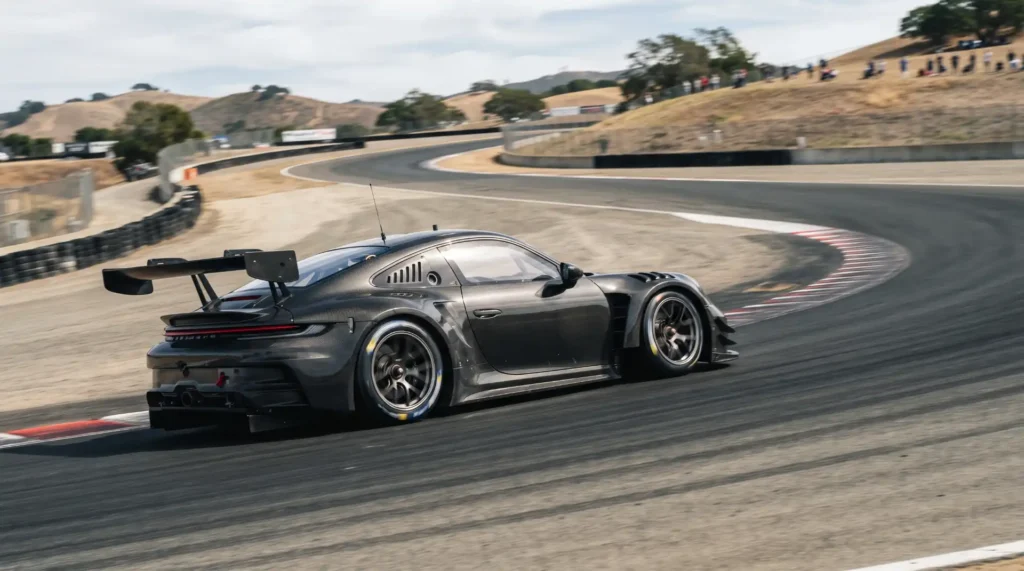 How Active Aerodynamics Fits Into a Complete Performance Build
For enthusiasts building a street or track vehicle, aerodynamic modifications should generally come after the vehicle has a solid mechanical foundation.
Tires, brakes, suspension, alignment, cooling, and power delivery all contribute to how effectively a car can use aerodynamic grip.
Adding downforce to a vehicle with inadequate tires does not automatically create better overall performance. The additional aerodynamic load still has to be converted into usable tire grip.
Likewise, a vehicle with significant aerodynamic performance needs suspension settings capable of maintaining predictable behavior as speed and aerodynamic load change.
This is why aerodynamic tuning should be treated as part of a complete vehicle-development process.
For enthusiasts interested in the relationship between wheels, tires, suspension, and handling, Auto Sport Performance’s article on wheel size and unsprung weight provides another useful part of the performance picture.
A balanced vehicle is usually more effective than one built around a single extreme modification.
Active Aerodynamics vs. Traditional Fixed Aero
Fixed aerodynamic components still have an important place in performance driving.
A properly designed fixed splitter, wing, diffuser, or spoiler can be relatively simple, durable, predictable, and cost-effective. For many track cars, fixed aerodynamic components make perfect sense.
The advantage of active aerodynamics is flexibility.
A fixed wing has one basic aerodynamic configuration. An active wing can have several.
That flexibility becomes especially valuable when a vehicle must perform well across different environments. A road car may need low drag during highway driving, aerodynamic stability during high-speed cornering, and additional aerodynamic resistance during hard braking.
A track-focused vehicle may prioritize even more aggressive changes.
The decision between fixed and active aero therefore depends on the vehicle’s purpose, budget, complexity, maintenance requirements, and performance goals.
Is Active Aerodynamics Worth It for a Performance Car?
For manufacturers building advanced sports cars and supercars, active aerodynamics can provide significant engineering advantages because it allows one vehicle to behave differently across a broad range of speeds and driving conditions.
For an aftermarket enthusiast, however, the question is more complicated.
An active aerodynamic system can be expensive and technically complex. It may require actuators, sensors, control modules, wiring, software, and custom aerodynamic components.
A high-quality fixed aerodynamic package may provide a more straightforward solution for a dedicated track car.
The right choice depends on the intended use of the vehicle.
A daily-driven performance car may benefit from subtle aerodynamic improvements that preserve ground clearance and drivability. A weekend track car may benefit from a larger fixed wing and splitter combination. An advanced build intended to replicate modern supercar technology could explore electronically controlled aerodynamic components.
The important point is to match the aerodynamic strategy to the vehicle rather than installing parts simply because they look aggressive.
The Role of Active Aerodynamics in 2026 and Beyond
Active aerodynamics is becoming one of the clearest examples of how modern performance engineering is changing.
The 2026 Formula 1 regulations have made active front and rear aerodynamics a major part of the sport’s new technical direction. Production manufacturers are also using active wings, spoilers, cooling shutters, and underbody systems to balance performance and efficiency.
This convergence between motorsport technology and road-car engineering is especially interesting for U.S. enthusiasts.
Performance vehicles are no longer defined only by engine displacement, horsepower, turbocharger size, or exhaust design. Software, sensors, aerodynamics, thermal management, suspension control, and energy management are becoming equally important.
That does not mean traditional performance modifications are disappearing. Instead, they are becoming part of a larger engineering system.
A turbocharger can create more power, but the tires must use it. Better tires can create more grip, but the suspension must control the vehicle. A stronger suspension setup can improve cornering, but aerodynamic balance can become important as speeds increase.
Active aerodynamics adds another tool to that system.
Final Thoughts on Active Aerodynamics
Active aerodynamics allows modern performance cars to change their aerodynamic characteristics according to driving conditions. By adjusting wings, spoilers, front aero components, cooling openings, and underbody elements, manufacturers can create a vehicle that produces more aerodynamic load when cornering and braking while reducing drag when straight-line efficiency is more important.
The technology addresses one of the oldest challenges in performance-car engineering: the conflict between downforce and drag.
A fixed aerodynamic package has to compromise. Active aerodynamics provides a way to make that compromise dynamic.
For U.S. performance enthusiasts, the technology is worth watching because it is increasingly appearing in both motorsport and production vehicles. The 2026 Formula 1 regulations have made active aero a central part of the sport’s latest technical era, while production vehicles from Porsche, Aston Martin, Mercedes-AMG, and other manufacturers demonstrate how similar principles are being adapted for road-going performance.
The biggest lesson is that aerodynamic performance should never be viewed in isolation. Downforce, drag, weight, suspension, tires, brakes, power delivery, cooling, and vehicle electronics all interact.
For a performance build, the goal should not simply be to generate the biggest possible downforce number. The goal is to create predictable aerodynamic behavior that works with the rest of the vehicle.
As cars become faster and more electronically controlled, active aerodynamics will likely become an increasingly important part of that equation. The future performance car may not simply have a wing. It may have an aerodynamic system that continually changes how the entire vehicle interacts with the air.
That is the real significance of active aerodynamics: instead of forcing drivers and engineers to choose one aerodynamic setup for every situation, modern technology allows the car to adapt its aerodynamic behavior to the road, track, speed, and driving demands.