
Turbocharger upgrades remain one of the most popular ways to increase performance in modern cars, and that trend is showing no signs of slowing down in 2026. From turbocharged four-cylinder sport compacts to high-output six-cylinder sports cars and powerful American performance vehicles, forced induction has become an important part of the modern performance landscape. An appropriately selected turbocharger can increase airflow, improve acceleration, expand an engine’s powerband, and transform the personality of a vehicle.
However, selecting the right turbocharger is not as simple as choosing the unit with the largest compressor or the highest advertised horsepower rating. A turbocharger is one component of a much larger performance system. The engine, fuel system, intercooler, exhaust, ECU calibration, cooling system, transmission, tires, brakes, and drivetrain all influence how effectively the additional airflow can be converted into usable performance.
This is particularly important for U.S. enthusiasts because street and track environments can be dramatically different. A vehicle that spends most of its time commuting through Los Angeles, Dallas, Chicago, Atlanta, Phoenix, Miami, or another major U.S. city has very different requirements from a car that regularly participates in road-course events at circuits such as Laguna Seca, Road Atlanta, Virginia International Raceway, or other American tracks.
The ideal turbocharger for a daily-driven performance car may not be the best choice for a dedicated track build. Likewise, a turbocharger designed for maximum high-RPM power may make a street car feel slower and less responsive during normal driving. Understanding those differences is the key to making a smart turbocharger upgrade in 2026.
Why Turbocharger Upgrades Continue to Grow in Popularity
Modern turbocharged engines offer an excellent foundation for performance modifications. Manufacturers have become increasingly skilled at producing substantial power from relatively small engines while maintaining emissions compliance, fuel efficiency, drivability, and durability.
Turbocharging makes this possible by forcing additional air into the engine. More air allows the engine to burn more fuel, which can increase the amount of energy produced during combustion. When the fuel system, cooling system, exhaust, and engine calibration are capable of supporting the additional airflow, a turbocharger upgrade can create a significant performance improvement.
The aftermarket has also evolved. Turbocharger manufacturers now offer a wide range of direct-fit, hybrid, motorsport, and custom units designed for different power levels and applications. This gives enthusiasts more choices, but it also makes selecting the correct turbocharger more complicated.
A street enthusiast may be able to choose a direct-fit turbocharger that works with much of the factory hardware. A high-horsepower track build may require a completely different turbocharger, custom exhaust manifold, external wastegate, larger fuel system, upgraded intercooling, and extensive ECU calibration.
Because of this, the first step should always be defining the intended use of the vehicle rather than shopping for a turbocharger based only on its advertised maximum horsepower.
Start With the Car’s Intended Purpose
One of the most important decisions in any turbocharger project is determining how the vehicle will actually be used. A daily-driven street car has different requirements from a drag car, autocross car, road-course car, or dedicated competition vehicle.
A street car normally operates across a wide range of engine speeds. The driver may spend considerable time below 3,000 rpm and only occasionally use the upper portion of the tachometer. In that environment, quick turbo response and strong midrange torque can make the car feel faster and more enjoyable.
A track car operates differently. During aggressive road-course driving, the engine may spend long periods at elevated RPM and under heavy load. The driver can also use gear selection to keep the engine within its preferred powerband.
This means a larger turbocharger can sometimes make more sense for a track-oriented vehicle because high-RPM airflow and sustained power may matter more than immediate low-RPM response.
Dual-purpose cars require the most careful compromise. Many American enthusiasts want a vehicle that can commute during the week, travel long distances, enjoy weekend drives, and participate in occasional track events. In that situation, a turbocharger that provides strong response while still offering meaningful top-end airflow is usually more useful than an extreme unit designed solely for maximum horsepower.
 Turbocharger Size and the Horsepower Trap
 Turbocharger Size and the Horsepower Trap
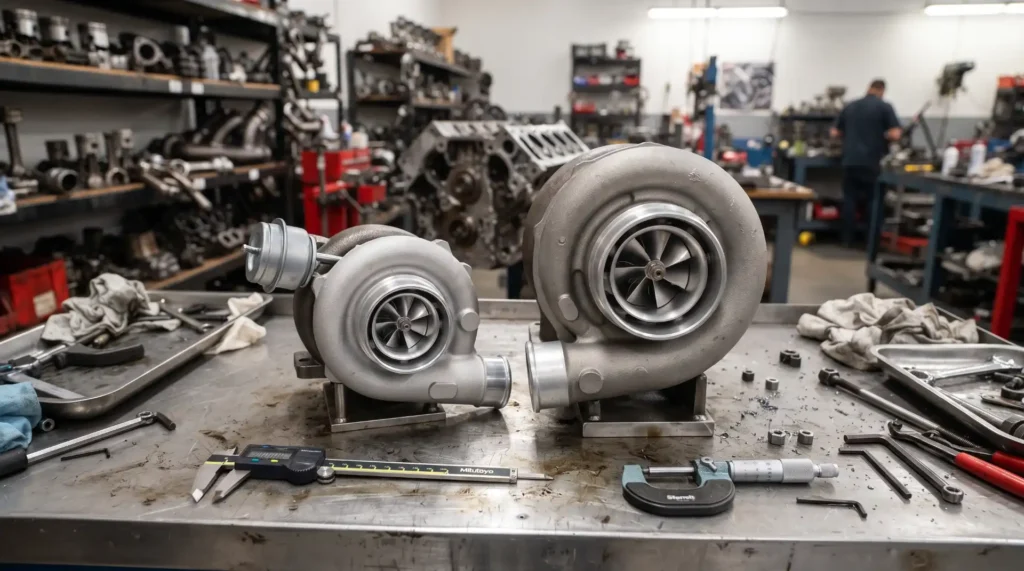
Turbocharger size is one of the most misunderstood subjects in performance tuning. It is common to see turbochargers marketed according to their maximum horsepower potential, but that number does not tell you how the turbocharger will behave on a specific engine.
A turbocharger capable of supporting 800 horsepower does not automatically mean it is the best turbo for an engine targeting 500 horsepower. The turbo may have the airflow capability, but it could operate outside its most efficient range during much of the engine’s normal operating conditions.
A smaller turbocharger can often provide quicker response and better low- and midrange performance. A larger turbocharger can provide greater high-RPM airflow and support higher peak power. The correct choice depends on where the engine will operate most frequently.
This creates the classic performance compromise between spool and peak power. Selecting a turbocharger means deciding where on the RPM curve the vehicle should make its power and how quickly the driver needs that power to arrive.
Understanding Turbo Spool and Turbo Lag
Turbo spool describes how quickly the turbocharger accelerates and begins producing meaningful boost. Turbo lag describes the delay between requesting additional power and receiving the resulting increase in boost and torque.
These characteristics are strongly influenced by turbocharger size, turbine housing design, compressor design, exhaust energy, engine displacement, camshaft characteristics, exhaust manifold design, and engine calibration.
For a street car, quick response is often extremely valuable. Drivers encounter stop-and-go traffic, freeway merges, short acceleration zones, and frequent changes in engine speed. A turbocharger that produces useful boost quickly can make the vehicle feel responsive without requiring the driver to constantly downshift.
Track drivers have somewhat different priorities. A driver approaching a corner can select a lower gear and keep the engine closer to the turbocharger’s preferred operating range. Because the engine spends more time at higher RPM, turbo lag can become less noticeable.
That does not mean lag is irrelevant on a track. Excessive delay in power delivery can still make corner exits more difficult. A predictable torque curve is often more useful than an aggressive boost surge.
Why Compressor Maps Matter
One of the best ways to move beyond marketing numbers is to understand compressor maps. A compressor map shows how a turbocharger behaves across different airflow and pressure-ratio conditions.
Instead of asking whether a turbocharger can theoretically support a certain horsepower number, enthusiasts can evaluate whether it operates efficiently across the engine’s actual operating range.
This is especially important when selecting a turbocharger for a street-and-track build. The engine will not remain at maximum RPM all the time. It will operate through a wide range of airflow requirements, and the turbocharger should ideally remain within an efficient portion of its compressor map across that range.
Garrett Motion’s Boost Adviser turbo-matching tool is one useful technical resource because it allows users to enter engine and performance parameters and compare turbocharger matches based on compressor-map information. Garrett also notes that altitude affects turbocharger operating conditions because the turbo must work harder to produce the same power at higher elevations.
This matters to American enthusiasts because the United States includes everything from sea-level coastal regions to high-elevation areas in states such as Colorado, Utah, Arizona, New Mexico, and California. A turbocharger setup developed at sea level may operate differently when the vehicle is driven thousands of feet above sea level.
Street Builds Need More Than Peak Horsepower
Street performance is about how a car feels during real-world driving. Peak dyno horsepower is only one part of that experience.
A street car needs usable power. The driver should be able to accelerate smoothly, merge onto highways, pass slower traffic, and enjoy spirited driving without waiting for the engine to reach an extremely high RPM.
This is why a moderate turbocharger upgrade can sometimes produce a more satisfying street car than a much larger unit. A smaller or medium-sized turbo can provide stronger response and useful torque across a broader range.
Street cars also face conditions that track vehicles may not encounter as frequently. They must deal with traffic, long periods of idling, extreme ambient temperatures, road debris, variable fuel quality, cold starts, and long highway trips.
For this reason, street-oriented turbocharger selection should consider reliability as seriously as power production.
Track Builds Change the Equation
Track driving places much greater demands on a turbocharged engine. Instead of producing maximum power for a few seconds, the engine may operate under high load repeatedly throughout an entire session.
This makes thermal efficiency extremely important.
A turbocharger that produces excellent peak numbers during a short dyno pull may not be ideal if intake temperatures, oil temperatures, exhaust temperatures, or coolant temperatures continue rising during extended track use.
Track builds should therefore consider sustained airflow and thermal performance rather than simply maximum output.
High-RPM airflow can be particularly important because track drivers often keep the engine closer to redline. A larger turbocharger may be useful if the engine has sufficient displacement, cylinder-head flow, fueling capacity, and internal strength to take advantage of it.
However, additional power also creates additional demands on tires, brakes, drivetrain components, and suspension.
That is why a track-oriented turbocharger should be selected as part of a complete vehicle strategy.
The Intercooler Becomes More Important After a Turbo Upgrade
 The Intercooler Becomes More Important After a Turbo Upgrade
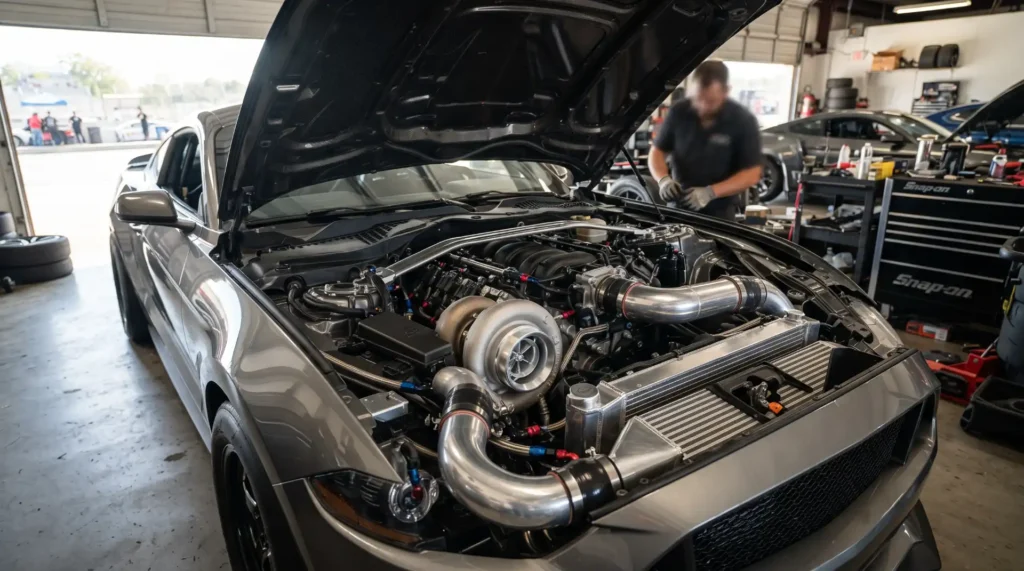
Turbochargers compress intake air, and compression increases temperature. The intercooler exists to remove much of that heat before the air reaches the engine.
When turbocharger airflow and boost increase, the charge-air cooling system can become a limiting factor.
This is particularly noticeable during repeated acceleration or track sessions. A factory intercooler may perform well during normal commuting but become heat soaked under repeated high-load operation.
Auto Sport Performance’s guide on whether an upgraded intercooler is worthwhile for a stock turbo car explains why intercooler performance can become important even before the turbocharger itself is upgraded.
Once a larger turbocharger is installed, the importance of matching the intercooler to the new airflow becomes even greater.
A good intercooler should provide effective heat rejection without creating excessive pressure drop. Core size, internal fin design, end-tank design, airflow, piping diameter, and packaging all contribute to performance.
For street cars, the intercooler should also be designed to recover quickly from heat soak. For track cars, sustained heat rejection becomes even more important.
Fuel System Capacity Must Match the Turbo
More airflow requires more fuel. This is one of the fundamental rules of forced-induction performance.
An upgraded turbocharger may be capable of supplying considerably more air than the factory unit, but the engine cannot safely take advantage of that airflow if the fuel system cannot keep up.
Depending on the vehicle, a turbocharger upgrade may require larger fuel injectors, a higher-capacity fuel pump, upgraded fuel lines, additional fuel-pressure control, or other supporting hardware.
Modern direct-injection engines can be particularly complicated because fuel pressure, injection timing, and ECU control are closely integrated.
Fuel choice can also influence the turbocharger strategy. Ethanol-based fuels such as E85 can provide advantages for appropriately designed turbocharged performance builds because ethanol has high knock resistance and provides a significant cooling effect during vaporization.
Auto Sport Performance’s existing guide to E85 and flex-fuel performance builds provides additional information about why ethanol can be attractive for turbocharged applications.
However, switching to E85 should never be treated as a simple fuel change. The vehicle needs a compatible fuel system and a calibration specifically designed for the fuel being used.
ECU Tuning Is Part of the Turbocharger Upgrade
A larger turbocharger changes the amount of air entering the engine and the way boost is produced. The ECU therefore needs to understand the new hardware.
Boost targets, wastegate control, ignition timing, fueling, throttle behavior, torque management, and other parameters may need to be recalibrated.
This is especially important on modern performance cars because the engine control system interacts with the transmission, traction control, stability control, emissions systems, and other vehicle functions.
A properly tuned turbocharger system should deliver controlled power rather than simply maximum boost.
Data logging is also valuable. Instead of judging the build solely by a dyno number, tuners can monitor parameters such as boost pressure, intake temperature, ignition timing, fuel pressure, air-fuel ratio, knock activity, coolant temperature, and oil temperature where available.
Modern data analysis is becoming increasingly important. Auto Sport Performance’s coverage of AI-assisted performance tuning and diagnostics explores how advanced analysis can help enthusiasts and tuners interpret the large amount of data generated by modern performance vehicles.
Wastegate Selection and Boost Control
The wastegate controls how much exhaust energy reaches the turbine. It is therefore a critical part of boost management.
Modern vehicles may use electronically controlled wastegates, while other applications use pneumatic or external wastegate systems. The correct configuration depends on the turbocharger, engine, exhaust manifold, ECU, and intended power level.
A larger turbocharger with an appropriately designed wastegate can provide precise control across a wide operating range. An improperly sized or poorly controlled wastegate can create boost-control problems, including boost creep, unstable boost, or difficulty reaching the desired pressure.
For street cars, predictable boost control improves drivability. For track cars, it can help produce smoother torque delivery when traction is limited.
Why Exhaust Design Matters
The turbine side of a turbocharger depends on exhaust energy. That means the exhaust manifold and exhaust system can have a significant effect on turbocharger performance.
A restrictive exhaust system can limit the ability of a larger turbocharger to move exhaust gases efficiently. Conversely, an exhaust system that is too large or poorly designed may compromise response or create other packaging and thermal issues.
The ideal exhaust setup depends on the engine, turbocharger, turbine housing, displacement, RPM range, emissions equipment, and power target.
U.S. enthusiasts should also consider federal and state emissions requirements before modifying catalytic converters or other emissions-related equipment. A modification that works well for a track-only vehicle may not be appropriate for a street-driven vehicle.
Turbocharger Heat Management in 2026
Heat management is one of the most important subjects in modern turbocharger performance.
A turbocharger operates in an extremely hot environment because the turbine is driven by exhaust gases. Increasing boost and airflow can increase thermal demand throughout the engine bay.
The cooling system therefore becomes part of the turbocharger project.
Auto Sport Performance’s article on performance cooling systems for modified engines explains why increased engine output can place additional demands on coolant, oil, intercooling, and airflow management.
This is particularly important for track cars because sustained high load can reveal weaknesses that never appear during normal street driving.
A car may complete several hard acceleration runs without any problem but begin experiencing rising coolant or oil temperatures after multiple laps. That does not necessarily mean the turbocharger is wrong, but it does mean the entire thermal-management system needs to be evaluated.
Oil Cooling and Turbocharger Reliability
Engine oil performs more jobs than simply lubricating moving components. It also helps remove heat from areas of the engine that experience significant thermal stress.
Turbocharged engines can place particularly high demands on engine oil because the turbocharger’s bearings and rotating components operate at high temperatures and speeds.
Using the correct oil, maintaining appropriate service intervals, and allowing the vehicle to reach proper operating temperature are basic but important parts of turbocharger reliability.
Track vehicles may require more frequent fluid inspections and service because sustained high temperatures can accelerate fluid degradation.
Oil temperature monitoring can also reveal problems that coolant temperature alone does not show.
Water-Methanol Injection and Turbo Builds
Some high-performance turbocharged vehicles use water-methanol injection as an additional method of managing intake temperatures and knock resistance.
The system introduces a controlled mixture into the intake stream under specified conditions. Evaporation can reduce intake charge temperature, while methanol can contribute fuel energy and high octane characteristics.
Water-methanol injection is not a substitute for a properly designed intercooler or cooling system, but it can be another tool for specialized performance applications.
It is especially relevant to high-boost builds where the engine is operating near the limits of the fuel and thermal systems.
However, systems that are integrated deeply into an engine’s calibration should include appropriate fail-safe strategies. If the engine’s tune depends heavily on injection, a loss of fluid or system malfunction needs to be detected and managed.
Transmission Considerations for Bigger Turbochargers
Increasing engine power also increases drivetrain stress.
This is especially relevant for modern automatic transmissions because electronic torque management is often closely integrated with the engine ECU.
A larger turbocharger can increase torque substantially, particularly in the midrange. If the transmission, clutch packs, driveshaft, axles, or differentials are not capable of handling the additional torque, reliability can become a concern.
Manual-transmission vehicles have their own limitations. The clutch may begin slipping as torque increases, particularly if the vehicle is used for launches or aggressive track driving.
AWD vehicles introduce additional considerations because the increased torque is distributed through multiple drivetrain components.
For this reason, turbocharger selection should consider the maximum torque the entire drivetrain can reasonably support.
Traction Can Become the New Limitation
 Traction Can Become the New Limitation
More horsepower does not automatically make a car faster.
If the tires cannot transfer the additional torque to the pavement, some of the new power may simply result in wheelspin.
This is especially important for high-output rear-wheel-drive cars. Increasing boost can dramatically increase torque during corner exits, potentially overwhelming the rear tires.
Front-wheel-drive performance cars can experience wheelspin and torque steer as power increases, while AWD systems can provide additional traction but may introduce additional drivetrain stress.
For street and track builds, tire selection should therefore be part of the turbocharger strategy.
A slightly less powerful car with excellent tires and predictable torque delivery can often be faster and easier to drive than a much more powerful vehicle that constantly struggles for traction.
Brake Upgrades Should Follow Power Upgrades
Higher acceleration capability also means the vehicle can reach higher speeds more quickly.
That makes braking performance increasingly important.
Street enthusiasts should make sure the vehicle’s braking system remains healthy before increasing engine output. Track drivers should evaluate pad compounds, brake fluid, rotor condition, cooling, and tire capability as part of a broader performance strategy.
A turbocharger upgrade should never be viewed as an isolated modification. Every increase in speed potential creates additional demands on the rest of the vehicle.
Street Turbo Versus Track Turbo
A street-oriented turbocharger should generally emphasize fast response, broad usability, manageable heat, and reliability.
A track-oriented turbocharger can place more emphasis on high-RPM airflow, thermal efficiency, and sustained power.
A dual-purpose setup needs to balance both.
For example, a daily-driven American performance car that visits a road course several times each year may benefit from a medium-sized turbocharger with excellent efficiency rather than an enormous unit designed for maximum horsepower.
The driver can enjoy responsive power during normal driving while still having enough top-end airflow to maintain performance during track sessions.
Altitude Matters for U.S. Performance Builds
Altitude is sometimes overlooked during turbocharger selection.
At higher elevations, atmospheric pressure is lower. A turbocharger must work harder to achieve the same manifold-pressure conditions available at sea level.
This can affect compressor efficiency and available airflow.
An enthusiast living near sea level may develop a turbo setup that performs extremely well under those conditions but experience different results after driving into high-elevation regions.
This is particularly relevant for enthusiasts who travel between states or participate in motorsport events at different elevations.
When selecting a turbocharger, the expected operating altitude should therefore be included in the planning process.
Hot Weather Performance Matters Too
Ambient temperature is another major factor.
Hot air is less dense than cool air, meaning the engine and turbocharger may need to work harder to achieve the same performance.
Hot weather also reduces the ability of radiators and intercoolers to reject heat because the temperature difference between the cooling medium and ambient air becomes smaller.
This is particularly important in parts of the United States where summer temperatures can exceed 100°F.
A turbocharged vehicle that performs perfectly during a cool morning track session may behave differently during an afternoon session in extreme heat.
Building in additional thermal capacity can therefore improve consistency.
Choosing Between a Direct-Fit and Custom Turbo
Direct-fit turbochargers are attractive because they can reduce installation complexity. They are generally designed around the dimensions and mounting requirements of a specific vehicle or engine platform.
This can make them particularly attractive for street cars.
Custom turbocharger systems provide much greater flexibility but also require more planning. The installer may need to fabricate an exhaust manifold, charge piping, downpipe, oil lines, coolant lines, intake plumbing, and wastegate system.
Custom systems can make sense for high-power track or competition builds where the desired output exceeds what direct-fit products can provide.
The correct choice depends on the project’s objectives, budget, fabrication capability, and intended use.
How Much Horsepower Should Your Turbo Support?
Instead of starting with a turbocharger’s maximum horsepower rating, start with the engine’s realistic target.
Consider the engine displacement, cylinder-head flow, RPM limit, fuel system, fuel type, compression ratio, engine internals, and intended boost level.
If the engine is expected to make 450 horsepower, selecting a turbocharger capable of producing 1,000 horsepower may be unnecessary unless there is a specific future upgrade plan.
A turbocharger should have enough headroom to meet the target without forcing the compressor to operate at the edge of its capabilities.
Some additional capacity can be useful because future modifications may increase airflow requirements. However, excessive oversizing can negatively affect response and drivability.
Common Turbocharger Upgrade Mistakes
One of the most common mistakes is choosing a turbocharger based entirely on an advertised horsepower figure. Maximum horsepower capability is not the same as ideal application matching.
Another common mistake is increasing boost without evaluating fuel capacity. More boost requires more air and generally more fuel, so the fuel system must be capable of supporting the target.
Ignoring intercooling is another mistake. A turbocharger can produce impressive airflow, but excessive intake temperatures can reduce performance and force the ECU to protect the engine.
Some enthusiasts also overlook cooling-system capacity. More power creates more heat, and that heat has to go somewhere.
Finally, increasing engine output without upgrading tires, brakes, or drivetrain components can create an unbalanced vehicle.
The best performance build is a system rather than a collection of individual parts.
Why Reliability Should Be a Performance Goal
Performance should not be measured only by peak horsepower.
A reliable 500-horsepower car that can complete a full track session without overheating may be more valuable than an 800-horsepower car that loses power after several laps.
Street cars need reliability because they must function in a wide range of conditions. Track cars need reliability because mechanical failures can end a valuable track day and potentially damage other components.
Turbocharger selection should therefore consider durability, cooling requirements, lubrication, boost control, operating efficiency, and maintenance.
Quality installation also matters. Oil lines should be properly routed, heat shielding should be used where necessary, and all connections should be checked carefully.
Performance modifications increase the importance of preventative maintenance.
What Makes a Good Turbocharger Upgrade in 2026?
The best turbocharger upgrade in 2026 is not necessarily the largest or most expensive option. It is the turbocharger that matches the engine’s airflow requirements and the driver’s intended use.
For a street car, response and drivability should receive significant attention. For a track car, sustained efficiency and thermal performance become more important. For a dual-purpose car, the best solution is usually a carefully selected compromise between these two objectives.
Modern turbochargers also benefit from improved aerodynamics, more sophisticated turbine and compressor designs, electronic control systems, and application-specific engineering. These improvements allow enthusiasts to achieve substantial performance gains without necessarily sacrificing all of the refinement associated with modern vehicles.
How to Plan a Turbocharger Upgrade Step by Step
The process should begin by establishing a realistic horsepower and torque target. That target should be based on the vehicle’s engine, intended use, fuel, drivetrain, and budget.
The next step is to evaluate turbocharger options using airflow requirements and compressor-map information. This is more reliable than selecting a turbo based only on an advertised maximum horsepower number.
After selecting the turbocharger, the supporting systems should be evaluated. This includes the intercooler, fuel system, exhaust, ECU calibration, cooling system, oil system, transmission, clutch, tires, and brakes.
The vehicle should then be tuned carefully using appropriate data logging and monitoring. Boost pressure alone is not enough. A tuner should consider fuel delivery, ignition behavior, temperatures, knock response, and other relevant parameters.
Finally, the completed vehicle should be tested progressively. Street testing can reveal drivability issues, while controlled track testing can expose thermal limitations that are impossible to reproduce during normal commuting.
The Future of Turbocharged Performance Cars
Turbocharged performance vehicles are becoming increasingly sophisticated. Hybrid systems, advanced engine management, electric turbo-assist technologies, improved variable geometry, and increasingly intelligent calibration strategies are changing the way forced-induction engines deliver power.
Some manufacturers are combining combustion engines with electric motors to fill torque gaps and improve response. Other systems use increasingly advanced electronic controls to manage boost more precisely.
These technologies do not eliminate the fundamentals of turbocharger selection. Airflow, pressure ratio, efficiency, heat, fueling, and engine durability still matter.
What is changing is the level of control available to manufacturers and tuners.
In the future, enthusiasts may have even greater ability to customize how power is delivered rather than simply how much power the engine produces.
Final Thoughts on Turbocharger Upgrades in 2026
Turbocharger upgrades remain one of the most effective ways to increase the performance of a modern gasoline-powered vehicle, but selecting the correct turbo requires more thought than simply choosing the largest available unit.
The right turbocharger should match the engine’s displacement, airflow requirements, RPM range, fuel system, cooling capacity, drivetrain, and intended use. Street cars generally benefit from responsive turbochargers with strong midrange performance, while track cars can justify more emphasis on high-RPM airflow and sustained efficiency.
For U.S. enthusiasts, climate and altitude should also be considered. A vehicle operating in a hot Southern state, a high-elevation mountain region, or a cool northern climate may experience very different turbocharger and cooling-system demands.
Supporting modifications are equally important. An upgraded turbocharger should be paired with adequate intercooling, fueling, ECU calibration, cooling, exhaust flow, and drivetrain capacity. Tires and brakes should also be capable of handling the increased performance.
The most successful builds are balanced builds. They do not simply chase a dyno number. Instead, they create a vehicle that delivers usable power, predictable response, stable temperatures, reliable operation, and consistent performance.
For most street and track enthusiasts in 2026, that approach is more rewarding than simply installing the biggest turbocharger that fits the engine bay.
A properly matched turbo can make a performance car dramatically faster while preserving the characteristics that make it enjoyable to drive. The objective should be to create a powerband that matches the vehicle and driver, not merely a specification sheet.